I Ching Hexagram 1 (The Creative): Meaning in Love, Career and Life
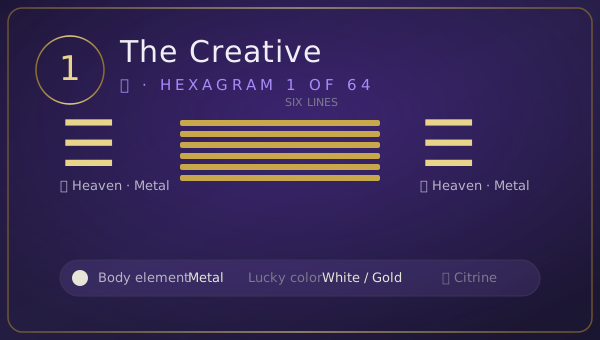
Hexagram 1 is the opening hexagram of the I Ching: six unbroken yang lines, heaven over heaven — the purest expression of active, creative force in the entire Book of Changes. Its classical judgment reads "supreme success, beneficial for firmness" (元亨利贞), and its image is the sky in constant motion, which is why the text says the noble person "strives ceaselessly to improve." When Hexagram 1 appears in a reading, it points to a moment of raw potential: the real question is not whether you have power, but when and how you use it.
The Story of Hexagram 1: The Sky That Never Asked Permission
Three thousand years ago, Chinese court astronomers kept nightly records of the sky, because they believed heaven moved by a pattern — and that whatever governed the sky also governed human affairs. The first hexagram of the I Ching is that belief compressed into six solid lines: heaven above, heaven below, nothing but active force. Tradition recorded in the Records of the Grand Historian says King Wen of Zhou began assembling the hexagrams into their complete system while he was imprisoned at Youli, having lost a kingdom but kept his mind — and the pattern he placed first was not a god or a throne. It was the sky: the one thing that never stops moving. That is the entire message of Hexagram 1. Power is not an event. It is a direction.
What Is Hexagram 1?
- Name: 乾 (Qian), traditionally rendered The Creative; also translated as The Initiating, Heaven, or The Key
- Structure: Heaven over Heaven — six unbroken yang lines, with no yin anywhere to soften them
- Position: 1 of 64, the first hexagram of the Book of Changes
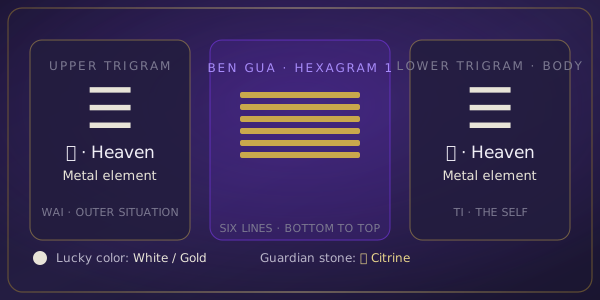
- Element: Metal — both trigrams belong to Metal in the five-phase system
- Body trigram: the lower trigram, pure yang Metal, which in plum blossom divination represents the self and the situation's driving force
- Core images: the sky, the dragon, the father, the creative principle, the ruler, the beginning of spring
The Core Meaning of Hexagram 1
The classical judgment of Hexagram 1 is four characters long: 乾:元亨利贞 — "great and originating, penetrating, advantageous, firm." That is not a blessing. It is a specification. Creative power comes with four conditions, and all four must hold for the hexagram to deliver what it promises.
- 元 — Originating. The power to begin. Hexagram 1 marks a source, a seed moment where something can be started that was not possible before. It is the spring of the cycle, not the harvest.
- 亨 — Penetrating. What begins must be able to spread and flow. A good start that cannot grow, communicate, or reach others stalls — and a stalled beginning is not 元 at all.
- 利 — Advantageous. Benefit comes through right action, not through force. The hexagram rewards correct movement and punishes movement that is merely strong.
- 贞 — Firm. Only persistence turns potential into reality. The sky does not move once; it moves always. Anything that behaves like heaven behaves the same way.
Three things this hexagram is telling you, each standing on its own:
Hexagram 1 is the source, not the peak. It is pure potential in its earliest form. The peak comes later — and in this hexagram's own six lines, the peak arrives only at line five, and line six is a warning. If you draw Hexagram 1, you are at the beginning of power, not at its summit, no matter how strong you feel.
Timing is the hidden variable. The same dragon that is "hidden in the deep" at line one is "flying in the heavens" at line five. The dragon never changes; the moment does. Hexagram 1 asks when, not whether.
Persistence is the price of admission. One burst of effort is thunder, not heaven. Thunder passes. The hexagram's image is the sky precisely because the sky never stops, and the text's instruction — 君子以自强不息, "the noble person strives ceaselessly to improve" — is a description of motion maintained, not motion achieved.
Pure force without humility collapses. The hexagram's final line shows an arrogant dragon with cause for regret. Strength that stops listening turns into the thing that destroys itself.
The question Hexagram 1 answers is not "will I succeed?" It is: is my action coming from the right source, at the right moment, with enough persistence to last?
Hexagram 1 in Love and Relationships
If you are single: Hexagram 1 favors initiative. The energy of this hexagram is yang — it moves first, it does not wait to be chosen. If you have been waiting for a sign to reach out, start a conversation, or put yourself in a new room, this hexagram is that sign. The one caution: 元 requires a beginning, not a conquest. Approach with origin energy, not hunting energy.
In an early or uncertain stage: Momentum is available and the hexagram encourages you to use it — but use it to build something real (亨 — penetrating) rather than to force a definition. What penetrates spreads; what forces breaks.
In a stable relationship: Hexagram 1 often describes a partnership where one person carries the initiating, structuring energy. That is workable and even natural — the hexagram's image is heaven, which leads by moving first. But line six of this hexagram is the arrogant dragon, and its warning is aimed exactly at relationships: the partner who leads by dominating eventually faces regret. Lead by motion, not by weight.
In a crisis: If the conflict is a power struggle, Hexagram 1 says the person who overreaches loses — not because they were weak, but because they kept pushing past the moment when strength should have become restraint. Look at which line changed before you decide who needs to yield.
Hexagram 1 in Career, Money and Decisions
Career: This is the hexagram of launching, leading, and founding. It favors starting the company, taking the lead on the project, stepping into the role you have been circling. The six lines double as a career map: hidden dragon (the apprenticeship — build, do not announce), dragon in the field (first visibility — get seen by the right people), vigilant all day (the grinding middle), leaping in the abyss (the test jump), flying dragon (the summit), arrogant dragon (the overreach that undoes the summit).
Money: Hexagram 1 generates wealth from source rather than from accumulation — 元 is original capital, 贞 is the discipline to keep compounding it. It favors creating value (a product, a skill, a business) over moving existing value around. The hexagram's condition, though, is patience at the start: the hidden dragon does not invest before its time.
Decision: Hexagram 1 almost never says a flat "go." It says: go if your motive is clean, your timing is right, and your persistence is real. If any of the three is missing, the same force that creates becomes the force that burns out — or burns others.
The Changing Lines of Hexagram 1: Six Scenes
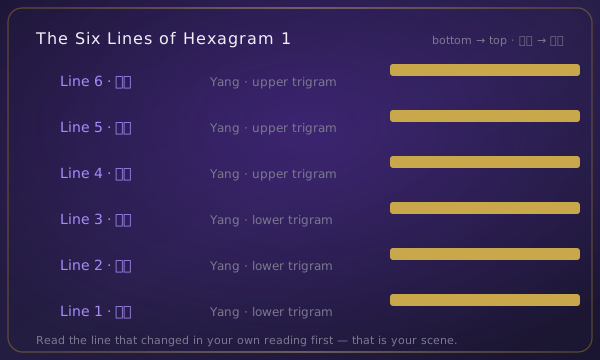
Each line of Hexagram 1 is one scene in the oldest rise-and-fall story ever compressed into six images. Read the line that changed in your reading first — that is your scene.
Line 1 (初九) — Hidden dragon, do not use. The scene: a dragon still deep under water, invisible. The modern reading: this is the apprenticeship phase. You have power, but the moment does not. Build capability, stay out of the spotlight, do not force visibility. Acting now wastes the strength you will need later.
Line 2 (九二) — Dragon appearing in the field. The scene: the dragon surfaces in the open field and is seen. The modern reading: first visibility. It is now beneficial to seek out mentors, allies, and people of substance ("see the great person"). Show your work, but from the field, not from the sky.
Line 3 (九三) — Active all day, vigilant at night. The scene: the dragon works from dawn to dusk and still checks itself at night. The modern reading: the grinding middle, where danger is real but blame is avoidable. Exhaustion and complacency are the two failure modes. Vigilance at night is what turns danger into no-blame.
Line 4 (九四) — Leaping in the abyss. The scene: the dragon tests the leap from the deep — not yet flight, no longer hiding. The modern reading: the trial move. Taking the stretch role, the bigger bet, the visible risk. Because it is a test and not a coronation, it carries no blame — as long as you treat it as a test.
Line 5 (九五) — Flying dragon in the heavens. The scene: the dragon in open sky, fully itself. The modern reading: the summit — leadership, recognition, maximum influence. Even here the line repeats "beneficial to see the great person": at the top, staying connected to honest counsel is what keeps you there.
Line 6 (上九) — Arrogant dragon has cause for regret. The scene: the dragon climbs past the sky and has nowhere left to go. The modern reading: overreach. The strength that won lines one through five becomes the strength that refuses to stop, delegate, or listen. This is the most quoted warning in the entire I Ching, and it is aimed at people who are winning.
When all six lines change (用九): "A flight of dragons without a head — auspicious." When every line of Hexagram 1 moves, the message shifts from individual power to collective power: no single dragon needs to lead. Strength distributed across a team outlasts strength concentrated in one neck.
How to Read Hexagram 1 with the Number Oracle
Hexagram 1 reaches you the same way every hexagram does: through three numbers that arise naturally — a clock, a receipt, a page number, a number that simply surfaces while you hold your question. The first number sets the upper trigram, the second the lower trigram, and the third identifies the changing line. Enter your three numbers and your question at numbers-oracle.com and you will get the hexagram plus an AI interpretation written for your situation — free, no registration. If you want the mechanics first, read how three numbers become a hexagram →
Your lucky energy for Hexagram 1: Metal element. Lucky colors are white, gold, and silver; the matching crystal is citrine, traditionally associated with abundance and clear, joyful energy.
Related hexagrams: Hexagram 2 (The Receptive) — its perfect opposite and other half; Hexagram 10 (Treading) — heaven below heaven again, this time as conduct and caution.
Hexagram 1: Common Questions
What does hexagram 1 mean in one sentence?
Hexagram 1 means pure creative force is available to you, and success depends on timing, integrity, and persistence rather than on strength alone.
Is hexagram 1 a yes or no?
Most readers treat Hexagram 1 as a conditional yes: the answer favors you if you act from the right motive, at the right moment, and persist — while the hexagram itself warns that arrogant, mistimed action brings regret.
What should I do when I receive hexagram 1?
Check which line changed. The line tells you your stage — hidden dragon (wait and build), dragon in the field (get visible), vigilant dragon (keep working carefully), leaping dragon (take the test), flying dragon (lead, and keep honest advisors), arrogant dragon (pull back before you overreach).
Why is hexagram 1 called "The Creative"?
Because it is six solid yang lines — active force with no receptive element to temper it. Every other hexagram mixes the two; Hexagram 1 is the pure source from which every situation in the Book of Changes develops.
The sky does not ask permission to move. Neither should the part of you that is still pure potential.