I Ching Hexagram 3 (Difficulty at the Beginning): Meaning in Love, Career and Life
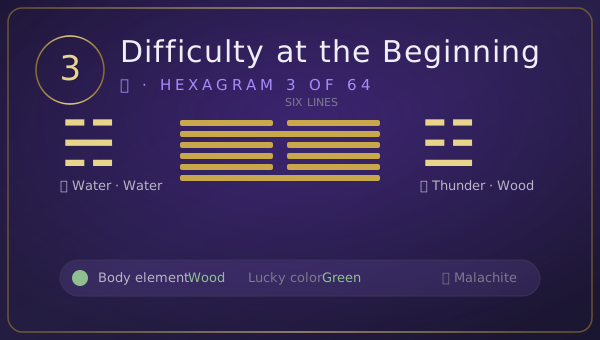
Hexagram 3 is the difficulty-at-the-beginning hexagram of the I Ching: thunder moving inside the cloud, the moment before the first rain of a new cycle. Its classical judgment reads "supreme success through perseverance; do not use this time for far-reaching campaigns; it is favorable to appoint helpers" (元亨,利贞,勿用有攸往,利建侯), and its image — clouds and thunder — says the noble one "sorts out the tangled threads" (经纶). When Hexagram 3 appears in a reading, it describes the hardest season of anything new: the beginning, where everything is potential and nothing has yet taken shape.
The Story of Hexagram 3: The Weaver's First Morning
The scene is early spring. Thunder sounds inside the cloud, but the rain has not yet broken. Under the crusted soil, a sprout is pushing toward a surface that is still cold. Nothing about this is going wrong — it is simply what the first days of anything look like from the inside.
The hexagram's image is a weaver's loom at the start of the day. 经纶 means sorting the tangled threads before the weave begins: the warp laid straight, the knots worked free, every thread given its place. It is unglamorous, exacting work, and without it there is no cloth. The horse in the hexagram's lines circles and staggers and refuses to advance — not from cowardice, but because every beginning first has to test its own legs.
What the old text asks of you in this season is narrower than ambition: find your helpers, establish your foothold (利建侯), keep your ground (磐桓,利居贞), and let the difficulty be the difficulty. The rain will come on its own schedule.
What Is Hexagram 3?
- Name: 屯 (Zhūn), traditionally rendered Difficulty at the Beginning; also translated as Initial Difficulty or Sprouting
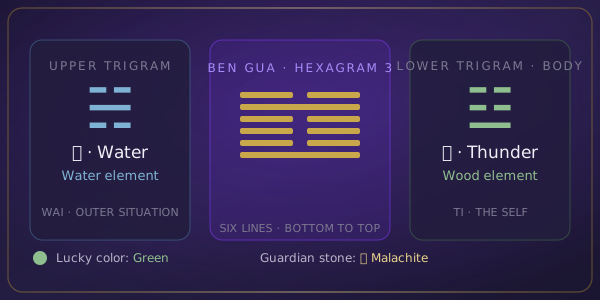
- Structure: Water over Thunder — thunder within the cloud, energy gathered with no release yet
- Position: 3 of 64, the first hexagram after the two primal forces; the beginning of all compounded things
- Element: Wood on the body trigram — the lower trigram (thunder) belongs to Wood; water above belongs to Water
- Body trigram: the lower trigram (thunder, Wood), which in plum blossom divination represents the self
- Core images: clouds and thunder, the tangled threads, the circling horse, the sprout under crust, the guide who is missing
The Core Meaning of Hexagram 3
The classical judgment of Hexagram 3 is a paradox wrapped in a blessing: 元亨 — supreme success — paired with 勿用有攸往, do not use this time for far-reaching campaigns. The success is real, but it belongs to the phase, and the phase is foundational. You do not march at the beginning. You build the base.
Three things this hexagram is telling you, each standing on its own:
The difficulty is structural, not personal. The hexagram's own commentary says "hard and soft begin to mingle, and difficulty is born with them" (刚柔始交而难生). Difficulty at the beginning is not a sign you chose wrong — it is what the first contact between potential and reality always feels like. Every woven cloth begins as a knot.
Helpers are the strategy. 利建侯 is the hexagram's core advice, repeated across its lines: appoint helpers, establish lords over the ground you hold. The famous third line spells out what happens without them — chasing the deer and entering the forest with no forester to guide you (即鹿无虞,惟入于林中). The beginner's error is not slowness; it is going alone into terrain you cannot read.
Move, but do not charge. 磐桓 means to pace in place, to circle, to hold your ground while your legs find their strength. The hexagram does not forbid motion — it forbids premature campaigns. Build locally, appoint carefully, consolidate. The far march belongs to a later hexagram.
The apparent threat may be a suitor. The second line's image is the one every reader remembers: a rider approaching in a cloud of dust — not a bandit, but a matchmaker (匪寇婚媾). At the beginning, things arrive in confusing disguises. The hexagram asks you to look twice before you arm yourself.
The question Hexagram 3 answers is not "will this work?" It is: am I willing to do the unglamorous first work, with the right people, without running ahead of the season?
Hexagram 3 in Love and Relationships
If you are single: Hexagram 3 describes the pre-relationship season — potential without form. The classical advice maps perfectly onto dating: keep your ground, let interest circle and reveal itself (磐桓), and remember the dust-cloud line (匪寇婚媾): the person who looks wrong at first glance may be arriving with an offer, and the one who looks like a rescuer may be neither. Slow recognition is this hexagram's native speed.
In an early or uncertain stage: Early love under Hexagram 3 is the tangled-threads phase: two people sorting out what this is. The hexagram rewards patience with process over premature definition. If it feels awkward, unformed, and slow — that is the hexagram being honest, not the relationship failing. The line to watch: "the girl keeps her chastity and does not bind herself; after ten years she binds herself" (女子贞不字,十年乃字). What is right at the beginning often refuses to hurry.
In a stable relationship: A stable relationship drawing Hexagram 3 is entering a new phase together — moving in, starting a family, rebuilding after a hard year. The hexagram's counsel: do the 经纶 work first. Sort the practical threads (space, money, roles, expectations) before you launch the grand campaign. Couples who skip the foundational season tend to relive it later, at higher cost.
In a crisis: If the relationship is in the crying-blood territory of the final line (泣血涟如), Hexagram 3 says the tangle has been left unworked too long. The remedy is not a dramatic gesture but a return to basics: helpers (a counselor, a trusted third party), small consolidations, and honest sorting of what has become knotted. Grief at this line is real — and it is also a signal that the weaving, not the cloth, is the problem.
Hexagram 3 in Career, Money and Decisions
Career: This is the startup hexagram — the new job, the new team, the new venture, the first quarter of anything. It favors building foundations over visible launches: your first hires (利建侯), your first processes, your first honest map of the terrain. The deer-without-a-forester line is the career warning of the whole Book: chasing an opportunity in territory you cannot read, alone, is how promising beginnings bleed out.
Money: Hexagram 3 is not an abundance hexagram — it is a survival-and-setup hexagram. The classical reading favors conserving resources, refusing expensive campaigns, and investing in the base (people, systems, skills). The "small perseverance is favorable, great perseverance is ominous" line (小贞吉,大贞凶) applies directly to budgets: at the beginning, big fixed commitments are the classic way a promising start turns into a stall.
Decision: Hexagram 3 says yes to beginning and no to conquering. Proceed — but with the scope adjusted down to what the phase can carry. If your plan requires everything to work on the first try, the plan is wrong for the season, not the season wrong for the plan. Consolidate, appoint, and let the rain come when it comes.
The Changing Lines of Hexagram 3: Six Scenes
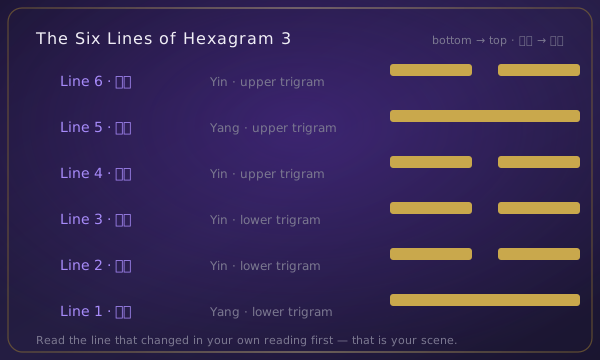
Each line of Hexagram 3 is one scene in the life of a beginning — the pacing, the confusion, the false alarm, the finding of a guide, the stored resources, the grief of an unworked tangle.
Line 1 (初九) — The horse circles; favorable to keep your ground; favorable to appoint helpers. The scene: the stallion pacing at the starting gate, strength gathered, not yet spent. The modern reading: the hexagram's foundational line. Hold position, establish your people. Momentum at line 1 is a resource, not an instruction.
Line 2 (初九→六二) — Circling and staggering, the rider's dust rises — not a bandit, a matchmaker. The girl keeps her chastity and does not bind herself; after ten years she binds herself. The scene: an approach in ambiguous disguise, answered by unhurried recognition. The modern reading: things arrive confusingly at the beginning — people, offers, opportunities. Look twice. And do not force early definition on anything genuinely right; right things have their own clock.
Line 3 (六三) — Chasing the deer without a forester, you only enter the depths of the forest; the noble one knows to give up. To go on is regret. The scene: the hunter without a guide, lost deeper by every step. The modern reading: the most important caution line in the hexagram. The skill being taught is the skill of quitting early — abandoning the chase while the cost is still small. Going on is 吝, regret.
Line 4 (六四) — Circling and staggering, but going to seek the match. Advance — good fortune, nothing unfavorable. The scene: the same circling horse, now with a destination and a purpose. The modern reading: once the right people and the right offer are identified, the circling stops and the movement is blessed. The difference between line 1 and line 4 is not courage — it is having something to go to.
Line 5 (九五) — Store your ointment; small perseverance is favorable, great perseverance is ominous. The scene: the reserves held back, the rich grease not yet spent. The modern reading: at the beginning, resources are for small, careful disbursements. Big commitments now — the grand launch, the all-in bet — turn the blessing ominous. Save the ointment for the wound that actually comes.
Line 6 (上六) — Circling and staggering, weeping blood in streams. The scene: the beginning that never resolved its tangles, grieving at the end of its rope. The modern reading: what unworked difficulty becomes. The line is not a curse — it is the hexagram's receipt. Everything this hexagram asks for (helpers, honest sorting, unhurried recognition) exists so that line 6 never has to happen.
When all six lines change: Hexagram 3 turns toward Hexagram 4 — a beginning that survives its difficulty becomes learning. The sprout that pushes through becomes the spring that flows.
How to Read Hexagram 3 with the Number Oracle
Hexagram 3 reaches you the same way every hexagram does: through three numbers that arise naturally while you hold your question — a clock, a receipt, a page number, a number that simply surfaces. The first number sets the upper trigram, the second the lower trigram, and the third identifies the changing line. Enter your three numbers and your question at numbers-oracle.com and you will get the hexagram plus an AI interpretation written for your situation — free, no registration. For the mechanics, read how three numbers become a hexagram →
Your lucky energy for Hexagram 3: Wood element (the body trigram, thunder below). Lucky colors are green and tender sprout tones; the matching crystal is malachite, traditionally associated with growth, renewal, and fresh starts.
Related hexagrams: Hexagram 4 (Youthful Folly) — what a beginning becomes when it survives; Hexagram 5 (Waiting) — the season after the sprout, before the rain.
Hexagram 3: Common Questions
What does hexagram 3 mean in one sentence?
Hexagram 3 means the structurally difficult phase at the beginning of anything new — success is available, but only through foundational work, the right helpers, and refusing to run ahead of the season.
Is hexagram 3 good or bad?
Hexagram 3 is neither — it is honest. Its judgment contains 元亨, supreme success, precisely because it describes beginnings: the difficulty is the price of the phase, not a verdict on you. Work the tangles, appoint your people, and the hexagram promises the weave holds.
What should I do when I receive hexagram 3?
Check which line changed. Circling horse (line 1) means consolidate before moving; dust-cloud matchmaker (line 2) means look twice at what is approaching; deer without a forester (line 3) means abandon the chase early; seeking the match (line 4) means move once the purpose is clear; storing ointment (line 5) means keep commitments small; weeping blood (line 6) means return to the unworked basics.
Why is hexagram 3 called "Difficulty at the Beginning"?
Because its own commentary says hard and soft begin to mingle and difficulty is born with them — every new thing's first contact with reality is tangled. The hexagram names the season honestly so you stop mistaking the beginning's difficulty for failure.
The rain always waits until the threads are sorted.