I Ching Hexagram 4 (Youthful Folly): Meaning in Love, Career and Life
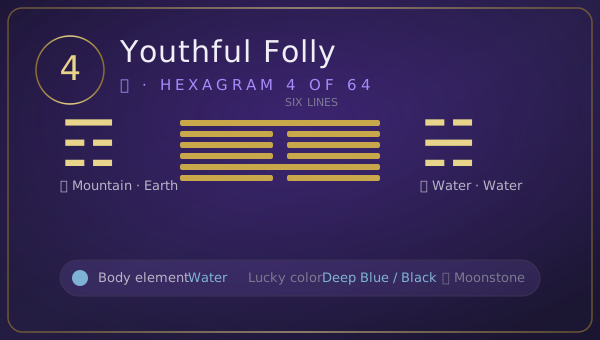
Hexagram 4 is the youthful-folly hexagram of the I Ching: a spring of clear water at the foot of the mountain, flowing without yet knowing the sea. Its classical judgment reads "success — but I do not seek the youthful fool; the youthful fool seeks me. At the first casting I answer; repeated asking is intrusion, and the intrusive are not answered. Favorable through perseverance" (亨,匪我求童蒙,童蒙求我。初筮告,再三渎,渎则不告。利贞), and its image — a spring beneath the mountain — says the noble one "acts decisively to nourish virtue" (果行育德). When Hexagram 4 appears in a reading, it marks the season of learning: the greenness of not-yet-knowing, and the exact terms on which knowledge is granted.
The Story of Hexagram 4: The Spring at the Foot of the Mountain
High on the mountain there is a spring. It has not seen the valley, has never heard the sea, does not know its own name. It simply flows — and everything it will eventually become is already inside that flow, undirected.
The old teachers read this hexagram from that image. A spring does not ask the mountain for a syllabus. It moves, and its movement is its education. What the hexagram asks is only this: keep the water honest. A spring that pretends to be a river dries up; a spring that admits it is a spring is fed.
The commentary attached to the hexagram turns the picture into a rule of study: it is not the teacher who begs for students (匪我求童蒙). The student arrives with the question, or the teaching does not happen. In the old records of the Confucian school, the master is remembered for a similar stance — "from the time anyone brought me a bundle of dried meat as tuition, I have never refused to teach" (《论语·述而》: 自行束脩以上,吾未尝无诲焉). The door opened to those who knocked. Hexagram 4 is the Book of Changes saying the same thing in six lines: ask, ask honestly, and ask once with your whole attention.
What Is Hexagram 4?
- Name: 蒙 (Méng), traditionally rendered Youthful Folly; also translated as The Inexperienced, Immaturity, or The Student
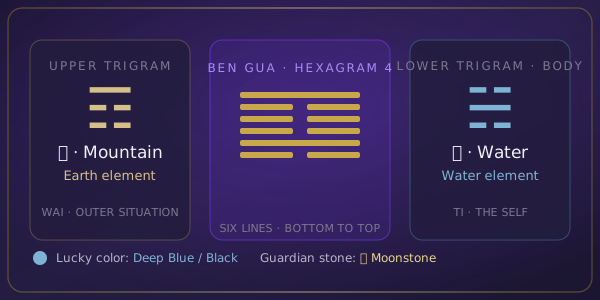
- Structure: Mountain over Water — the spring at the mountain's foot, covered and beginning its flow
- Position: 4 of 64, the hexagram that follows Difficulty at the Beginning; the school that opens after the sprout
- Element: Water on the body trigram — the lower trigram (water) belongs to Water; the mountain above belongs to Earth
- Body trigram: the lower trigram (water, Water), which in plum blossom divination represents the self
- Core images: the mountain spring, the covered ravine, the youthful fool, the bundle of dried meat, the first casting
The Core Meaning of Hexagram 4
The judgment of Hexagram 4 is a contract about learning, stated from the teacher's side. Success is possible (亨) — but only on the condition that the student does the arriving. 童蒙求我: the young and unformed seek out the form. And the casting rule that follows is one of the most quoted sentences in the whole Book: the first question is answered; ask the same question three times and you are not asking, you are bargaining — and the bargainer gets nothing (再三渎,渎则不告).
Three things this hexagram is telling you, each standing on its own:
Not-knowing is the position, not the problem. The hexagram is not a reprimand. 童蒙 — youthful folly — names a stage, and every stage has its own proper use. The spring is not ashamed of being at the mountain's foot. What the hexagram punishes is not ignorance but the performance of knowledge: the third line's figure is the woman who sees a man of means and abandons her own substance (见金夫,不有躬) — the student who chases the teacher's status instead of the teaching.
The question has to be yours. The judgment's whole mechanism runs on genuine seeking. In modern terms: the person who asks the real question gets the real answer; the person who asks to hear a preferred answer gets the Book's silence. Discernment about your own motives is the first lesson.
Discipline is part of education, not opposed to it. The opening line's image is startling — "to develop the foolish, it is favorable to use the punishing man, to remove the shackles" (发蒙,利用刑人,用说桎梏). The old commentators read this as education requiring structure: the shackles come off because the form was learned. And the final line balances it — "to strike the foolish is unfavorable as banditry, favorable as defense" (不利为寇,利御寇): correction aimed at protecting the student is teaching; correction aimed at dominating them is violation.
The question Hexagram 4 answers is not "what do I know?" It is: am I actually asking — with my whole attention, my own question, and my own feet?
Hexagram 4 in Love and Relationships
If you are single: Hexagram 4 describes the green season of love — the time for learning people, not for being an expert. The hexagram's rule maps directly onto dating: arrive with real questions (童蒙求我), not with a script; and treat the first sincere answer as an answer, not as an opening bid. The second line's blessing (包蒙吉 — embracing the foolish, good fortune) favors the person generous enough to be a beginner in public.
In an early or uncertain stage: Early love under Hexagram 4 is two students meeting. Each is a spring at the foot of the mountain; neither has seen the sea. The hexagram rewards curiosity over performance: asking, admitting not-knowing, letting the other person teach you something. Watch the third line's warning in relationship form — attraction to someone's shine (the man of gold) without any substance of your own is a setup for loss.
In a stable relationship: A stable relationship drawing Hexagram 4 has entered a learning phase — perhaps a new stage of life, a hard chapter, a confession of inexperience. The hexagram's counsel: keep asking, and keep the structure honest. The line "a child can carry the house" (子克家) is the promise of the hexagram: what is learned properly becomes capable of holding real weight. Couples who learn together become load-bearing; couples who only perform at each other stay decorative.
In a crisis: If the relationship is stuck in mutual accusation, Hexagram 4 says someone is performing knowledge they do not have. The remedy is a return to genuine questions — one real question asked once, with attention. The final line's rule governs repair: correction is for defense (利御寇), never for conquest. Fix the shared structure; do not win the fight.
Hexagram 4 in Career, Money and Decisions
Career: This is the apprenticeship hexagram — the new role, the new field, the first year of anything professional. It favors finding real teachers (the seeking is the contract), doing the unglamorous foundational work (果行育德 — decisive action to nourish virtue), and accepting structure without resenting it. The line about shackles coming off (用说桎梏) is the career arc in miniature: what feels like constraint at the beginning is what makes you free later.
Money: Hexagram 4 is the student's budget — modest, structured, honest about what is not yet known. It does not favor speculative confidence; it favors paying for real instruction (the bundle of dried meat) over paying for the appearance of expertise. The repeated-questioning line (再三渎) applies to money decisions too: re-asking a settled question, hoping for a better answer, is how money leaks.
Decision: Hexagram 4 says: ask first, and ask properly. If you are weighing a choice while pretending you already know the outcome, the hexagram's answer is silence — the intrusion rule. Bring a real question, accept the first honest answer, and move. The decision this hexagram blesses is always made one step further from certainty and one step closer to learning.
The Changing Lines of Hexagram 4: Six Scenes
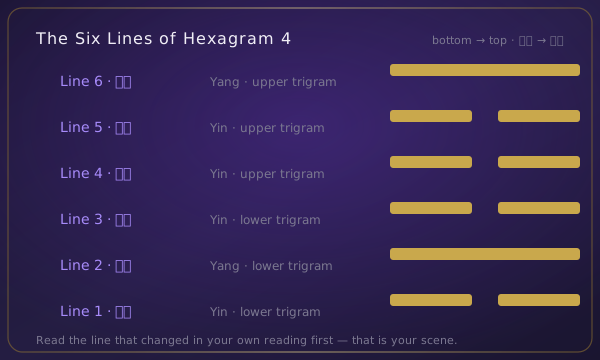
Each line of Hexagram 4 is one scene in the education of a spring — how it is opened, embraced, endangered, blocked, kept pure, and finally defended.
Line 1 (初六) — To develop the foolish, use the punishing man and remove the shackles; going on is regret. The scene: the schoolroom with its rules, the discipline that frees. The modern reading: structure at the beginning is a gift, not an insult. The line's warning is against continuing past the need — structure that becomes its own purpose is the failure.
Line 2 (九二) — Embracing the foolish, good fortune; taking a wife, good fortune; the child can carry the house. The scene: the teacher with a wide embrace, the household that can hold weight. The modern reading: the hexagram's central blessing — tolerance of greenness, in others and in yourself, is what builds capacity. What is learned properly becomes load-bearing.
Line 3 (六三) — Do not take this woman: she sees the man of means and has no substance of her own; nothing is favorable. The scene: the student who wants the teacher's shine, not the teaching. The modern reading: the motive test. If what draws you is status, payoff, or the reflected light of someone else's expertise, the learning will not hold. Check why you are asking.
Line 4 (六四) — Bound foolishness; regret. The scene: the spring sealed under stone. The modern reading: the isolated learner — too proud to ask, too afraid to be seen green. This is the hexagram's only unambiguously hard line, and its cause is named: the question was never brought. 困蒙 is a choice before it is a condition.
Line 5 (六五) — Childlike folly; good fortune. The scene: the beginner who admits it openly and is loved for it. The modern reading: the paradox line of the hexagram. The honest beginner is closer to the teaching than the anxious expert. "Good fortune" attaches to the confession itself.
Line 6 (上九) — To strike the foolish: unfavorable as banditry, favorable as defense. The scene: the correction that protects versus the correction that conquers. The modern reading: the ethics line. Teaching, feedback, and hard truths are legitimate when they defend the student's growth — and illegitimate the moment they serve the striker. The test is who ends up freer.
When all six lines change: Hexagram 4 turns toward Hexagram 5 — learning that survives its season becomes waiting, fed. The spring that learned its course becomes the cloud that gathers before rain.
How to Read Hexagram 4 with the Number Oracle
Hexagram 4 reaches you the same way every hexagram does: through three numbers that arise naturally while you hold your question — a clock, a receipt, a page number, a number that simply surfaces. The first number sets the upper trigram, the second the lower trigram, and the third identifies the changing line. Enter your three numbers and your question at numbers-oracle.com and you will get the hexagram plus an AI interpretation written for your situation — free, no registration. For the mechanics, read how three numbers become a hexagram →
Your lucky energy for Hexagram 4: Water element (the body trigram, the spring below). Lucky colors are deep blue and black; the matching crystal is moonstone, traditionally associated with intuition, dreams, and emotional flow.
Related hexagrams: Hexagram 3 (Difficulty at the Beginning) — the season before the school opens; Hexagram 5 (Waiting) — the patience the student graduates into.
Hexagram 4: Common Questions
What does hexagram 4 mean in one sentence?
Hexagram 4 means the season of genuine learning — success comes to those who bring honest questions with their own attention, accept real structure, and do not perform knowledge they do not have.
Is hexagram 4 good or bad?
Hexagram 4 is favorable when approached correctly: its judgment promises success on one condition — that the seeking is real. The student who arrives with an honest question is answered; the one who asks to hear a preferred answer is not. The hexagram judges the asking, not the asker.
What should I do when I receive hexagram 4?
Check which line changed. Shackles removed (line 1) means accept the structure that frees you; embracing the foolish (line 2) means tolerate greenness in yourself and others; the woman without substance (line 3) means check your motives; bound foolishness (line 4) means the regret is in not asking — ask; childlike folly (line 5) means honest admission is the good fortune; striking the foolish (line 6) means correct only to defend, never to conquer.
Why is hexagram 4 called "Youthful Folly"?
Because its image is the mountain spring — water that has not yet found its course, with everything it will become still inside it. The old translators kept the word "folly" to honor the text's honesty: not-knowing is the starting position of the hexagram, and its whole teaching is about how knowledge is properly received.
The spring does not know the sea. That is exactly why it is worth drinking.