I Ching Hexagram 5 (Need): Meaning in Love, Career and Life
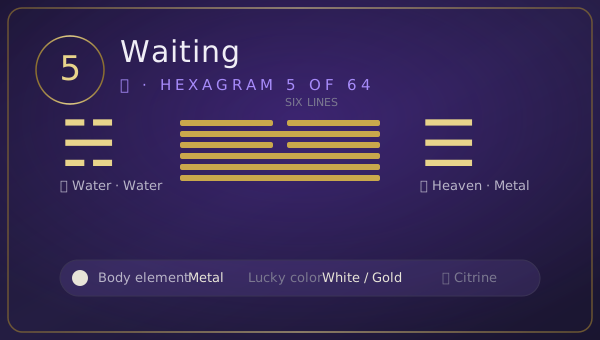
Hexagram 5 is the waiting hexagram of the I Ching: clouds massed above heaven, moisture gathered with no rain yet. Its classical judgment reads "with sincerity, radiant success; favorable perseverance; favorable to cross the great water" (有孚,光亨,贞吉,利涉大川), and its image — clouds rising in the sky — says the noble one "drinks and eats, feasts and is merry" (饮食宴乐). When Hexagram 5 appears in a reading, it describes the season between readiness and release: you have done the work, sincerity is in place, and what remains is to nourish yourself without burning the waiting.
The Story of Hexagram 5: The Fisherman at the Wei River
Around 1050 BCE, an old man sat on the bank of the Wei River with a straight hook and no bait. He was, by the standards of his age, a failure: three wives divorced him, a dozen careers abandoned, most of a lifetime spent not arriving. Passersby mocked the strange fisherman. He kept fishing.
His name was 吕尚, later known to the history books as the Grand Duke of Qi. According to the Records of the Grand Historian, what he was actually doing on that riverbank was not fishing — it was waiting in public. The story goes that when King Wen of Zhou came to the river, the old man's attention was on the depths rather than the line. The king spoke with him, and the conversation reportedly ran so deep that the king said, "My grandfather anticipated that a sage would come to Zhou and help it flourish — are you that sage? You have waited a long time for me." (《史记·齐太公世家》: 吾太公望子久矣 — "our old lord has expected you for a long time.") The old fisherman was taken home, and in time became the strategist behind the rise of the Zhou dynasty.
This is the hexagram's image read as a life: 密云不雨 — dense clouds, no rain — held without bitterness, for decades. The waiting was not passivity. It was the fishing itself: staying at the right water, with a straight hook, while the world caught up to what he was becoming. When the rain finally came, it came all at once.
What Is Hexagram 5?
- Name: 需 (Xū), traditionally rendered Waiting; also translated as Need, Waiting for Nourishment, or Calculated Waiting
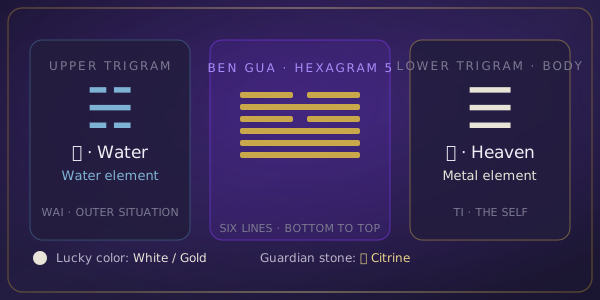
- Structure: Water over Heaven — the sky under the clouds, moisture gathered with no release yet
- Position: 5 of 64, the hexagram after Youthful Folly; the patience the student graduates into
- Element: Metal on the body trigram — the lower trigram (heaven) belongs to Metal; water above belongs to Water
- Body trigram: the lower trigram (heaven, Metal), which in plum blossom divination represents the self
- Core images: clouds without rain, the straight hook, the feast before the crossing, the sandbank and the mud
The Core Meaning of Hexagram 5
The judgment of Hexagram 5 is unusual for pairing waiting with radiant success: 有孚,光亨,贞吉 — sincerity, brilliance, success, favorable perseverance. The waiting is not dead time. It is a charged interval in which the one requirement is to stay sincere and fed, because the hexagram's promise is 利涉大川: you will cross the great water — after the waiting, not before it.
Three things this hexagram is telling you, each standing on its own:
Waiting has geography. The six lines are a map of how far you are from the crossing: the outskirts (郊), the sandbank (沙), the mud (泥), the bloody ravine (血) and the cave (穴), the feast (酒食), and finally the cave with three unexpected guests. Each position has its own correct behavior. The beginning of wisdom in a 需 season is knowing which ground you are actually standing on — the person who waits in the mud as if at a feast is the one the hexagram warns will draw the bandits (致寇至).
Sincerity is what makes waiting wait-able. 有孚 — the hexagram opens with it. Waiting without sincerity becomes resentment; waiting with sincerity becomes preparation. The cloud gathers because it is honestly full. If your waiting is full of grievance, you are not in 需 — you are in a stall of your own making, and the hexagram's remedy is the feast line: eat, drink, keep yourself genuinely nourished.
The crossing is promised, but it comes after. 利涉大川 sits in the judgment itself. The great water is not canceled — it is scheduled. What the hexagram forbids is not the crossing but the premature crossing. Everything in its image — drinking, eating, feasting — is instruction for how to hold a long season without hollowing out.
The question Hexagram 5 answers is not "when?" It is: is my waiting nourished and sincere, or is it a slow starvation I am calling patience?
Hexagram 5 in Love and Relationships
If you are single: Hexagram 5 describes the long season before the right connection — and it refuses to call that season a failure. The Grand Duke waited on his riverbank for decades. The hexagram's practical counsel: stay fed (饮食宴乐), stay visible at the right water, and do not let waiting curdle into bitterness, because bitterness is what makes people miss the moment they were waiting for. The "unexpected guests" line of the final position holds a promise: help arrives from unlooked-for directions.
In an early or uncertain stage: Early love under Hexagram 5 is cloud-gathering: something is forming, and the correct behavior is nourishment, not forcing. The hexagram's lines mark the stages precisely — pleasant anticipation at the outskirts (郊), some gossip at the sandbank (沙, 小有言), the danger zone in the mud (泥, where impatience invites trouble), and the blessed feast at the center. If you are in the mud and calling it the outskirts, that is the hexagram's diagnosis.
In a stable relationship: A stable relationship drawing Hexagram 5 is in a held season — waiting on a decision, a move, a repair, a change that has not yet ripened. The hexagram's counsel for held seasons is counterintuitive: feast. Keep the relationship nourished while you wait — shared meals, real rest, honest enjoyment — because starving relationships do not wait well. The final line's three uninvited guests (不速之客三人来) reminds long-term partners that the waiting can end abruptly, from an unexpected direction; the ones who treat the interval as sacred are ready for it.
In a crisis: If the relationship is in the cave (穴) of the fourth line — trapped, bleeding, having to leave the position to survive — Hexagram 5 says exit the cave first and eat later. The line reads 需于血,出自穴: the waiting happens from outside the trap, not inside it. Crisis seasons are not the place for heroic patience. Get out, get fed, then wait from strength.
Hexagram 5 in Career, Money and Decisions
Career: This is the between-jobs, between-rounds, between-seasons hexagram — the long application period, the project awaiting approval, the offer that has not landed. The hexagram's core counsel is professional as much as spiritual: keep yourself nourished and sincere (饮食宴乐, 有孚), because the crossing (利涉大川) is scheduled after the waiting. Careers die less from waiting than from the erosion that happens during it — the skill that rusts, the network that cools, the spirit that sours.
Money: Hexagram 5 is not the hexagram of the big move — it is the hexagram of the reserve. Its image of feasting during the wait has a hard financial edge: fund the waiting, do not bet on its ending. The mud line (需于泥,致寇至) is the hexagram's warning about desperate financial improvisation during dry seasons — impatience is what invites the loss. Hold the reserve, keep the outflows small, and let the crossing happen on the hexagram's schedule.
Decision: Hexagram 5 says: yes, and not yet. The great water will be crossed — the judgment says so — but the season between here and there is a working season, not a killing one. If you are deciding whether to force the timing, the hexagram's answer is the same at every line: identify your ground, keep sincerity, stay nourished, and let the rain arrive when the cloud is honestly full.
The Changing Lines of Hexagram 5: Six Scenes
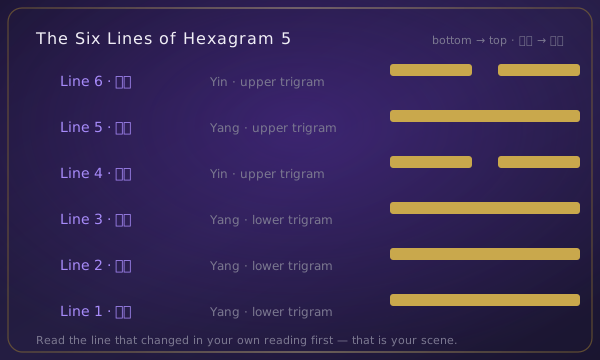
Each line of Hexagram 5 is one station on the road to the crossing — the outskirts, the sandbank, the mud, the ravine, the feast, and the cave with its uninvited guests.
Line 1 (初九) — Wait at the outskirts; favorable to keep constancy; no blame. The scene: the traveler camped beyond the city walls, far from the water, in no danger. The modern reading: the safest position in the hexagram. Waiting here costs only patience. The instruction is 利用恒 — constancy is the active work of this line. Do not confuse safety with delay.
Line 2 (九二) — Wait on the sandbank; a little gossip; in the end, good fortune. The scene: closer to the water now, feet on sand that shifts; people talk. The modern reading: waiting becomes public — comments, questions, the small friction of being seen to wait. The hexagram's promise: the talk ends in good fortune (终吉) if the sandbank does not become the mud.
Line 3 (九三) — Wait in the mud; the bandits will come. The scene: the waiting that has gone too close to danger — the quicksand position. The modern reading: the hexagram's only genuine danger line. The failure is not waiting; it is waiting in the wrong place, too exposed, too long. When you are in the mud, bandits are not bad luck — they are the predictable cost of the position. Move first.
Line 4 (六四) — Wait in blood; get out of the cave. The scene: the wounded position, the trap that has already drawn blood. The modern reading: the line of the necessary exit. Whatever the waiting was for, it is not worth staying in the cave. The hexagram does not ask for heroism here — it asks for evacuation. From outside the cave, waiting resumes as waiting.
Line 5 (九五) — Wait at the feast; perseverance is favorable. The scene: the center of the hexagram — the waiting that has become a celebration. The modern reading: the secret of the hexagram. The feast is not a reward for finishing the wait; it is how the wait is survived. Eat, drink, keep the table — the crossing is closer than the mud ever admitted.
Line 6 (上六) — Enter the cave; three uninvited guests arrive; treat them with respect; in the end, good fortune. The scene: the wait that ends abruptly — help arriving unlooked-for at the cave mouth. The modern reading: the hexagram's final promise. What you waited for arrives on its own schedule, often from a direction you had stopped watching. The only instruction: receive it with respect (敬之终吉). The guest who is not disowned is the one who stays.
When all six lines change: Hexagram 5 turns toward Hexagram 6 — waiting that has been nourished becomes the strength to stop fighting. The cloud that rained does not argue with the ground.
How to Read Hexagram 5 with the Number Oracle
Hexagram 5 reaches you the same way every hexagram does: through three numbers that arise naturally while you hold your question — a clock, a receipt, a page number, a number that simply surfaces. The first number sets the upper trigram, the second the lower trigram, and the third identifies the changing line. Enter your three numbers and your question at numbers-oracle.com and you will get the hexagram plus an AI interpretation written for your situation — free, no registration. For the mechanics, read how three numbers become a hexagram →
Your lucky energy for Hexagram 5: Metal element (the body trigram, heaven below). Lucky colors are white, gold, and silver; the matching crystal is citrine, traditionally associated with abundance and clear, joyful energy.
Related hexagrams: Hexagram 4 (Youthful Folly) — the season the student graduates from; Hexagram 9 (Small Taming) — the dense cloud that still has not rained; Hexagram 39 (Obstruction) — the waiting that has become stuck.
Hexagram 5: Common Questions
What does hexagram 5 mean in one sentence?
Hexagram 5 means a charged season of waiting — sincerity is in place, the crossing is promised, and the work is to stay nourished and honest until the cloud honestly rains.
Is hexagram 5 a yes or no?
Hexagram 5 is a yes with a date you do not control. Its judgment includes 利涉大川 — the great water will be crossed — but only after the waiting, and only if the waiting is nourished rather than resentful. Forced timing turns this hexagram into its shadow.
What should I do when I receive hexagram 5?
Check which line changed. Wait at the outskirts (line 1) means keep constancy and stay safe; the sandbank (line 2) means let the gossip pass; the mud (line 3) means move before the bandits arrive; blood and the cave (line 4) means exit the trap first; the feast (line 5) means nourish yourself through the wait; the cave with guests (line 6) means receive what arrives unlooked-for.
Why is hexagram 5 called "Waiting"?
Because its image is clouds massed above the sky with no rain — 密云不雨. Everything is gathered; nothing has fallen. The old translators called it Need or Waiting for Nourishment because the hexagram's real subject is how a person stays whole and sincere inside a season that has not yet delivered.
Dense clouds are not a broken sky. They are a full one.