I Ching Hexagram 6 (Conflict): Meaning in Love, Career and Life
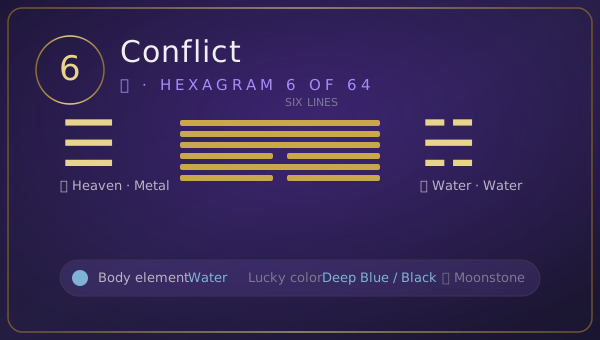
Hexagram 6 is the conflict hexagram of the I Ching: heaven and water moving in opposite directions, two honest forces that can no longer meet. Its classical judgment reads "sincerity is blocked; be wary — good fortune in the middle; in the end, misfortune. Favorable to see the great person; not favorable to cross the great water" (有孚窒,惕,中吉,终凶。利见大人,不利涉大川), and its image — heaven above, water below, each going its own way — says the noble one "plans the beginning in everything he does" (作事谋始). When Hexagram 6 appears in a reading, it marks a dispute at the point where argument has replaced exchange — and its counsel is about when to stop arguing, not how to win.
The Story of Hexagram 6: The Two Streams That Never Meet
In the picture behind the hexagram, heaven moves upward and water flows downward, and the two never touch. Each is entirely itself. Each is entirely correct. And because they are both correct in opposite directions, the world they make between them is dry — a dispute where both parties can be sincere and the situation still goes nowhere.
The old commentators were precise about where the hexagram's hope lies. 中吉 — good fortune is in the middle. The middle lines of the hexagram are the ones that stop: line 2 gives up the lawsuit and flees his own town (不克讼,归而逋其邑), line 4 gives up the lawsuit and submits to fate (不克讼,复即命), line 5 is the only position where the suit itself is blessed (讼,元吉) because it is brought to the one person entitled to judge. And the final line shows what winning actually looks like: the leather belt of office is conferred at dawn, and stripped three times before noon (或锡之鞶带,终朝三褫之).
The hexagram's whole teaching is compressed into its image. 作事谋始 — plan the beginning in everything you do. Most disputes are not won or lost in the argument; they are sown at the start, in the contract nobody read, the boundary nobody set, the expectation nobody said out loud. The hexagram asks you to stop looking at the courtroom and look at the drafting table.
What Is Hexagram 6?
- Name: 讼 (Sòng), traditionally rendered Conflict; also translated as Litigation, The Lawsuit, or Opposition
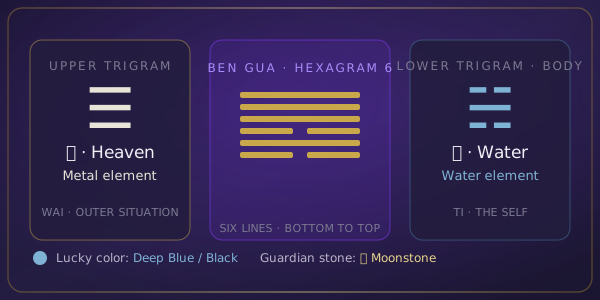
- Structure: Heaven over Water — the two elements moving apart, each in its own direction
- Position: 6 of 64, the hexagram after Waiting; what nourished waiting becomes when it curdules
- Element: Water on the body trigram — the lower trigram (water) belongs to Water; heaven above belongs to Metal
- Body trigram: the lower trigram (water, Water), which in plum blossom divination represents the self
- Core images: heaven and water diverging, the blocked sincerity, the stolen belt of office, the three hundred households
The Core Meaning of Hexagram 6
The judgment of Hexagram 6 is a warning dressed as a verdict: 有孚窒 — sincerity is blocked. Even a sincere position, pushed as conflict, strangles on itself. The structure of the promise is unusual: good fortune in the middle (中吉), misfortune at the end (终凶). Disputes may start justly; they end badly. The hexagram's two practical instructions follow from that: see the great person (利见大人) — take it to the one with standing to settle it — and do not cross the great water (不利涉大川) — do not escalate to the irreversible.
Three things this hexagram is telling you, each standing on its own:
The first move in a dispute is withdrawal, not argument. Line 1 is explicit: do not carry the matter to the end (不永所事). Small words may be exchanged — the hexagram concedes 小有言 — but in the end, good fortune (终吉). The conflict hexagram's first lesson is that most disputes are shrunk by early retreat, not won by persistence.
Losing the lawsuit can be the favorable outcome. Lines 2 and 4 both describe the person who does not win and is blessed for it. Line 2 gives up the town and its three hundred households and escapes calamity (无眚); line 4 gives up, returns to duty, changes, and finds peace in correctness (安贞吉). The hexagram is teaching a hard arithmetic: in a conflict you cannot win cleanly, the exit is the victory.
Only the centered position can justly judge. Line 5 — the center of the hexagram, the position of the ruler — is the only line where litigation itself is supreme good fortune (元吉). The reading: disputes settle correctly in front of the one genuinely entitled to decide. Your lawyer, your mediator, the person both sides accept. Not the argument, and not the escalation.
The question Hexagram 6 answers is not "am I right?" It is: is this dispute still shrunk by retreat, or has it already crossed into the territory where everyone loses?
Hexagram 6 in Love and Relationships
If you are single: Hexagram 6 rarely governs attraction — it governs the arguments attraction starts. If you are drawing it while single, look at the pattern rather than the person: the same recurring dispute with the same kind of partner, the sincerity that keeps getting blocked at the same point. The hexagram's counsel: 作事谋始 applies to dating too. Most relationship conflicts are sown in the beginning — in what was never said. Set the terms before the season, not during the fight.
In an early or uncertain stage: Early love under Hexagram 6 is the stage where small misunderstandings start hardening into positions. The hexagram's line 1 is exactly right here: do not carry the matter to the end. Say the small thing (小有言), settle it, and stop. The relationship that learns early how to end a dispute small is the one that survives to be large.
In a stable relationship: A stable relationship drawing Hexagram 6 has one recurring dispute — and the hexagram says the dispute is structural, not personal. 有孚窒: sincerity itself is blocked; both people are honest and the channels still cannot meet. The remedy lines are withdrawal and mediation, not victory. Line 5's instruction — bring it to the great person — is the hexagram's recommendation of the counselor, the elder, the one both partners trust.
In a crisis: If the relationship is heading for the final line — the belt conferred and stripped, the win that humiliates — Hexagram 6 is unambiguous: the victory is the loss. Winning this argument costs the belt three times over by noon. The hexagram's whole counsel for crises is: shrink it, center it, settle it with the entitled person, and refuse the crossing (the irreversible act) at all costs.
Hexagram 6 in Career, Money and Decisions
Career: This is the workplace-dispute hexagram — the contested credit, the rivalry, the grievance, the contract fight. The hexagram's career counsel has three tiers: avoid carrying matters to the end (line 1), know that losing cleanly can be the favorable exit (lines 2 and 4), and put the decision in front of the entitled person (line 5) rather than the crowd. The final line is the career warning of the whole Book: the promotion won through conflict is conferred at dawn and stripped by noon — victories of this kind do not hold.
Money: Hexagram 6 governs disputes over money directly — the debt, the contract, the inheritance, the partnership split. The judgment's 不利涉大川 is financial advice: do not cross into the irreversible (the ruinous suit, the scorched-earth response). The hexagram favors arbitration, the entitled judge, and — repeatedly — the person willing to lose a town (line 2's three hundred households) to keep the calamity out. Money recovered through conflict, in this hexagram's arithmetic, is the belt that gets stripped.
Decision: Hexagram 6 says: shrink it. If you are deciding whether to escalate a dispute — the lawsuit, the confrontation, the public fight — the hexagram's structure answers with its own geometry: good fortune in the middle, misfortune at the end. The decision it blesses is always the earlier, smaller, centered one. And its deepest counsel is upstream of the dispute entirely: 作事谋始 — plan the beginning. Most of the conflicts you are fighting now were drafted long before they arrived.
The Changing Lines of Hexagram 6: Six Scenes
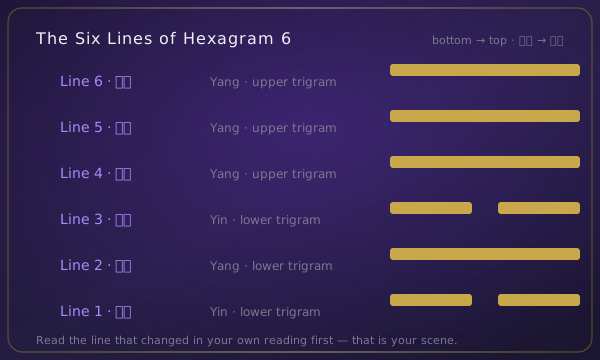
Each line of Hexagram 6 is one scene in the life of a dispute — its small words, its exits, its single centered judgment, and its hollow victory.
Line 1 (初六) — Do not carry the matter to the end; small words exchanged; in the end, good fortune. The scene: the quarrel that is stopped while it is still a quarrel. The modern reading: the hexagram's first and most practical line. Words will happen — say the small thing and let it end. The one who insists on carrying the matter to the end has already lost the hexagram.
Line 2 (九二) — Not prevailing in conflict, flee to your own town; its three hundred households escape calamity. The scene: the litigant who gives up the case and goes home. The modern reading: the exit line. What looks like retreat — dropping the claim, leaving the town, yielding the territory — is read by the hexagram as escape from calamity (无眚). Losing the lawsuit is the favorable outcome.
Line 3 (六三) — Live on the old virtue; perseverance brings danger; in the end, good fortune. If you serve the king's work, do not claim the achievement. The scene: the person sustained by old merit in a contested season. The modern reading: the hexagram's nuance line. If you are inside a conflict you did not start, live on what you have already earned — and do not claim credit for work done under contention. The claim is what turns your position dangerous.
Line 4 (九四) — Not prevailing in conflict, return to your duty, change; peace through perseverance is good fortune. The scene: the litigant who stops, resumes his post, and is rewritten by the stopping. The modern reading: the second exit line, deeper than the first. Not merely leaving the dispute — changing (渝). The person who returns to his proper work, having genuinely changed, finds the peace the lawsuit was promised to deliver.
Line 5 (九五) — Conflict: supreme good fortune. The scene: the one centered position where the suit itself is blessed. The modern reading: the judgment line. When a dispute is brought before the one genuinely entitled to decide — the mediator, the court, the person both sides accept — conflict itself becomes the path to supreme good fortune. The hexagram does not forbid conflict; it locates the only place conflict works.
Line 6 (上九) — The leather belt of office is conferred, and stripped three times before noon. The scene: the victory that humiliates itself by noon. The modern reading: the final warning. A win in conflict is conferred and confiscated in the same morning — the belt of office means nothing when the day ends in disgrace. The hexagram's last word on winning is: this is what winning costs.
When all six lines change: Hexagram 6 turns toward Hexagram 7 — conflict exhausted becomes the need for a disciplined host. The lawsuit that ends badly is why armies exist.
How to Read Hexagram 6 with the Number Oracle
Hexagram 6 reaches you the same way every hexagram does: through three numbers that arise naturally while you hold your question — a clock, a receipt, a page number, a number that simply surfaces. The first number sets the upper trigram, the second the lower trigram, and the third identifies the changing line. Enter your three numbers and your question at numbers-oracle.com and you will get the hexagram plus an AI interpretation written for your situation — free, no registration. For the mechanics, read how three numbers become a hexagram →
Your lucky energy for Hexagram 6: Water element (the body trigram, the stream below). Lucky colors are deep blue and black; the matching crystal is moonstone, traditionally associated with intuition, dreams, and emotional flow.
Related hexagrams: Hexagram 5 (Waiting) — the season before the dispute curdles; Hexagram 7 (The Army) — what unresolved conflict organizes into; Hexagram 43 (Breakthrough) — the decisive resolution conflict keeps avoiding.
Hexagram 6: Common Questions
What does hexagram 6 mean in one sentence?
Hexagram 6 means a dispute where sincerity is blocked — good fortune belongs to shrinking the conflict early or settling it before the entitled person, and misfortune to carrying it to the end.
Is hexagram 6 always bad?
No — its structure is 中吉,终凶: good fortune in the middle, misfortune at the end. The hexagram is favorable for disputes settled early, settled small, or settled by the proper judge. It is the carried-to-the-end dispute that the hexagram condemns, and the final line's stripped belt shows why.
What should I do when I receive hexagram 6?
Check which line changed. Small words (line 1) means settle it while it is small; fleeing the town (line 2) means the exit is the victory; living on old virtue (line 3) means claim nothing under contention; returning to duty (line 4) means stop and change; conflict itself (line 5) means bring it to the entitled judge; the stripped belt (line 6) means the win you are chasing is confiscated by noon.
Why is hexagram 6 called "Conflict"?
Because its image is heaven above and water below — the two elements moving in opposite directions, each sincere, each unable to meet. The old translators called it The Lawsuit because its lines read like a case file: what the dispute costs, where it can be settled, and what the hollow victory looks like.
The dispute that ends at noon wins nothing the afternoon can keep.