I Ching Hexagram 7 (The Army): Meaning in Love, Career and Life
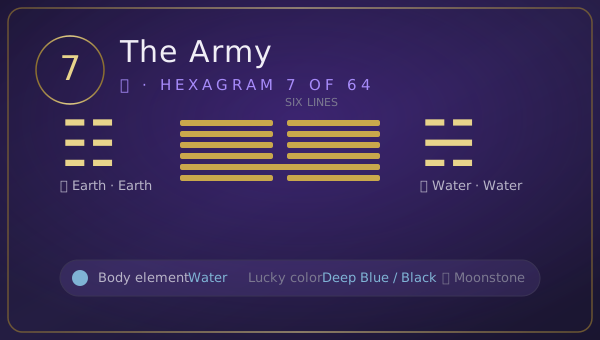
Hexagram 7 is the army hexagram of the I Ching: water contained within the earth, the disciplined host held inside the state. Its classical judgment reads "perseverance; the old and experienced person is favorable; no blame" (贞,丈人吉,无咎), and its image — water in the earth — says the noble one "tolerates the people and gathers the masses" (容民畜众). When Hexagram 7 appears in a reading, it describes any situation that requires organization, discipline, and one accountable leader — from a literal campaign to a team, a family, or a difficult project.
The Story of Hexagram 7: The General and the Palace Women
The Records of the Grand Historian tell the story of how a stranger became the most feared military mind of his age. Around 512 BCE, Sun Tzu — a wandering strategist from the state of Qi — arrived at the court of Wu and presented his treatise on war to King Helü. The king read it and, according to the account, decided to test whether the man could actually lead. He proposed a small demonstration: drill the palace women.
One hundred and eighty concubines were assembled in the courtyard, divided into two companies under the king's two favorite attendants as captains. Drums signaled. The women laughed. The king himself was delighted by the disorder. Sun Tzu was not. He warned that when orders are unclear the general is at fault — and then repeated the instructions, drums again. The laughter came again. This time he ordered the two captains — the king's favorites — seized and executed. The king protested from his pavilion; the general replied, reportedly, that a general in the field has his orders to follow even against the king's wishes. The executions were carried out. New captains were appointed, drums sounded, and the women drilled in perfect silence, every movement exact.
The king, chastened, hired him. (《史记·孙子吴起列传》)
The story is the hexagram's first line given flesh. 师出以律 — when the army goes out, it goes out by rule — and 否臧凶: if the rule is bad, or if the rule is not kept, misfortune. Discipline is not cruelty. In the hexagram's arithmetic, the two executions are what save the other hundred and eighty.
What Is Hexagram 7?
- Name: 师 (Shī), traditionally rendered The Army; also translated as The Host, Legions, or Disciplined Action
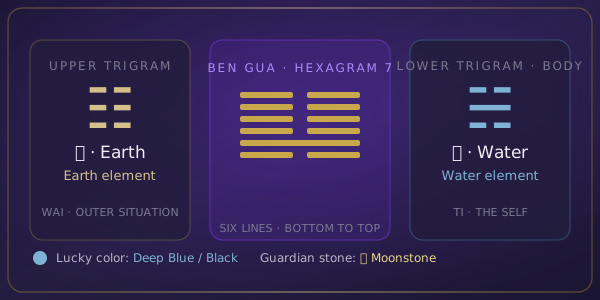
- Structure: Earth over Water — the great water stored within the earth, the host within the state
- Position: 7 of 64, the hexagram after Conflict; what unresolved conflict organizes into
- Element: Water on the body trigram — the lower trigram (water) belongs to Water; earth above belongs to Earth
- Body trigram: the lower trigram (water, Water), which in plum blossom divination represents the self
- Core images: water within the earth, the cart carrying the corpse, the three royal gifts, the old and experienced leader
The Core Meaning of Hexagram 7
The judgment of Hexagram 7 is four characters long and every one of them matters: 师,贞,丈人吉,无咎 — the army, through correctness, the old and experienced person, good fortune, no blame. Two things are being said at once. First, this hexagram is about organized force, not individual heroism. Second, the person who wields it must be a 丈人 — an old, seasoned hand — and the purpose must be 贞, correct. The Book of Changes has no blessing for the young and ambitious commander.
Three things this hexagram is telling you, each standing on its own:
Discipline precedes everything. The opening line is absolute: 师出以律,否臧凶 — the army marches by rule, and if the rule is bad or unkept, misfortune. In the story above, the women did not need more motivation. They needed a rule that was true. Every team drawing Hexagram 7 is being asked: is the standard real, and is it kept?
One leader, not a committee. The hexagram's central line puts the commander in the midst of the army (在师中) and shows the king bestowing gifts three times (王三锡命) — the trust is personal and singular. The failure mode is named in line 5: when a disciple leads instead of the elder (弟子舆尸), the cart carries a corpse. Divided command is not caution; in this hexagram's language, it is a funeral.
The army must be released when the campaign ends. The final line is the hexagram's quiet masterpiece: the great ruler issues the decree (大君有命), fiefs are granted, families are enfeoffed — and 小人勿用, the small man is not to be employed. Organized force is for the campaign, not for the peace. The unit that stays mobilized after its mission becomes its own disaster.
The question Hexagram 7 answers is not "are we strong?" It is: is this force correct, disciplined, and held by one experienced hand — and will it be released when the work is done?
Hexagram 7 in Love and Relationships
If you are single: Hexagram 7 in the love sphere is unusual but real — it governs the person who is organizing their life as a campaign rather than a performance. Discipline in the self (fitness, finances, habits, the long project) is this hexagram's native attractiveness. The Book's condition, though, is the 丈人 rule: maturity, not raw force. Intensity without seasoning reads as threat, not appeal.
In an early or uncertain stage: Early love under Hexagram 7 is two disciplined people coordinating — logistics, timing, the practical architecture of a shared life. The hexagram's counsel: one decision-maker per domain, agreed in advance. Most early relationships fail not from lack of love but from the corpse-cart line — two people giving incompatible orders to the same enterprise. Decide who decides what.
In a stable relationship: A stable relationship drawing Hexagram 7 is running a joint operation — a household, a business, children, the long work. The hexagram's structure is the clearest available map: a shared standard (律), a seasoned lead in each domain, and the discipline to demobilize after each campaign. Relationships that stay permanently mobilized — every disagreement fought as a war — exhaust themselves by the hexagram's own logic.
In a crisis: If the relationship is in open conflict, Hexagram 7 says: appoint one commander and one objective. The line about the cart carrying the corpse (师或舆尸,凶) is the crisis line — when both people command at once, the campaign is already dead. The hexagram does not recommend force in crises. It recommends the oldest, calmest person available taking the lead, and everyone else holding their post.
Hexagram 7 in Career, Money and Decisions
Career: This is the leadership and organization hexagram — the new manager, the project in chaos, the turnaround, the team that must perform. Its career counsel is exact: the leader must be seasoned (丈人), the rules must be real (律), the trust must be concentrated in one hand (在师中,王三锡命). If you are drawing it while leading, the hexagram is asking whether your team follows a standard or follows your mood — and the palace-women story is the answer about what the second option costs.
Money: Hexagram 7 governs pooled resources — the investment pool, the family budget, the shared venture. The hexagram's financial counsel: discipline first, returns second. An undisciplined pool is the army that marches without rule (否臧凶) — it may win a battle and lose the war. And the final line applies to money directly: when the campaign ends, distribute. Gains that are never distributed become the next conflict.
Decision: Hexagram 7 is a go for organized, disciplined action under seasoned leadership — and a stop for solo heroics, committee command, and permanent mobilization. If your plan depends on everyone being motivated, redesign it to depend on the rule. If your plan has no one accountable, the hexagram has already named its outcome: 舆尸 — the cart that carries a corpse.
The Changing Lines of Hexagram 7: Six Scenes
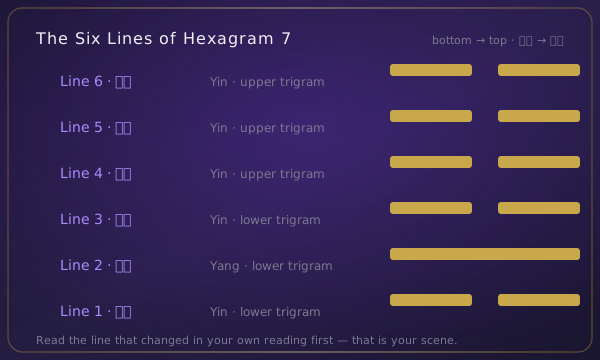
Each line of Hexagram 7 is one scene in the life of an army — its rules, its command, its corpses, its rests, its hunts, and its release.
Line 1 (初六) — The army marches by rule; if the rule is bad, misfortune. The scene: the standard raised before the first step. The modern reading: the hexagram's foundation line. Whatever you are organizing, the rule comes first — and the rule must be true, not decorative. The palace-women story is this line told as history.
Line 2 (九二) — The commander in the midst of the army; good fortune, no blame; the king bestows gifts three times. The scene: the general among the troops, trusted personally by the throne. The modern reading: the central line. Leadership that works is present leadership with concentrated trust. The gifts are not decoration — they are the mandate, and they come to one hand.
Line 3 (六三) — The army perhaps carries corpses; misfortune. The scene: the campaign that has become a funeral procession. The modern reading: the failure line of the hexagram. Corpses on the cart mean the mission has become its own casualty — bad command, wrong objective, or people sent where they should not be. The hexagram's verdict is a single word: 凶.
Line 4 (六四) — The army makes its bivouac to the left; no blame. The scene: the disciplined rest — camp pitched, arms stacked, no blame attached. The modern reading: the recovery line. Even campaigns require demobilization, and demobilization without guilt is a skill. The team that never rests is the team that dies at line 3.
Line 5 (六五) — There is game in the field; favorable to seize it with words; no blame. The eldest son leads the army; a younger brother carts the corpse — perseverance is ominous. The scene: the hunt and the command decision, side by side. The modern reading: the hexagram's clearest warning about divided command. When the seasoned lead holds the mission (长子帅师), the hunt succeeds. When the junior is allowed to command (弟子舆尸), the same mission becomes a funeral. Persisting in that structure is ominous.
Line 6 (上六) — The great ruler issues the decree; founds states, establishes houses; the small man is not employed. The scene: the victory settlement — fiefs granted, ranks distributed, and one exclusion named. The modern reading: the release line. Organized force ends in distribution, not in permanent command. And the exclusion is the hexagram's ethics: those who led through smallness are not carried into the peace.
When all six lines change: Hexagram 7 turns toward Hexagram 8 — the army that completed its campaign becomes alliance. Discipline released becomes unity.
How to Read Hexagram 7 with the Number Oracle
Hexagram 7 reaches you the same way every hexagram does: through three numbers that arise naturally while you hold your question — a clock, a receipt, a page number, a number that simply surfaces. The first number sets the upper trigram, the second the lower trigram, and the third identifies the changing line. Enter your three numbers and your question at numbers-oracle.com and you will get the hexagram plus an AI interpretation written for your situation — free, no registration. For the mechanics, read how three numbers become a hexagram →
Your lucky energy for Hexagram 7: Water element (the body trigram, water below). Lucky colors are deep blue and black; the matching crystal is moonstone, traditionally associated with intuition, dreams, and emotional flow.
Related hexagrams: Hexagram 6 (Conflict) — the dispute that organizes into a host; Hexagram 8 (Holding Together) — the campaign that becomes alliance; Hexagram 45 (Gathering Together) — the larger assembly of many hosts.
Hexagram 7: Common Questions
What does hexagram 7 mean in one sentence?
Hexagram 7 means organized force under discipline — success belongs to the correct mission led by one seasoned commander with real rules, and released once the campaign is done.
Is hexagram 7 good or bad in a reading?
Hexagram 7 is conditional. Its judgment — perseverance, the old and experienced person, no blame — is favorable when the conditions are met and harsh when they are not. The corpse-cart line (师或舆尸,凶) is the Book's plainest warning: this hexagram punishes divided command and unclear purpose without qualification.
What should I do when I receive hexagram 7?
Check which line changed. Marching by rule (line 1) means make the standard real; the commander in the midst (line 2) means lead personally and hold the mandate; carrying corpses (line 3) means stop the mission that is killing your people; the bivouac (line 4) means rest without guilt; game in the field (line 5) means one commander per mission; the decree (line 6) means distribute the gains and release the force.
Why is hexagram 7 called "The Army"?
Because its image is the great water stored within the earth — a vast, disciplined force contained inside the boundaries of the state. The old translators kept the military reading because the hexagram's lines are a complete manual: rules, command structure, the costs of bad leadership, and the settlement after victory.
Discipline is not the opposite of mercy. It is what mercy looks like before the battle.