I Ching Hexagram 8 (Holding Together): Meaning in Love, Career and Life
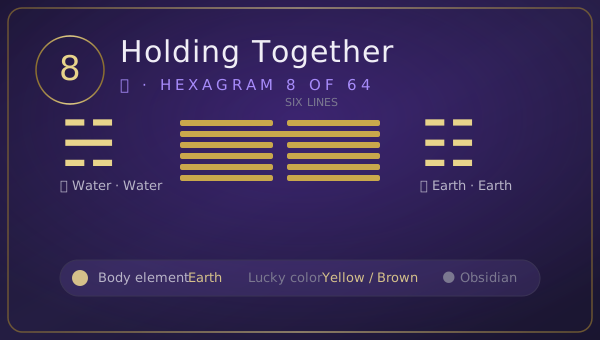
Hexagram 8 is the holding-together hexagram of the I Ching: water spread over the earth, seeking the low places where everything gathers. Its classical judgment reads "good fortune. The original casting: supreme, lasting, favorable perseverance; no blame. Those who were restless come late; the latecomer is inauspicious" (吉。原筮元永贞,无咎。不宁方来,后夫凶), and its image — water on the ground — says the early kings "established the myriad states and drew close to the feudal lords" (建万国,亲诸侯). When Hexagram 8 appears in a reading, it describes alliance: the power of people who chose each other, and the cost of arriving after the choosing was done.
The Story of Hexagram 8: The Eight Hundred Lords at Meng Ford
The Records of the Grand Historian preserve the moment when an alliance formed without being summoned. King Wen of Zhou had died, and his son King Wu was biding his time at his capital. Two years after the death of the last Shang king's favored ruler, according to the account, King Wu led his forces east "to review the troops" — and reached a ford on the Yellow River called Mengjin. There, the feudal lords assembled. Not by royal command, and not by prior arrangement: the records say those who came without appointment numbered eight hundred. Each lord reportedly said the same thing — that the Shang had become intolerable, that Zhou was the only house fit to lead. King Wu, however, judged that the time was not yet ripe. He did not cross. He turned the host around, and the alliance waited.
(《史记·周本纪》: 诸侯不期而会者八百)
The hexagram's judgment reads like a commentary on that day. 不宁方来 — the restless come — describes the eight hundred lords arriving because unrest had made its own summons. And 后夫凶 — the latecomer is inauspicious — describes what happened to the houses that hesitated past the assembling. Alliance, in this hexagram, is a body of water finding its level. It forms when it forms, and the one who arrives after the level is found has no channel to flow into.
What Is Hexagram 8?
- Name: 比 (Bǐ), traditionally rendered Holding Together; also translated as Union, Alliance, or Fellowship with the Near
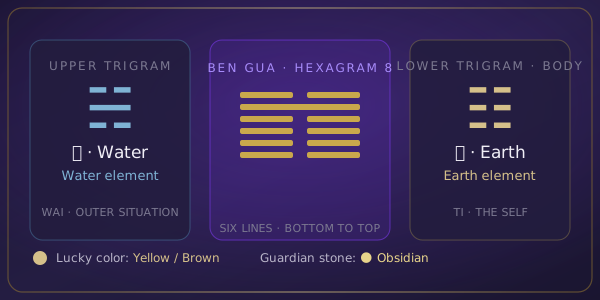
- Structure: Water over Earth — water spreading across the ground, gathering in the low places
- Position: 8 of 64, the hexagram after The Army; the campaign that becomes alliance
- Element: Earth on the body trigram — the lower trigram (earth) belongs to Earth; water above belongs to Water
- Body trigram: the lower trigram (earth, Earth), which in plum blossom divination represents the self
- Core images: water on the earth, the overflowing earthenware jar, the three-sided hunt, the latecomer at the empty ford
The Core Meaning of Hexagram 8
The judgment of Hexagram 8 opens with a single word — 吉, good fortune — and then spends the rest of its breath on conditions. The original casting must be 元永贞: supreme, enduring, correct. Alliance is not a momentary convenience; it is a long commitment to the right party. And the closing line of the judgment is the hexagram's hardest teaching: 后夫凶. Those who come late, after the restless have already gathered, meet misfortune.
Three things this hexagram is telling you, each standing on its own:
Union is a seeking of the low place. Water over earth flows downward, gathering where the ground is humble. The hexagram's central line is explicit — 显比, open union — and its image is the king's hunt with three sides (王用三驱), letting the front go free: alliance is offered openly, never cornered. People draw close to the one who draws close; force gathers grudges, not companions.
The bond is held by sincerity, and the jar must overflow. Line 1's image is the earthenware jar filled to overflowing (有孚盈缶) — sincerity that cannot be contained, that arrives from within rather than from calculation. And the line adds a strange promise: even if another fortune comes (终来有它吉), the overflow is what made it possible. Alliances that hold are built on a supply of trust that exceeds the immediate need.
The choice of company is the whole decision. Line 3 is the hexagram's entire warning in four characters: 比之匪人 — union with those who are not your people. Not every gathering is a union; not every crowd is an alliance. The hexagram asks you to look at who is actually drawing close, and to refuse the bond that flatters you into the wrong company.
The question Hexagram 8 answers is not "who wants me?" It is: who did I choose, is the bond sincere and open, and did I arrive while the ford was still open?
Hexagram 8 in Love and Relationships
If you are single: Hexagram 8 is the strongest alliance hexagram in the Book for connection — and its whole counsel is about quality of company, not quantity of attention. The open-union line (显比) favors the person who is genuinely available, who does not corner, who lets attraction come freely. And the latecomer line is real in dating: the person who waits until everyone has paired and then panics into the nearest bond is the hexagram's inauspicious case.
In an early or uncertain stage: Early love under Hexagram 8 is mutual choosing — two people deciding, openly, to draw close. The hexagram's conditions apply directly: the bond must be original and enduring (元永贞), not convenient; the sincerity must overflow the jar; and the drawing-close must be visible (显比) rather than strategic. If one party is managing the other's options, this hexagram is not present.
In a stable relationship: A stable relationship drawing Hexagram 8 is an alliance in maintenance — the marriage, the partnership, the decade-long bond. The hexagram's counsel for long alliances is the king's three-sided hunt: do not corner, do not control, keep the front open. And the final line is the hexagram's deepest warning — 比之无首: a bond with no head, no clear beginning and no clear leader, ends badly. Long alliances need their origin remembered.
In a crisis: If the relationship is in conflict, Hexagram 8 says the bond itself is not the problem — the choice of company may be. The 比之匪人 line asks the hardest question in the hexagram: is this actually my person? The hexagram does not bless every bond; it blesses the correct one. And its image of the king's hunt — the front left free — is the counsel for repair: release, do not corner.
Hexagram 8 in Career, Money and Decisions
Career: This is the alliance and partnership hexagram — the co-founder, the consortium, the hiring of your people, the professional network that actually functions. Its career counsel: choose companions deliberately (原筮 — cast again, check the original intent), hold the bond openly (显比), and remember that the restless assemble on their own schedule. If the right people are gathering, join the assembling; if you arrive after the level is found, you are the latecomer the hexagram warns about.
Money: Hexagram 8 governs shared ventures — the investment syndicate, the family business, the pooled fund. Its financial counsel is the jar: commitments should overflow with sincerity rather than be measured to the contract minimum. The hexagram's final line (比之无首) is its financial warning — a pooled venture with no clear lead, no founding intent, no accountable head, is the inauspicious case. Structure the alliance before the money, not after.
Decision: Hexagram 8 says: choose, openly and for the long term. If you are deciding whether to join — a team, a venture, a bond — the hexagram's test is not whether the alliance is available but whether it is correct, open, and arrived at in time. The judgment's three conditions (元, 永, 贞) are the checklist: original intent, enduring commitment, right conduct. Miss one, and 后夫凶 — the late or late-hearted — is the outcome named in the text.
The Changing Lines of Hexagram 8: Six Scenes
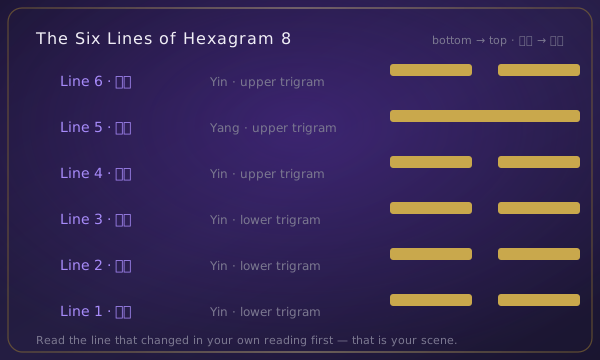
Each line of Hexagram 8 is one scene in the life of an alliance — its sincerity, its choosing, its openness, its outer bonds, its centered hunt, and its headless ending.
Line 1 (初六) — Sincerity in the bond; no blame. The earthenware jar overflows; in the end another good fortune comes. The scene: the jar filled past its rim, trust that cannot be contained. The modern reading: the foundation line. Bonds that hold are fed from an overflowing supply — the sincerity comes first, the return comes second, and the hexagram promises the second arrives (终来有它吉).
Line 2 (六二) — The bond from within; perseverance is favorable. The scene: union drawn from the inside out — your own household, your own circle, your own substance. The modern reading: the hexagram's inward line. The alliance that works begins at the core: choose from your genuine center, and the pull outward is strong because the center is held.
Line 3 (六三) — Union with those who are not your people. The scene: the bond made with the wrong company. The modern reading: the hexagram's only hard line. Not every closeness is an alliance; not every offer is a bond. The hexagram names the failure precisely — the company was wrong — and leaves the remedy to the reader: leave.
Line 4 (六四) — Outer union; perseverance is favorable. The scene: alliance extended outward — the outside partner, the foreign ally, the bond beyond the inner circle. The modern reading: the expansion line. Bonds held from a strong center can extend safely; the outer alliance is favorable precisely because the inner one (line 2) was held first.
Line 5 (九五) — Open union — the king's three-sided hunt, letting the front go free; the townsmen are not warned, and good fortune follows. The scene: the hunt with one side open, the alliance offered without cornering. The modern reading: the central line and the hexagram's signature. Power that is offered openly gathers freely; the townsmen need no warning because there is nothing to fear. This is the leadership image of every alliance that lasts.
Line 6 (上六) — The bond has no head; misfortune. The scene: the alliance that lost its origin — no founding, no leader, no beginning to return to. The modern reading: the final warning. Bonds without a head are crowds, not alliances. The remedy implied by the line: remember the beginning (原筮) or the bond dissolves into its own formlessness.
When all six lines change: Hexagram 8 turns toward Hexagram 9 — alliance held becomes the small accumulation. The gathered waters become the clouds.
How to Read Hexagram 8 with the Number Oracle
Hexagram 8 reaches you the same way every hexagram does: through three numbers that arise naturally while you hold your question — a clock, a receipt, a page number, a number that simply surfaces. The first number sets the upper trigram, the second the lower trigram, and the third identifies the changing line. Enter your three numbers and your question at numbers-oracle.com and you will get the hexagram plus an AI interpretation written for your situation — free, no registration. For the mechanics, read how three numbers become a hexagram →
Your lucky energy for Hexagram 8: Earth element (the body trigram, earth below). Lucky colors are yellow and earth brown; the matching crystal is obsidian, traditionally associated with protection, grounding, and shielding from stress.
Related hexagrams: Hexagram 7 (The Army) — the campaign that becomes alliance; Hexagram 45 (Gathering Together) — the larger assembly, many bonds at once; Hexagram 38 (Opposition) — the hexagram's shadow, when bonds turn to estrangement.
Hexagram 8: Common Questions
What does hexagram 8 mean in one sentence?
Hexagram 8 means alliance held well — good fortune belongs to the bond that is chosen deliberately, fed by overflowing sincerity, offered openly, and entered while the gathering is still open.
Is hexagram 8 a yes or no?
Hexagram 8 is one of the Book's clearer favorable signs for questions about joining, partnership, and connection — with two conditions built into its judgment. The bond must be original, enduring, and correct (元永贞), and you must not be the latecomer (后夫凶). A forced or last-minute alliance is the inauspicious case.
What should I do when I receive hexagram 8?
Check which line changed. The overflowing jar (line 1) means give more sincerity than the bond requires; union from within (line 2) means choose from your center; union with the wrong people (line 3) means leave the company; outer union (line 4) means extend the alliance from strength; open union (line 5) means offer without cornering; the bond with no head (line 6) means recover the founding intent.
Why is hexagram 8 called "Holding Together"?
Because its image is water spread across the earth — many streams finding one level, gathering in the low places without being forced. The old translators called it Union or Alliance because its lines read like the constitution of a partnership: how it forms, how it is fed, and the one failure that dissolves it.
The ford is open while the lords are still crossing.