I Ching Hexagram 10 (Treading): Meaning in Love, Career and Life
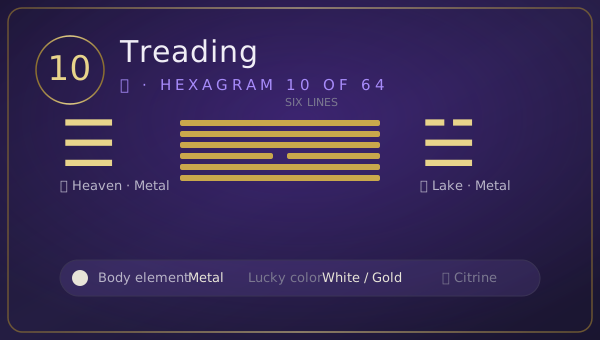
Hexagram 10 is the treading hexagram of the I Ching: heaven above, the lake below — a person walking on the tiger's tail. Its classical judgment reads "treading on the tiger's tail; it does not bite the person; success" (履虎尾,不咥人,亨), and its image — heaven above, the marsh below — says the noble one "distinguishes high and low and settles the people's aims" (辩上下,定民志). When Hexagram 10 appears in a reading, it describes conduct: the exact art of moving correctly through dangerous ground, where grace and precision are the same thing.
The Story of Hexagram 10: The Hymn of the Thin Ice
Long before the Book of Changes was compiled, the Zhou court had already written the hexagram's manual into song. The Book of Songs preserves the line that every later generation of officials carried like a staff:
"战战兢兢,如临深渊,如履薄冰" — trembling, trembling, cautious, cautious, as if on the edge of an abyss, as if treading on thin ice.
(《诗经·小雅·小旻》)
The old commentators quoted this hymn as the plain-language version of Hexagram 10, and the pairing has never been improved upon. The tiger's tail is not a threat to be eliminated. It is ground to be walked on — slowly, with the weight in the right place, with no sudden movements. The tiger does not bite the person who treads correctly (不咥人). What the hexagram describes is not courage in the modern sense — the absence of fear — but courage in the older sense: correct motion while afraid.
The hexagram's six lines are a curriculum in that motion. It begins with plain treading — 素履, walking without ornament, in your own genuine character. It continues with the level road of the hidden person (履道坦坦,幽人贞吉): the one nobody is watching still walks correctly. It warns at the third line about the one-eyed man who thinks he can see and the lame man who thinks he can walk — the person who overestimates his position gets bitten (咥人,凶). It grants its central blessing to the fearful walker (履虎尾,愬愬,终吉): the one who trembles all the way to the end is the one who finishes. And its final line turns the whole journey into an audit — 视履考祥: examine the treading, and the turning of it brings supreme good fortune (其旋元吉). The walk that can look back on itself is the walk that was correct.
What Is Hexagram 10?
- Name: 履 (Lǚ), traditionally rendered Treading; also translated as Conduct, Treading on the Tiger's Tail, or Propriety
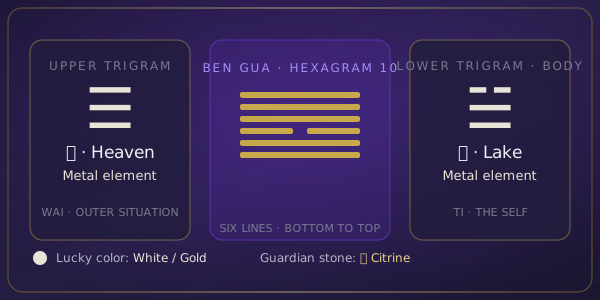
- Structure: Heaven over the Lake — the marsh below the sky, the tiger's tail beneath the foot
- Position: 10 of 64, the hexagram after Small Taming; the careful path after the rain
- Element: Metal on the body trigram — the lower trigram (the lake) belongs to Metal; heaven above also belongs to Metal
- Body trigram: the lower trigram (the lake, Metal), which in plum blossom divination represents the self
- Core images: the tiger's tail, the thin ice, the plain shoe, the hidden person's level road, the examination of the walk
The Core Meaning of Hexagram 10
The judgment of Hexagram 10 is the whole hexagram in one image: 履虎尾,不咥人,亨 — treading on the tiger's tail, the tiger does not bite, success. The danger is not denied. The danger is walked. What makes the tiger not bite is not force, not luck, and not the absence of the tiger — it is the correctness of the treading itself.
Three things this hexagram is telling you, each standing on its own:
Conduct is the content. The hexagram is not about the situation you are in; it is about how you move in it. 辩上下,定民志 — the image of heaven above and lake below is a hierarchy: the noble one distinguishes high from low and settles the aims of the people. In any dangerous structure — a new workplace, a difficult family, a sensitive negotiation — the hexagram's counsel is to know exactly where you stand and to walk from that position, not from an imagined one.
Plainness is the correct footwear. The opening line is 素履 — treading plainly, in undyed shoes. The hexagram's first counsel is against ornament: do not dress the walk up. The person who moves in their genuine character, without performance, is the one the tiger does not bite. The danger zone (line 3) is precisely the person performing a position he does not actually hold.
Fear is part of the correct walk. The fourth line's blessing goes to 愬愬 — the trembling one. The hexagram does not reward fearlessness; it rewards the person who is afraid and treads correctly anyway. Trembling is information. The one who has stopped trembling on the tiger's tail is the one the tiger is about to correct.
The question Hexagram 10 answers is not "is this dangerous?" It is: am I walking this ground in my true position, plainly, with my fear intact — and can I examine the walk afterward without flinching?
Hexagram 10 in Love and Relationships
If you are single: Hexagram 10 governs the walk into new connection — the approach, the early signals, the delicate choreography of interest. Its counsel is the hexagram's counsel: plain shoes (素履). Show up as you actually are; do not perform a position. The one-eyed and the lame at line 3 are the dating failures — the person performing confidence he does not have, walking toward a tiger he cannot see.
In an early or uncertain stage: Early love under Hexagram 10 is thin ice — the beautiful, dangerous, necessary choreography of two people finding their positions. The hexagram rewards the trembler (line 4): the one who feels the risk and moves carefully anyway finishes well. And the level road of the hidden person (line 2, 幽人) is the early-relationship promise: the bond that forms when nobody is performing is the bond that holds.
In a stable relationship: A stable relationship drawing Hexagram 10 is in its long conduct phase — the daily walk, the routine that is also thin ice if neglected. The hexagram's counsel for long bonds is its image: 辩上下 — know the positions. Not dominance, but clarity: who is who, what belongs to whom, what the structure actually is. Relationships decay when the positions become unstated and each person walks on an imagined map.
In a crisis: If the relationship is in crisis, Hexagram 10 says the bite came from a misstep, not from the tiger. The examination line (视履考祥) is its counsel: look at the walk. Where did you step wrong — what position were you performing, what ornament were you wearing, where did you stop trembling and start strutting? The correction is always in the conduct, never in the tiger.
Hexagram 10 in Career, Money and Decisions
Career: This is the conduct hexagram of professional life — the new organization with its invisible rules, the sensitive negotiation, the position that requires exactness. Its career counsel is precise: learn the hierarchy (辩上下), settle your aim (定民志), walk plainly in your real position, and keep your fear operational. The hexagram rewards the employee who trembles correctly in month one over the one who strides; the stride is the bite.
Money: Hexagram 10 governs financial conduct — the walk through sensitive money: the audit, the partnership terms, the family obligation. Its counsel: 素履 — plainness in financial dealings, no ornament, no performance of wealth or position. And the final line is the hexagram's financial audit: 视履考祥 — examine the walk. The money that can look back on its own conduct without flinching is the money that was correctly handled.
Decision: Hexagram 10 says: walk it, carefully, in your true position. If you are deciding whether to enter dangerous ground — the job, the deal, the conversation — the hexagram does not forbid the ground. It specifies the footwear. Plainness, clarity about where you stand, and the trembling kept intact. The decision it blesses is always the one made from the position you actually hold, not the one you would prefer to hold.
The Changing Lines of Hexagram 10: Six Scenes
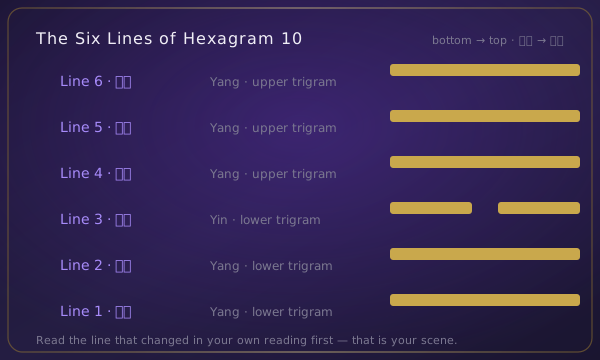
Each line of Hexagram 10 is one scene in the art of walking dangerous ground — the plain shoe, the level road, the overreaching step, the trembling finish, the decisive stride, and the examination.
Line 1 (初九) — Plain treading; going forward, no blame. The scene: the undyed shoe on the tiger's tail — walking in your genuine character, without ornament. The modern reading: the foundation line. Performance is the danger; plainness is the protection. The hexagram's first counsel is simply: be what you actually are, where you actually are.
Line 2 (九二) — The way of treading is level and smooth; the hidden person perseveres and good fortune follows. The scene: the one nobody is watching, walking the level road correctly anyway. The modern reading: the integrity line. Conduct that holds when unobserved is the conduct the hexagram blesses. The 幽人 — the person in obscurity — is the hexagram's true hero.
Line 3 (六三) — The one-eyed man thinks he can see; the lame man thinks he can walk. He treads on the tiger's tail and is bitten — misfortune. The warrior acts as a great lord. The scene: the overestimated position, the step taken on an imagined leg. The modern reading: the hexagram's danger line. The bite is not bad luck; it is the predictable outcome of performing a position you do not hold. The warrior acting as a great lord is the hexagram's image of the failure.
Line 4 (九四) — Treading on the tiger's tail, trembling all the way; in the end, good fortune. The scene: the fearful walker who finishes the whole distance. The modern reading: the hexagram's central blessing. Fear is not the enemy of the correct walk; it is the correct walk's native sensation. The one who trembles to the end is the one who reaches the end.
Line 5 (九五) — Decisive treading; perseverance brings danger. The scene: the stride — confidence become decision. The modern reading: the warning line, placed at the center of power. Decisiveness without trembling is its own danger; the hexagram attaches 厉, danger, to the stride. Even at the center, the thin ice is thin.
Line 6 (上九) — Look at the treading and examine the signs; its turning brings supreme good fortune. The scene: the walker who turns and looks back at his own footprints. The modern reading: the completion line. The journey becomes good fortune when it can be examined — when the conduct can be reviewed without flinching. The hexagram's final word is audit: 视履考祥,其旋元吉.
When all six lines change: Hexagram 10 turns toward Hexagram 11 — the walk completed becomes peace. The tiger's tail, walked correctly, becomes the open bridge.
How to Read Hexagram 10 with the Number Oracle
Hexagram 10 reaches you the same way every hexagram does: through three numbers that arise naturally while you hold your question — a clock, a receipt, a page number, a number that simply surfaces. The first number sets the upper trigram, the second the lower trigram, and the third identifies the changing line. Enter your three numbers and your question at numbers-oracle.com and you will get the hexagram plus an AI interpretation written for your situation — free, no registration. For the mechanics, read how three numbers become a hexagram →
Your lucky energy for Hexagram 10: Metal element (the body trigram, the lake below). Lucky colors are white, gold, and silver; the matching crystal is citrine, traditionally associated with abundance and clear, joyful energy.
Related hexagrams: Hexagram 9 (Small Taming) — the gathering before the walk; Hexagram 11 (Peace) — the open bridge the correct walk arrives at; Hexagram 15 (Modesty) — the plain-shoe virtue in its purest form.
Hexagram 10: Common Questions
What does hexagram 10 mean in one sentence?
Hexagram 10 means treading dangerous ground correctly — success comes to the person who walks plainly in their true position, keeps fear intact, and can examine their own conduct afterward.
Is hexagram 10 good or bad?
Hexagram 10 is favorable with conditions. Its judgment promises success (亨) precisely for correct conduct: the tiger does not bite the person who treads correctly. The hexagram's danger is named at line 3 and line 5 — the overestimated step and the un-trembling stride. The walk is safe; the misstep is not.
What should I do when I receive hexagram 10?
Check which line changed. Plain treading (line 1) means drop the performance; the level road (line 2) means walk correctly unobserved; the one-eyed and lame (line 3) means do not act beyond your actual position; trembling to the end (line 4) means keep fear and finish; decisive treading (line 5) means watch the stride; examine the treading (line 6) means audit your own walk honestly.
Why is hexagram 10 called "Treading"?
Because its entire image is a foot on a tiger's tail — 履虎尾. The old translators rendered it Conduct or Propriety because the hexagram is less about the danger than about the manner of walking it: plain shoes, true position, trembling intact, and a backward look at the end.
Trembling is not the opposite of walking. It is what correct walking feels like from the inside.