I Ching Hexagram 11 (Peace): Meaning in Love, Career and Life
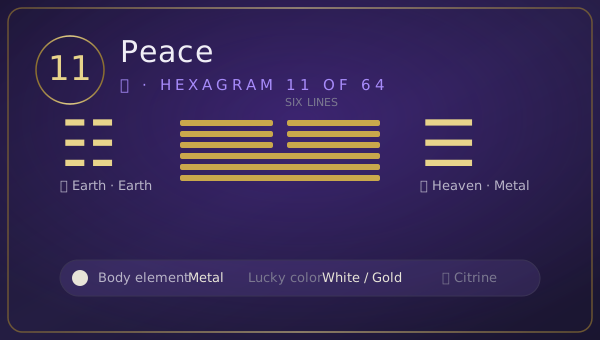
Hexagram 11 is the peace hexagram of the I Ching: heaven below, earth above — the two elements in active exchange rather than isolation. Its classical judgment reads "the small departs, the great arrives; good fortune and success" (小往大来,吉亨), and its image is heaven and earth crossing, which the text says lets the ruler "complete the way of heaven and earth and assist the people." When Hexagram 11 appears in a reading, it marks one of the most favorable configurations in the entire Book of Changes: a window where things flow because two directions of traffic are open at once.
The Story of Hexagram 11: When Heaven Leans Down
Heaven and earth never speak, but twice a day they cross. Vapor rises from the soil; moisture descends from the sky. Where the two currents meet, you get rain, rivers, grain, and everything alive. When they stop crossing, the same two elements turn into the next hexagram in the sequence — 否, Standstill — and nothing grows. In the old cosmology behind the I Ching, that crossing is exactly what 泰 names: heaven's energy moving downward, earth's energy rising to meet it, and the whole world between them in motion. The hexagram's own text compares it to a royal marriage — 帝乙归妹, the king giving his daughter in marriage — because peace, in this system, is never a static state. It is a relationship in motion: two directions of traffic on one open bridge.
What Is Hexagram 11?
- Name: 泰 (Tai), traditionally rendered Peace; also translated as Great Tranquility or The Wavering
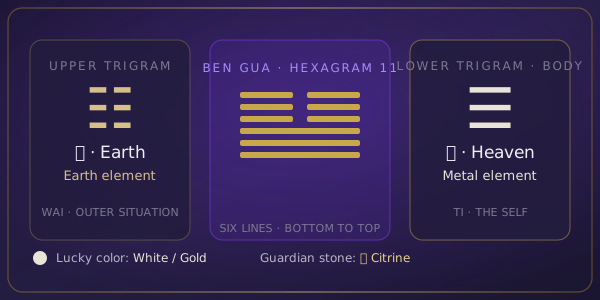
- Structure: Earth over Heaven — heaven below, earth above; the two elements in communication rather than opposition
- Position: 11 of 64, immediately followed by Hexagram 12 (Standstill), its inverted form and its warning
- Element: Metal on the body trigram — the lower trigram (heaven) belongs to Metal; earth above belongs to Earth
- Body trigram: the lower trigram (heaven, Metal), which in plum blossom divination represents the self
- Core images: heaven and earth crossing, the open bridge, the marriage alliance, the favorable season
The Core Meaning of Hexagram 11
The classical judgment of Hexagram 11 is short: 泰:小往大来,吉亨 — "The small departs, the great arrives; good fortune and success." That sentence describes a direction of exchange: what leaves is small, what arrives is great. Energy is flowing toward you, and it is flowing through an open channel rather than a forced one.
Three things this hexagram is telling you, each standing on its own:
Peace is exchange, not stillness. The hexagram's image is not a quiet room — it is two currents crossing. What makes Hexagram 11 work is that heaven descends and earth rises: giving and receiving happen at the same time. In any situation this hexagram describes — a relationship, a team, a market, a negotiation — the favorable condition is two-way traffic. One-way giving decays; one-way taking blocks.
The small going out is the price of the great coming in. 小往大来 is an accounting: something modest leaves so something substantial can enter. The hexagram does not promise gain without release. If you are drawing Hexagram 11 while clinging to something small — a minor grudge, a small comfort, a small identity — the hexagram's arithmetic is telling you what has to move first.
The window is real but not permanent. The line that matters most is the third: 无平不陂,无往不复 — "there is no flat ground that is not also a slope, nothing that goes that does not return." Hexagram 11 itself contains the knowledge of its own ending, which is exactly why the classical image says the ruler uses this time to "complete the way of heaven and earth": favorable conditions are for building, not for coasting.
Favorable conditions are for building, not for coasting. The hexagram's final line shows the city wall collapsing into its own moat. Peaks in this system are worksites, not resting places.
The question Hexagram 11 answers is not "is this good?" It is: what is exchanging with what, and am I using the open window while it is open?
Hexagram 11 in Love and Relationships
If you are single: Hexagram 11 is one of the strongest favorable signs in the Book of Changes for connection. The crossing image is literally two energies moving toward each other, and the hexagram's own marriage line (帝乙归妹) blesses unions formed at exactly this kind of moment. Practically: you are visible, you are reachable, and the channels are open. The hexagram's one condition is reciprocity — exchange, not performance.
In an early or uncertain stage: This is the hexagram of mutual, flowing early stages — conversations that go both ways, interest that is returned, plans that form easily. The classical lines favor moving together with your circle (翩翩不富,以其邻 — coming down lightly, with your people, on trust rather than on proof) rather than grand gestures. Ease is the signal here; if it requires force, the window is not actually open.
In a stable relationship: Hexagram 11 describes a partnership in genuine exchange — both people giving, both receiving, neither performing. It is the healthiest long-term configuration in the sequence, and the hexagram's own warning is about maintenance: 无平不陂. Stable relationships decay not through conflict but through the slow closing of channels. Keep the traffic moving.
In a crisis: If the relationship has gone cold, Hexagram 11 says the problem is almost always blocked exchange rather than absent love — one direction stopped flowing and the other followed. The hexagram's remedy is reopening the channel, not escalating the pressure. Note the final line's image, though: if the walls themselves are falling (城复于隍), repair the structure, do not send the army.
Hexagram 11 in Career, Money and Decisions
Career: This is the hexagram of the favorable window — the merger that is easy, the team that is aligned, the moment when your side of the market and the market's side of you are finally in contact. It favors alliance-building, deals, hiring, and any move that depends on two parties flowing toward each other. The classical image of the ruler "assisting the people" frames it as leadership through facilitation: your job during a 泰 window is to keep the bridge open, not to cross it alone.
Money: 小往大来 is a favorable-arithmetic hexagram: modest outflows now, substantial inflows later. It favors investing in the exchange itself — the relationship, the platform, the reputation — rather than extracting maximum value at every step. The hexagram's final line is a reminder that prosperous periods end through internal decay (the wall falling from within), so the correct move during a good market is to fortify, not to celebrate.
Decision: Hexagram 11 is a go — conditionally. Go if the exchange is genuinely two-way, and use the window to build something that survives it. The hexagram contains its own expiry date, so "later" is not a plan; the classical line says hold firm through the difficulty that is already inside the good fortune (艰贞无咎).
The Changing Lines of Hexagram 11: Six Scenes
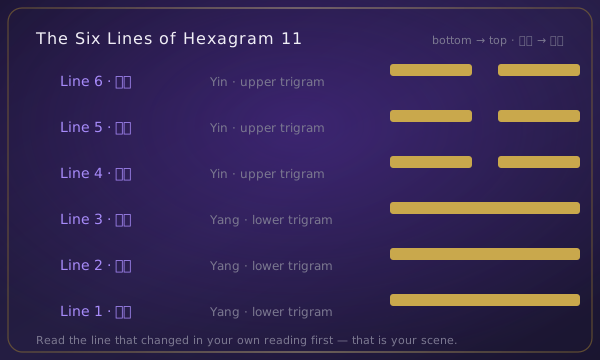
Each line of Hexagram 11 is one scene in the life of a favorable window — how it opens, how it holds, and how it ends.
Line 1 (初九) — Pull up the茅 grass, roots and all; advance with your cluster. The scene: a clump of grass whose roots interlock — pull one and the whole cluster comes. The modern reading: favorable conditions arrive through your network. Move with your people, not solo; the hexagram explicitly rewards collective advance (征吉) at this stage.
Line 2 (九二) — Embrace the wasteland, cross the river without bridging, forget no one, keep no favorites. The scene: a leader whose tolerance is wide enough to include useless ground and difficult crossings. The modern reading: the window holds because of inclusivity — the difficult people, the distant allies, the unpopular tasks all stay in scope. Favoritism (朋亡) is the named failure mode.
Line 3 (九三) — No flat ground without a slope, nothing goes that does not return. The scene: the horizon that is secretly already tilting. The modern reading: the hexagram's central warning, placed exactly in the middle of the good fortune. The favorable period contains its own decline; hold firm through it (艰贞无咎) and the hexagram promises you will not be blamed — and will eat well (于食有福).
Line 4 (六四) — Fluttering down, not rich, with your neighbors, trusted without warning. The scene: neighbors exchanging on trust rather than on contracts. The modern reading: the exchange works because it is light and mutual — no posturing, no wealth display, just neighborly flow. This is the most purely "peaceful" line in the hexagram.
Line 5 (六五) — Di Yi gives his daughter in marriage; blessing and supreme good fortune. The scene: the royal marriage alliance, two houses joined. The modern reading: the hexagram's signature line for unions — relationships, partnerships, mergers formed at the right moment with the right party. It is the line most readers hope to see for love questions.
Line 6 (上六) — The city wall collapses into the moat; do not mobilize the army. The scene: the fortress that falls inward. The modern reading: decline that begins at the peak, from inside. The hexagram's explicit advice: do not fight it with force (勿用师). Repair, report honestly from your own position (自邑告命), and accept that insisting on the old position at this stage brings regret.
When all six lines change: Hexagram 11 inverts into Hexagram 12 — peace fully completed becomes standstill. The window that stops moving turns into the blockage it was holding off.
How to Read Hexagram 11 with the Number Oracle
Hexagram 11 reaches you the same way every hexagram does: through three numbers that arise naturally while you hold your question — a clock, a receipt, a page number, a number that simply surfaces. The first number sets the upper trigram, the second the lower trigram, and the third identifies the changing line. Enter your three numbers and your question at numbers-oracle.com and you will get the hexagram plus an AI interpretation written for your situation — free, no registration. For the mechanics, read how three numbers become a hexagram →
Your lucky energy for Hexagram 11: Metal element (the body trigram, heaven below). Lucky colors are white, gold, and silver; the matching crystal is citrine, traditionally associated with abundance and clear, joyful energy.
Related hexagrams: Hexagram 12 (Standstill) — its inverted form and the warning inside the window; Hexagram 14 (Great Possession) — what a 泰 window can grow into when held well.
Hexagram 11: Common Questions
What does hexagram 11 meaning in one sentence?
Hexagram 11 means a favorable window where exchange flows both ways — giving and receiving move at the same time, and conditions favor connection, alliance, and forward motion.
Is hexagram 11 a yes or no?
Hexagram 11 is the clearest yes in the I Ching for questions about relationships, partnerships, and forward moves — with the built-in condition that the exchange stays two-way and that you use the window while it is open.
What should I do when I receive hexagram 11?
Check which line changed. Grass cluster (line 1) means move with your network; embrace the wasteland (line 2) means stay inclusive; no flat without slope (line 3) means build now because the window has an expiry; fluttering neighbors (line 4) means keep exchange light and mutual; royal marriage (line 5) means the union or alliance is blessed; collapsing wall (line 6) means repair the structure, do not force.
Why is hexagram 11 called "Peace"?
Because heaven's energy descends and earth's rises — the two elements communicate instead of isolating. Peace in this system is not stillness; it is the world's traffic flowing in both directions at once.
Peace is not the silence after the bridge is closed. It is the traffic crossing it.