I Ching Hexagram 12 (Standstill): Meaning in Love, Career and Life
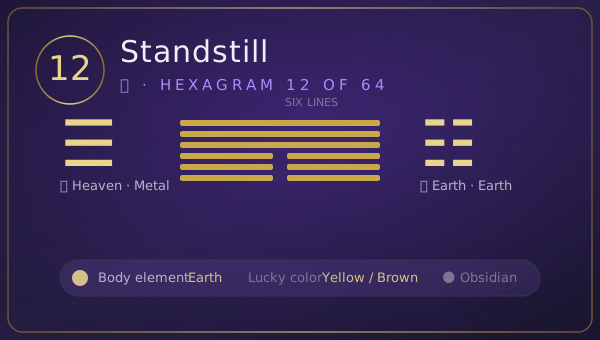
Hexagram 12 is the standstill hexagram of the I Ching: heaven above, earth below — the two elements separated, no longer crossing. Its classical judgment reads "unfavorable for the perseverance of the noble one; the great departs, the small arrives" (不利君子贞,大往小来), and its image is heaven and earth not communicating, which the text says means the noble one "frugal in virtue, avoids difficulty, and cannot be honored with salary." When Hexagram 12 appears in a reading, it marks a blocked period — not a permanent condition, but one that punishes force and rewards conservation.
The Story of Hexagram 12: The Year the Sky Forgot to Come Down
Heaven stays up. Earth stays down. Nothing crosses. In the old cosmology behind the I Ching, that single failure explains everything that goes wrong: no rain falls because vapor never rises, no crop grows because moisture never descends, and the same two elements that made Hexagram 11 prosperous become, in Hexagram 12, a drought. The text's image is exact — 天地不交, "heaven and earth do not communicate." The hexagram's own picture of the blockage is social as much as meteorological: in a standstill period, sycophants flourish (包承,小人吉) while people of substance wait. The hexagram's final line names the escape — 倾否, "overturn the standstill" — because the whole point of the drought is that it ends. Nothing that goes fails to return (无往不复), and that includes the sky.
What Is Hexagram 12?
- Name: 否 (Pi), traditionally rendered Standstill; also translated as Stagnation, Obstruction, or Not in Harmony
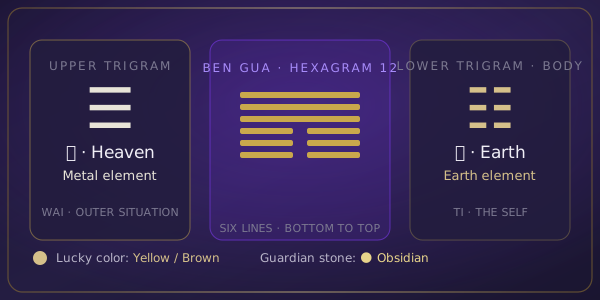
- Structure: Heaven over Earth — heaven above, earth below; the two elements separated rather than in exchange
- Position: 12 of 64, the inverted counterpart of Hexagram 11 (Peace), and the middle of the sequence's first great turn
- Element: Earth on the body trigram — the lower trigram (earth) belongs to Earth; heaven above belongs to Metal
- Body trigram: the lower trigram (earth), which in plum blossom divination represents the self
- Core images: blocked sky, drought, a closed channel, the honest person waiting out a corrupt period
The Core Meaning of Hexagram 12
The classical judgment of Hexagram 12 reads: 否:不利君子贞,大往小来 — "Unfavorable for the perseverance of the noble one; the great departs, the small arrives." That is the exact inversion of Hexagram 11's arithmetic: instead of the small leaving and the great arriving, the great leaves and the small arrives. Substance exits; petty things flourish.
Three things this hexagram is telling you, each standing on its own:
Blockage is a failure of exchange, not a failure of you. The image is heaven and earth not communicating. Nothing is wrong with the heaven, and nothing is wrong with the earth — the channel between them has closed. Hexagram 12 describes periods when good people, good products, and good efforts stall for structural reasons, and the hexagram's first duty is to say: this is the weather, not your worth.
The hexagram's advice is conservation, not confrontation. The image text is unusually specific: 君子以俭德辟难 — "the noble one uses frugality of virtue to avoid difficulty." This is not a call to fight the stagnation; it is a call to stop spending yourself on it. Do not seek honors during this period (不可荣以禄), do not force the channel open, and do not mistake your frustration for a strategy.
The turn is built into the hexagram. Lines four, five, and six describe the standstill ending: the mandate arrives (有命无咎), the standstill rests (休否), and finally the standstill is overturned (倾否,先否后喜 — "first blockage, then joy"). The hexagram's promise is not that the drought is pleasant; it is that the drought is a phase with a designed exit.
Waiting is a skill with a cost. The line about tying the mulberry root (其亡其亡,系于苞桑 — "may it not fall, may it not fall!") shows that holding on through blockage requires active vigilance, not passive hope. You do not wait out a 否 period by sleeping; you wait it out by staying anchored.
The question Hexagram 12 answers is not "when will this end?" It is: what am I conserving, what am I refusing to spend, and where is the turn already forming?
Hexagram 12 in Love and Relationships
If you are single: Hexagram 12 describes a period when connection is structurally blocked — the channels that normally bring people together are closed. The hexagram does not say "stay home and never go out"; it says do not spend your essence proving yourself to a closed door. The favorable move is inward: build the self (俭德), stay visible to your real circle, and let the period pass without letting it define you.
In an early or uncertain stage: If a budding connection has gone quiet or strange, Hexagram 12 names the pattern: exchange has stopped. One person's messages no longer land; effort no longer converts. The hexagram's advice against forcing is direct — pushing against a closed channel produces 包羞 (line 3, "bearing shame"), the humiliation of over-offering to something that cannot receive.
In a stable relationship: Hexagram 12 is the cold-house hexagram: two people in the same structure who have stopped crossing. Nothing may be "wrong" in the dramatic sense, and that is exactly the problem — heaven above, earth below, no traffic. The hexagram's remedy is reopening exchange at the level it closed, and its warning is that long blockage eventually produces the line-6 fight, which is never about what it appears to be about.
In a crisis: If you are in open conflict, Hexagram 12 says the fight is a symptom of blocked exchange, and winning the fight will not reopen the channel. The hexagram's own counsel for crisis periods is frugality of virtue — spend nothing on the conflict that you would need for the recovery. And note line 6: 倾否, the blockage gets overturned from inside when the structure finally moves.
Hexagram 12 in Career, Money and Decisions
Career: This is the hexagram of the blocked period — the promotion that stalls, the product that will not land, the environment where flattery outperforms substance. The hexagram's image text names the strategy precisely: frugality of virtue, avoid difficulty, do not seek honors. In practice that means: keep your skills sharp, keep your head down, keep your integrity cheap to maintain (do not need the salary you cannot get), and let the period exhaust itself. The hexagram is explicit that petty people thrive in standstill periods — that is weather, not evidence.
Money: Hexagram 12 is the most conservative hexagram in the sequence for money. 大往小来 — substance leaves, small things arrive. It favors defense: preserve capital, avoid new commitments, and treat any apparent opportunity during the blockage with the suspicion the hexagram's line 2 reserves for sycophants. The lines do describe a turn (lines 4-6), which is when the hoarded resources finally matter — the person who conserved during 否 is the one who can move when 倾否 arrives.
Decision: Hexagram 12 says do not decide while blocked. Every major decision made inside a standstill is made with distorted information — the channel that would tell you the truth is closed. The hexagram's advice is to postpone, conserve, and watch for the structural turn (line 5's 休否) rather than forcing an answer. If you must act, act small and reversible.
The Changing Lines of Hexagram 12: Six Scenes
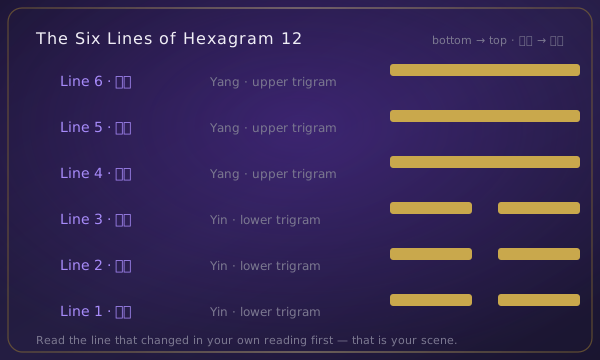
Each line of Hexagram 12 is one scene in the life of a blockage — how it holds, how it degrades, and how it ends.
Line 1 (初六) — Pull up the茅 grass, roots and all; hold with your cluster. The scene: the same interlocking grass clump from Hexagram 11, now a holding pattern. The modern reading: during blockage, your cluster is your asset. Stay connected to your real people, move together, and do not let the standstill scatter you. The line promises that correctness within the group keeps the path open (贞吉亨).
Line 2 (六二) — Bear and endure; the petty person flourishes, the great person stands blocked but keeps integrity. The scene: a period where flattery outperforms substance. The modern reading: the hexagram's most uncomfortable line, and its most honest. The great person is blocked (否) but complete (亨) — the blockage is external, the integrity is internal. Do not read the success of petty people as a signal about your own worth.
Line 3 (六三) — Bear the shame. The scene: over-offering to something that cannot receive, and eating the humiliation. The modern reading: the line that catches people who keep pushing against a closed channel — the messages that go unanswered, the proposals that keep getting "considered." The hexagram does not say stop trying for good; it says stop paying shame for a door that is not going to open.
Line 4 (九四) — When the mandate arrives, no blame; companions share the blessing. The scene: the first structural movement — authority or opportunity begins to flow again. The modern reading: the turn begins at line four, not line six. If you have conserved, this is where you re-enter: with the mandate, with your cluster, and without the resentment that blocked people often carry into better periods.
Line 5 (九五) — The standstill rests; the great person is fortunate. "May it not fall! May it not fall!" — tied to the mulberry root. The scene: holding the line at the moment it finally holds. The modern reading: the blockage ends, and the danger becomes complacency — the double warning (其亡其亡) says the recovery is fragile and must be actively anchored. Good fortune at this line belongs to the person who keeps tending the root, not the one who assumes the drought is finished for good.
Line 6 (上九) — Overturn the standstill; first blockage, then joy. The scene: the wall that was the blockage becoming the road out of it. The modern reading: the blockage ends by inversion, not by effort — the same structure that blocked exchange now carries it. The hexagram's promise, stated plainly: first the blockage, then the joy.
When all six lines change: Hexagram 12 inverts into Hexagram 11 — standstill fully exhausted becomes peace. The drought that has said everything it has to say turns back into the crossing.
How to Read Hexagram 12 with the Number Oracle
Hexagram 12 reaches you the same way every hexagram does: through three numbers that arise naturally while you hold your question. The first number sets the upper trigram, the second the lower trigram, and the third identifies the changing line. Enter your three numbers and your question at numbers-oracle.com and you will get the hexagram plus an AI interpretation written for your situation — free, no registration. For the mechanics, read how three numbers become a hexagram →
Your lucky energy for Hexagram 12: Earth element (the body trigram, earth below). Lucky colors are yellow, brown, and earth tones; the matching crystal is obsidian, traditionally associated with protection and grounding.
Related hexagrams: Hexagram 11 (Peace) — its inverted form, the window on the other side; Hexagram 23 (Splitting Apart) — the decline family this blockage belongs to.
Hexagram 12: Common Questions
What does hexagram 12 mean in one sentence?
Hexagram 12 means a blocked period where exchange has stopped — substance stalls and petty things flourish — and the correct response is conservation and integrity until the structure turns.
Is hexagram 12 a yes or no?
Most readers treat Hexagram 12 as a no for now: unfavorable for pushing forward, launching, or forcing outcomes. The hexagram's yes is conditional on the turn — lines four through six describe the blockage ending, and conserving until then is what makes the recovery usable.
What should I do when I receive hexagram 12?
Check which line changed. Grass cluster (line 1) means hold with your people; bear and endure (line 2) means integrity while blocked; bear the shame (line 3) means stop pushing the closed door; mandate arrives (line 4) means the turn is starting — re-enter with your cluster; standstill rests (line 5) means anchor the recovery, do not coast; overturn (line 6) means the blockage itself becomes the exit.
Why is hexagram 12 called "Standstill"?
Because heaven and earth have stopped communicating — the two elements that cross in Hexagram 11 are now isolated, one above and one below, and everything that depends on their exchange (growth, flow, connection) stalls with them.
The sky has not abandoned the field. It is a season with a designed exit — spend nothing on the drought you will need for the rain.