I Ching Hexagram 13 (Fellowship) in Love: What It Means for Your Relationship
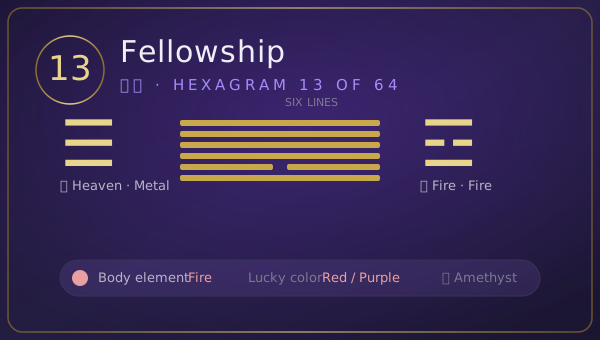
Hexagram 13 is the fellowship hexagram of the I Ching: fire rising under heaven, two flames moving in the same direction. Its classical judgment reads "fellowship with men in the open country; success; favorable to cross the great water; favorable for the noble one to persevere" (同人于野,亨。利涉大川,利君子贞), and its image — fire and heaven alike — says the noble one "groups by kind and distinguishes things" (类族辨物). When Hexagram 13 appears in a reading, it describes connection by likeness: people drawn together not by chance or convenience but by a shared direction, and the exact conditions under which such fellowship holds.
The Story of Hexagram 13: The Fire That Climbs
Watch a campfire. The flames do not spread across the ground — they climb, and they climb toward the same sky that stands above everything. That is the picture the old commentators found inside this hexagram: fire below, heaven above, and between them a single direction of movement. 同人 — men who are alike — is not a crowd. It is a shared vector.
The hexagram's judgment says where the fellowship must happen: 同人于野, in the open country, not behind a gate. Its first line is the household fellowship (同人于门) — no blame, but small. Its second line is the clan fellowship (同人于宗) — narrower still, and the hexagram names its cost: 吝. The teaching is geometric: every narrowing of the circle costs the hexagram something. Fellowship that stays inside the gate stays inside the gate.
The middle lines tell the harder story — the soldier ambushing in the thicket (伏戎于莽), the attacker mounting the wall and being unable to strike (乘其墉,弗克攻). Fellowship draws hostility as surely as it draws members, because every circle implies an outside. And the fifth line — first weeping, then laughing, the armies meeting at last (同人先号咷而后笑,大师克相遇) — is the hexagram's promise: the fellowship that survives its opposition arrives through reconciliation, not through victory.
The final line sends the fellowship to the suburbs (同人于郊) — the farthest honest reach of the circle, where 无悔, no regret, is the highest praise the Book offers at an ending.
What Is Hexagram 13?
- Name: 同人 (Tóng Rén), traditionally rendered Fellowship with Men; also translated as Concord, Gathering of the Like-Minded, or Companions
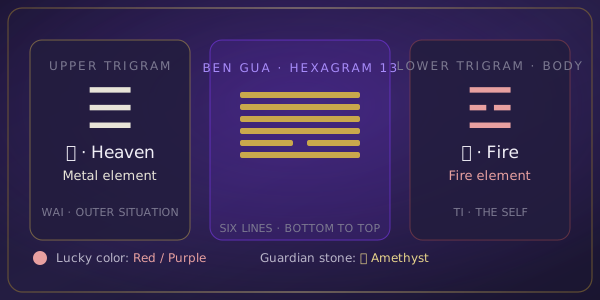
- Structure: Heaven over Fire — flame beneath the sky, both elements moving upward together
- Position: 13 of 64, the first hexagram of the sequence's second half; fellowship after alliance
- Element: Fire on the body trigram — the lower trigram (fire) belongs to Fire; heaven above belongs to Metal
- Body trigram: the lower trigram (fire, Fire), which in plum blossom divination represents the self
- Core images: fire climbing toward heaven, the open country, the ambush in the thicket, the armies that meet and laugh
The Core Meaning of Hexagram 13
The judgment of Hexagram 13 is a location and a direction. 同人于野 — fellowship in the open — means the circle must extend past the gate, past the clan, into the widest honest ground. Success and the crossing of the great water both belong to that wide fellowship, and the hexagram's one condition is 利君子贞: the noble one's perseverance, because fellowship without conduct is just a mob with good intentions.
Three things this hexagram is telling you, each standing on its own:
Likeness is the mechanism. Fire and heaven rise alike; that is the whole image. Fellowship is not built on obligation or proximity — it is built on shared direction. The hexagram's image says 类族辨物: group by kind, distinguish things. The honest work of fellowship is first knowing what you actually are, so that the people you gather are gathering around something real.
The circle must keep widening. Gate is blameless; clan is 吝; the open country is 亨. The hexagram grades its own locations, and the grade is exact: the wider the honest circle, the stronger the fellowship. Every retreat into the clan — into the familiar, the same, the safe — costs the hexagram something measurable.
Fellowship draws opposition; reconciliation is its completion. The ambush and the mounted wall are in the hexagram because every circle creates an outside. The fifth line is the resolution — the weeping that turns to laughing, the armies that meet and embrace. Fellowship that survives its opposition does not defeat it; it meets it, and the meeting is the good fortune.
The question Hexagram 13 answers is not "who likes me?" It is: are we alike in a real direction, and is the circle wide enough to hold what we are becoming?
Hexagram 13 in Love and Relationships
If you are single: Hexagram 13 is one of the Book's strongest signs for meeting someone genuinely alike — the shared-direction hexagram. Its counsel for the single: go to the open country (同人于野). Fellowship happens where your actual direction and other people's actual direction can meet — the practice, the field, the real community — not behind the gate of curated introductions. And the hexagram's condition applies to you first: know your kind (类族), so you recognize your people when the paths cross.
In an early or uncertain stage: Early love under Hexagram 13 is the recognition of shared direction — the conversation that keeps climbing. The hexagram's grading of locations is its counsel for early bonds: keep widening. The gate (line 1) is the safe introduction; the clan (line 2) is the narrowing that the hexagram quietly marks as 吝 — the relationship that only works in isolation, that never meets the open country, is the one this hexagram warns about.
In a stable relationship: A stable relationship drawing Hexagram 13 is a fellowship in maintenance — two people who chose each other because of a shared direction, still walking it. The hexagram's counsel for long bonds: protect the width. Couples who narrow to the clan — each other only, the world excluded — lose the open country the hexagram blesses. Keep the circle of the relationship wide enough that both people still meet the world.
In a crisis: If the relationship is at the ambush or the wall (lines 3 and 4), Hexagram 13 says the opposition was drawn by the fellowship itself — every circle has an outside, and sometimes the outside is inside the relationship. The fifth line is the hexagram's counsel for crisis: the weeping comes first, then the laughing, and the armies meet. Reconciliation is not the weaker ending; in this hexagram it is the only ending.
Hexagram 13 in Career, Money and Decisions
Career: This is the like-minded-team hexagram — the co-founders who actually share direction, the professional community, the alliance of purpose. Its career counsel is exact: hire and partner by kind (类族辨物), not by availability; and keep the circle in the open country, where the crossing (利涉大川) is possible. The ambush line is its warning: teams that draw opposition from a narrowed circle spend their strength on walls instead of water.
Money: Hexagram 13 governs shared ventures built on shared direction — the co-founded company, the partnership of purpose. Its financial counsel: the venture is only as strong as the likeness beneath it, and the circle must stay wide enough to cross (利涉大川). The hexagram's fifth line — armies meeting after weeping — is its promise for money in conflict: the reconciliation is worth more than the win.
Decision: Hexagram 13 says: gather the like, and gather wide. If you are deciding whether to join or form a fellowship — a team, a venture, a bond — the hexagram's test is direction, not warmth: are we alike in something real, and is the circle honest enough to extend past the gate? The decision it blesses is always made in the open country.
The Changing Lines of Hexagram 13: Six Scenes
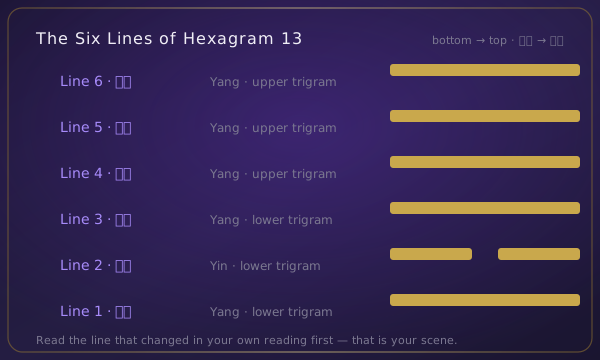
Each line of Hexagram 13 is one scene in the life of a fellowship — its gates, its clans, its ambushes, its walls, its reconciliation, and its suburbs.
Line 1 (初九) — Fellowship at the gate; no blame. The scene: the household circle, people gathered at the door. The modern reading: the opening line, honest but small. Fellowship begins at the gate — the family, the first friends — and the hexagram grants it no blame while quietly noting that the gate is not the open country.
Line 2 (六二) — Fellowship within the clan; regret. The scene: the circle narrowed to the family name. The modern reading: the hexagram's only regret line among its fellowships. Kinship is not likeness; the clan that mistakes itself for a fellowship pays the hexagram's named cost. The remedy is implicit: widen.
Line 3 (九三) — The soldier hides in the thicket, climbs the high mound; for three years he does not rise. The scene: the hostility that fellowship draws, crouched in the undergrowth. The modern reading: the opposition line. Every circle creates an outside, and the outside sometimes arms. The hexagram's counsel is not battle but patience — three years, and the ambush does not rise.
Line 4 (九四) — Mounts the wall but cannot strike; good fortune. The scene: the attacker who reaches the battlements and cannot bring himself to strike. The modern reading: the turning line. The opposition, at the moment of striking, fails — because the fellowship was never the enemy it imagined. Good fortune here belongs to the one who stops at the wall.
Line 5 (九五) — Fellowship: first weeping, then laughing; the great armies meet and overcome. The scene: the separation, the grief, and the reunion that erases both. The modern reading: the central line and the hexagram's signature. Fellowship that survives opposition arrives through meeting, not winning. The laughter after the weeping is the hexagram's promise in its purest form.
Line 6 (上九) — Fellowship in the suburbs; no regret. The scene: the circle extended to its farthest honest reach. The modern reading: the completion line. The suburbs are past the gate, past the clan — the fellowship has reached its widest real extent, and the hexagram grants its highest ending: 无悔, no regret.
When all six lines change: Hexagram 13 turns toward Hexagram 14 — fellowship held becomes great possession. The circle that crossed becomes the harvest.
How to Read Hexagram 13 with the Number Oracle
Hexagram 13 reaches you the same way every hexagram does: through three numbers that arise naturally while you hold your question — a clock, a receipt, a page number, a number that simply surfaces. The first number sets the upper trigram, the second the lower trigram, and the third identifies the changing line. Enter your three numbers and your question at numbers-oracle.com and you will get the hexagram plus an AI interpretation written for your situation — free, no registration. For the mechanics, read how three numbers become a hexagram →
Your lucky energy for Hexagram 13: Fire element (the body trigram, flame below). Lucky colors are red and warm purple; the matching crystal is amethyst, traditionally associated with clarity of mind and calm, open insight.
Related hexagrams: Hexagram 8 (Holding Together) — alliance by choice, fellowship by likeness; Hexagram 14 (Great Possession) — what the circle that crossed becomes; Hexagram 38 (Opposition) — the hexagram's shadow, when fellowship turns to estrangement.
Hexagram 13: Common Questions
What does hexagram 13 mean in one sentence?
Hexagram 13 means fellowship by shared direction — success belongs to the circle of like-minded people that extends past the clan into the open country, and that survives its opposition through meeting rather than winning.
Is hexagram 13 good for love?
Hexagram 13 is one of the Book's favorable signs for connection by likeness. Its one warning is width: the gate is blameless but small, and the clan is named as 吝. A relationship that works only in isolation is the case this hexagram quietly warns about — keep the circle wide enough that both people still meet the world.
What should I do when I receive hexagram 13?
Check which line changed. Fellowship at the gate (line 1) means start honest and small; the clan (line 2) means widen the circle; the ambush (line 3) means let the opposition wait; the wall (line 4) means stop at the battlements; weeping then laughing (line 5) means reconciliation is the victory; the suburbs (line 6) means extend to your farthest honest reach.
Why is hexagram 13 called "Fellowship"?
Because its image is fire beneath heaven — flame and sky rising in the same direction. The old translators called it Fellowship with Men because the hexagram's subject is the circle held by likeness rather than by blood or convenience, and its lines read like the life story of every real community.
Fire does not ask the sky for permission to climb.