I Ching Hexagram 15 (Modesty): Meaning in Love, Career and Life
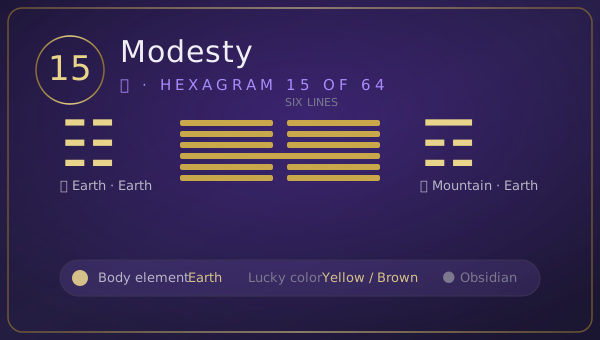
Hexagram 15 is the modesty hexagram of the I Ching: a mountain hidden inside the earth — the largest thing on the landscape, showing nothing of itself. Its classical judgment reads "success; the noble one has completion" (亨,君子有终), and its image — earth enclosing mountain — says the noble one "diminishes the excessive and adds to the deficient, weighing things to distribute fairly" (裒多益寡,称物平施). When Hexagram 15 appears in a reading, it describes the rarest configuration in the whole Book: a hexagram whose every line is favorable, because the virtue it names is the one that never becomes its own opposite.
The Story of Hexagram 15: The Mountain Inside the Earth
Stand on a plain and you will see mountains. Stand inside this hexagram and you will not. The mountain is there — the hexagram's image is explicit: 地中有山, mountain within earth — but it is enclosed, showing nothing, claiming nothing. The old commentators found the whole teaching in the picture: the mountain does not become smaller by being hidden. It becomes safer. What is inside the earth cannot be eroded, cannot be climbed, cannot be competed with.
The records of the Zhou court preserve the historical shape of this virtue in the story of the Duke of Zhou. After his brother King Wu's death, the duke refused the throne, ruled as regent for the young King Cheng, and governed with a thoroughness that later historians still cite. The account says that when he was receiving guests, he would stop a meal three times to rise and meet them — "one bath, three times grasping his wet hair; one meal, three times spitting out his food" — reportedly explaining that he could not afford to keep worthy men waiting even by the length of a bath. (《史记·鲁周公世家》) The most powerful man in the realm, interrupting his own dinner to answer a knock.
That is the hexagram's mountain-inside-the-earth in a life: power that hides, not from weakness, and not from strategy, but because the hiding is what the power is for. 谦 is not self-erasure. It is the mountain, still fully mountain, enclosed.
What Is Hexagram 15?
- Name: 谦 (Qiān), traditionally rendered Modesty; also translated as Humility, The Selfless Heart, or Making Small
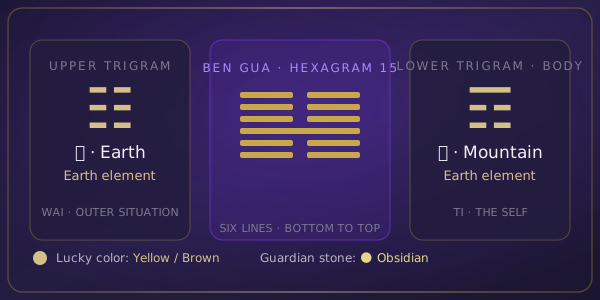
- Structure: Earth over Mountain — the mountain enclosed within the earth, the summit below ground level
- Position: 15 of 64, the hexagram after Great Possession; what the zenith casts
- Element: Earth on the body trigram — the lower trigram (mountain) belongs to Earth; earth above also belongs to Earth
- Body trigram: the lower trigram (mountain, Earth), which in plum blossom divination represents the self
- Core images: the mountain within the earth, the dimmed scale, the merit that announces itself, the labor that does not claim
The Core Meaning of Hexagram 15
The judgment of Hexagram 15 is famously spare: 亨,君子有终 — success, and the noble one has completion. Every other hexagram in the Book carries warnings somewhere in its six lines; the traditional reading holds that Modesty is the one hexagram where no line turns bad. The reason is structural: modesty is the virtue that does not generate its own opposite. Excess breeds its end; pride invites its fall; even abundance must guard against swelling. Modesty has no failure mode, because the person who makes themselves small has nothing left to be knocked down from.
Three things this hexagram is telling you, each standing on its own:
The mountain inside the earth is still a mountain. Modesty is not diminishment. The hexagram's image is not a hill — it is the largest landform, fully present, simply enclosed. The counsel is not to become less; it is to hold what you are without the display. What is hidden cannot be taken, cannot be envied, cannot be toppled.
Modesty redistributes. The image says 裒多益寡,称物平施 — take from the excess, add to the deficit, weigh and distribute fairly. Modesty is not only an inner posture; it is an economic act. The person who holds their advantages enclosed is the person who can level the scales around them. This is why the hexagram follows Great Possession: abundance kept un-swelled becomes abundance redistributed.
Merit announces itself; modesty does not. The second and final lines both use the word 鸣 — the sound that carries. Modesty in this hexagram is not silence; it is the right relationship to being heard. Line 3 is the deeper teaching: 劳谦 — laboring modesty, the merit earned by work and not claimed by the performance of work. The hexagram's whole arc moves from the humble posture (line 1) to the honored labor (line 3) to the redistribution (line 5) to the sound that carries on its own (line 6).
The question Hexagram 15 answers is not "am I good enough?" It is: is my mountain enclosed — and is the excess I hold being weighed and redistributed?
Hexagram 15 in Love and Relationships
If you are single: Hexagram 15 describes attractiveness of the rarest kind — the person who is substantial and does not display it. The hexagram's counsel for the single season: enclose the mountain. What draws people to the modest is not smallness but the sense of depth withheld; the person who performs availability performs scarcity of self. Let your substance be inferred rather than advertised.
In an early or uncertain stage: Early love under Hexagram 15 is two people choosing not to perform. The hexagram's lines map the early bond precisely: modesty that carries across the great water (line 1 — the crossing is available to the one who does not insist), modesty that announces itself correctly (line 2 — letting yourself be seen without manufacturing the seeing), and the labor of care (line 3) over the display of care.
In a stable relationship: A stable relationship drawing Hexagram 15 is the long bond held by two enclosed mountains. The hexagram's counsel for the long term: 称物平施 — weigh and distribute fairly. The daily arithmetic of a household (tasks, credit, space, effort) is the hexagram's domain: take from the excess, add to the deficit. And its deepest promise is in the judgment itself: 君子有终 — the one who completes. This is the hexagram of relationships that last, because neither person keeps score publicly.
In a crisis: If the relationship is in crisis, Hexagram 15 says the failure is almost never modesty — it is its opposite that has been performing. The hexagram's counsel for crisis: stop announcing. Line 2's 鸣谦 is the sound that carries on its own; the crisis is usually the moment when someone has been insisting on being heard. Return the mountain to the earth, and the redistribution begins.
Hexagram 15 in Career, Money and Decisions
Career: This is the professional-virtue hexagram — the person whose work is substantial and whose presence is quiet. Its career counsel is exact: labor, do not perform the labor (劳谦); let the merit carry (鸣谦) rather than announcing it; and weigh the distribution of credit (称物平施) actively. The hexagram's judgment — 君子有终 — is the Book's promise about how careers actually end: the substantial, enclosed ones complete; the displayed ones are eroded.
Money: Hexagram 15 governs wealth held without display — the hexagram that follows Great Possession is teaching what to do with possession once the swelling is refused. Its financial counsel: redistribute (裒多益寡), weigh fairly (称物平施), and let the wealth be enclosed rather than exhibited. The final line's image — using modesty to move the army, to campaign against the邑国 — is the hexagram's permission slip: resources held quietly are resources available for real campaigns.
Decision: Hexagram 15 says: enclose the mountain. If you are deciding how to hold what you have — position, credit, advantage, substance — the hexagram's answer is its image: keep it below ground level. Not as self-erasure, but as protection and as the condition for fair distribution. The decision it blesses is always the one that weighs and levels.
The Changing Lines of Hexagram 15: Six Scenes
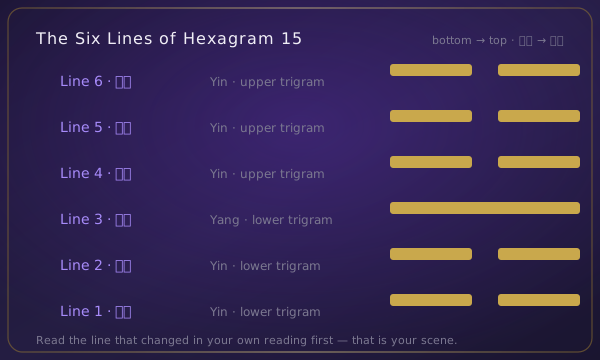
Each line of Hexagram 15 is one scene in the life of the enclosed mountain — its crossing, its sound, its labor, its redistribution, its campaigns, and its carrying voice.
Line 1 (初六) — Modesty upon modesty; the noble one uses it to cross the great water; good fortune. The scene: the doubled humility, the mountain twice enclosed. The modern reading: the foundation line and the hexagram's paradox — the deepest lowering is what makes the crossing possible (用涉大川). What you do not insist on, you can carry.
Line 2 (六二) — Modesty that announces itself; perseverance is favorable. The scene: the sound that carries without being forced. The modern reading: the visibility line. Modesty is not invisibility — it is the right relationship to being seen. Let the merit be heard; do not manufacture the hearing. Perseverance (贞吉) is the condition.
Line 3 (九三) — Laboring modesty; the noble one has completion; good fortune. The scene: the merit earned by work and not claimed by performance. The modern reading: the central line and the hexagram's keystone. 劳谦 is the distinction between substance and display — the work that is done and does not announce itself. This is the line the whole hexagram is built to reach, and its promise is 君子有终, completion.
Line 4 (六四) — Nothing is unfavorable; manifesting modesty. The scene: the posture made visible without being made loud. The modern reading: the expression line. Modesty that can be shown — in conduct, in manners, in the small courtesies — without becoming performance. The hexagram grants this line 无不利: the everyday practice of not insisting.
Line 5 (六五) — Not rich, using his neighbors; favorable to campaign with force; nothing unfavorable. The scene: the one who holds wealth enclosed and uses it outward. The modern reading: the redistribution line. The mountain's contents are weighed and distributed (称物平施), and the hexagram grants the enclosed resources their purpose: 利用侵伐 — the campaign. What modesty holds, it holds available.
Line 6 (上六) — Modesty that announces itself; favorable to campaign against the city and state. The scene: the sound that carries at full scale. The modern reading: the completion line. Modesty that has become influence — the voice that is heard because the mountain behind it is real. The hexagram's final permission: 利用行师,征邑国 — the quiet substance is now the authority.
When all six lines change: Hexagram 15 turns toward Hexagram 16 — modesty completed becomes enthusiasm. The enclosed mountain, fully itself, becomes thunder.
How to Read Hexagram 15 with the Number Oracle
Hexagram 15 reaches you the same way every hexagram does: through three numbers that arise naturally while you hold your question — a clock, a receipt, a page number, a number that simply surfaces. The first number sets the upper trigram, the second the lower trigram, and the third identifies the changing line. Enter your three numbers and your question at numbers-oracle.com and you will get the hexagram plus an AI interpretation written for your situation — free, no registration. For the mechanics, read how three numbers become a hexagram →
Your lucky energy for Hexagram 15: Earth element (the body trigram, the mountain below). Lucky colors are yellow and earth brown; the matching crystal is obsidian, traditionally associated with protection, grounding, and shielding from stress.
Related hexagrams: Hexagram 14 (Great Possession) — the abundance that refuses to swell; Hexagram 10 (Treading) — the plain shoe, modesty's cousin; Hexagram 42 (Increase) — the redistribution made active.
Hexagram 15: Common Questions
What does hexagram 15 mean in one sentence?
Hexagram 15 means modesty as power enclosed — the mountain inside the earth, fully itself and showing nothing, with the traditional reading that this is the one hexagram in which no line turns unfavorable.
Is hexagram 15 always a good sign?
In the traditional reading, yes — Hexagram 15 is the one hexagram whose lines all read favorably, because modesty does not generate its own opposite the way excess does. Its judgment is 亨,君子有终: success, and completion for the one who does not insist.
What should I do when I receive hexagram 15?
Check which line changed. Modesty upon modesty (line 1) means the lowering is what carries you across; announcing modesty (line 2) means let the merit be heard, do not force the hearing; laboring modesty (line 3) means work without performing the work; manifesting modesty (line 4) means practice not insisting; redistribution (line 5) means weigh and distribute what you hold; the carrying voice (line 6) means the quiet substance has become authority.
Why is hexagram 15 called "Modesty"?
Because its image is the mountain inside the earth — 地中有山. The old translators rendered it Modesty or Making Small because the hexagram's subject is greatness held without display: not self-erasure, but the enclosure that keeps substance safe and available for fair distribution.
The mountain inside the earth has never once been climbed.