I Ching Hexagram 16 (Enthusiasm): Meaning in Love, Career and Life
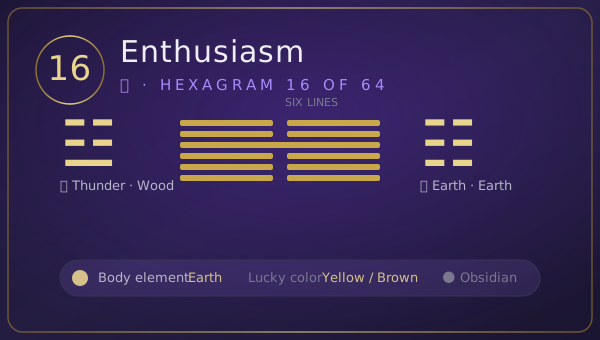
Hexagram 16 is the enthusiasm hexagram of the I Ching: thunder breaking out of the earth, movement that mobilizes everything around it. Its classical judgment reads "favorable to appoint lords and to set the host in motion" (利建侯行师), and its image — thunder surging up out of the ground — says the early kings "made music to honor virtue, presented it grandly to the High Lord, and paired it with their ancestors" (作乐崇德,殷荐之上帝,以配祖考). When Hexagram 16 appears in a reading, it describes momentum: the moment when a movement has found its rhythm — and the hexagram's six lines are a manual on who rides it correctly and who is ridden by it.
The Story of Hexagram 16: The Thunder Under the Field
The scene is a field that looks empty. Then the ground moves. Thunder does not fall from above in this hexagram — it breaks upward, out of the earth, and everything on the field is suddenly in motion.
The old commentators noticed what the early kings did with that image: they made music. 作乐崇德 — music to honor virtue, offered at the highest altar. The connection is exact. Enthusiasm in this hexagram is not private excitement; it is collective rhythm. A drum is not a sound — it is a tempo that many bodies agree to move in. That is what 豫 names: the moment when a group discovers it can move as one.
The hexagram's lines are the story of what happens to people inside that rhythm. The first line is the one who announces his own enthusiasm (鸣豫) — the hexagram answers with a single word: 凶. The second line is the one who stands firm as stone and does not wait for the day to end (介于石,不终日) — the one whose resolve is faster than the momentum. The third line is the one who stares up at the rhythm and regrets, then regrets the delay of the regret (盱豫,悔,迟有悔). The fourth line is the source of the enthusiasm itself — 由豫, the one the rhythm comes from, gathering friends like hair in a clasp (朋盍簪). The fifth line is the hexagram's honest center: 贞疾,恒不死 — a persistent illness that does not kill. And the final line is the darkness of enthusiasm (冥豫), the momentum that has become oblivious — with the hexagram's one exit attached: if it changes (成有渝), no blame.
Momentum is a drum. The hexagram's whole teaching is about who is playing it.
What Is Hexagram 16?
- Name: 豫 (Yù), traditionally rendered Enthusiasm; also translated as Providing For, Harmonizing with the Movement, or Readiness
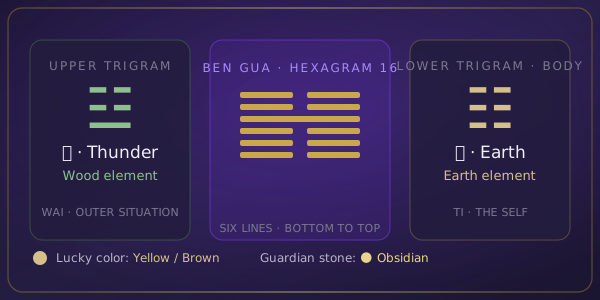
- Structure: Thunder over Earth — the quake rising from below, everything on the field set in motion
- Position: 16 of 64, the hexagram after Modesty; what the enclosed mountain becomes
- Element: Earth on the body trigram — the lower trigram (earth) belongs to Earth; thunder above belongs to Wood
- Body trigram: the lower trigram (earth, Earth), which in plum blossom divination represents the self
- Core images: thunder out of the earth, the drum and the music, the stone-firm resolve, the hair clasp of friends, the persistent illness
The Core Meaning of Hexagram 16
The judgment of Hexagram 16 is a mobilization order: 利建侯行师 — appoint the lords, set the host in motion. Enthusiasm in this hexagram is not a feeling; it is a capacity for collective movement, and the Book treats it as a strategic asset. The image tells you how it is properly used: the early kings took the energy of the thunder and gave it form — music, offered at the highest altar, paired with the ancestors. Momentum needs a ritual, or it disperses.
Three things this hexagram is telling you, each standing on its own:
Enthusiasm is collective or it is noise. The image is a field, not a person. The drum only works because many bodies agree on the tempo. The hexagram's favor (利建侯行师) belongs to movements — teams, causes, campaigns — not to private highs. The question it asks of your excitement is: can others move to this rhythm?
The rhythm has a source, and it should be a person. The fourth line is the hexagram's center of gravity: 由豫 — the enthusiasm comes from here. The source of a movement's momentum is the one who gathers people like hair in a clasp (朋盍簪), holding them in a single form. If you are drawing Hexagram 16 while leading, the hexagram is asking whether you are the source or the passenger.
Momentum blind is momentum lost. The final line names the failure: 冥豫 — dark enthusiasm, the movement that has stopped seeing. The hexagram's exit is attached in the same breath: 成有渝,无咎 — if it changes, no blame. Enthusiasm without sight is the one configuration the hexagram cannot bless, and even there, it leaves the door open.
The question Hexagram 16 answers is not "am I excited?" It is: is this rhythm collective, sourced, and still seeing — and am I playing the drum or being played by it?
Hexagram 16 in Love and Relationships
If you are single: Hexagram 16 describes the season when your life has rhythm — and the hexagram's counsel for that season is to make the rhythm shareable. The music image is the love image: what draws people is not intensity but a tempo others can move to. The first line is the single-season warning: announcing your own enthusiasm (鸣豫) is the hexagram's one unqualified 凶. Let the field feel the thunder; do not narrate it.
In an early or uncertain stage: Early love under Hexagram 16 is two rhythms finding a shared tempo. The hexagram's lines are a precise early-relationship manual: the stone-firm resolve of line 2 (介于石 — knowing your position before the day is out), the upward stare of line 3 (盱豫 — watching the other person's excitement instead of your own ground), and the source line of line 4 (由豫 — the one the shared rhythm actually comes from, gathering friends into the bond).
In a stable relationship: A stable relationship drawing Hexagram 16 is a partnership in shared motion — the life the two of you have built a tempo for. The hexagram's counsel for the long term is its image: keep the ritual. 作乐崇德 — the music, the meals, the anniversaries, the small ceremonies — are not decoration; they are how collective rhythm is maintained. And its fifth line is the hexagram's honest warning about long bonds: 贞疾,恒不死 — the persistent ailment that does not kill. Some relationships carry a chronic condition; the hexagram says chronic is survivable, hidden is not.
In a crisis: If the relationship is at the final line — dark enthusiasm, the momentum that has stopped seeing — Hexagram 16 leaves the door open: 成有渝,无咎. If it changes, no blame. The blindness of momentum is the crisis; the exit is the recovery of sight. Stop moving together long enough to look at where the rhythm has been carrying you.
Hexagram 16 in Career, Money and Decisions
Career: This is the momentum hexagram of professional life — the team on a streak, the movement with wind behind it, the launch that has found its rhythm. Its career counsel is the judgment itself: appoint the lords and set the host in motion (利建侯行师). Momentum is a mobilization asset, and the hexagram rewards the leader who converts it into structure — people, roles, a shared tempo. The first line is the career warning: the person who performs enthusiasm instead of sourcing it is marked 凶.
Money: Hexagram 16 governs the momentum of money — the market with wind behind it, the venture in its expansion, the cycle that is moving. Its financial counsel: ride the rhythm but keep the source. Line 4's image — the one the enthusiasm comes from, friends gathered in a clasp — is the hexagram's financial network: capital moves with the source, not with the noise. And the final line's warning applies to bull seasons directly: momentum that has stopped seeing (冥豫) is how good cycles become losses.
Decision: Hexagram 16 says: move, together, with sight. If you are deciding whether to act on momentum, the hexagram's test is threefold: is the rhythm collective (can others move to it), is it sourced (do I know where it comes from), and is it seeing (can I still describe where it is carrying us)? All three yes is 利建侯行师. Any one no is the hexagram's named failure mode.
The Changing Lines of Hexagram 16: Six Scenes
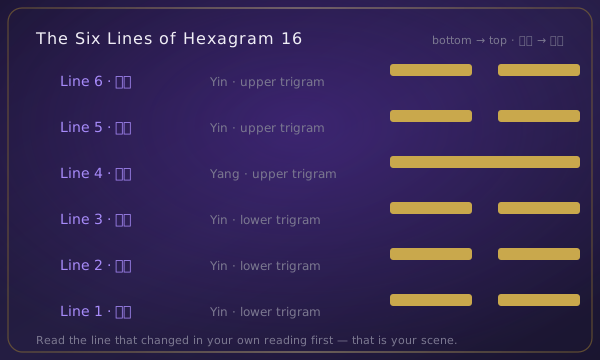
Each line of Hexagram 16 is one scene in the life of a momentum — its announcement, its firmness, its upward stare, its source, its chronic condition, and its blindness.
Line 1 (初六) — Announcing enthusiasm; misfortune. The scene: the one who narrates the rhythm instead of moving in it. The modern reading: the hexagram's only unqualified harsh verdict. Enthusiasm performed is enthusiasm spent — the announcement consumes the momentum it claims to ride. The field feels the thunder; the mouth describing the thunder is the failure.
Line 2 (六二) — Firm as stone; not waiting for the day to end; perseverance is favorable. The scene: the resolve that is already complete before the situation resolves. The modern reading: the position line. Inside a moving rhythm, the one who has already decided is the one who is not carried. 介于石 — stone between the self and the momentum. Not stubbornness; pre-commitment.
Line 3 (六三) — Staring upward at the enthusiasm; regret. Delay in the regret is regret. The scene: the one watching other people's momentum instead of holding their own ground. The modern reading: the warning line. Looking up at the drum divides the field in two — those who play and those who watch. The hexagram's edge is sharp: even the regret must be timely. Late regret is its own category of loss.
Line 4 (九四) — The source of the enthusiasm; great attainment; do not doubt; friends gather like hair in a clasp. The scene: the one the rhythm comes from, and the circle that clasps around them. The modern reading: the central line and the hexagram's blessing. The source of a movement gathers its people naturally (朋盍簪) and attains greatly (大有得). The condition: 勿疑 — do not doubt. Sources that second-guess their own rhythm disperse it.
Line 5 (六五) — Persistent illness; it does not kill. The scene: the chronic condition carried at the center of the movement. The modern reading: the hexagram's honest center. 贞疾,恒不死 — some situations carry an ailment that persists and does not kill. The hexagram neither denies it nor dramatizes it. Chronic, named, and survivable is the configuration it describes.
Line 6 (上六) — Dark enthusiasm; if it changes, no blame. The scene: the momentum that has stopped seeing, moving at full speed in the dark. The modern reading: the failure line and its exit. Blind rhythm is the one configuration the hexagram cannot bless — and even here it attaches the condition: 成有渝,无咎. If it changes, no blame. The door is open at the end of the hexagram.
When all six lines change: Hexagram 16 turns toward Hexagram 17 — enthusiasm completed becomes following. The thunder that has mobilized becomes the movement that adapts.
How to Read Hexagram 16 with the Number Oracle
Hexagram 16 reaches you the same way every hexagram does: through three numbers that arise naturally while you hold your question — a clock, a receipt, a page number, a number that simply surfaces. The first number sets the upper trigram, the second the lower trigram, and the third identifies the changing line. Enter your three numbers and your question at numbers-oracle.com and you will get the hexagram plus an AI interpretation written for your situation — free, no registration. For the mechanics, read how three numbers become a hexagram →
Your lucky energy for Hexagram 16: Earth element (the body trigram, the field below). Lucky colors are yellow and earth brown; the matching crystal is obsidian, traditionally associated with protection, grounding, and shielding from stress.
Related hexagrams: Hexagram 15 (Modesty) — the enclosed mountain before the thunder; Hexagram 17 (Following) — the movement that adapts to the rhythm; Hexagram 40 (Deliverance) — the release the momentum is building toward.
Hexagram 16: Common Questions
What does hexagram 16 mean in one sentence?
Hexagram 16 means enthusiasm as collective momentum — favorable when it is a rhythm many can move to, sourced in a real person, and still seeing; unfavorable when it is announced, watched, or gone dark.
Is hexagram 16 good or bad?
Hexagram 16 is favorable in its judgment (利建侯行师 — it blesses mobilization) but carries the sharpest single-line verdict in its sequence: line 1's announced enthusiasm is marked 凶, and line 6's dark enthusiasm is momentum without sight. The hexagram judges not the energy but the blindness.
What should I do when I receive hexagram 16?
Check which line changed. Announcing enthusiasm (line 1) means stop narrating and start moving; firm as stone (line 2) means decide before the day ends; staring upward (line 3) means stop watching the drum and hold your ground; the source (line 4) means do not doubt the rhythm you carry; persistent illness (line 5) means name the chronic condition and carry it; dark enthusiasm (line 6) means recover sight — the exit is still open.
Why is hexagram 16 called "Enthusiasm"?
Because its image is thunder breaking out of the earth — 雷出地奋 — the field suddenly in motion. The old translators rendered it Enthusiasm or Providing For because the hexagram's subject is collective rhythm: the drum, the music, the movement that many bodies agree to, and the discipline of staying sighted inside it.
The drum is not loud because it is struck hard. It is loud because the field agreed on the tempo.