I Ching Hexagram 17 (Following): Meaning in Love, Career and Life
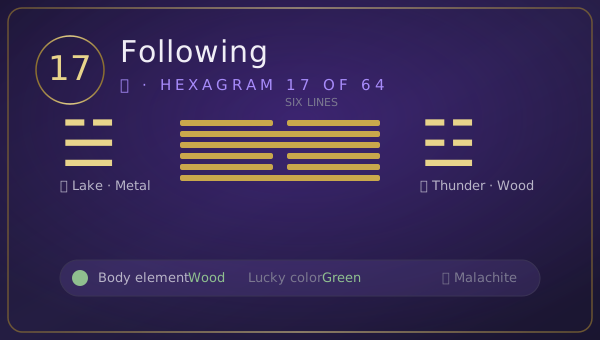
Hexagram 17 is the following hexagram of the I Ching: thunder resting inside the lake, movement held inside stillness. Its classical judgment reads "supreme success; favorable perseverance; no blame" (元亨利贞,无咎), and its image — thunder within the marsh — says the noble one "turns toward dusk and enters into rest" (向晦入宴息). When Hexagram 17 appears in a reading, it describes adaptation: the art of moving with what is moving, of following what deserves to be followed, and of resting at the right hour without being forced.
The Story of Hexagram 17: Thunder in the Lake
The picture is a lake at dusk. Beneath its surface, thunder is still sounding — movement held inside rest. The old commentators read the hexagram from that exact geometry: 随 is not passivity. It is the configuration in which movement is contained by stillness, and stillness gives movement its direction.
The judgment is unusually full — 元亨利贞, all four virtues at once — and the hexagram earns them by solving the problem most people get wrong about following. Its lines draw the map of the error with precision. The second line is the child-tether: 系小子,失丈夫 — hold on to the young thing and you lose the mature one. The third line is the reverse: 系丈夫,失小子 — hold the mature and lose the young, but with something gained in the exchange (随有求得). The error is never following; the error is tethering to the wrong object and calling it loyalty.
The fourth line is the hexagram's caution at the top: following brings attainment, and attainment at this position is dangerous (贞凶) — unless it is held with sincerity in the way and clarity about it (有孚在道,以明何咎). The fifth line is the hexagram's center: 孚于嘉 — sincerity in what is excellent. And the final line is the strangest image in the sequence: the one who is bound and held, who is then followed and secured (拘系之,乃从维之), and the king uses him in offering at the western mountain — the follower so fully trusted that the binding itself becomes the ordination.
Following, in this hexagram, is a discipline with a dusk hour. 向晦入宴息 — the noble one knows when the light is going and goes to rest. Even the follower has a schedule.
What Is Hexagram 17?
- Name: 随 (Suí), traditionally rendered Following; also translated as Adapting, Pursuit, or Accord with What Moves
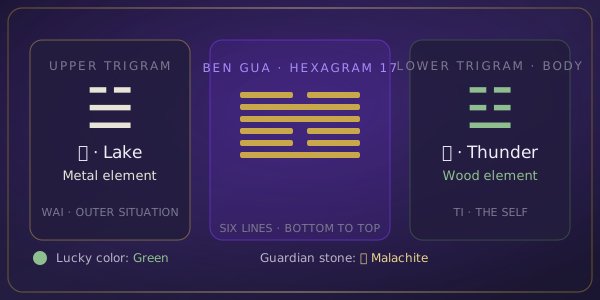
- Structure: Lake over Thunder — the quake held within the marsh, movement inside rest
- Position: 17 of 64, the hexagram after Enthusiasm; what the mobilized movement becomes
- Element: Wood on the body trigram — the lower trigram (thunder) belongs to Wood; the lake above belongs to Metal
- Body trigram: the lower trigram (thunder, Wood), which in plum blossom divination represents the self
- Core images: thunder in the lake, the dusk hour, the child tether and the mature tether, the bound follower at the western mountain
The Core Meaning of Hexagram 17
The judgment grants Hexagram 17 the full sequence of virtues — 元亨利贞 — and no blame. Following done correctly is not a diminished position; it is one of the Book's complete configurations. What makes it correct is the hexagram's own geometry: movement held inside stillness. The thunder sounds, but the lake contains it. Adaptation is not drift — it is containment with direction.
Three things this hexagram is telling you, each standing on its own:
Every following is a choice of object. The hexagram's central problem is not whether to follow but what to follow, and its second and third lines make the cost explicit. 系小子,失丈夫: tether to the small and you lose the substantial. The choice of what to attach to is the whole decision, and it is made — usually invisibly — long before anyone calls it loyalty.
Rest is part of following. The image's instruction is 向晦入宴息: turn toward dusk and enter rest. The follower who does not rest is the follower who breaks. This is the hexagram's quiet radicalism — adaptation includes knowing when the light is going, and going to rest without guilt or negotiation.
Attainment inside following is the danger zone. The fourth line is the hexagram's warning: following that brings attainment is dangerous (贞凶) unless it is held with sincerity in the way (有孚在道) and clarity about the position. Success in a subordinate position is the exact configuration where people lose their footing — the attainment starts to feel like the source.
The question Hexagram 17 answers is not "should I follow?" It is: what am I tethered to, is it excellent — and do I know the hour when the follower rests?
Hexagram 17 in Love and Relationships
If you are single: Hexagram 17 describes the season of adapting — letting connection move at its own tempo instead of forcing yours. The hexagram's counsel for the single season: follow what is excellent (line 5's 孚于嘉). The tethers of lines 2 and 3 are the dating errors: holding on to the exciting-but-small and losing the substantial, or holding the substantial while resenting the loss of the exciting. The hexagram asks which tether is actually yours.
In an early or uncertain stage: Early love under Hexagram 17 is two tempos finding their shared hour. The hexagram's lines map it exactly: the child tether (line 2) is the early bond held by novelty; the mature tether (line 3) is the bond held by substance, and the hexagram says something is gained in that exchange (随有求得). Early relationships reveal their nature by what they tether to.
In a stable relationship: A stable relationship drawing Hexagram 17 is the long adaptation — two people who have learned to move with each other rather than against. The hexagram's counsel for the long bond is its image: 向晦入宴息. Long bonds need the dusk hour — the rhythm of rest, the agreement about when the day's motion ends. And its fourth line is the long-bond warning: the partner who attains (the success, the recognition) must hold it with sincerity in the way, or the attainment becomes the rift.
In a crisis: If the relationship is at the final line — the binding, the securing — Hexagram 17's strange image is its counsel for crisis: 拘系之,乃从维之. Sometimes the bond that survives is the bond that is explicitly re-secured — the recommitment, the stated terms, the follower who is bound and finds the binding to be trust rather than prison. The king's offering at the western mountain is the hexagram's promise: what is re-secured is what gets used.
Hexagram 17 in Career, Money and Decisions
Career: This is the following hexagram of professional life — the deputy, the second chair, the team member inside a movement larger than themselves. Its career counsel is precise: choose the object of your following deliberately (the child-tether error is the career error of a lifetime), hold any attainment with sincerity in the way (line 4), and keep your dusk hour (向晦入宴息) — the professional who never rests is not more loyal, only more breakable.
Money: Hexagram 17 governs money that moves with a source — the investment that follows a cycle, the salary that follows a structure, the partner who follows a lead. Its financial counsel is its lines: follow what is excellent (line 5), not what is merely loud (line 2's child); and treat attainment inside following as the danger line (line 4) — the windfall inside a subordinate position is where people lose their footing. The final line's bound-and-secured follower is the hexagram's image for money under explicit terms: what is formally secured is what can be used.
Decision: Hexagram 17 says: follow — and choose carefully what. If you are deciding whether to attach yourself to a person, a company, a movement, a cycle, the hexagram's test is line 5's word: 嘉, excellence. Follow what is excellent, hold the attainment honestly, keep the dusk hour. The decision it blesses is always the tether to the substantial, never to the merely loud.
The Changing Lines of Hexagram 17: Six Scenes
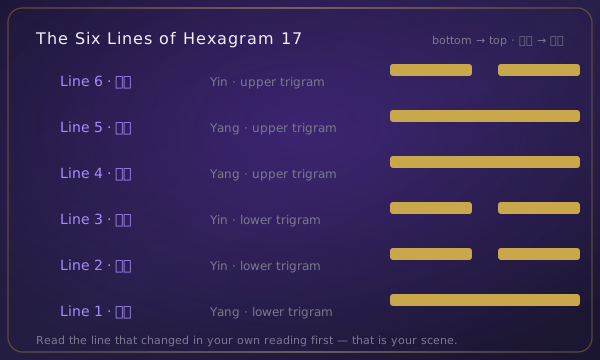
Each line of Hexagram 17 is one scene in the life of following — its tethers, its exchanges, its attainment, its excellence, and its binding.
Line 1 (初九) — The offices change; perseverance is favorable; going out to meet brings merit. The scene: the shifting position, the one who moves to meet what is moving. The modern reading: the foundation line. Following is not stationary — the offices change (官有渝), and the follower who goes out to meet the change earns the merit (出门交有功). Adaptation is active.
Line 2 (六二) — Tethering the child, losing the mature one. The scene: the bond held by the small thing. The modern reading: the error line. Holding on to the exciting-but-small — the comfort, the novelty, the immediate — and losing the substantial. The hexagram names the cost without drama: 失丈夫. You cannot hold both; the child tether is a choice.
Line 3 (六三) — Tethering the mature, losing the child; in following there is something to gain. Favorable to persevere in dwelling. The scene: the exchange made deliberately — the small given up for the substantial. The modern reading: the correction line. Following what is substantial costs something (the child is lost), and the hexagram names the gain: 随有求得. The condition: 利居贞 — persevere in where you have chosen to dwell.
Line 4 (九四) — Following brings attainment; perseverance is ominous. With sincerity in the way, used with clarity — what blame is there? The scene: the follower who has succeeded, standing on the edge. The modern reading: the danger line. Attainment inside a subordinate position is the configuration where people lose their footing — the success starts to feel like the source. The hexagram's condition: sincerity in the way (有孚在道) and clarity (以明) about what you actually are.
Line 5 (九五) — Sincerity in what is excellent; good fortune. The scene: the following that has found its true object. The modern reading: the central line and the hexagram's keystone. 孚于嘉 — the tether to excellence is the whole teaching in three characters. Following the excellent person, the excellent work, the excellent path is good fortune without qualification.
Line 6 (上六) — Bound and held; then followed and secured. The king uses him in offering at the western mountain. The scene: the follower so fully trusted that the binding becomes the ordination. The modern reading: the completion line. The deepest trust in the hexagram is not loose — it is explicitly secured, and the securing is what makes the follower usable (王用亨于西山). The bound follower is the honored one.
When all six lines change: Hexagram 17 turns toward Hexagram 18 — following completed becomes repair. The follower who rested becomes the one who works on what has decayed.
How to Read Hexagram 17 with the Number Oracle
Hexagram 17 reaches you the same way every hexagram does: through three numbers that arise naturally while you hold your question — a clock, a receipt, a page number, a number that simply surfaces. The first number sets the upper trigram, the second the lower trigram, and the third identifies the changing line. Enter your three numbers and your question at numbers-oracle.com and you will get the hexagram plus an AI interpretation written for your situation — free, no registration. For the mechanics, read how three numbers become a hexagram →
Your lucky energy for Hexagram 17: Wood element (the body trigram, thunder below). Lucky colors are green and tender sprout tones; the matching crystal is malachite, traditionally associated with growth, renewal, and fresh starts.
Related hexagrams: Hexagram 16 (Enthusiasm) — the momentum that becomes adaptation; Hexagram 18 (Work on the Decayed) — the repair the follower graduates into; Hexagram 53 (Development) — the gradual path, following at walking pace.
Hexagram 17: Common Questions
What does hexagram 17 mean in one sentence?
Hexagram 17 means following done correctly — supreme success belongs to the one who tethers deliberately to what is excellent, holds any attainment with honesty, and keeps the dusk hour of rest.
Is hexagram 17 a yes or no?
Hexagram 17 is one of the Book's complete configurations — its judgment is the full 元亨利贞 with no blame. The conditions live in its lines: tether to the excellent (not the loud), hold attainment with sincerity, and rest at the right hour. Following the wrong object is the named failure; following the excellent one is the named good fortune.
What should I do when I receive hexagram 17?
Check which line changed. The changing offices (line 1) means go out to meet the shift; the child tether (line 2) means you are holding the small at the cost of the substantial; the mature tether (line 3) means the exchange is worth it; following with attainment (line 4) means hold your success with honesty about your position; sincerity in the excellent (line 5) means the tether is right; bound and secured (line 6) means the explicit commitment is the trust.
Why is hexagram 17 called "Following"?
Because its image is thunder resting inside the lake — movement held by stillness. The old translators rendered it Following or Adapting because the hexagram's subject is the discipline of moving with what moves: the choice of what to follow, the honesty required at the moment of attainment, and the dusk hour when even the follower rests.
The lake does not chase the thunder. It holds it, and gives it a direction.