I Ching Hexagram 18 (Work on the Decayed): Meaning in Love, Career and Life
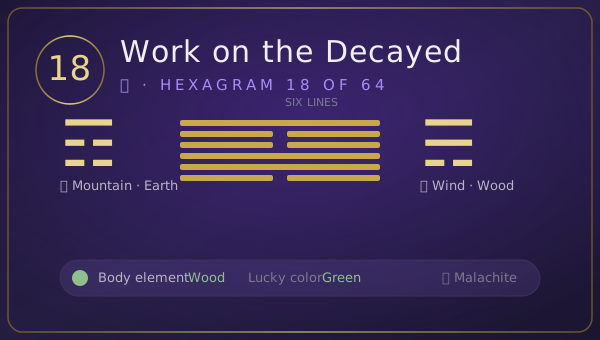
Hexagram 18 is the work-on-the-decayed hexagram of the I Ching: wind stopped at the foot of the mountain, the air beneath the mass going stale. Its classical judgment reads "supreme success; favorable to cross the great water. Before the first day, three days; after the first day, three days" (元亨,利涉大川。先甲三日,后甲三日), and its image — wind beneath the mountain — says the noble one "stirs the people and nourishes virtue" (振民育德). When Hexagram 18 appears in a reading, it describes repair: something inherited, something neglected, something rotting at the root — and the exact discipline of fixing what was handed to you.
The Story of Hexagram 18: The Wind Under the Mountain
The scene is a mountainside where the wind cannot circulate. The air beneath the mass grows stale; what was once fresh begins to turn. The old commentators read the hexagram from that stagnation — 蛊 is not dramatic collapse. It is the slow corruption of what stopped moving.
The judgment is the hexagram's paradox: supreme success and the crossing of the great water, granted to the person willing to work on the decayed. Repair is not a lesser vocation in this system — it is the one that earns the full blessing. And the timing instruction is the hexagram's most quoted phrase: 先甲三日,后甲三日 — three days before the first day, three days after. The commentators read it as a rule of sequence: examine what came before, act at the turning, and watch what follows. Repair has a before, a during, and an after, and the one who skips the before and the after repairs badly.
The lines are a family story, told almost literally. The first line is the son who repairs the father's decay — the heir who takes up what was spoiled (干父之蛊,有子). The second is the gentler case: the mother's decay cannot be repaired by pure firmness (不可贞). The third is the small regret of the honest repair — little remorse, no great blame (小有悔,无大咎). The fourth is the too-tolerant repair — going forward, meeting with regret (往见吝). The fifth is the repair that earns reputation (用誉). And the final line is the hexagram's escape hatch: 不事王侯,高尚其事 — the one who does not serve the king or the lords, whose work is its own elevation. Even repair has an exit into independence.
What Is Hexagram 18?
- Name: 蛊 (Gǔ), traditionally rendered Work on the Decayed; also translated as Repair, Corruption, The Poison, or Decay
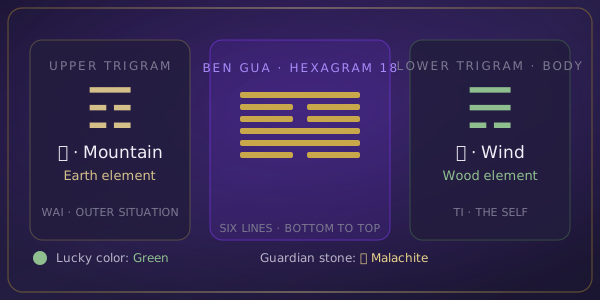
- Structure: Mountain over Wind — the wind stopped beneath the mountain, the air going stale
- Position: 18 of 64, the hexagram after Following; what the rested follower becomes
- Element: Wood on the body trigram — the lower trigram (wind) belongs to Wood; the mountain above belongs to Earth
- Body trigram: the lower trigram (wind, Wood), which in plum blossom divination represents the self
- Core images: the stale air beneath the mountain, the father's decay, the first day and the three days, the reputation of repair, the one who does not serve
The Core Meaning of Hexagram 18
The judgment of Hexagram 18 grants the full blessing — 元亨 — to the work of repair, plus 利涉大川, the crossing of the great water. This is remarkable: the Book gives its strongest success language to the person who takes on what has decayed. The message is that repair is not cleanup; it is the work that clears the ground for everything the crossing requires.
Three things this hexagram is telling you, each standing on its own:
Decay is inherited, and inheriting it is the assignment. The hexagram's lines are almost entirely about the father (父) — the decay you did not cause, the rot you received. The question Hexagram 18 asks is not whose fault it is. It is whether you are the kind of heir who works on it. 有子 — the existence of the son who repairs — is the first line's entire good news.
Repair has a sequence, and the sequence is the discipline. 先甲三日,后甲三日: three days before, three days after. Examine what came before the decay; act at the turning; watch what follows the act. The lines show the failure modes of sequence — the too-tolerant repair (line 4) and the dishonest one (line 2's 不可贞 — firmness applied where softness was required).
Repair can end in independence. The final line is the hexagram's hidden teaching: 不事王侯,高尚其事. The one who does the repair work so thoroughly — and so much on their own terms — that they no longer serve the structure they repaired. Work on the decayed, done at full integrity, is a path out of servitude.
The question Hexagram 18 answers is not "how did this rot?" It is: am I the heir who works on it — in sequence, with the right firmness, and toward my own elevation?
Hexagram 18 in Love and Relationships
If you are single: Hexagram 18 describes the season of repairing what you carry into connection — the patterns inherited from family, the decayed expectations, the stale air of old bonds. The hexagram's counsel: do the work before the crossing. 利涉大川 is granted to the repaired, and the single season is exactly when the repair is cheapest.
In an early or uncertain stage: Early love under Hexagram 18 often means two people bringing inherited patterns into something new — each other's family scripts, each other's decayed habits. The hexagram's lines are its counsel: repair the father's decay with the right firmness (line 1), apply softness where firmness fails (line 2), accept the small remorse of honest repair (line 3), and refuse the tolerant non-repair (line 4) that lets early small things rot into later large things.
In a stable relationship: A stable relationship drawing Hexagram 18 is in its repair phase — something has decayed and both people know it. The hexagram's counsel for long bonds is its timing rule: three days before, three days after. Examine what came before the rot (when did the air stop circulating), act at the turning, and watch what follows. And its fifth line is the long-bond promise: 干父之蛊,用誉 — the repair that earns reputation. Couples are known, in the end, by what they repaired.
In a crisis: If the relationship is in crisis under Hexagram 18, the hexagram says the rot was inherited or neglected, not caused — and the repair is still available with the full blessing (元亨). The final line is the crisis counsel in its purest form: 不事王侯,高尚其事. Sometimes the healthiest act is to stop serving the structure — the relationship's history, its obligations, its court of grievances — and to do the work on your own terms.
Hexagram 18 in Career, Money and Decisions
Career: This is the repair hexagram of professional life — the turnaround, the inherited mess, the legacy system, the department that has been neglected. Its career counsel is the hexagram's judgment: the crossing (利涉大川) is granted to the one who works on the decayed, and the timing rule is the discipline — examine the history, act at the turning, watch the outcome. The line about the tolerant repair (往见吝) is the career warning: the manager who tolerates the rot to avoid conflict walks forward into regret.
Money: Hexagram 18 governs money in repair — the restructured debt, the cleaned-up accounts, the asset that has been quietly decaying. Its financial counsel: the full success (元亨) is available to the repair, and the sequence is the discipline — audit what came before, act at the turning, monitor what follows. The final line's independence is its financial promise: the one who repairs the finances thoroughly enough can stop serving them — debt cleaned, systems fixed, obligations discharged.
Decision: Hexagram 18 says: repair, in sequence. If you are deciding whether to take on the decayed thing — the project, the system, the bond, the debt — the hexagram's answer is its judgment: supreme success and the crossing belong to this work, on three conditions. Examine the before, act at the turning with the right firmness, and keep your own elevation as the point. Repair that has no elevation in it is just servitude to the rot.
The Changing Lines of Hexagram 18: Six Scenes
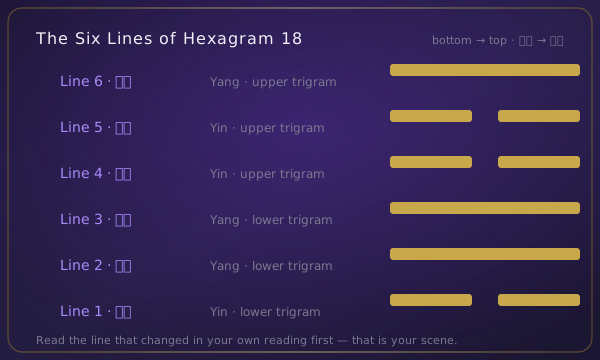
Each line of Hexagram 18 is one scene in the life of repair — the heir's firmness, the soft case, the honest small regret, the tolerant failure, the reputed repair, and the elevation.
Line 1 (初六) — Repairing the father's decay: there is a son. The deceased one is blameless; danger, but in the end, good fortune. The scene: the heir who takes up what the parent spoiled. The modern reading: the foundation line. The decay is not yours; the repair is. The hexagram's first promise is simply that the son exists (有子) — and that the repair ends well (厉终吉) even through the danger.
Line 2 (九二) — Repairing the mother's decay: cannot be firm. The scene: the case where firmness is the wrong instrument. The modern reading: the nuance line. Not every decay is repaired by force — some situations (the mother's, the delicate one) require the soft approach, and applying pure principle (不可贞) is the failure. Diagnose before you apply.
Line 3 (九三) — Repairing the father's decay: a little remorse, no great blame. The scene: the honest repair that costs something. The modern reading: the reality line. Every real repair leaves small damage — the thing that had to be broken to be fixed. The hexagram's arithmetic is exact: 小有悔,无大咎. Small remorse is the receipt of a repair done properly.
Line 4 (六四) — Tolerating the father's decay: going forward, meeting with regret. The scene: the heir who looks at the rot and lets it be. The modern reading: the failure line. Tolerance of decay is not patience — it is postponement with interest. The hexagram's verdict: 往见吝. Walking forward on un-repaired ground meets regret, every time.
Line 5 (六五) — Repairing the father's decay: reputation is earned. The scene: the repair that makes a name. The modern reading: the central line. The hexagram's promise for the one who does the work in sequence and with the right firmness: 用誉. Reputation is not sought in this hexagram — it is the byproduct of repair done properly, and it arrives on its own.
Line 6 (上九) — Not serving the king or the lords; the work itself is lofty. The scene: the repairer who outgrows the structure they repaired. The modern reading: the completion line and the hexagram's escape hatch. 不事王侯,高尚其事 — the one who does the decayed work at full integrity ends up serving nobody but the work. Repair, completed, is a path out of servitude.
When all six lines change: Hexagram 18 turns toward Hexagram 19 — repair completed becomes approach. The air that circulates again becomes the arrival.
How to Read Hexagram 18 with the Number Oracle
Hexagram 18 reaches you the same way every hexagram does: through three numbers that arise naturally while you hold your question — a clock, a receipt, a page number, a number that simply surfaces. The first number sets the upper trigram, the second the lower trigram, and the third identifies the changing line. Enter your three numbers and your question at numbers-oracle.com and you will get the hexagram plus an AI interpretation written for your situation — free, no registration. For the mechanics, read how three numbers become a hexagram →
Your lucky energy for Hexagram 18: Wood element (the body trigram, wind below). Lucky colors are green and tender sprout tones; the matching crystal is malachite, traditionally associated with growth, renewal, and fresh starts.
Related hexagrams: Hexagram 17 (Following) — the rest that precedes repair; Hexagram 49 (Revolution) — the repair that becomes total change; Hexagram 59 (Dispersion) — the dissolving of what repair cannot hold.
Hexagram 18: Common Questions
What does hexagram 18 mean in one sentence?
Hexagram 18 means work on what has decayed — supreme success and the crossing belong to the one who repairs the inherited rot in sequence: examine the before, act at the turning with the right firmness, watch the after.
Is hexagram 18 good or bad?
Hexagram 18 is one of the Book's strongest favorable signs for the willing — its judgment is 元亨,利涉大川, the full success and the crossing. It is unfavorable only for the tolerant one: line 4's non-repair is marked 吝. The hexagram judges not the decay but the response to it.
What should I do when I receive hexagram 18?
Check which line changed. Repairing the father's decay (line 1) means take up the inherited work; the mother's decay (line 2) means apply softness where firmness fails; small remorse (line 3) means accept the cost of honest repair; tolerating the decay (line 4) means stop postponing; reputation earned (line 5) means let the work make the name; not serving (line 6) means keep your own elevation as the point.
Why is hexagram 18 called "Work on the Decayed"?
Because its image is wind stopped beneath the mountain — air that no longer circulates, going stale. The old translators rendered it Repair or Corruption because the hexagram's lines read like an inheritance file: what was spoiled, who repairs it, with what firmness, and what the repair ultimately earns.
The stale air is nobody's fault. Circulating it is nobody's job but yours.