I Ching Hexagram 19 (Approach): Meaning in Love, Career and Life
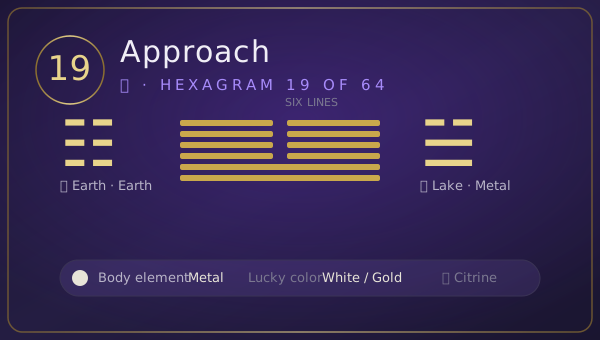
Hexagram 19 is the approach hexagram of the I Ching: the lake rising toward the earth, the water coming up to meet the ground. Its classical judgment reads "supreme success; favorable perseverance. When it has reached the eighth month, there will be misfortune" (元亨利贞。至于八月有凶), and its image — the marsh over the earth — says the noble one "teaches and ponders without end, and shelters the people without limit" (教思无穷,容保民无疆). When Hexagram 19 appears in a reading, it describes arrival: the moment that is coming toward you, favorable and strong — with the hexagram's one warning attached to its own timing.
The Story of Hexagram 19: The Lake Rising
The scene is a lake at flood, its water climbing toward the shore, the boundary between water and earth dissolving as the one moves toward the other. The old commentators read the hexagram from that motion — 临 means to look down from above and to come near. The great thing is descending toward the small; the high energy is reaching down to the ground.
The judgment is the strongest the Book gives: 元亨利贞 — all four virtues — and then the strange sentence that has kept commentators busy for two thousand years: 至于八月有凶. When it reaches the eighth month, misfortune. The readings vary; the structure does not. The hexagram is telling you that favorable moments have a season, and that the season of this approach is finite. The lake rises; the lake also recedes. What the hexagram asks is that you use the rising while the water is coming up.
The lines are a manual for the one who arrives with power. The first two lines are the favorable approach — shared, then doubly shared (咸临,贞吉; 咸临,吉无不利): the arrival that includes others is the arrival that works. The third is the sweet approach (甘临) — the pleasant advance that gains nothing, until it becomes aware of itself (既忧之,无咎). The fourth is the arrival at the position (至临,无咎). The fifth is the hexagram's center — 知临, knowing approach, the great lord's proper art (大君之宜,吉). And the final line is the generous approach (敦临,吉,无咎) — the arrival that is sincere enough to be weighty.
The water reaches its highest. That is when the countdown in the judgment begins.
What Is Hexagram 19?
- Name: 临 (Lín), traditionally rendered Approach; also translated as Coming Near, Drawing Near, or The Overseeing
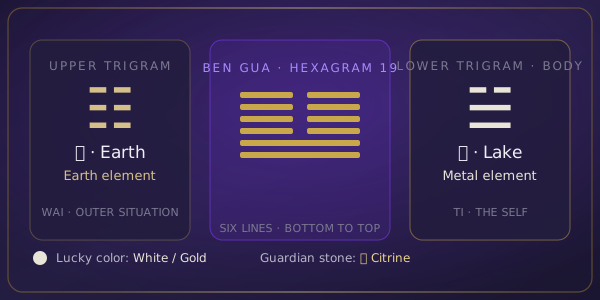
- Structure: Earth over the Lake — the marsh rising toward the earth, water meeting ground
- Position: 19 of 64, the hexagram after Work on the Decayed; what circulated air becomes
- Element: Metal on the body trigram — the lower trigram (the lake) belongs to Metal; earth above belongs to Earth
- Body trigram: the lower trigram (the lake, Metal), which in plum blossom divination represents the self
- Core images: the rising lake, the eighth month, the sweet advance, the knowing approach, the generous arrival
The Core Meaning of Hexagram 19
The judgment of Hexagram 19 is the Book's strongest opening — 元亨利贞, the full sequence of virtues — attached to a motion rather than a state. Approach is the moment when the favorable thing is coming toward you: the opportunity arriving, the position opening, the season turning in your direction. And the judgment's coda is the hexagram's entire discipline: 至于八月有凶. The favorable moment has a scheduled end.
Three things this hexagram are telling you, each standing on its own:
The approach is shared or it is not an approach. The hexagram's first two lines both use 咸临 — shared approach, mutual drawing near. The favorable arrival is not a solo conquest; it is the water meeting the ground, both parties moving. The opportunity that comes only to you, that no one else is moving toward, is the configuration the hexagram quietly declines.
Knowing is the center of the approach. The fifth line — the position of the great lord — names the correct art of arriving: 知临, knowing approach. Not force, not sweetness, but understanding. The hexagram's center holds the one who arrives with knowledge of what is actually arriving: the season, the people, the terms.
Sweetness is the approach's failure mode. The third line is the hexagram's warning: 甘临 — the pleasant advance, the arrival that is easy and gains nothing. Sweetness without awareness gains nothing (无攸利), and the line's repair is awareness itself (既忧之,无咎). The approach that has not yet become honest about itself is the one that stalls.
The question Hexagram 19 answers is not "is it coming?" It is: am I arriving with knowledge, shared motion, and sincerity — and do I know what month it is?
Hexagram 19 in Love and Relationships
If you are single: Hexagram 19 is one of the Book's favorable signs for connection arriving — the shared approach of its first lines is the mutual drawing-near the single season hopes for. The hexagram's counsel: let the approach be shared (咸临) rather than pursued, and let it be knowing (知临) rather than sweet (甘临). And its judgment is the single-season warning: the favorable window has a date. The connection that arrives while the water is rising is the one that finds the boundary still soft.
In an early or uncertain stage: Early love under Hexagram 19 is the approach itself — two people drawing near, the boundary between them dissolving. The hexagram's lines map it: the shared approach (lines 1-2) is the mutual interest; the sweet approach (line 3) is the early bond that is pleasant and gains nothing until someone becomes honest about it; the position arrival (line 4) is the moment the relationship takes its actual place.
In a stable relationship: A stable relationship drawing Hexagram 19 is in a favorable season of closeness — the water high, the boundary soft. The hexagram's counsel for the favorable season is its judgment: use it, and know its month. The eighth-month warning is the long-bond teaching: favorable seasons end, and the bond that knows the season is the one that does not get caught by the recession. And its final line — 敦临, the generous, weighty approach — is the long-bond promise: the arrival that endures is the sincere one.
In a crisis: If the relationship is in crisis under Hexagram 19, the hexagram's diagnosis is usually the sweet approach that was never made honest (甘临) — the pleasant advance that gained nothing because no one said what was actually happening. The line's repair is in the text: 既忧之,无咎 — become aware of it, and the blame dissolves. The crisis is the awareness the approach was avoiding.
Hexagram 19 in Career, Money and Decisions
Career: This is the favorable-arrival hexagram of professional life — the position opening, the recognition coming, the moment when the ground is rising to meet you. Its career counsel is the judgment: use the favorable window, and use it with knowledge (知临 — line 5, the great lord's art). The third line is the career warning: the pleasant advance, the easy yes, the nice-sounding offer that gains nothing until someone examines it. And the eighth-month coda is the hexagram's timing discipline: favorable windows are scheduled, and the schedule is not yours.
Money: Hexagram 19 is favorable for money arriving — the window open, the inflow coming. Its financial counsel: share the approach (the first lines' mutual drawing-near — the deal both parties want), arrive with knowledge (line 5 — understand what is actually arriving before you commit), and refuse the sweet advance (line 3 — the easy money that gains nothing until examined). The judgment's eighth month is its financial timing rule: favorable cycles have a scheduled end; the one who knows the schedule uses the rising.
Decision: Hexagram 19 says: the favorable moment is approaching — approach it correctly. If you are deciding how to meet what is coming toward you, the hexagram's test is threefold: is the approach shared (both parties moving), is it knowing (do you understand what is arriving), and is it sincere (敦临 — weighty, not sweet)? And the judgment's coda is the hexagram's final counsel: know what month it is. Use the rising.
The Changing Lines of Hexagram 19: Six Scenes
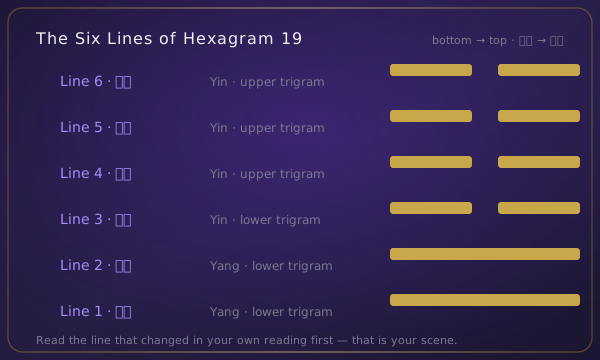
Each line of Hexagram 19 is one scene in the life of an approach — its shared arrivals, its sweetness, its position, its knowledge, and its weight.
Line 1 (初九) — Shared approach; perseverance is favorable. The scene: the arrival that includes others, the water meeting ground on both sides. The modern reading: the foundation line. The favorable approach is mutual — the opportunity arrives because both parties are moving. The hexagram's condition: 贞吉, perseverance. The shared approach held is the approach that holds.
Line 2 (九二) — Shared approach; good fortune, nothing unfavorable. The scene: the mutual drawing-near, doubled. The modern reading: the hexagram's most open favorable line. When the approach is genuinely shared — the deal, the bond, the position both sides want — the hexagram grants 吉无不利. Nothing is withheld.
Line 3 (六三) — Sweet approach; nothing is gained. Once you are aware of it, no blame. The scene: the pleasant advance that gains nothing. The modern reading: the warning line. Sweetness without honesty is the approach that stalls — the easy yes, the nice offer, the advance that feels good and arrives nowhere. The line's repair is named: awareness (既忧之). The blame dissolves the moment the approach becomes honest.
Line 4 (六四) — To the utmost approach; no blame. The scene: the arrival at the position itself — the water reaching the ground. The modern reading: the position line. The approach completed — the thing actually arrived at, the place actually taken. The hexagram grants it 无咎: no blame attached to the arrival itself.
Line 5 (六五) — Knowing approach; the great lord's proper art; good fortune. The scene: the one who arrives with understanding. The modern reading: the central line and the hexagram's keystone. 知临 — knowing approach — is the art the hexagram assigns to the great lord. Not force, not sweetness: knowledge of what is arriving, and of the month it is arriving in.
Line 6 (上六) — Generous approach; good fortune, no blame. The scene: the weighty, sincere arrival. The modern reading: the completion line. 敦临 — the approach with substance behind it, generous enough to be trusted with weight. The hexagram's final promise: 吉无咎. The arrival that endures is the sincere one.
When all six lines change: Hexagram 19 turns toward Hexagram 20 — approach completed becomes contemplation. The water that reached the ground becomes the view from above.
How to Read Hexagram 19 with the Number Oracle
Hexagram 19 reaches you the same way every hexagram does: through three numbers that arise naturally while you hold your question — a clock, a receipt, a page number, a number that simply surfaces. The first number sets the upper trigram, the second the lower trigram, and the third identifies the changing line. Enter your three numbers and your question at numbers-oracle.com and you will get the hexagram plus an AI interpretation written for your situation — free, no registration. For the mechanics, read how three numbers become a hexagram →
Your lucky energy for Hexagram 19: Metal element (the body trigram, the lake below). Lucky colors are white, gold, and silver; the matching crystal is citrine, traditionally associated with abundance and clear, joyful energy.
Related hexagrams: Hexagram 18 (Work on the Decayed) — the repair that precedes arrival; Hexagram 20 (Contemplation) — the view the arrival earns; Hexagram 11 (Peace) — the favorable window at its fullest.
Hexagram 19: Common Questions
What does hexagram 19 mean in one sentence?
Hexagram 19 means the favorable approach — supreme success belongs to the arrival that is shared, knowing, and sincere, with the hexagram's one warning that the favorable moment has a scheduled month.
Is hexagram 19 good or bad?
Hexagram 19 is one of the Book's strongest favorable signs — its judgment is the full 元亨利贞 — with a single coda: 至于八月有凶, when it reaches the eighth month, misfortune. The hexagram is favorable for using the rising and unfavorable only for mistaking the rising for permanent.
What should I do when I receive hexagram 19?
Check which line changed. Shared approach (line 1) means let it be mutual; doubly shared (line 2) means the favorable arrival is open; sweet approach (line 3) means examine what feels easy; the utmost approach (line 4) means the position is taken; knowing approach (line 5) means understand what is arriving; generous approach (line 6) means let the arrival be weighty and sincere.
Why is hexagram 19 called "Approach"?
Because its image is the lake rising toward the earth — water climbing to meet the ground, the boundary softening. The old translators rendered it Approach or Drawing Near because the hexagram's subject is the favorable thing coming toward you, and its whole discipline is about meeting it correctly and on time.
The water reaches its highest. The wise one is already counting.