I Ching Hexagram 20 (Contemplation): Meaning in Love, Career and Life
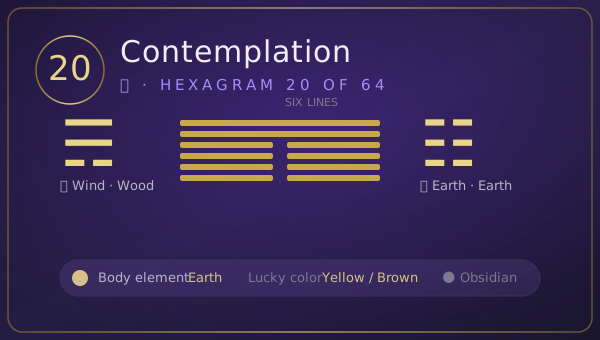
Hexagram 20 is the contemplation hexagram of the I Ching: wind moving over the earth, touching everything, revealing everything, changing nothing. Its classical judgment reads "the washing of hands is made, but not yet the offering; with sincerity, look up in reverence" (盥而不荐,有孚颙若), and its image — wind traveling across the ground — says the early kings "inspected the regions, observed the people, and set up the teaching" (省方观民设教). When Hexagram 20 appears in a reading, it describes the season before action: seeing clearly, being seen, and understanding that observation is itself the work of the phase.
The Story of Hexagram 20: The Wind Over the Field
The scene is a field of grain with wind crossing it. Nothing is planted. Nothing is harvested. The wind moves through everything, and the whole field moves with it — visibly, completely, without a single stalk being changed into something else.
The old commentators found the hexagram's ritual in that image. The judgment describes a ceremony at the exact moment of preparation: the hands are washed, the offerings are arranged — but the sacrifice has not yet been made (盥而不荐). Everything is ready; nothing has been spent. That interval, the hexagram says, is the holiest part. 有孚颙若 — sincerity, and the countenance looking up in reverence. The moment of full preparation before the act is not dead time. It is the act's foundation.
The image tells you what the wind does when it crosses a country: the early kings toured the regions, watched the people, and only then set up the teaching (省方观民设教). Observation first; instruction second. The hexagram grades its observers with unusual severity. The child's view (童观) is blameless for the small person and a fault for the noble one. The peeking view (窥观) — looking through the gap, seeing from concealment — is fit for a woman's perseverance and nothing more. The real viewing begins at the third line: 观我生 — viewing one's own life, one's own growth, the decision to advance or retreat. The fourth line is the view of the state's light (观国之光) — the observer worthy to be the king's guest. The fifth line the君子 viewing his own life again, this time from the center. And the final line widens the lens: 观其生 — viewing the life of the other, the leader observed by those he leads.
The field moves entirely under the wind. The wind is not in a hurry.
What Is Hexagram 20?
- Name: 观 (Guān), traditionally rendered Contemplation; also translated as Viewing, The Watch, or Contemplation of the Way
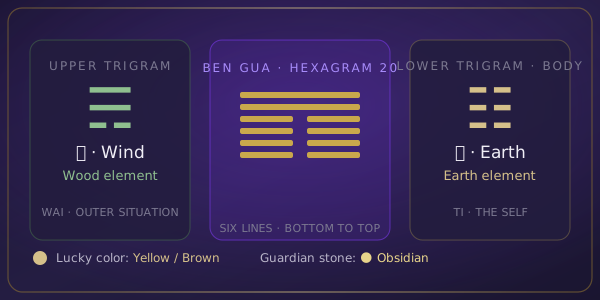
- Structure: Wind over Earth — the wind crossing the ground, touching everything, changing nothing
- Position: 20 of 64, the hexagram after Approach; the view the arrival earns
- Element: Earth on the body trigram — the lower trigram (earth) belongs to Earth; wind above belongs to Wood
- Body trigram: the lower trigram (earth, Earth), which in plum blossom divination represents the self
- Core images: the wind over the field, the washed hands before the offering, the child's view, the peeking view, the view of the state's light
The Core Meaning of Hexagram 20
The judgment of Hexagram 20 places the hexagram at the exact interval between preparation and act. 盥而不荐 — the ablution is done, the offering has not been made — and the hexagram locates the power of the whole ceremony in that held moment: 有孚颙若, sincerity, and the upward-looking countenance. The teaching is unusual and precise: the quality of the act is decided in the looking, not in the doing.
Three things this hexagram is telling you, each standing on its own:
Observation is a position, not a pause. The hexagram is not telling you to wait passively; it is telling you that seeing is the active work of this phase. The image's early kings did not sit in the capital — they toured, watched, and only then taught. Contemplation in this hexagram is fieldwork: the wind that crosses the whole field is doing something complete.
You are always being observed too. The hexagram's later lines turn the lens — line 5's 观我生 and line 6's 观其生 make the viewer the viewed. The leader is contemplated by those he leads; the example is studied more closely than the instruction. The hexagram's ethical weight is here: in a season of watching, what is seen matters as much as what is noticed.
The shallow view is the named fault. The child's view (童观) and the peeking view (窥观) are the hexagram's two warnings — looking without depth, or looking from concealment. Both are forms of not actually seeing. The hexagram grants the small person the child's view without blame, and withholds it from the noble one (小人无咎,君子吝): the higher the position, the deeper the required looking.
The question Hexagram 20 answers is not "what should I do?" It is: am I actually seeing — deeply, openly, including myself — and do I understand that what I am showing is being studied?
Hexagram 20 in Love and Relationships
If you are single: Hexagram 20 describes the season of watching — people, patterns, yourself. The hexagram's counsel for the single season: look deeply and look at yourself (观我生). The child's view and the peeking view are the dating errors: superficial scanning and covert surveillance. What the hexagram asks is the wind's view — the whole field, openly, with nothing hidden in the gap.
In an early or uncertain stage: Early love under Hexagram 20 is the observation phase — and the hexagram's counsel is that observation is legitimate work here. Its lines map the early bond precisely: the child's view (line 1) is the superficial scan; the peeking view (line 2) is the covert checking — social media, mutual friends, the gap in the fence; the real viewing (line 3) is the turn inward, examining your own life and whether this advances or retreats from it.
In a stable relationship: A stable relationship drawing Hexagram 20 is in the seeing season — something is being observed, by both parties, and the hexagram says the observation is the relationship's current work. Its fifth line is the long-bond center: 观我生,君子无咎 — viewing your own life honestly, from the center, is what the phase requires. And its final line is the long-bond warning: 观其生 — you are being watched. The example is studied more closely than the instruction.
In a crisis: If the relationship is in crisis under Hexagram 20, the hexagram's diagnosis is usually a failure of seeing — the child's view (superficial), the peeking view (covert), or the complete absence of 观我生 (the honest self-examination). The hexagram's counsel for crisis: stop peeking and start viewing. Look at your own life, look at the other's, openly, and let the sincerity of the looking (有孚颙若) do what the surveillance could not.
Hexagram 20 in Career, Money and Decisions
Career: This is the observation hexagram of professional life — the assessment period, the research phase, the season of watching the organization before moving within it. Its career counsel is the image: 省方观民设教. Tour the territory, observe the people, then set up the teaching. The leader who instructs before observing is the leader the hexagram quietly marks. And its final line is the career warning of the whole Book: 观其生 — you are being watched. In a season of contemplation, the example is studied more closely than the policy.
Money: Hexagram 20 governs money in the observation phase — the research before the investment, the diligence before the deal, the watching before the commitment. Its financial counsel: the ablution is done, the offering is not (盥而不荐) — the preparation is the work of this phase, and the spending waits for the seeing to complete. The hexagram's line 4 — viewing the state's light, worthy to be the king's guest — is its promise for the observer: the one who has genuinely done the looking is the one who gets invited into the room.
Decision: Hexagram 20 says: look, and let the looking be the work. If you are deciding whether to act, the hexagram's answer is its judgment: the ceremony is at its holiest before the offering. Do the fieldwork — observe the territory, observe the people, observe yourself (观我生) — and understand that the decision, when it comes, will be decided by the quality of what you have seen. The act that follows real contemplation is the only one this hexagram blesses.
The Changing Lines of Hexagram 20: Six Scenes
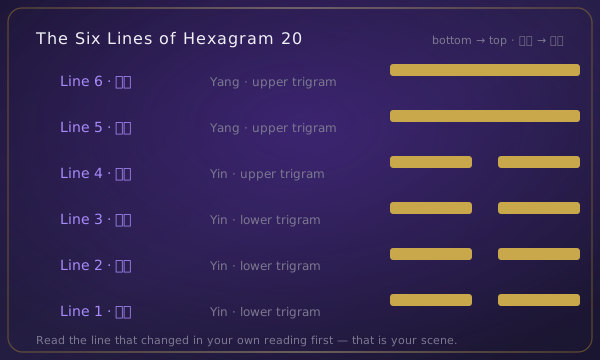
Each line of Hexagram 20 is one scene in the life of contemplation — its shallow views, its inward turn, its state's light, its self-viewing, and its being viewed.
Line 1 (初六) — The child's view: no blame for the small person, regret for the noble one. The scene: the superficial look, the scan that sees the surface. The modern reading: the opening line and its grading. The hexagram does not condemn shallow seeing — it grades it by position. The higher you stand, the deeper the required looking. The noble one's regret is the cost of the child's view.
Line 2 (六二) — Peeking view; favorable for a woman's perseverance. The scene: looking through the gap, seeing from concealment. The modern reading: the covert-observation line. Checking from hiding — the surveillance, the reconnaissance, the view through the fence — has a narrow legitimacy and a clear ceiling. The hexagram grants it 利女贞 and nothing more: what is seen from concealment cannot build what is built in the open.
Line 3 (六三) — Viewing my own life: advance or retreat. The scene: the observer turning the lens inward. The modern reading: the turning line. Contemplation becomes real when it includes the contemplator. 观我生,进退 — the honest self-view is what makes the advance-or-retreat decision possible. This is where the hexagram's fieldwork actually begins.
Line 4 (六四) — Viewing the state's light; favorable to be the king's guest. The scene: the observer who has done the work, invited into the room. The modern reading: the reward line. The one who has genuinely looked — at the territory, the people, the self — earns access (利用宾于王). Contemplation completed is a credential.
Line 5 (九五) — Viewing my own life; the noble one is blameless. The scene: the self-view from the center, the position of full power. The modern reading: the central line. The leader at the center examining his own life — not the led, the self — is blameless (君子无咎). The hexagram's deepest ethic: the highest position owes the deepest self-examination.
Line 6 (上九) — Viewing his life; the noble one is blameless. The scene: the lens turned outward again — the leader viewed by those he leads. The modern reading: the completion line. 观其生 — the contemplation comes full circle. What the leader is showing is being studied, and the hexagram's verdict on the one whose life can be openly viewed is 君子无咎. The watched life, lived visibly, is the blameless one.
When all six lines change: Hexagram 20 turns toward Hexagram 21 — contemplation completed becomes decisive action. The field that has been fully seen becomes the bite.
How to Read Hexagram 20 with the Number Oracle
Hexagram 20 reaches you the same way every hexagram does: through three numbers that arise naturally while you hold your question — a clock, a receipt, a page number, a number that simply surfaces. The first number sets the upper trigram, the second the lower trigram, and the third identifies the changing line. Enter your three numbers and your question at numbers-oracle.com and you will get the hexagram plus an AI interpretation written for your situation — free, no registration. For the mechanics, read how three numbers become a hexagram →
Your lucky energy for Hexagram 20: Earth element (the body trigram, the field below). Lucky colors are yellow and earth brown; the matching crystal is obsidian, traditionally associated with protection, grounding, and shielding from stress.
Related hexagrams: Hexagram 19 (Approach) — the arrival that earns the view; Hexagram 21 (Biting Through) — the decisive act the seeing prepares; Hexagram 59 (Dispersion) — the wind released from the field.
Hexagram 20: Common Questions
What does hexagram 20 mean in one sentence?
Hexagram 20 means contemplation as active work — the ceremony is holiest before the offering, and this phase belongs to seeing deeply: the field, the people, and yourself, understanding that you are being watched as you watch.
Is hexagram 20 good or bad?
Hexagram 20 is neither favorable nor unfavorable on its own — it is a phase, and the hexagram grades the observer rather than the observation. The child's view and the peeking view are its named faults; viewing your own life and the state's light are its named goods. The hexagram rewards depth and openness, not speed.
What should I do when I receive hexagram 20?
Check which line changed. The child's view (line 1) means look deeper than the surface; the peeking view (line 2) means stop observing from concealment; viewing my own life (line 3) means turn the lens inward; the state's light (line 4) means the looking earns access; viewing my life from the center (line 5) means the highest position owes the deepest self-examination; viewing his life (line 6) means you are being watched — live visibly.
Why is hexagram 20 called "Contemplation"?
Because its image is wind crossing the earth — touching the whole field, changing nothing, revealing everything. The old translators rendered it Viewing or The Watch because the hexagram's judgment describes a ceremony held at its most powerful interval: hands washed, offering not yet made, the countenance looking up.
The wind has never once been in a hurry, and it has never once missed a field.