I Ching Hexagram 22 (Grace): Meaning in Love, Career and Life
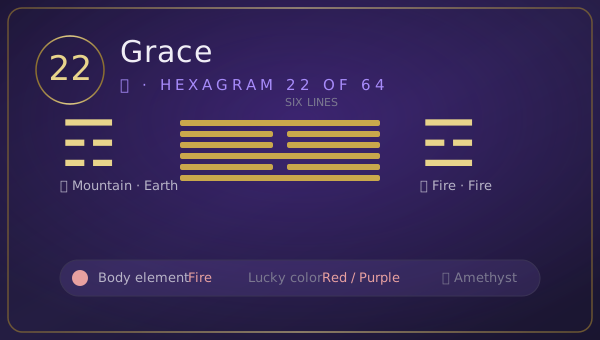
Hexagram 22 is the grace hexagram of the I Ching: fire burning beneath the mountain, light cast upward on the mass. Its classical judgment reads "success; small benefit in having somewhere to go" (亨。小利有攸往), and its image — fire below the mountain — says the noble one "is clear in the many affairs of government and dares not decide lawsuits" (明庶政,无敢折狱). When Hexagram 22 appears in a reading, it describes form: the surface that carries meaning, the ornament that reveals substance — and the hexagram's careful distinction between beauty that illuminates and decoration that conceals.
The Story of Hexagram 22: The Fire Under the Mountain
The scene is a mountainside at dusk. Fire burns at its foot, and the light climbs the rock face — every crag, every line in the stone suddenly legible. Without the fire, the mountain is a silhouette. With it, the mountain is a text. The old commentators read the hexagram from that relationship: 贲 is not the fire and not the mountain. It is what the fire does to how the mountain is seen.
The hexagram's whole arc is a journey toward simplicity. It begins at the feet — 贲其趾, the ornamented toes — with the image of the person who abandons the carriage and walks (舍车而徒): the ornament that is chosen over the transport, the form that is worth more than the speed. It continues at the chin (贲其须), the ornament that follows the face's own motion. At the third line, ornament becomes saturation — 贲如濡如, grace like moisture — and the hexagram attaches its condition: 永贞吉, permanence through perseverance. The fourth line is the hexagram's most cinematic image: the white one, the white horse flying (贲如皤如,白马翰如) — and the line's twist is the same one readers met at Hexagram 3: not a bandit, a matchmaker (匪寇婚媾). The fifth line is ornament at the hill garden, with the humble bolts of silk (束帛戋戋) — poor offering, and the hexagram says: 吝,终吉, stingy, and in the end good fortune. And the final line is the hexagram's destination: 白贲 — white ornament, the ornament that has become plain. The mountain at dawn, no fire needed, the form so honest it disappears into what it was for.
The fire was never the point. The mountain was never the point. The seeing was the point.
What Is Hexagram 22?
- Name: 贲 (Bì), traditionally rendered Grace; also translated as Adornment, Beauty, or Form
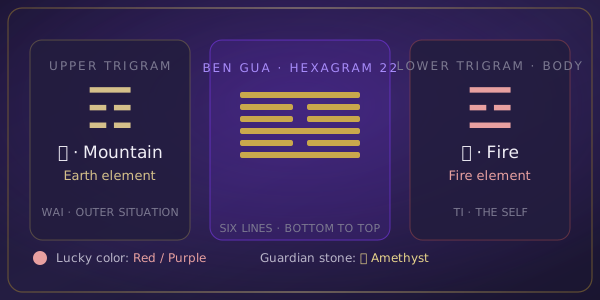
- Structure: Mountain over Fire — fire beneath the mass, light cast upward on the stone
- Position: 22 of 64, the hexagram after Biting Through; the face after the obstruction clears
- Element: Fire on the body trigram — the lower trigram (fire) belongs to Fire; the mountain above belongs to Earth
- Body trigram: the lower trigram (fire, Fire), which in plum blossom divination represents the self
- Core images: fire beneath the mountain, the abandoned carriage, the flying white horse, the humble bolts of silk, white ornament
The Core Meaning of Hexagram 22
The judgment of Hexagram 22 is deliberately modest: 亨 — success — 小利有攸往, small benefit in having somewhere to go. Grace is not the hexagram of the grand march; it is the hexagram of form, and form moves at the speed of what it carries. The image adds the hexagram's discipline: 明庶政,无敢折狱 — be clear in the many affairs, and do not decide lawsuits. Beauty clarifies administration; it does not render judgments. The ornament is not the substance, and the hexagram knows the difference precisely.
Three things this hexagram is telling you, each standing on its own:
Form is a carrier, not a disguise. The fire under the mountain makes the mountain legible — that is the hexagram's function for ornament. Form is how substance becomes visible. The feet are ornamented so the walk is seen; the face is ornamented so the expression travels. What the hexagram opposes is not beauty but the beauty that has stopped carrying anything.
The journey of grace is a journey toward plainness. The hexagram's six lines move from ornamented feet to white ornament — 白贲, the final line, where grace has become so honest it has become plain. This is the hexagram's deepest teaching: form at its completion stops performing. The mountain at dawn needs no fire.
Grace is small motion, honestly scaled. 小利有攸往 — the benefit of going somewhere is small. Grace does not power the conquest; it carries the message. The hexagram's own image keeps ornament out of the courtroom (无敢折狱): beauty clarifies, but the judgment belongs to a different hexagram — the one with the bite.
The question Hexagram 22 answers is not "is it beautiful?" It is: is this form carrying its substance — and has the ornament begun its journey back toward plainness?
Hexagram 22 in Love and Relationships
If you are single: Hexagram 22 describes the season of form — how you present, how you are seen, the ornament you have chosen. The hexagram's counsel for the single season is its arc: let the ornament carry the substance, and let it be moving toward plainness. The abandoned carriage (line 1) is its warning: the person who chooses the appearance over the actual journey. And its fourth line is its promise: the white horse flying, not a bandit — a matchmaker. Grace, honestly worn, is what makes the approach legible.
In an early or uncertain stage: Early love under Hexagram 22 is the choreography of form — the presentation, the gestures, the way each person is seen. The hexagram's lines map it: the ornamented feet (line 1) are the first impressions chosen over transport; the chin ornament (line 2) is the form that follows the face's own motion — the real expression; the saturated grace (line 3) is the early bond's beauty, with its condition: 永贞吉, keep it permanent through perseverance.
In a stable relationship: A stable relationship drawing Hexagram 22 is in its form phase — the rituals, the anniversaries, the daily beauties that carry the bond. The hexagram's counsel for the long term is its fifth line: 束帛戋戋,吝,终吉 — the humble offering, the small silk, the gesture that looks stingy and ends in good fortune. Long bonds are carried by small forms honestly offered, not by grand displays. And the final line is the hexagram's long-bond destination: 白贲 — the ornament that has become plain, the love that no longer needs to perform.
In a crisis: If the relationship is in crisis under Hexagram 22, the hexagram's diagnosis is usually ornament detached from substance — the form still beautiful, the carrier empty. The hexagram's counsel for crisis: return the fire to beneath the mountain. Stop performing the form; let the substance be what is seen. The white ornament of the final line is not the removal of beauty but the removal of performance.
Hexagram 22 in Career, Money and Decisions
Career: This is the form hexagram of professional life — the presentation, the brand, the design, the way the work is seen. Its career counsel is the image: 明庶政 — be clear in the many affairs. Form clarifies; it does not decide (无敢折狱). The professional who understands this hexagram uses beauty to make the substance legible and never mistakes the deck for the decision. The third line's condition (永贞吉) is its warning: saturated charm must be kept permanent through perseverance, or it evaporates.
Money: Hexagram 22 governs money spent on form — the marketing, the packaging, the presentation layer. Its financial counsel is the hexagram's judgment: 小利有攸往 — small benefit in having somewhere to go. Form pays small and honest returns; the hexagram warns against funding the ornament while the carriage is abandoned (line 1's 舍车而徒). And the fifth line is its financial image: the humble bolts of silk — the modest, honest presentation that ends well (终吉) precisely because it was not a display.
Decision: Hexagram 22 says: let the form carry the substance. If you are deciding how to present something — the offer, the work, yourself — the hexagram's test is its arc: is this ornament carrying anything real, and is it moving toward plainness (白贲) or away from it? The decision it blesses is always the honest form: beauty that could be replaced by its substance without anyone noticing the difference.
The Changing Lines of Hexagram 22: Six Scenes
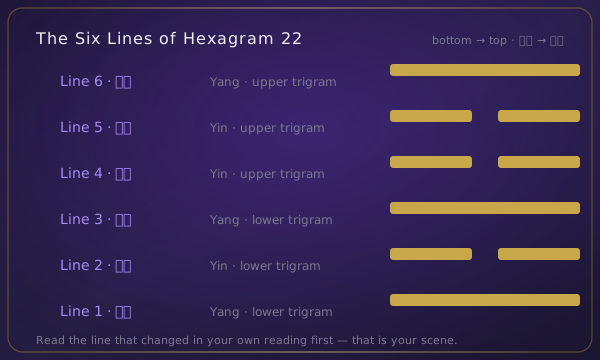
Each line of Hexagram 22 is one scene in the life of form — its feet, its chin, its saturation, its flying horse, its humble silk, and its whiteness.
Line 1 (初九) — Ornamenting the feet; abandoning the carriage and walking. The scene: the ornament chosen over the transport. The modern reading: the foundation line and its warning. Form at the feet is real — the walk is seen — but the carriage abandoned is the hexagram's caution: the appearance chosen over the actual movement. Ornament the feet; do not discard the journey.
Line 2 (六二) — Ornamenting the beard. The scene: the form that follows the face's own motion. The modern reading: the dependent line. The beard does not move the face; it moves because the face moves. Ornament at this line follows substance — and the hexagram's quiet praise is for the form that knows its place: second, following, never leading.
Line 3 (九三) — Grace like moisture, like saturation; permanence through perseverance is good fortune. The scene: ornament so complete it shines. The modern reading: the saturation line and its condition. Charm at full intensity is intoxicating — and the hexagram attaches 永贞: keep it permanent. Saturated grace that is not persevered becomes the ornament that peeled off. The moisture dries.
Line 4 (六四) — Grace like whiteness, like the plain; the white horse flies — not a bandit, a matchmaker. The scene: the hexagram's most cinematic image, with the reader's expectation overturned. The modern reading: the approach line. What arrives at full beauty is ambiguous — the dust, the speed, the white horse — and the hexagram's teaching is the one from Hexagram 3: look twice. The thing approaching in splendor is a suitor, not a raider.
Line 5 (六五) — Ornamenting the hill garden; the bolts of silk are meager — stingy, but in the end, good fortune. The scene: the humble offering at the high place. The modern reading: the central line. Form at the center is modest — the small silk, the plain gift, the ornament that costs little — and the hexagram's verdict is exact: 吝,终吉. Stingy by the standards of display, and in the end good fortune. The honest small form outperforms the dishonest large one.
Line 6 (上九) — White ornament; no blame. The scene: the mountain at dawn, no fire needed. The modern reading: the completion line and the hexagram's destination. 白贲 — the ornament that has become plain. Form at its completion is the form that has stopped performing, the beauty so honest it has become indistinguishable from substance. The hexagram grants it 无咎.
When all six lines change: Hexagram 22 turns toward Hexagram 23 — grace completed becomes splitting apart. The mountain fully seen becomes the mountain being stripped.
How to Read Hexagram 22 with the Number Oracle
Hexagram 22 reaches you the same way every hexagram does: through three numbers that arise naturally while you hold your question — a clock, a receipt, a page number, a number that simply surfaces. The first number sets the upper trigram, the second the lower trigram, and the third identifies the changing line. Enter your three numbers and your question at numbers-oracle.com and you will get the hexagram plus an AI interpretation written for your situation — free, no registration. For the mechanics, read how three numbers become a hexagram →
Your lucky energy for Hexagram 22: Fire element (the body trigram, the flame below). Lucky colors are red and warm purple; the matching crystal is amethyst, traditionally associated with clarity of mind and calm, open insight.
Related hexagrams: Hexagram 21 (Biting Through) — the clearing that precedes the face; Hexagram 15 (Modesty) — the plain-shoe virtue at its purest; Hexagram 35 (Progress) — the sunrise the fire was imitating.
Hexagram 22: Common Questions
What does hexagram 22 mean in one sentence?
Hexagram 22 means grace as form that carries substance — success is small and honest, ornament exists to make the real legible, and the journey of beauty is a journey back toward plainness.
Is hexagram 22 good or bad?
Hexagram 22 is favorable with a modest scope — 亨,小利有攸往. Its success is real and small: form clarifies, and clarity travels at the speed of what it carries. The hexagram's conditions are in its lines: ornament must follow substance (line 2), saturation must be persevered (line 3), and the journey ends in white plainness (line 6).
What should I do when I receive hexagram 22?
Check which line changed. Ornamenting the feet (line 1) means do not abandon the carriage for the appearance; the beard (line 2) means let form follow substance; grace like moisture (line 3) means persevere the charm or it dries; the white horse (line 4) means look twice at what approaches in splendor; the meager silk (line 5) means the humble honest form ends well; white ornament (line 6) means let the form become plain.
Why is hexagram 22 called "Grace"?
Because its image is fire beneath the mountain — light cast upward on stone, making the mass legible. The old translators rendered it Grace or Adornment because the hexagram's subject is beauty in its proper function: not the surface that conceals, but the surface that carries, all the way to the white ornament where carrying and substance become the same thing.
The mountain at dawn needs no fire. That is what the fire was practicing for.