I Ching Hexagram 23 (Splitting Apart): Meaning in Love, Career and Life
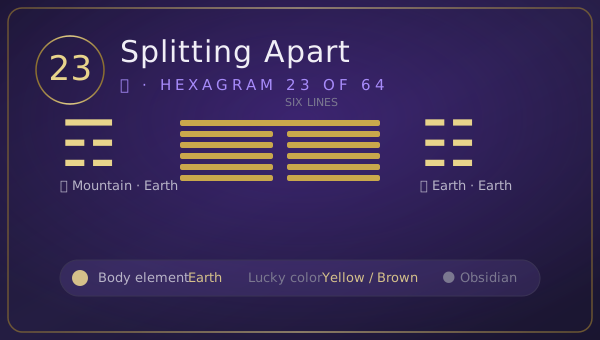
Hexagram 23 is the splitting-apart hexagram of the I Ching: the mountain resting on the earth, being stripped from below. Its classical judgment is the shortest warning in the Book — 不利有攸往, not favorable to have somewhere to go — and its image, the mountain attached to the ground, says the ruler "thickens what is below to secure the dwelling" (厚下安宅). When Hexagram 23 appears in a reading, it describes erosion: something being taken away layer by layer, from the bottom up — and the hexagram's counsel is about what survives the stripping, not how to stop it.
The Story of Hexagram 23: The Bed and the Fruit
The hexagram's central image is a bed being taken apart. Not overturned — disassembled, one layer at a time, from the bottom. First the legs (剥床以足), then the frame (剥床以辨), then the surface itself, then the skin of the one lying on it (剥床以肤). Each line is a deeper removal, and the Book's verdict at each stage is the same word: 凶. What is being stripped cannot be argued with; it can only be watched honestly.
The old commentators read the hexagram's situation in the mountain's position — 山附于地, the mountain resting on the earth, held up by the very ground that is eroding. And the image's counsel is the hexagram's whole strategy: 厚下安宅. Thicken what is below. Secure the foundation. In a season of stripping, the only available work is at the base — the ground beneath the mountain, not the peak.
The fifth line is the hexagram's hidden center. Amid the general collapse, one image of order survives: 贯鱼 — the fish strung together, the palace women favored in order, one after another, nothing left out, nothing preferred. Order at the center, in the middle of stripping, and the hexagram grants it 无不利. And the final line is the hexagram's deepest promise: 硕果不食 — the great fruit that is not eaten. One fruit remains on the stripped tree. The noble one eats from the cart; the small man strips the shelter. What the stripping cannot take is the seed.
The bed comes apart. The fruit stays. The fruit is the whole point of the tree.
What Is Hexagram 23?
- Name: 剥 (Bō), traditionally rendered Splitting Apart; also translated as Stripping Away, Flaying, or Erosion
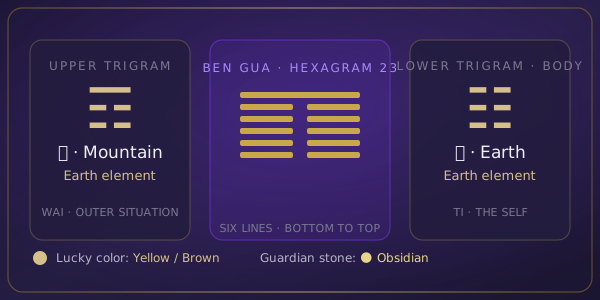
- Structure: Mountain over Earth — the mass resting on the ground, being undermined
- Position: 23 of 64, the hexagram after Grace; what fully seen form becomes
- Element: Earth on the body trigram — the lower trigram (earth) belongs to Earth; the mountain above belongs to Earth
- Body trigram: the lower trigram (earth, Earth), which in plum blossom divination represents the self
- Core images: the stripped bed, the mountain on eroding ground, the fish strung in order, the great fruit not eaten
The Core Meaning of Hexagram 23
The judgment of Hexagram 23 is one sentence: 不利有攸往. In a Book that fills its judgments with conditions and virtues, this bare negative is startling — and it is the hexagram's honesty. In a season of splitting apart, forward motion is not available. What is being taken away cannot be marched against.
Three things this hexagram is telling you, each standing on its own:
Erosion proceeds from the bottom. The bed loses its legs before its surface; the mountain is undermined before it moves. The hexagram's geography is exact: what is failing first is what is lowest — the foundation, the base, the support nobody was watching. The Book's counsel in the image follows the geography: 厚下安宅. The work available in a 剥 season is work on what is below.
The stripping is not the end of the story. The final line is the hexagram's counterweight to its own judgment. 硕果不食 — the great fruit is not eaten. Something in the stripped thing survives the stripping, and the hexagram names the two ways people meet that fact: the noble one takes the fruit from the cart (the seed is carried forward); the small man strips the shelter (what remains is consumed). The fruit distinguishes them.
Order survives at the center, even here. The fifth line is the hexagram's quiet miracle — 贯鱼, the strung fish, in sequence, nothing skipped. In the middle of the general collapse, one position still holds order: the center, the palace, the line where things are still in sequence and none is preferred. The hexagram grants even this position its full favor (无不利).
The question Hexagram 23 answers is not "how do I stop this?" It is: what is being taken from below, what is the fruit that will survive, and am I carrying it or consuming it?
Hexagram 23 in Love and Relationships
If you are single: Hexagram 23 describes a season of stripping in the self — layers coming away, identities being removed, the bottom of the bed being taken out. The hexagram's counsel for the single season: do not march (不利有攸往). This is not the season for forward motion in connection; it is the season for 厚下安宅 — thickening the foundation. And its final line is its promise: the great fruit is not eaten. Something survives the stripping, and it is the seed of the next season.
In an early or uncertain stage: Early love under Hexagram 23 is fragile by structure — the foundation is being stripped, and anything built on it will go with it. The hexagram's counsel for early bonds: work at the base or do not build. The bed's layers are the hexagram's map of what to watch: the legs (the practical support), the frame (the structure), the surface (the daily life). And the fifth line is its promise: order at the center — the one thing kept in sequence — survives.
In a stable relationship: A stable relationship drawing Hexagram 23 is in erosion — something being taken away layer by layer, usually from below (the trust, the base, the small daily securities nobody was watching). The hexagram's counsel for long bonds is its image: thicken what is below (厚下安宅). The work is never at the peak; it is at the foundation. And the final line is the hexagram's long-bond promise: 硕果不食 — what the erosion cannot take is the seed.
In a crisis: If the relationship is at the skin-level line (剥床以肤), Hexagram 23's verdict is the Book's plainest: 凶. The stripping has reached the surface of the person. The hexagram does not offer a repair manual for this line — it offers the final line's distinction: the noble one carries the fruit; the small one consumes the shelter. In crisis, ask what can still be carried forward.
Hexagram 23 in Career, Money and Decisions
Career: This is the erosion hexagram of professional life — the position being stripped, the structure being undermined, the layering-off of what held the work up. Its career counsel is the judgment: 不利有攸往 — forward motion is not available in this season. And its image is the work that is: 厚下安宅 — thicken what is below. The foundation, the base, the unglamorous support. The final line is its promise: the great fruit is not eaten — what survives the stripping is carried forward by the one who does not consume it.
Money: Hexagram 23 governs money in erosion — the reserve being drawn down, the base being removed layer by layer. Its financial counsel is the judgment: do not advance (不利有攸往) — the new commitment in a stripping season is the classic way erosion becomes collapse. The image's counsel is financial: thicken what is below, secure the dwelling, protect the base. And the final line's fruit is its financial promise: the seed survives. What is not consumed in the stripping is what rebuilds.
Decision: Hexagram 23 says: stop moving and start thickening. If you are deciding whether to advance, commit, or push forward, the hexagram's answer is its bare judgment: not favorable. What is available is the work below — the foundation, the base, the thing nobody was watching. And the hexagram's final distinction is the decision's whole ethics: the fruit that survives is either carried forward or consumed. Choose which.
The Changing Lines of Hexagram 23: Six Scenes
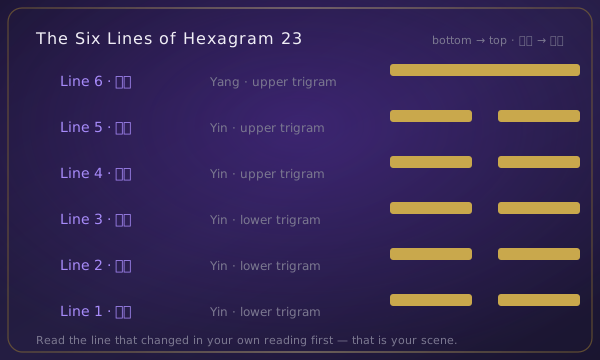
Each line of Hexagram 23 is one scene in the life of a stripping — the bed's layers, the bed's skin, the surviving order, and the fruit.
Line 1 (初六) — Stripping the bed from its legs; destroying perseverance is ominous. The scene: the bottom layer going first. The modern reading: the foundation line. Erosion begins at what is lowest — the legs of the bed, the base of the structure, the support nobody inspected. The hexagram's verdict: 蔑贞凶. The destruction of perseverance is the destruction of the base.
Line 2 (六二) — Stripping the bed from its frame; destroying perseverance is ominous. The scene: the second layer, the structure itself. The modern reading: the progression line. The stripping has reached the frame — the thing that held the surface up. The hexagram's verdict is unchanged, and the teaching is in the repetition: erosion is a process, and each layer has its own verdict.
Line 3 (六三) — Stripping it; no blame. The scene: the stripping itself, named without verdict. The modern reading: the hexagram's most interesting line. Amid the general 凶, this line alone is 无咎 — and the commentators read it as the position that has separated from the collapse, that has stopped being part of what is being stripped. The exemption is real, and it is positional.
Line 4 (六四) — Stripping the bed to its skin; ominous. The scene: the stripping reaches the surface of the person lying on the bed. The modern reading: the personal line. The erosion has stopped being structural and started being existential — what is being taken is touching the self. The hexagram's verdict: 凶.
Line 5 (六五) — The fish are strung in order; the palace women are favored in sequence; nothing is unfavorable. The scene: order surviving at the center. The modern reading: the hidden center. Amid the general stripping, one position still holds sequence — 贯鱼, the strung fish, nothing skipped, nothing preferred. The hexagram grants even this its full favor: 无不利.
Line 6 (上九) — The great fruit is not eaten. The noble one gains the cart; the small man strips the shelter. The scene: the single surviving fruit, and the two ways of meeting it. The modern reading: the completion line and the hexagram's promise. 硕果不食 — what the stripping cannot take. The noble one carries it forward (得舆); the small man consumes what remains (剥庐). The fruit is the seed, and the seed is the next hexagram.
When all six lines change: Hexagram 23 turns toward Hexagram 24 — splitting apart completed becomes return. The un-eaten fruit, planted, becomes the thunder under the earth.
How to Read Hexagram 23 with the Number Oracle
Hexagram 23 reaches you the same way every hexagram does: through three numbers that arise naturally while you hold your question — a clock, a receipt, a page number, a number that simply surfaces. The first number sets the upper trigram, the second the lower trigram, and the third identifies the changing line. Enter your three numbers and your question at numbers-oracle.com and you will get the hexagram plus an AI interpretation written for your situation — free, no registration. For the mechanics, read how three numbers become a hexagram →
Your lucky energy for Hexagram 23: Earth element (the body trigram, the ground below). Lucky colors are yellow and earth brown; the matching crystal is obsidian, traditionally associated with protection, grounding, and shielding from stress.
Related hexagrams: Hexagram 22 (Grace) — the fully seen form before the stripping; Hexagram 24 (Return) — the un-eaten fruit, planted; Hexagram 47 (Oppression) — the stripping from the inside.
Hexagram 23: Common Questions
What does hexagram 23 mean in one sentence?
Hexagram 23 means splitting apart — a season of stripping from below in which forward motion is not favorable, the only work is thickening the foundation, and the great fruit that survives is either carried forward or consumed.
Is hexagram 23 always bad?
Hexagram 23 is the Book's hardest judgment — 不利有攸往, not favorable to go anywhere — but it is not without its gifts. The fifth line's surviving order is 无不利, the third line is 无咎, and the final line's great fruit is the hexagram's promise that something in the stripped thing survives. The hexagram condemns the season, not the person.
What should I do when I receive hexagram 23?
Check which line changed. The bed's legs (line 1) means the base is going — inspect the foundation; the frame (line 2) means the structure itself is being stripped; no blame (line 3) means your position is exempt from the collapse; the bed's skin (line 4) means the erosion has reached you personally; the strung fish (line 5) means keep order at the center; the great fruit (line 6) means identify what survives and carry it.
Why is hexagram 23 called "Splitting Apart"?
Because its image is the mountain resting on eroding ground — the mass held up by the very ground being taken away, layer by layer, from below. The old translators rendered it Splitting Apart or Stripping Away because the hexagram's lines read like an inventory of loss: the bed's legs, its frame, its skin, and then — the one thing that does not go — the fruit.
The tree is stripped. The seed was never the tree's decoration.