I Ching Hexagram 24 (Return): Meaning in Love, Career and Life
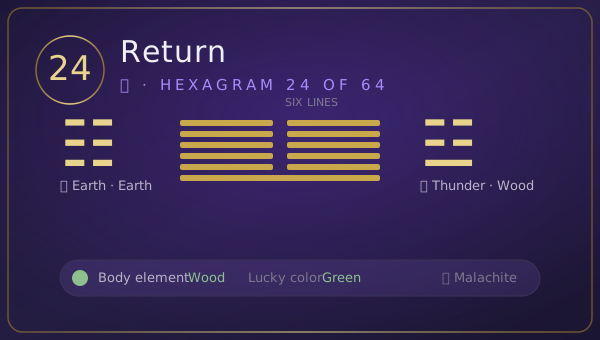
Hexagram 24 is the return hexagram of the I Ching: earth above, thunder below — a single yang line rising back at the bottom of a field of yin. Its classical judgment reads "success; going out and coming in without illness; friends arrive without blame; return follows its own path, and in seven days comes the return" (复:亨。出入无疾,朋来无咎。反复其道,七日来复。利有攸往), and its image is thunder sleeping underground, which the text says made the ancient kings "close the gates at the solstice; merchants did not travel, the ruler did not inspect the provinces." When Hexagram 24 appears in a reading, it marks the turn of the cycle — the exact point where decline becomes renewal.
The Story of Hexagram 24: The Thunder Under the Snow
Every winter, the old farming calendar kept one appointment above all others: the solstice. On that day the ancients closed the gates, stopped the caravans, and suspended the ruler's tours of the provinces — 先王以至日闭关,商旅不行,后不省方. Not because the world had ended, but because something invisible was being reborn under the snow. In the I Ching's cosmology, the winter solstice is the moment the first yang line — the seed of light, the first thunder — returns underground. Nothing is visible yet. The ground is frozen. And yet the cycle has already turned, because the darkest day of the year is also the day the light begins to grow. That is the entire message of Hexagram 24. Return does not announce itself. It begins under the surface, at the bottom, while everything above still looks like winter.
What Is Hexagram 24?
- Name: 复 (Fu), traditionally rendered Return; also translated as The Turning Point, Recovery, or Renewal
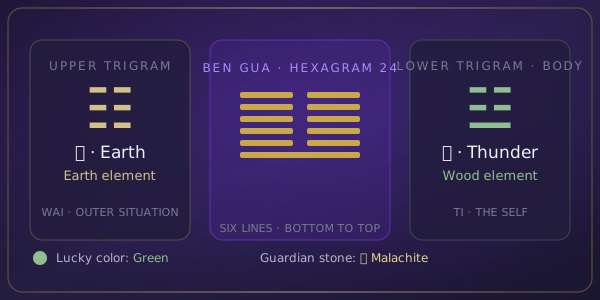
- Structure: Earth over Thunder — five yin lines with one yang line at the base
- Position: 24 of 64, the exact center of the sequence's first half and the winter solstice of the Book of Changes
- Element: Wood on the body trigram — the lower trigram (thunder) belongs to Wood; earth above belongs to Earth
- Body trigram: the lower trigram (thunder), which in plum blossom divination represents the self — and here it carries the single returning yang line
- Core images: thunder underground, the solstice, the seed under snow, the first day of growth, the road that leads back
The Core Meaning of Hexagram 24
The classical judgment of Hexagram 24 reads: 复:亨。出入无疾,朋来无咎。反复其道,七日来复。利有攸往 — "Success. Going out and coming in without illness; friends arrive without blame. The way goes and returns; in seven days comes the return. Favorable to have somewhere to go."
Three things this hexagram is telling you, each standing on its own:
The turn begins at the bottom, not at the top. One yang line under five yin lines is not a powerful position — it is the smallest possible seed of light. The hexagram's claim is that this is enough, because direction beats magnitude at turning points. The cycle does not reverse from its peak; it reverses from its base. If you are at a low point and drawing Hexagram 24, the hexagram is telling you the low point is precisely where the turn is manufactured.
Return follows a path, and the path takes time. 反复其道,七日来复 — "the way goes and returns; in seven days comes the return." The hexagram gives recovery a schedule, and the schedule is not instant. Seven is the number of a completed cycle in this system; the return is not a mood, it is a process with its own clock. Trying to compress it produces the line-3 pattern (频复, repeated returns — danger, though no blame).
Recovery is social. 朋来无咎 — "friends arrive without blame." Return is not a solo act; the hexagram says allies come back, or come for the first time, once the direction reverses. The practical reading: this is a favorable moment to reach back out to people, because the hexagram's own judgment says the channel for connection is open again.
The return must be genuine. The first line is the hexagram's masterpiece: 不远复,无祗悔,元吉 — "return before going far; no real regret; supreme good fortune." The earliest return is the one that counts, the small correction made while it is still cheap. The hexagram's final line is the opposite pole: 迷复 — being lost in the return, forcing a reversal that has already passed its moment, which brings misfortune.
The question Hexagram 24 answers is not "will things get better?" It is: what is returning, how early is the correction, and am I letting the cycle run at its own speed?
Hexagram 24 in Love and Relationships
If you are single: Hexagram 24 is the second-chance hexagram and also the fresh-start hexagram. It favors returning to something unfinished — a reconnection, an old conversation reopened — and it favors beginnings made from a corrected direction rather than the same direction that failed before. The hexagram's condition is 不远复: return early, while the regret is still small. A return attempted after too much damage becomes line 6 (迷复), the lost return.
In an early or uncertain stage: This hexagram describes a connection that has found its footing after an awkward start — the tone resets, the exchange resumes, friends and mutual contacts reappear (朋来). It is a favorable, gentle hexagram for early stages: slow, warm, and correctly paced. The hexagram warns against rushing the pace (频复 — repeatedly forcing the reset is dangerous even when each attempt is forgivable).
In a stable relationship: Hexagram 24 is the renewal hexagram — the relationship that circles back after a cold stretch, a misunderstanding, or a period of distance, and finds its footing again. The classical judgment's "without illness" (无疾) is the promise: the return is clean, not a symptom of something unresolved. The hexagram's counsel for stable relationships is to keep returning early — small corrections before the distance compounds.
In a crisis: If the relationship has gone seriously cold, Hexagram 24 says the cycle itself is on your side: yang returns at the bottom of yin, meaning the darkest phase already contains the reversal. The practical reading is the hexagram's own: return before going far (不远复), and if the damage has already gone far, expect the return to take the full seven days — the cycle's schedule, not yours.
Hexagram 24 in Career, Money and Decisions
Career: This is the restart hexagram — the career that comes back after a layoff, a failure, or a long pause; the project that resumes after it was shelved; the person who returns to a field they once left. It favors going out and coming in cleanly (出入无疾): leaving a situation without bitterness and re-entering without baggage. It is also the hexagram of the solstice strategy — rest deliberately when the season is at its darkest, because the turn is being manufactured underground while you wait.
Money: Hexagram 24 marks the recovery phase — income returns, stalled deals unfreeze, a cycle completes and begins again. The hexagram's specific financial advice is timing discipline: the return follows its path (反复其道) and in seven days completes, so forcing the recovery early produces the repeated-return pattern of line 3 — multiple small attempts that drain more than they recover. Conserve through the last of the winter; the hexagram says movement becomes favorable once the turn is real (利有攸往).
Decision: Hexagram 24 is a conditional go — and the condition is honesty about what is returning. If something is genuinely coming back around (an opportunity, a relationship, a direction), the hexagram favors moving with it. If what you are calling a "return" is actually a repetition of what already failed, the hexagram's line 6 is the warning: a forced reversal past its moment brings ten years of failed campaigns.
The Changing Lines of Hexagram 24: Six Scenes
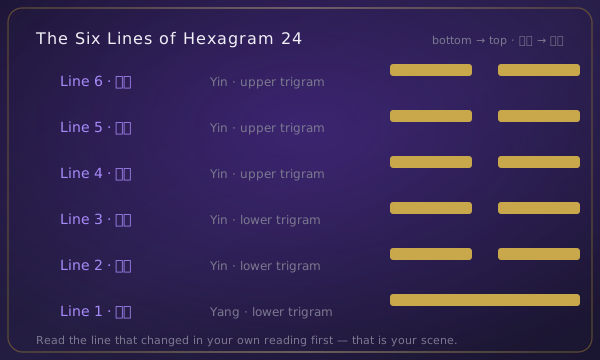
Each line of Hexagram 24 is one scene in the story of a return — its timing, its depth, and the difference between renewal and repetition.
Line 1 (初九) — Return before going far; no real regret; supreme good fortune. The scene: the traveler who turns back at the first wrong bend. The modern reading: the hexagram's central line, and its core teaching. The cheapest correction is the earliest one. If you have noticed a drift — in a project, a relationship, a habit — this line says turn now, while the turn costs almost nothing. Supreme fortune belongs to the person who returns early.
Line 2 (六二) — Return in repose; good fortune. The scene: coming home and resting, not immediately setting out again. The modern reading: the good return includes rest. After any ending or failure, the hexagram grants a recovery period — the solstice closed gates — and this line says use it. Returning to something at full speed, without repose, is not recovery, it is relapse.
Line 3 (六三) — Repeated return; danger, but no blame. The scene: turning back, setting out, turning back again. The modern reading: the pattern of false starts — the on-and-off relationship, the project that keeps restarting and never sustaining. Each attempt is forgivable (无咎), but the repetition itself is dangerous (厉). The line asks: what keeps failing to hold?
Line 4 (六四) — Returning alone in the middle way. The scene: the one person who comes back to the right path while the others stay on the wrong one. The modern reading: return is not always collective. Sometimes you correct course while your group, your market, or your circle continues as before. This line blesses the solitary correction — walking the middle alone is still walking the middle.
Line 5 (六五) — Return through sincerity; no regret. The scene: returning not because you must, but because you mean it. The modern reading: the deepest return is the honest one. Coming back to a commitment, a person, or a path with genuine intent — rather than from guilt, pressure, or convenience — is what makes the return hold. No regret belongs to the sincere return.
Line 6 (上六) — Lost return; misfortune and disaster. Using the army ends in great defeat; for the ruler's state, ten years without campaign. The scene: the return attempted after its moment has passed. The modern reading: the hexagram's catastrophe line, and the most quoted warning against forcing a reversal. A "return" that has become an obsession — the ex you keep recreating, the strategy you keep reviving, the comeback that has become an identity — produces the hexagram's image of endless failed campaigns. If you are at line 6, the return you need is not backward.
When all six lines change: Hexagram 24 inverts into Hexagram 23 — return fully exhausted becomes splitting apart. The cycle that turns once and then stops has begun a different kind of descent.
How to Read Hexagram 24 with the Number Oracle
Hexagram 24 reaches you the same way every hexagram does: through three numbers that arise naturally while you hold your question. The first number sets the upper trigram, the second the lower trigram, and the third identifies the changing line. Enter your three numbers and your question at numbers-oracle.com and you will get the hexagram plus an AI interpretation written for your situation — free, no registration. For the mechanics, read how three numbers become a hexagram →
Your lucky energy for Hexagram 24: Wood element (the body trigram, thunder below). Lucky colors are green and teal; the matching crystal is malachite, traditionally associated with growth, healing, and fresh starts.
Related hexagrams: Hexagram 16 (Enthusiasm) — the same two trigrams inverted, thunder above earth; Hexagram 46 (Pushing Upward) — the growth that follows a successful return.
Hexagram 24: Common Questions
What does hexagram 24 mean in one sentence?
Hexagram 24 means the cycle is turning — the first light is returning at the bottom of a dark period, and recovery has begun on its own schedule.
Is hexagram 24 a yes or no?
Hexagram 24 is a favorable, conditional yes: movement becomes advantageous (利有攸往) once the return is genuine, and the hexagram explicitly warns that forcing the reversal early — or reviving something whose moment has passed — turns the yes into misfortune.
What should I do when I receive hexagram 24?
Check which line changed. Return before going far (line 1) means correct course immediately; return in repose (line 2) means rest before restarting; repeated return (line 3) means examine why the restart never holds; returning alone (line 4) means your correction may be solitary; sincere return (line 5) means come back with genuine intent; lost return (line 6) means stop reviving what has already ended.
Why is hexagram 24 called "Return"?
Because it contains one yang line rising back into five yin lines — the solstice of the system, the exact structural moment where decline becomes growth. Everything in the hexagram describes how a cycle comes back around.
The darkest day is the day the light starts growing. Return begins under the snow, or it does not begin at all.