I Ching Hexagram 25 (Innocence): Meaning in Love, Career and Life
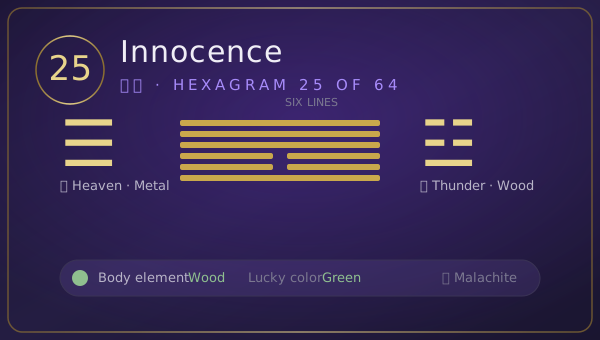
Hexagram 25 is the innocence hexagram of the I Ching: thunder moving beneath the whole sky, every creature responding without being forced. Its classical judgment reads "supreme success; favorable perseverance. What is not correct has calamity; not favorable to have somewhere to go" (元亨利贞。其匪正有眚,不利有攸往), and its image — thunder under heaven — says the early kings "flourished in responding to the seasons and nurtured all things" (茂对时,育万物). When Hexagram 25 appears in a reading, it describes the unforced: action without ulterior motive, and the hexagram's hard honesty about what happens to motives that are not clean.
The Story of Hexagram 25: The Thunder Under the Sky
The scene is an open sky with thunder rolling under all of it. Nothing is targeted. Nothing is aimed. The thunder moves, and everything alive responds — the birds lift, the animals still, the grass bends — not because they were commanded, but because the season has spoken. The old commentators found the hexagram in that universality: 无妄 is the state in which things move because they are what they are, not because they are being manipulated toward an end.
The hexagram's whole teaching is about motive, and its lines test it with uncomfortable precision. The first line is the promise: 无妄,往吉 — no ulterior motive, going forward is good fortune. The second is the hexagram's hardest sentence: 不耕获,不菑畲 — do not plow expecting the harvest, do not clear the field expecting the yield — and then the surprise: 则利有攸往, it is favorable to go. The work done without the claim on its result is the work that moves. The third line is the hexagram's famous case: 无妄之灾 — the disaster that comes to the innocent — a traveler's ox is tethered, a villager takes it, and the loss lands on the one who never touched it. The fourth line is the hexagram's center: 可贞,无咎 — perseverance is possible, no blame. The fifth is the illness that needs no medicine (无妄之疾,勿药有喜). And the final line is the hexagram's warning: 无妄行,有眚 — action taken in the name of innocence, with calamity attached.
Innocence, in this hexagram, is not naivety. It is the absence of the ulterior — and the Book's whole difficulty is that the world is full of disasters that arrive without cause and actions that fail despite good ones.
What Is Hexagram 25?
- Name: 无妄 (Wú Wàng), traditionally rendered Innocence; also translated as The Unexpected, No Error, or Freedom from Error
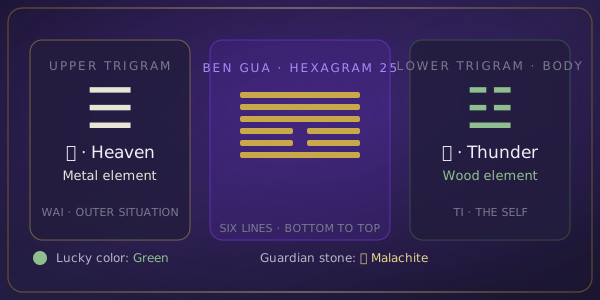
- Structure: Heaven over Thunder — the quake under the whole sky, movement without target
- Position: 25 of 64, the hexagram after Return; what the renewed cycle meets
- Element: Wood on the body trigram — the lower trigram (thunder) belongs to Wood; heaven above belongs to Metal
- Body trigram: the lower trigram (thunder, Wood), which in plum blossom divination represents the self
- Core images: thunder under the sky, the plow without the claim, the tethered ox, the illness that needs no medicine
The Core Meaning of Hexagram 25
The judgment of Hexagram 25 grants the full sequence of virtues — 元亨利贞 — to the unforced life, and then attaches the hexagram's hard condition: 其匪正有眚. What is not correct has calamity. Innocence is not the absence of standards; it is the absence of ulterior motive inside correct action. And the judgment closes with the same restriction as the stripping hexagram: 不利有攸往 — the innocent do not force their movement.
Three things this hexagram is telling you, each standing on its own:
The work is done without the claim. The second line is the hexagram's center of gravity: 不耕获,不菑畬. Do not plow for the harvest; do not clear for the yield. The hexagram's paradox is that this is precisely what makes going forward favorable (则利有攸往). Work done without the claim on its result is the only work that is actually free — and the free work is the work that moves.
Innocence does not prevent disaster. The third line is the Book's most honest sentence about the innocent: 无妄之灾 — the calamity of the unforced. The tethered ox is taken by the traveler; the loss falls on the villager who did nothing. The hexagram does not explain this away. Disasters arrive without cause, and the innocent are not exempt. What the hexagram offers is not protection but position: the one who did nothing wrong did nothing wrong.
Not every impulse named innocence is innocent. The final line is the hexagram's warning: 无妄行 — action in the name of innocence, action taken because it felt unforced — and the hexagram attaches calamity to it (有眚,无攸利). The unforced must be actually unforced, not merely untested. Motive is the hexagram's whole subject, and it is examined at every line.
The question Hexagram 25 answers is not "am I a good person?" It is: is this action actually free of the ulterior — and can I act without the claim on the result?
Hexagram 25 in Love and Relationships
If you are single: Hexagram 25 describes connection without strategy — the hexagram's counsel for the single season is its hardest sentence: do not plow expecting the harvest (不耕获). Show up, be present, do the work of being a person without the claim on the outcome. The hexagram's promise is attached to exactly this: 则利有攸往 — the forward motion belongs to the one who is not calculating it. And the third line is its comfort: 无妄之灾 — the romantic disaster that arrives without cause is real, and it is not a verdict on you.
In an early or uncertain stage: Early love under Hexagram 25 is two people meeting without strategy — and the hexagram's lines are its counsel. The first line's going forward (往吉) is the unforced approach; the second line's plow-without-harvest is the early bond that does not demand a definition; the third line's tethered ox is the misunderstanding that lands on the one who did nothing. The hexagram asks both people: is this unforced, or is it managed?
In a stable relationship: A stable relationship drawing Hexagram 25 is the bond without the claim — the daily acts done without ledger. The hexagram's counsel for long bonds is its second line: the breakfast made without being counted, the support given without being filed. And its fifth line is its long-bond image: the illness that needs no medicine (勿药有喜) — the chronic suspicion, the small wound, the thing a partner keeps treating when the treatment itself is the problem. Leave it; it heals.
In a crisis: If the relationship is at the final line — action in the name of innocence — Hexagram 25's verdict is the hexagram's hardest: 有眚,无攸利. The grand gesture made because it felt pure, the confrontation launched in the name of honesty, the leave-taking justified as freedom — the hexagram attaches calamity to all of it. The crisis counsel: examine the motive before the action, not after.
Hexagram 25 in Career, Money and Decisions
Career: This is the motive hexagram of professional life — the work done without the claim, the career advanced without the maneuver. Its career counsel is the second line: do the work for the work (不耕获), and the hexagram promises the forward motion belongs to exactly that person (则利有攸往). The third line is its career honesty: the professional disaster without cause — the reorg, the client's collapse, the market's turn — is real, and it is not a verdict. And the final line is its warning: the career move made in the name of following your truth, untested, is the one the hexagram marks 有眚.
Money: Hexagram 25 governs money without strategy — the investment made without the claim, the work done without the invoice attached in advance. Its financial counsel is the second line's discipline: plow without the harvest in mind, and the motion becomes favorable. The third line is its financial case study: the loss that arrives without cause — the tethered ox taken, the innocent villager's cost. And the fifth line's medicine is its financial comfort: the position that needs no treatment heals better than the one being over-treated.
Decision: Hexagram 25 says: act, if the action is actually unforced — and do not claim the result. If you are deciding whether to move, the hexagram's test is motive, not outcome: is this action free of the ulterior, is the work being done without the claim on its yield, and is the innocence actually innocence or merely untested? The decision it blesses is the unforced one; the decision it marks is the one named innocence without examination.
The Changing Lines of Hexagram 25: Six Scenes
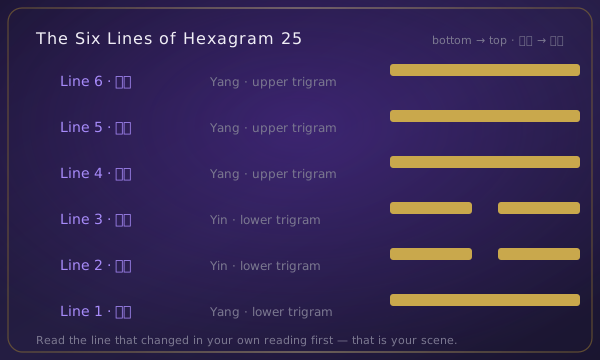
Each line of Hexagram 25 is one scene in the life of the unforced — its plows, its oxen, its medicines, and its calamities.
Line 1 (初九) — No ulterior motive; going forward is good fortune. The scene: the unforced step, taken without strategy. The modern reading: the promise line. The hexagram opens with its condition and its reward in one breath: act without the ulterior (无妄), and going forward is blessed (往吉). The freedom and the fortune are the same thing.
Line 2 (六二) — Do not plow expecting the harvest; do not clear the field expecting the yield — then it is favorable to have somewhere to go. The scene: the work done with no claim on its result. The modern reading: the keystone line. The hexagram's hardest and most quoted sentence, and its paradox: the work without the claim is the work that makes going favorable. The harvest is not the motive; the plowing is the act.
Line 3 (六三) — The calamity of the unforced: someone's ox is tethered; the traveler gains it, the villager has the disaster. The scene: the loss that lands on the one who did nothing. The modern reading: the honesty line. Disasters arrive without cause — the ox tethered, taken, and the cost falling where no fault lies. The hexagram does not explain it. It records it, and the recording is the comfort: 无妄之灾 has a name, and the name is not your fault.
Line 4 (九四) — Perseverance is possible; no blame. The scene: the position where correctness can still be held. The modern reading: the center line. Amid the hexagram's difficulties, this position can hold (可贞) and is granted 无咎. The hexagram's promise is positional: some ground still allows the unforced to remain unforced.
Line 5 (九五) — The illness of the unforced: do not medicate it — there is joy. The scene: the condition that heals because it is left alone. The modern reading: the healing line. The chronic thing — the suspicion, the small wound, the over-managed detail — gets better when the treatment stops. 勿药有喜: the medicine is the problem.
Line 6 (上九) — Action in the name of innocence: there is calamity; nothing is favorable. The scene: the unforced act that was never examined. The modern reading: the warning line. The movement taken because it felt free, the act justified as pure, the decision named innocence without the motive examined — the hexagram attaches calamity (有眚) and withdraws favor (无攸利). The unforced must be actually unforced.
When all six lines change: Hexagram 25 turns toward Hexagram 26 — innocence completed becomes great taming. The work done without the claim becomes the reserve stored without the display.
How to Read Hexagram 25 with the Number Oracle
Hexagram 25 reaches you the same way every hexagram does: through three numbers that arise naturally while you hold your question — a clock, a receipt, a page number, a number that simply surfaces. The first number sets the upper trigram, the second the lower trigram, and the third identifies the changing line. Enter your three numbers and your question at numbers-oracle.com and you will get the hexagram plus an AI interpretation written for your situation — free, no registration. For the mechanics, read how three numbers become a hexagram →
Your lucky energy for Hexagram 25: Wood element (the body trigram, thunder below). Lucky colors are green and tender sprout tones; the matching crystal is malachite, traditionally associated with growth, renewal, and fresh starts.
Related hexagrams: Hexagram 24 (Return) — the renewed cycle before the unforced life; Hexagram 26 (Great Taming) — the reserve built without the claim; Hexagram 4 (Youthful Folly) — the honest beginner, innocence's cousin.
Hexagram 25: Common Questions
What does hexagram 25 mean in one sentence?
Hexagram 25 means innocence in the sense of the unforced — supreme success belongs to action without ulterior motive, work done without the claim on its result, and the hexagram's honest caveat that disasters still arrive without cause.
Is hexagram 25 good or bad?
Hexagram 25 grants the full 元亨利贞 to the unforced life, which makes it one of the Book's strong configurations — with two hard lines. The third line names the disaster that arrives without cause (无妄之灾), and the final line marks the act named innocence without examination (无妄行,有眚). The hexagram blesses actual innocence, not performed innocence.
What should I do when I receive hexagram 25?
Check which line changed. Going forward (line 1) means the unforced step is blessed; the plow without harvest (line 2) means do the work without claiming the result; the tethered ox (line 3) means the loss without cause is not your fault; perseverance possible (line 4) means hold correctness here; the illness without medicine (line 5) means stop treating what is healing; action named innocence (line 6) means examine the motive before moving.
Why is hexagram 25 called "Innocence"?
Because its image is thunder under the whole sky — 天下雷行 — movement that touches everything and targets nothing. The old translators rendered it Innocence or The Unexpected because the hexagram's subject is the unforced: the act without the ulterior, the work without the claim, and the Book's frank acknowledgment that the innocent still meet disaster.
Thunder does not aim. That is not the same as being harmless.