I Ching Hexagram 27 (Nourishment): Meaning in Love, Career and Life
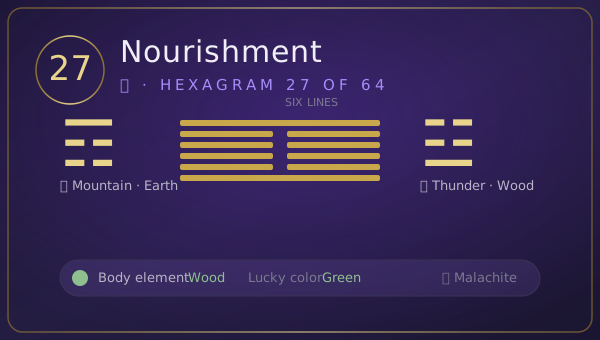
Hexagram 27 is the nourishment hexagram of the I Ching: thunder beneath the mountain, the open jaws, the question of what goes in. Its classical judgment reads "perseverance is good fortune. Observe the nourishment; seek your own mouth's filling" (贞吉。观颐,自求口实), and its image — thunder under the mountain — says the noble one "is careful in speech and moderate in eating and drinking" (慎言语,节饮食). When Hexagram 27 appears in a reading, it describes intake at every level: what feeds you, what you feed on, who feeds you — and the hexagram's exact counsel about the mouth.
The Story of Hexagram 27: The Open Jaws
The hexagram's shape is a mouth — two lines above, two below, the opening between. The old commentators read the whole hexagram from that anatomy: 颐 is about what goes in. Food, first, and everything food stands for — information, attention, affection, influence, the daily intake that becomes the body.
The judgment's instruction is startlingly direct: 观颐 — observe the nourishment — and then 自求口实: seek your own mouth's filling. Not the neighbor's. The hexagram's subject is your own intake, and the first responsibility is knowing what is actually going into you.
The lines are a sequence of mouths. The first line is the hexagram's famous opening image: 舍尔灵龟,观我朵颐 — you abandon your own spiritual turtle and watch my jaw hang open — and the verdict is 凶. The turtle is the hexagram's symbol of self-sufficiency: the creature that carries its own nourishment. Abandoning it to salivate at someone else's provision is the hexagram's first and plainest failure. The second line is the upside-down nourishment — 颠颐 — seeking feeding from the hill, going up to be fed, and the hexagram marks it 凶. The third is nourishment pushed away (拂颐), rejected, with the hexagram's hardest arithmetic: ten years not usable. The fourth is the line of the tiger's gaze — 虎视眈眈,其欲逐逐 — the fierce, focused attention that the hexagram grants 无咎, because the appetite at this line is honest and its object is clear. The fifth is the line of the bending rule (拂经) — the nourishment that goes against the grain — held at the center, and the hexagram grants 居贞吉 but forbids the crossing (不可涉大川). And the final line is the source: 由颐 — the nourishment comes from here. The hexagram's completion is the one who feeds.
What goes in becomes what you are. The hexagram's whole work is the watching of the mouth.
What Is Hexagram 27?
- Name: 颐 (Yí), traditionally rendered Nourishment; also translated as The Corners of the Mouth, Providing Nourishment, or The Jaws
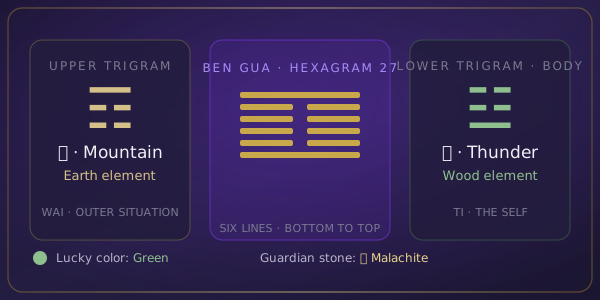
- Structure: Mountain over Thunder — the quake beneath the mass, the open mouth in the mountain's shape
- Position: 27 of 64, the hexagram after Great Taming; what the stored reserve is for
- Element: Wood on the body trigram — the lower trigram (thunder) belongs to Wood; the mountain above belongs to Earth
- Body trigram: the lower trigram (thunder, Wood), which in plum blossom divination represents the self
- Core images: the open jaws, the spiritual turtle, the hanging jaw, the tiger's gaze, the source of nourishment
The Core Meaning of Hexagram 27
The judgment of Hexagram 27 is a discipline with a practice: 贞吉 — perseverance is good fortune — 观颐,自求口实 — observe the nourishment and seek your own mouth's filling. The hexagram treats intake as the whole subject: what you eat, obviously, and also what you read, whom you listen to, whose approval you consume, what you take in daily that becomes the substance of you. And its image is the practice: 慎言语,节饮食 — careful in speech, moderate in intake. The mouth is the organ of both.
Three things this hexagram is telling you, each standing on its own:
Your own mouth is your own responsibility. 自求口实 — seek your own filling. The hexagram's first move is to locate the intake with the owner. What you are consuming is not your family's choice, your culture's choice, or your hunger's accident. The hexagram's first line is the failure of outsourcing this: watching someone else's provision with your own turtle abandoned.
The spiritual turtle is the self-sufficient intake. 灵龟 — the spirit turtle — is the old symbol of the creature that carries what feeds it. The hexagram's first warning is against abandoning your own source to salivate at another's spread. Self-sufficiency in nourishment is the hexagram's foundation, and it is abandoned one hanging jaw at a time.
Nourishment has a source, and the source is a position. The final line — 由颐, the nourishment comes from here — is the hexagram's completion: the one who feeds. The hexagram moves from the salivating mouth to the feeding source, and the whole arc is the question of which position you occupy: the one whose jaw hangs open, or the one whose provision feeds others.
The question Hexagram 27 answers is not "am I hungry?" It is: what am I taking in, whose mouth is being fed, and have I abandoned my own turtle to watch someone else's spread?
Hexagram 27 in Love and Relationships
If you are single: Hexagram 27 describes the season of intake — what you are feeding on emotionally, whose attention you are consuming, what you are taking in that becomes your relational substance. The hexagram's counsel for the single season is its first line: keep your turtle. The self-sufficient intake — your own sources of nourishment, your own fullness — is what makes you someone who can feed rather than salivate. The hanging jaw (朵颐) is the single-season warning.
In an early or uncertain stage: Early love under Hexagram 27 is a question of mutual feeding — who is nourishing whom, and what is being consumed. The hexagram's lines map it precisely: the abandoned turtle (line 1) is the early bond where one person's own sources are dropped for the other's provision; the tiger's gaze (line 4) is the honest, fierce appetite with a clear object — the hexagram grants it no blame; the bending rule (line 5) is the nourishment that goes against the grain.
In a stable relationship: A stable relationship drawing Hexagram 27 is a feeding arrangement — the daily intake of care, attention, and substance each partner provides. The hexagram's counsel for the long term is its image: 慎言语,节饮食 — careful speech, moderate intake. The mouth that feeds the bond is the same mouth that can wound it. And its final line is the long-bond promise: 由颐 — the source. Long bonds end with one partner as the source of nourishment, and the source is a position that can be held.
In a crisis: If the relationship is at the third line — nourishment rejected, ten years not usable — Hexagram 27's arithmetic is its harshest: 贞凶,十年勿用,无攸利. The feeding has been refused so completely and so long that the hexagram declares the arrangement unusable for a decade. The hexagram does not soften this. What it offers is the final line's alternative: become the source, or find one.
Hexagram 27 in Career, Money and Decisions
Career: This is the intake hexagram of professional life — what you are consuming professionally: information, mentorship, approval, the daily diet of your field. Its career counsel is the judgment: 观颐 — observe the nourishment. Audit the intake. And the image is the career discipline: 慎言语,节饮食 — careful in what you say, moderate in what you take in. The first line is the career warning: the professional who abandons their own source to salivate at another's spread.
Money: Hexagram 27 governs money as nourishment — income, provision, what feeds the household and the work. Its financial counsel: seek your own mouth's filling (自求口实) — your own sources, your own provision, not the salivation at another's spread. The fourth line's tiger gaze is its financial image: the focused, honest appetite with a clear object. The fifth line's forbidden crossing (不可涉大川) is its warning: nourishment that goes against the grain can be held (居贞吉) but not expanded.
Decision: Hexagram 27 says: audit the intake. If you are deciding what to consume — the job, the information diet, the relationship's provisions, the daily attention — the hexagram's test is its first line: is your turtle intact? The decision it blesses is always the one that keeps your own source of nourishment in place; the decision it marks is the hanging jaw.
The Changing Lines of Hexagram 27: Six Scenes
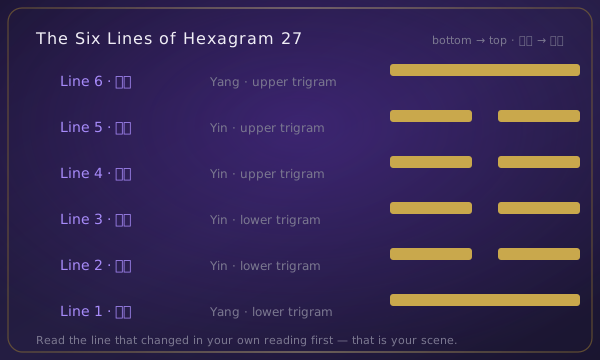
Each line of Hexagram 27 is one scene in the life of the mouth — its hanging jaw, its rejected nourishment, its tiger's gaze, and its source.
Line 1 (初九) — You abandon your spirit turtle and watch my jaw hang open; misfortune. The scene: the self-sufficient creature traded for salivation. The modern reading: the failure line. Abandoning your own source of nourishment to watch someone else's spread — the hexagram's first and plainest 凶. The turtle is the whole teaching: the creature that carries its own feeding.
Line 2 (六二) — Nourishment turned upside down; going up to the hill for feeding; perseverance is ominous. The scene: the mouth seeking feeding from above. The modern reading: the dependency line. Seeking nourishment from the hill — the wrong direction, the wrong source, the wrong order. The hexagram marks the perseverance in this position ominous (征凶): the dependency held is the dependency that hardens.
Line 3 (六三) — Nourishment pushed away; perseverance is ominous; for ten years it cannot be used; nothing is favorable. The scene: the feeding refused, long and completely. The modern reading: the hexagram's hardest line. The nourishment rejected — the care refused, the provision pushed away — and the hexagram's arithmetic: ten years not usable. What has been refused this completely does not reopen on the schedule of the refuser.
Line 4 (六四) — Nourishment turned upside down; good fortune. The tiger gazes down, its desire pursuing; no blame. The scene: the fierce, focused appetite with a clear object. The modern reading: the appetite line. The tiger's gaze — 眈眈, focused, unhurried, entirely intent — is the honest appetite, and the hexagram grants it 吉 and 无咎. What it blesses is not the hunger but the clarity: the object is seen, and the seeing is steady.
Line 5 (六五) — Going against the rule of nourishment; dwelling in perseverance is good fortune; not favorable to cross the great water. The scene: the nourishment that bends the grain, held at the center. The modern reading: the center line and its limit. The feeding arrangement that goes against the natural order can be held (居贞吉) but not expanded — the hexagram forbids the crossing (不可涉大川). Some nourishments are sustainable at their size and no larger.
Line 6 (上九) — The source of nourishment; danger, but good fortune; favorable to cross the great water. The scene: the one who feeds. The modern reading: the completion line. 由颐 — the nourishment comes from here. The hexagram's destination: the position of the source, feeding others from your own fullness. The hexagram attaches 厉 (danger — sources carry weight) and then grants both the good fortune and the crossing: 厉吉,利涉大川.
When all six lines change: Hexagram 27 turns toward Hexagram 28 — nourishment completed becomes great excess. The source that has fed becomes the load that must be carried.
How to Read Hexagram 27 with the Number Oracle
Hexagram 27 reaches you the same way every hexagram does: through three numbers that arise naturally while you hold your question — a clock, a receipt, a page number, a number that simply surfaces. The first number sets the upper trigram, the second the lower trigram, and the third identifies the changing line. Enter your three numbers and your question at numbers-oracle.com and you will get the hexagram plus an AI interpretation written for your situation — free, no registration. For the mechanics, read how three numbers become a hexagram →
Your lucky energy for Hexagram 27: Wood element (the body trigram, thunder below). Lucky colors are green and tender sprout tones; the matching crystal is malachite, traditionally associated with growth, renewal, and fresh starts.
Related hexagrams: Hexagram 26 (Great Taming) — the stored reserve that becomes the meal; Hexagram 48 (The Well) — the other source hexagram, nourishment shared; Hexagram 5 (Need) — the feast held before the crossing.
Hexagram 27: Common Questions
What does hexagram 27 mean in one sentence?
Hexagram 27 means nourishment — perseverance through watching what you take in, seeking your own mouth's filling, and the hexagram's warning against abandoning your own source to salivate at another's spread.
Is hexagram 27 good or bad?
Hexagram 27 is favorable at its foundation (贞吉) and grades its own mouths. The hanging jaw and the rejected feeding are its named misfortunes; the tiger's focused gaze and the source position are its named goods. The hexagram judges the intake — its source, its object, and its order — not the hunger.
What should I do when I receive hexagram 27?
Check which line changed. The abandoned turtle (line 1) means keep your own source of nourishment; upside-down feeding (line 2) means the dependency is in the wrong direction; nourishment rejected (line 3) means what has been refused this long does not reopen on schedule; the tiger's gaze (line 4) means the honest appetite with a clear object is blameless; against the grain (line 5) means hold it but do not expand it; the source (line 6) means feed from your own fullness.
Why is hexagram 27 called "Nourishment"?
Because its shape is a mouth — the open jaws — and its whole subject is intake: what goes in, at every level, and what the intake becomes. The old translators rendered it Nourishment or The Corners of the Mouth because the hexagram treats the mouth as the organ of both feeding and speaking, and makes the watching of it the whole discipline.
The turtle carries its own feeding. That is the entire hexagram in one image.