I Ching Hexagram 28 (Preponderance of the Great): Meaning in Love, Career and Life
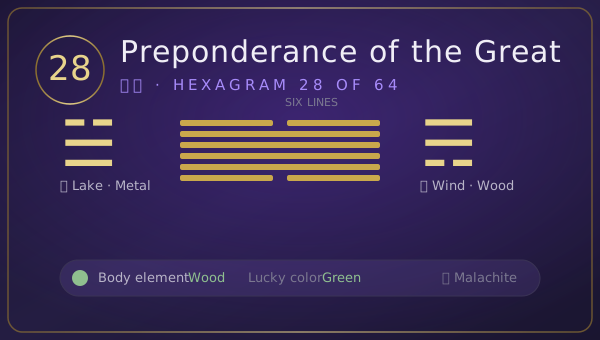
Hexagram 28 is the great-excess hexagram of the I Ching: the lake flooding the wood, the tree submerged under weight it was never shaped to carry. Its classical judgment reads "the ridgepole bends; favorable to have somewhere to go; success" (栋桡,利有攸往,亨), and its image — the lake drowning the tree — says the noble one "stands alone without fear, and withdraws from the world without resentment" (独立不惧,遯世无闷). When Hexagram 28 appears in a reading, it describes overload: the load that exceeds the structure — and the hexagram's counsel about how extraordinary weight is carried by extraordinary posture.
The Story of Hexagram 28: The Ridgepole and the Flood
The hexagram's structure is its situation: four strong lines in the middle, the weight concentrated where the structure is weakest. The image is a lake that has risen past the tree's roots — the wood submerged, the lake heavier than what holds it. And the judgment names the symptom exactly: 栋桡 — the ridgepole bends. The roof's central beam, under more than it was cut to bear, is curving.
The old commentators were struck by the hexagram's paradox: it grants movement and success (利有攸往,亨) to the most overloaded configuration in the Book. The reason is in the image. 独立不惧,遯世无闷 — the noble one stands alone without fear and retreats from the world without resentment. Overload requires a posture that ordinary times do not: the willingness to be alone under the weight, and the willingness to walk away from the world's opinion about the weight.
The lines are a sequence of load-carryings. The first is the hexagram's foundational image: 藉用白茅 — the offering mat laid with white grass beneath it. Nothing is wrong; the excess is precaution. The hexagram grants it 无咎. The second line is the hexagram's famous image: 枯杨生稊 — the withered poplar growing new shoots — the old man taking the young wife, and the hexagram grants 无不利. The third line is the warning: 栋桡,凶 — the ridgepole actually bending, and the Book's verdict is 凶. The fourth line is the ridgepole corrected — 栋隆, the beam rising true — with the hexagram's caveat: 有它吝, there is another small regret. The fifth line is the second withered poplar: 枯杨生华 — the old willow flowering — the old woman with the young husband, and the hexagram's honest arithmetic: 无咎无誉, no blame and no praise. And the final line is the hexagram's extremity: 过涉灭顶 — wading so far the water covers the head — and the Book's strange double verdict: 凶,无咎.
Excess is not the sin. The posture under excess is the whole question.
What Is Hexagram 28?
- Name: 大过 (Dà Guò), traditionally rendered Preponderance of the Great; also translated as Great Excess, Excess of the Great, or Critical Mass
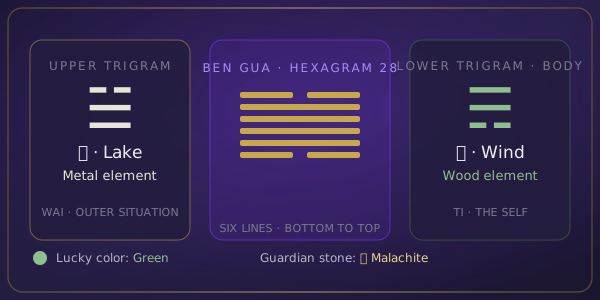
- Structure: Lake over Wood — the water flooding the tree, weight over what supports it
- Position: 28 of 64, the hexagram after Nourishment; what the source that fed becomes
- Element: Wood on the body trigram — the lower trigram (wood) belongs to Wood; the lake above belongs to Metal
- Body trigram: the lower trigram (wood, Wood), which in plum blossom divination represents the self
- Core images: the bending ridgepole, the flooded tree, the white grass beneath the mat, the withered poplar's new shoots, the water over the head
The Core Meaning of Hexagram 28
The judgment of Hexagram 28 is the Book's most honest statement about overload: the ridgepole bends (栋桡) — and going somewhere is favorable (利有攸往,亨). The configuration is extreme and the movement is blessed, because the hexagram's subject is not the weight but the posture. What carries extraordinary load is not a stronger beam; it is the stance of the one standing under it.
Three things this hexagram is telling you, each standing on its own:
Excess is a structure problem before it is a virtue problem. The hexagram's geometry is exact: the weight is in the middle, and the structure is weakest there. Overload fails at the center, and the center is where the judgment points. The first question of a 大过 season is structural: what is actually bearing this, and is it curved yet?
The posture is the solution. The image is the hexagram's whole counsel: 独立不惧,遯世无闷. Standing alone without fear; retreating from the world without resentment. Overload is carried by the one willing to be alone under it — not cheered, not understood, not accompanied. The hexagram grants its success (亨) to exactly this posture.
Precaution and honesty are the load's accessories. The first line's white grass beneath the mat is excess as precaution — the extra care under something that will hold. The third line's bending ridgepole is the failure to be honest about the curve. And the final line's water-over-the-head is the extremity, with the Book's strange mercy: 凶,无咎 — misfortune, and no blame. The one who went too far is not blamed for going too far.
The question Hexagram 28 answers is not "is this too much?" It is: is the structure still true, is my posture the one that carries this, and am I being honest about the bend?
Hexagram 28 in Love and Relationships
If you are single: Hexagram 28 describes a season of unusual weight — the self carrying more than its structure was cut for. The hexagram's counsel for the single season is its image: stand alone without fear (独立不惧), retreat without resentment (遯世无闷). Overload in the self is carried by the posture, not by rescue. And the first line is its quiet practice: the white grass — the extra care laid under things that will hold.
In an early or uncertain stage: Early love under Hexagram 28 is two overloaded structures meeting — each person carrying more than their shape. The hexagram's lines are its counsel: the white grass (line 1) is the extra precaution in the early bond; the withered poplar's new shoots (line 2) is the unlikely renewal — the hexagram grants it 无不利; the bending ridgepole (line 3) is the early bond loaded past its structure, and the verdict is 凶.
In a stable relationship: A stable relationship drawing Hexagram 28 is in overload — the household, the work, the care, the years, all landing on the same ridgepole. The hexagram's counsel for the long bond is structural honesty: is the pole still true (栋隆) or is it bending (栋桡)? And its image is the long-bond posture: 独立不惧 — the one who can stand alone under the weight without resentment is the one the load does not break. Long bonds survive overload by the posture, not by the denial of the weight.
In a crisis: If the relationship is at the final line — the water over the head — Hexagram 28's double verdict is its crisis counsel: 凶,无咎. The extremity is real (凶), and the blame is not (无咎). The one who waded too far is not blamed for the wading. What the hexagram offers in crisis is exactly this: the honesty about the extremity, and the release from the blame.
Hexagram 28 in Career, Money and Decisions
Career: This is the overload hexagram of professional life — the role that exceeds its holder, the project past its structure, the season when the load is in the middle and the middle is weakest. Its career counsel is the hexagram's structure: be honest about the bend (栋桡 is the failure to be honest), correct the pole (栋隆), and take the image's posture — stand alone without fear, retreat without resentment. The first line's white grass is its career practice: the extra precaution under the load that will hold.
Money: Hexagram 28 governs money under extreme load — the leverage, the stretched commitment, the structure carrying what it was not cut for. Its financial counsel is structural: the ridgepole is the balance sheet's center, and the hexagram's first question is whether it is true or curved. The first line's white grass is the financial precaution — the extra margin laid under the position that will hold. And the final line is its honest extremity: 过涉灭顶,凶,无咎 — the position that went too far is not blamed for the going.
Decision: Hexagram 28 says: the load is real — check the pole and fix your posture. If you are deciding whether to carry this, the hexagram's test is threefold: is the structure still true (the center, the ridgepole), is my posture the one that carries (alone, unresentful), and am I honest about the bend? The decision it blesses is the movement under the honest pole; the decision it marks is the load carried on a curve nobody named.
The Changing Lines of Hexagram 28: Six Scenes
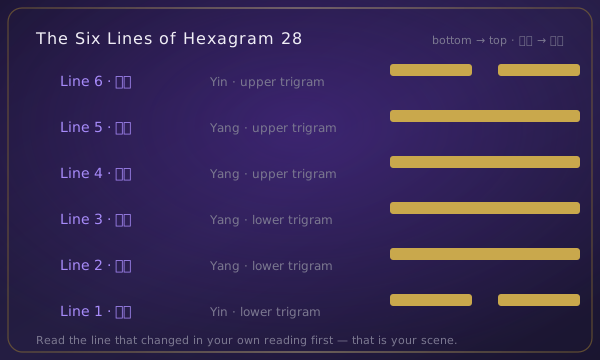
Each line of Hexagram 28 is one scene in the life of an overload — its precautions, its renewals, its bends, its corrections, and its extremity.
Line 1 (初六) — The offering mat laid with white grass beneath it; no blame. The scene: the extra care under something that will hold. The modern reading: the precaution line. Excess at its foundation is precaution — the white grass beneath the mat, the extra margin under the load that is sound. The hexagram grants it 无咎: the over-careful beginning is blameless.
Line 2 (九二) — The withered poplar grows new shoots; the old man takes the young wife; nothing is unfavorable. The scene: the improbable renewal, the dead wood shooting green. The modern reading: the renewal line. The hexagram's famous image of unlikely life — the old structure, the unexpected growth — and its verdict is 无不利. Overload seasons produce their strangest renewals.
Line 3 (九三) — The ridgepole bends; misfortune. The scene: the central beam under too much, curving. The modern reading: the failure line and the hexagram's core warning. The weight is in the middle and the middle is weakest — the pole bends, and the Book's verdict is unqualified: 凶. The failure is not the weight; it is the dishonesty about the curve.
Line 4 (九四) — The ridgepole rises true; good fortune. There is another small regret. The scene: the beam corrected, the structure honest again. The modern reading: the correction line. The pole straightened — the load redistributed, the structure made true — and the hexagram grants 吉 with a caveat: 有它吝. The correction is good, and it leaves a residue. Both are true.
Line 5 (六五) — The withered willow flowers; the old woman takes the young husband; no blame, no praise. The scene: the second improbable renewal, and the hexagram's honest accounting. The modern reading: the center line and its neutrality. 无咎无誉 — no blame and no praise. Some overloads are carried without either honor or disgrace; the hexagram refuses to romanticize the second poplar.
Line 6 (上六) — Wading across, the water covers the head; misfortune, and no blame. The scene: the extremity — the crossing taken too far, the water over the head. The modern reading: the completion line and the hexagram's strange mercy. 凶,无咎 — the extremity is real, and the blame is not. The one who went too far under the load is not condemned for the going. The hexagram's final honesty.
When all six lines change: Hexagram 28 turns toward Hexagram 29 — great excess completed becomes the abyss. The load that submerged becomes the water that tests.
How to Read Hexagram 28 with the Number Oracle
Hexagram 28 reaches you the same way every hexagram does: through three numbers that arise naturally while you hold your question — a clock, a receipt, a page number, a number that simply surfaces. The first number sets the upper trigram, the second the lower trigram, and the third identifies the changing line. Enter your three numbers and your question at numbers-oracle.com and you will get the hexagram plus an AI interpretation written for your situation — free, no registration. For the mechanics, read how three numbers become a hexagram →
Your lucky energy for Hexagram 28: Wood element (the body trigram, the wood below). Lucky colors are green and tender sprout tones; the matching crystal is malachite, traditionally associated with growth, renewal, and fresh starts.
Related hexagrams: Hexagram 27 (Nourishment) — the source that becomes the load; Hexagram 62 (Small Excess) — the same excess at small scale; Hexagram 29 (The Abysmal) — the water that tests.
Hexagram 28: Common Questions
What does hexagram 28 mean in one sentence?
Hexagram 28 means preponderance of the great — the load that exceeds the structure, where success belongs to the one who checks the ridgepole honestly and carries the weight with the posture of standing alone without fear.
Is hexagram 28 good or bad?
Hexagram 28 grants movement and success to its overloaded configuration (利有攸往,亨) — with one hard line. The bending ridgepole is 凶. The hexagram is favorable for the honest structure and the unresentful posture, and unfavorable for the curve nobody names.
What should I do when I receive hexagram 28?
Check which line changed. The white grass (line 1) means add precaution under what will hold; the withered poplar's shoots (line 2) means the improbable renewal is available; the bending ridgepole (line 3) means stop and tell the truth about the load; the ridgepole rising true (line 4) means correct the structure and accept the residue; the flowering willow (line 5) means carry it without blame or praise; water over the head (line 6) means the extremity is real and the blame is not.
Why is hexagram 28 called "Preponderance of the Great"?
Because its structure is its subject — four strong lines in the middle, the weight concentrated where the structure is weakest, the lake flooding the tree. The old translators rendered it Great Excess or Preponderance of the Great because the hexagram's whole teaching is about overload: the ridgepole, the posture, and the honesty about the bend.
The pole does not lie about the weight. It curves.