I Ching Hexagram 29 (The Abysmal): Meaning in Love, Career and Life
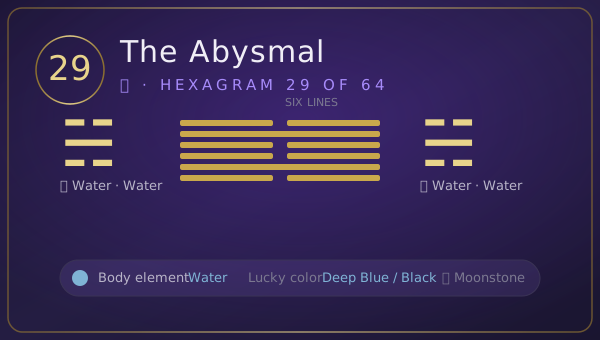
Hexagram 29 is the abysmal hexagram of the I Ching: water upon water, the ravine inside the ravine, danger doubled. Its classical judgment reads "with sincerity, the heart is nourished to success; action is honored" (有孚,维心亨,行有尚), and its image — water coming again and again — says the noble one "walks in constant virtue and practices the work of teaching" (常德行,习教事). When Hexagram 29 appears in a reading, it describes the pit: real danger, honestly named — and the hexagram's exact counsel about what carries a person through water that has no bottom in it.
The Story of Hexagram 29: The Ravine Inside the Ravine
The hexagram's structure is its first lesson: water over water. Not one difficulty — two, stacked. The old commentators called it 习坎, the ravine repeated, the pit inside the pit, and they noted that every other hexagram in the Book names its situation once. This one names it twice, because some dangers are not events — they are terrains. You do not pass through the abyss; you travel in it.
The judgment is the hexagram's whole counsel compressed: 有孚 — sincerity — 维心亨 — the heart is what is nourished to success — 行有尚 — action is honored. Notice what the hexagram does not promise: it does not promise the water recedes. What it promises is that the heart, held sincere, passes through — and that movement inside the pit (not out of it, not yet) is what earns honor.
The lines are a sequence of descents and the few places of footing. The first line is the pit within the pit (入于坎窞) — the fall inside the fall — and the verdict is 凶. The second is the abyss with its hazard, and the small gain that is still available (求小得). The third is the hexagram's most human line: coming to ravine after ravine, danger and then more danger, falling into the pit — and the instruction is 勿用, do not act. The fourth line is the hexagram's hidden center: a cup of wine and a basket of food, earthenware vessels, the offering passed through the window (樽酒簋贰,用缶,纳约自牖) — the simplest provision, honestly exchanged in the dark — and the hexagram grants 终无咎. The fifth line is the ravine not filled, the water leveled (坎不盈,祗既平) — the pit that has stopped growing — and 无咎. And the final line is the hexagram's extremity: bound with cords, planted among thorns, three years not free (系用徽纆,寘于丛棘,三岁不得) — and the Book's verdict is simply 凶.
The abyss does not end. The hexagram never claims it does. What it claims is that the heart can be held, the small gain can be taken, and the window can be used.
What Is Hexagram 29?
- Name: 坎 (Kǎn), traditionally rendered The Abysmal; also translated as The Pit, Danger, or Repeated Danger
- Structure: Water over Water — the ravine within the ravine, danger doubled
- Position: 29 of 64, the hexagram after Great Excess; what the flood becomes
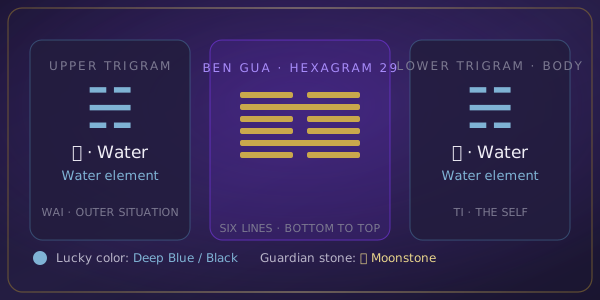
- Element: Water on the body trigram — the lower trigram (water) belongs to Water; water above also belongs to Water
- Body trigram: the lower trigram (water, Water), which in plum blossom divination represents the self
- Core images: the ravine inside the ravine, the cup of wine through the window, the unfilled pit, the cords and the thorns
The Core Meaning of Hexagram 29
The judgment of Hexagram 29 is the Book's manual for terrain that has no exit: 有孚,维心亨,行有尚. Sincerity; the heart nourished to success; action honored. The hexagram does not promise rescue, and it does not recommend fighting the water. What it locates is the one thing that can be held in a pit — the heart, kept sincere — and it grants honor to the action taken inside the danger rather than the escape from it.
Three things this hexagram is telling you, each standing on its own:
Some dangers are terrain, not events. Water upon water — the hexagram names its situation twice because pits do not happen to you once. The person in a 坎 season is not passing through difficulty; they are living in it, and the hexagram's counsel is written for a resident, not a traveler.
The heart is what is nourished. 维心亨 — the hexagram's exact promise is not about the water. It is about the heart. In terrain with no bottom, the resource that can be maintained is sincerity, and the hexagram's image says how: 常德行,习教事 — walk in constant virtue, practice the work of teaching. The daily practice, repeated, is what holds a person in a pit.
Small gains are available, and the window is the way. The second line's small gain (求小得) and the fourth line's window (纳约自牖) are the hexagram's two practical counsels. In the pit, the available movement is small and honest — the cup of wine, the basket of food, the provision passed through the window. Not the grand rescue; the window.
The question Hexagram 29 answers is not "how do I get out?" It is: what holds my heart in this terrain, and what is the smallest honest movement available?
Hexagram 29 in Love and Relationships
If you are single: Hexagram 29 describes a season of doubled difficulty in the self — the pit inside the pit — and the hexagram's counsel for the single season is its judgment: hold the heart sincere (维心亨), and do not mistake the pit for a permanent verdict on connection. The hexagram's fourth line is its quiet promise: the cup of wine through the window. Honest provision, passed through the smallest opening, is how the pit is survived.
In an early or uncertain stage: Early love under Hexagram 29 is two people in difficult terrain — each carrying a pit, the relationship itself a ravine. The hexagram's counsel for early bonds in danger: the smallest honest exchanges (line 4's window), the small gains that are actually available (line 2), and the instruction of the third line — 勿用 — do not act. Some seasons forbid the grand gesture; the pit is one of them.
In a stable relationship: A stable relationship drawing Hexagram 29 is in a long danger — the hard years, the illness, the debt, the grief, the terrain with no exit in sight. The hexagram's counsel for the long bond is its image: 常德行 — walk in constant virtue. The daily practice, repeated without drama, is what holds. And its fifth line is its promise: 坎不盈,祗既平 — the ravine not filled, the water leveled. The pit has stopped growing. That is not the exit, and the hexagram grants it 无咎 anyway.
In a crisis: If the relationship is at the final line — the cords and the thorns, three years not free — Hexagram 29's verdict is 凶, and the hexagram does not soften it. Some pits hold. What the hexagram offers in the extremity is not false hope but its judgment's standing promise: 有孚 — the sincerity is still available, still the thing that is nourished, still the only asset the water cannot take.
Hexagram 29 in Career, Money and Decisions
Career: This is the pit hexagram of professional life — the doubled difficulty, the terrain with no exit: the failing quarter, the hostile organization, the career in a ravine. Its career counsel is the judgment: hold the heart sincere, and take the small available gain (求小得). The image is the career discipline: 常德行,习教事 — the daily practice, repeated. And the third line is its clearest instruction: 勿用 — in the deepest pit, do not act. The action the pit forbids is the desperate one.
Money: Hexagram 29 governs money in danger — the drawdown, the leverage, the season when the terrain itself is the problem. Its financial counsel is the fourth line's window: 樽酒簋贰,用缶 — the cup of wine, the basket of food, earthenware vessels. The simplest honest provision, exchanged directly (纳约自牖). In a financial pit, the available movement is small, honest, and through the smallest opening. The fifth line is its financial promise: the ravine not filled — the loss that has stopped growing — is granted no blame.
Decision: Hexagram 29 says: hold the heart, take the small gain, use the window. If you are deciding what to do inside danger, the hexagram's test is its own geometry: is this terrain rather than event (am I living in it, not passing through), is my heart the thing being maintained, and is my movement the smallest honest one? The decision it blesses is the sincere small one; the decision it marks is the desperate large one (勿用 — the pit forbids it).
The Changing Lines of Hexagram 29: Six Scenes
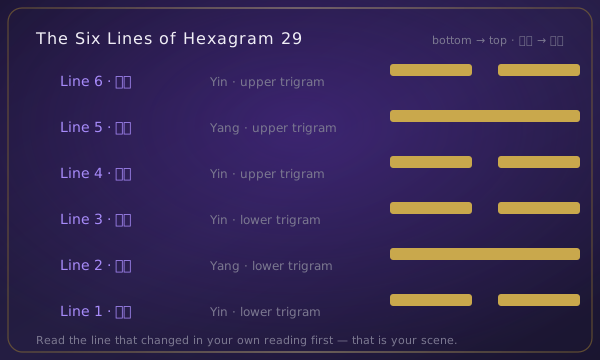
Each line of Hexagram 29 is one scene in the life of the abyss — its pits within pits, its small gains, its window, its leveling, and its cords.
Line 1 (初六) — The repeated ravine; falling into the pit within the pit; misfortune. The scene: the fall inside the fall. The modern reading: the descent line. The pit inside the pit — the second difficulty landing inside the first — and the Book's verdict is 凶. The hexagram does not soften the bottom.
Line 2 (九二) — The ravine has its hazard; seek the small gain. The scene: the danger with a small available movement. The modern reading: the pragmatism line. In the pit, the available gain is small — and the hexagram's counsel is to take it (求小得). The small gain taken is how the pit is crossed, one honest step at a time.
Line 3 (六三) — Coming to ravine after ravine; danger and more danger; falling into the pit; do not act. The scene: the deepest point of the hexagram, and its instruction. The modern reading: the stillness line. 来之坎坎,险且枕,入于坎窞,勿用 — ravine upon ravine, and the instruction is the whole teaching: do not act. In the deepest pit, the desperate movement is the forbidden one.
Line 4 (六四) — A cup of wine and a basket of food, earthenware vessels; the offering passed through the window; in the end, no blame. The scene: the simplest provision, exchanged honestly in the dark. The modern reading: the hidden center and the hexagram's quiet masterpiece. The window (纳约自牖) — the smallest opening, the plainest offering, the most direct exchange — is how the pit is survived. The hexagram grants it 终无咎.
Line 5 (九五) — The ravine is not filled; the water is only leveled; no blame. The scene: the pit that has stopped growing. The modern reading: the center line. 坎不盈,祗既平 — the ravine not filled, the water merely flat. This is not the exit, and the hexagram grants it 无咎 anyway. The pit that stops deepening is its own kind of rescue.
Line 6 (上六) — Bound with black cords, planted among the thorns; three years not free; misfortune. The scene: the pit that holds. The modern reading: the extremity line. 系用徽纆,寘于丛棘,三岁不得 — the cords, the thorns, the three years. The Book's verdict is 凶, and the hexagram does not decorate the bottom of the abyss.
When all six lines change: Hexagram 29 turns toward Hexagram 30 — the abyss completed becomes clinging. The water that tested becomes the fire that illuminates.
How to Read Hexagram 29 with the Number Oracle
Hexagram 29 reaches you the same way every hexagram does: through three numbers that arise naturally while you hold your question — a clock, a receipt, a page number, a number that simply surfaces. The first number sets the upper trigram, the second the lower trigram, and the third identifies the changing line. Enter your three numbers and your question at numbers-oracle.com and you will get the hexagram plus an AI interpretation written for your situation — free, no registration. For the mechanics, read how three numbers become a hexagram →
Your lucky energy for Hexagram 29: Water element (the body trigram, water upon water). Lucky colors are deep blue and black; the matching crystal is moonstone, traditionally associated with intuition, dreams, and emotional flow.
Related hexagrams: Hexagram 28 (Great Excess) — the flood before the abyss; Hexagram 30 (The Clinging) — the light after the water; Hexagram 47 (Oppression) — the abyss from the inside.
Hexagram 29: Common Questions
What does hexagram 29 mean in one sentence?
Hexagram 29 means the abysmal — danger doubled, where the hexagram's promise is not escape but the heart nourished to success through sincerity, small honest gains, and the window.
Is hexagram 29 always bad?
Hexagram 29 is the Book's danger hexagram — water upon water — but its judgment contains a promise: 有孚,维心亨,行有尚. The heart is nourished; action is honored. Its middle lines grant small gains, no blame at the leveling, and the window's honest exchange. The hexagram is unfavorable at its bottom (lines 1 and 6 are 凶) and favorable for the one who holds the heart.
What should I do when I receive hexagram 29?
Check which line changed. The pit within the pit (line 1) means the second fall is the real one; the small gain (line 2) means take what is actually available; ravine upon ravine (line 3) means do not act — the pit forbids the desperate move; the window (line 4) means the smallest honest exchange is the way; the leveling (line 5) means the loss has stopped growing; the cords (line 6) means this pit is holding — keep the sincerity anyway.
Why is hexagram 29 called "The Abysmal"?
Because its structure is water over water — 水洊至,习坎 — the ravine repeated, danger doubled. The old translators rendered it The Abysmal or The Pit because the hexagram names its situation twice: some dangers are not events you pass through but terrain you live in, and the Book wrote this hexagram for residents.
The abyss does not end. The heart can still be held. That is the whole promise.