I Ching Hexagram 30 (The Clinging): Meaning in Love, Career and Life
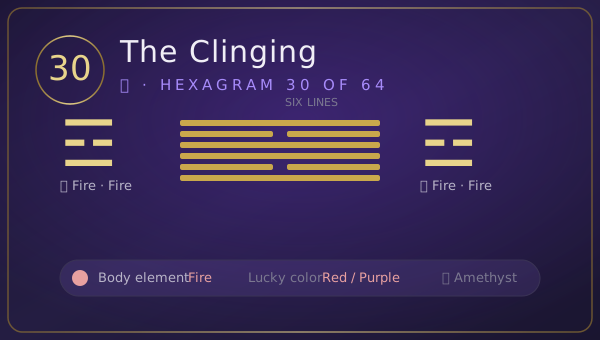
Hexagram 30 is the clinging hexagram of the I Ching: fire upon fire, clarity doubled, the light that depends on what it burns. Its classical judgment reads "favorable perseverance; success. Rearing the cow of the female brings good fortune" (利贞,亨。畜牝牛,吉), and its image — brightness rising twice — says the great man "continues the brightness and illuminates the four quarters" (继明照于四方). When Hexagram 30 appears in a reading, it describes attachment at full clarity: what you cling to, what clings to you, and the exact conditions under which light stays light.
The Story of Hexagram 30: The Fire That Depends
The scene is a fire, watched closely. It does not burn by itself — it depends on fuel, on air, on the thing it consumes. And it does not light by itself — it depends on a spark, a source, a continuity. The old commentators found the hexagram in that dependence: 离 means to cling, to attach, to depend on. Fire is the element that cannot exist alone. Everything that is clear in this world is clear by depending on something.
The judgment names the discipline: 利贞 — favorable perseverance — and then the hexagram's strange instruction: 畜牝牛,吉 — rear the cow of the female. The commentators read it as a counsel of gentleness: clarity at its peak is kept by yielding, not by force. Fire clings; the cow submits to the halter. Brightness that does not insist on its own direction is brightness that lasts.
The lines are the life cycle of a flame. The first is the steps taken in confusion, and the reverence that carries them (履错然,敬之无咎) — the beginning of clarity is careful stepping. The second is the hexagram's center: 黄离,元吉 — yellow brightness, supreme good fortune — the color of the center, the light that holds the middle. The third is the sun at three in the afternoon (日昃之离) — the setting light, and the hexagram's warning: if you do not drum on the pot and sing, you will end with the old man's sigh (不鼓缶而歌,则大耋之嗟,凶). The fourth is the hexagram's violent image: 突如其来如,焚如,死如,弃如 — the flame that comes suddenly, burns, dies, and is cast away. The fifth is the hexagram's grief: 出涕沱若,戚嗟若 — the tears pouring, the sighing — and its verdict is 吉. And the final line is the flame as the king's campaign: 王用出征,有嘉折首 — the king marches, cuts off the head of the enemy, and takes no captives. Clarity that has become decisive.
The fire depends on what it burns. That is not the fire's weakness. That is the fire's nature.
What Is Hexagram 30?
- Name: 离 (Lí), traditionally rendered The Clinging; also translated as Fire, The Radiance, or Brightness
- Structure: Fire over Fire — brightness doubled, clarity depending on clarity
- Position: 30 of 64, the hexagram after The Abysmal; what the water that tested becomes
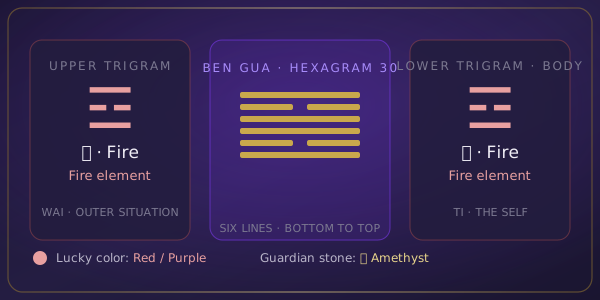
- Element: Fire on the body trigram — the lower trigram (fire) belongs to Fire; fire above also belongs to Fire
- Body trigram: the lower trigram (fire, Fire), which in plum blossom divination represents the self
- Core images: the doubled flame, the cow of the female, yellow brightness, the sun at three in the afternoon, the king's campaign
The Core Meaning of Hexagram 30
The judgment of Hexagram 30 grants perseverance and success to the clinging configuration — 利贞,亨 — and adds the hexagram's signature condition: 畜牝牛,吉. Clarity is kept by the yielding principle, not the forceful one. The image says what the clarity is for: 继明照于四方 — the great man continues the brightness and illuminates the four quarters. Light does not hoard itself; it depends on being transmitted.
Three things this hexagram is telling you, each standing on its own:
Everything clear depends on something. Fire upon fire — the hexagram's whole structure is dependence. What you cling to (person, practice, source, discipline) is what your clarity is made of. The hexagram asks you to know your fuel, because the flame that does not know what it burns is the flame that burns what it should not.
Clarity is kept by yielding. The cow of the female is the hexagram's central image of gentle strength. Brightness at its peak is fragile in one specific way: it hardens. The light that insists on its own direction becomes the fourth line's sudden flame — 焚如,死如,弃如 — burning, dying, discarded. The light that submits to the halter is the light that continues (继明).
Brightness has a time of day, and the afternoon has its own discipline. The third line is the hexagram's most human teaching: the sun at three in the afternoon. The light that is past its peak has exactly two options — drum on the pot and sing (鼓缶而歌, the acceptance of the decline) or end with the old man's sigh (大耋之嗟). The hexagram attaches 凶 to the sigh. The afternoon is not the failure; the refusal of the afternoon is.
The question Hexagram 30 answers is not "am I clear?" It is: what is my clarity clinging to, is it yielding enough to last, and do I know what time of day it is?
Hexagram 30 in Love and Relationships
If you are single: Hexagram 30 describes the season of clarity in the self — the light you carry, and what it depends on. The hexagram's counsel for the single season: know your fuel (everything clear depends on something), keep the yielding principle (畜牝牛), and know your time of day. The fourth line's sudden flame is the single-season warning: the connection that burns suddenly, brilliantly, and briefly is the flame that was never going to last.
In an early or uncertain stage: Early love under Hexagram 30 is two flames clinging — the clarity between them depends on what it burns. The hexagram's lines map it: the careful stepping of the beginning (line 1), the yellow brightness of the center (line 2 — the light that holds the middle), the afternoon light (line 3 — knowing what time of day the bond is in), and the sudden flame (line 4 — the burn that ends in discard).
In a stable relationship: A stable relationship drawing Hexagram 30 is the long clinging — the bond that has stayed clear for years. The hexagram's counsel for the long term is its judgment: 畜牝牛 — the yielding principle. Long clarity is kept by gentleness, not force. And its third line is the long-bond honesty: every bond has its afternoon. The ones that last are the ones that drum on the pot and sing — that accept the decline of intensity without sighing after the noon that has passed.
In a crisis: If the relationship is at the fifth line — the tears pouring, the sighing — Hexagram 30's verdict is 吉, and this is one of the hexagram's most compassionate moments. The grief of clarity — the honest crying about what is seen — is itself the good fortune. And the final line is the hexagram's decisive image: the campaign that cuts off the head and takes no captives. Some crises are ended by decisiveness, not by negotiation.
Hexagram 30 in Career, Money and Decisions
Career: This is the clarity hexagram of professional life — the insight, the visibility, the position that illuminates. Its career counsel is the judgment: keep clarity by yielding (畜牝牛), continue the brightness (继明), and know your fuel. The third line is the career warning about the afternoon: the professional at the peak who will not drum on the pot and sing is the one the hexagram marks 凶. The fourth line is its harder warning: the sudden rise that burns out (突如其来如,焚如,死如,弃如).
Money: Hexagram 30 governs money at full clarity — the visible position, the transparent deal, the peak cycle. Its financial counsel: the yielding principle keeps it (畜牝牛,吉) — the portfolio that does not insist on its own direction outlasts the one that forces. The third line's afternoon is its timing discipline: know what time of day the cycle is in, and act accordingly — the pot-and-sing acceptance or the sigh. The final line's decisive campaign is its permission for the clean exit: cut off the head, take no captives, end it completely.
Decision: Hexagram 30 says: stay clear, stay yielding, and know your hour. If you are deciding how to hold what you see — the position, the insight, the bond, the cycle — the hexagram's test is threefold: do I know what my clarity depends on, is it yielding enough to continue, and do I know what time of day it is? The decision it blesses is the continuing light; the decision it marks is the sudden flame.
The Changing Lines of Hexagram 30: Six Scenes
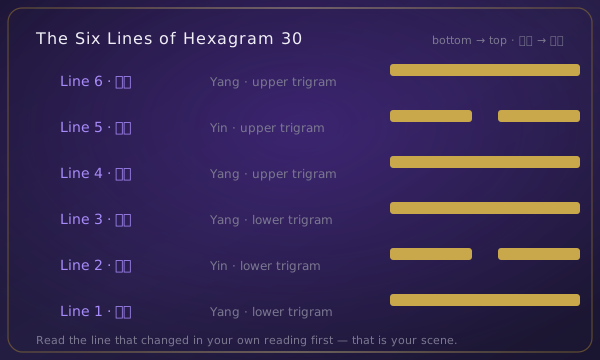
Each line of Hexagram 30 is one scene in the life of a flame — its careful stepping, its yellow center, its afternoon, its sudden burn, its tears, and its campaign.
Line 1 (初九) — The steps taken in confusion; with reverence, no blame. The scene: the beginning of clarity, walked carefully. The modern reading: the foundation line. The start of any clear thing is a stumble — 错然, steps crossed, uncertain — and the hexagram's counsel is 敬之: reverence. The careful, humble beginning of brightness is blameless.
Line 2 (六二) — Yellow brightness; supreme good fortune. The scene: the light at the center, the color of the middle. The modern reading: the central line and the hexagram's promise. 黄离,元吉 — yellow is the color of the center, and the brightness that holds the middle is granted the Book's supreme fortune. Clarity at the center is the whole hexagram's destination.
Line 3 (九三) — The sun at three in the afternoon; if you do not drum on the pot and sing, it is the old man's sigh; misfortune. The scene: the light past its peak, and its two options. The modern reading: the afternoon line. The decline is real, and the hexagram's verdict is not on the decline but on the response: drum on the pot and sing (accept it), or end with the sigh (refuse it). The refusal is 凶.
Line 4 (九四) — Suddenly it comes like this: burning, dying, discarded. The scene: the flame that arrives all at once and leaves nothing. The modern reading: the violent line. The sudden brightness — the flash success, the instant bond, the abrupt rise — comes, burns, dies, and is thrown away. The hexagram's image is the whole life cycle in nine characters.
Line 5 (六五) — Tears pour like rain, sighing and grieving; good fortune. The scene: the grief of clarity, and its strange verdict. The modern reading: the compassionate line. The honest crying about what is seen — 出涕沱若,戚嗟若 — is granted 吉. The hexagram's rare mercy: the grief that comes from seeing clearly is itself the good fortune.
Line 6 (上九) — The king uses it to march; there is praise for cutting off the head; the captives are not taken; no blame. The scene: clarity that has become decisive. The modern reading: the completion line. 王用出征,有嘉折首,获匪其丑 — the campaign, the decisive strike, and the discipline of taking no captives. Clarity at its end is not mercy; it is the clean, complete, decisive act.
When all six lines change: Hexagram 30 turns toward Hexagram 31 — the clinging completed becomes influence. The flame that has clarified becomes the attraction that moves.
How to Read Hexagram 30 with the Number Oracle
Hexagram 30 reaches you the same way every hexagram does: through three numbers that arise naturally while you hold your question — a clock, a receipt, a page number, a number that simply surfaces. The first number sets the upper trigram, the second the lower trigram, and the third identifies the changing line. Enter your three numbers and your question at numbers-oracle.com and you will get the hexagram plus an AI interpretation written for your situation — free, no registration. For the mechanics, read how three numbers become a hexagram →
Your lucky energy for Hexagram 30: Fire element (the body trigram, flame upon flame). Lucky colors are red and warm purple; the matching crystal is amethyst, traditionally associated with clarity of mind and calm, open insight.
Related hexagrams: Hexagram 29 (The Abysmal) — the water that tested before the light; Hexagram 22 (Grace) — the fire beneath the mountain, illumination cast; Hexagram 35 (Progress) — the sun rising, brightness at dawn.
Hexagram 30: Common Questions
What does hexagram 30 mean in one sentence?
Hexagram 30 means the clinging — fire upon fire, where clarity depends on what it burns, and perseverance comes through yielding rather than force, with the afternoon of any brightness requiring the pot and the song.
Is hexagram 30 good or bad?
Hexagram 30 is favorable — 利贞,亨 — with the hexagram's own conditions attached. The third line's refused afternoon is 凶 and the fourth line's sudden flame burns out. The hexagram is favorable for the yielding, continuing light and unfavorable for the light that insists on its own direction.
What should I do when I receive hexagram 30?
Check which line changed. Confused steps (line 1) means begin with reverence; yellow brightness (line 2) means hold the center; the sun at three (line 3) means accept the decline — drum and sing; the sudden flame (line 4) means watch the flash that leaves nothing; the tears (line 5) means the honest grief is the good fortune; the king's campaign (line 6) means act decisively and take no captives.
Why is hexagram 30 called "The Clinging"?
Because fire is the element that cannot exist alone — it depends on fuel, on a source, on continuity. The old translators rendered it The Clinging or Fire because the hexagram's subject is attachment at full clarity: what your light depends on, and the yielding that keeps the flame from becoming the sudden burn.
Fire has never once been its own fuel. That is what makes it worth tending.