I Ching Hexagram 32 (Duration) in Love: What It Means for Your Relationship
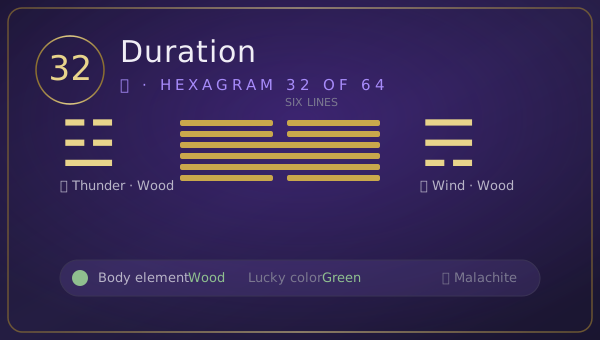
Hexagram 32 is the duration hexagram of the I Ching: thunder and wind together, the quake and the movement that carries it, enduring as one. Its classical judgment reads "success; no blame; favorable perseverance; favorable to have somewhere to go" (亨,无咎,利贞。利有攸往), and its image — thunder and wind — says the noble one "stands firm and does not change his direction" (立不易方). When Hexagram 32 appears in a reading, it describes constancy: the long thing that holds, the commitment that outlasts its reasons — and the hexagram's exact counsel about what duration requires and what it cannot survive.
The Story of Hexagram 32: Thunder and Wind
The scene is a storm that does not pass. Thunder sounds, and the wind that carries the sound keeps moving — the quake and the current, together, neither exhausting the other. The old commentators found the hexagram in that pairing: 恒 is duration, and duration is not stillness. Thunder and wind are both forces of movement, and their duration is a movement that repeats. Constancy is not the absence of change; it is the pattern that survives change.
The judgment is generous — 亨,无咎,利贞,利有攸往, success and no blame and perseverance and somewhere to go — and the image locates the discipline: 立不易方. Stand firm; do not change your direction. Not your position, your direction. The hexagram's constancy is a bearing, not a coordinate.
The lines test that bearing with uncomfortable honesty. The first is the hexagram's warning at the outset: 浚恒 — the deep-dug constancy, the commitment pursued too hard at the beginning — and the verdict is 贞凶. Duration cannot be forced at the start; the bond that demands permanence before it has earned it is ominous. The second line is the hexagram's center of balance: 悔亡 — the regret dissolves. Constancy held at the center cancels its own doubt. The third is the hexagram's hardest teaching: 不恒其德,或承之羞 — the one who is not constant in virtue will bear the shame of it. Duration is a virtue or it is nothing. The fourth is the field with no game (田无禽) — the constant pursuit that has no object, the loyalty that hunts empty ground. The fifth is the hexagram's gendered line: 恒其德,贞,妇人吉,夫子凶 — constancy of virtue is favorable for the wife and ominous for the husband — the hexagram's one concession to its own era, and its deepest teaching about position: the same virtue has different weights at different positions. And the final line is the hexagram's extremity: 振恒 — the constancy that is shaken — 凶. Even duration can be vibrated apart.
The storm endures because thunder and wind have agreed on a direction. The day one of them changes direction, it is no longer the same storm.
What Is Hexagram 32?
- Name: 恒 (Héng), traditionally rendered Duration; also translated as Constancy, Perseverance, or The Long-Enduring
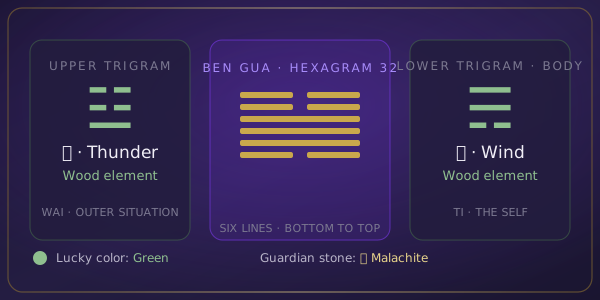
- Structure: Thunder over Wind — the quake and the current, movement enduring movement
- Position: 32 of 64, the hexagram after Influence; what attraction becomes when it holds
- Element: Wood on the body trigram — the lower trigram (wind) belongs to Wood; thunder above belongs to Wood
- Body trigram: the lower trigram (wind, Wood), which in plum blossom divination represents the self
- Core images: thunder and wind, the unchanging direction, the field with no game, the shaken constancy
The Core Meaning of Hexagram 32
The judgment of Hexagram 32 grants the full favorable set — success, no blame, perseverance, somewhere to go — to the enduring configuration. Duration is not the hexagram's price; it is the hexagram's gift. What the hexagram tests, line by line, is whether the constancy is actually constant: in virtue, in direction, in object. The bearing that holds is the bearing that was true at the start.
Three things this hexagram is telling you, each standing on its own:
Constancy is a direction, not a position. 立不易方 — stand firm, do not change direction. The hexagram's discipline is not about staying put; it is about keeping the bearing. Thunder and wind both move; the storm endures because they move in agreement. The long thing is the thing whose parts keep pointing the same way.
Duration cannot be forced at the beginning. The first line is the hexagram's warning: 浚恒,贞凶. The deep-dug, over-pursued constancy — the bond that demands permanence before it has earned it, the commitment extracted before it has grown — is ominous. Duration has a natural tempo, and the tempo at the beginning is not yet duration.
Inconstancy of virtue is the named failure. The third line is the hexagram's hardest sentence: 不恒其德,或承之羞. The one who is not constant in virtue bears shame. Everything else in the hexagram — the wrong object (line 4), the shaken constancy (line 6) — is a variation on this: duration is a virtue, and virtues are constant or they are not virtues.
The question Hexagram 32 answers is not "will this last?" It is: is my direction still true, is my virtue constant, and am I hunting a field that actually has game?
Hexagram 32 in Love and Relationships
If you are single: Hexagram 32 describes the long view of connection — and its counsel for the single season is its first line: do not force duration (浚恒). The single season is not the place to extract permanence from something that has not grown it. The hexagram's single-season work is direction: know which way you are actually pointing, so that when the long thing arrives, it arrives pointing the same way.
In an early or uncertain stage: Early love under Hexagram 32 is the test of whether the bearing is true — and the hexagram's lines are its manual for exactly this phase. The over-pursued constancy (line 1) is the early bond that demands permanence before earning it. The dissolving regret (line 2) is the early bond held at the center, where doubt cancels. And the third line's virtue test is the early bond's real question: is each person constant in what they claim to be?
In a stable relationship: A stable relationship drawing Hexagram 32 is the long bond itself — this is the hexagram's home territory. Its counsel for the long term is the image: 立不易方. Not the same position — the same direction. Long bonds survive not by staying identical but by keeping the bearing, the way thunder and wind keep the storm. The fifth line is its long-bond honesty about position: the same virtue weighs differently at different positions (妇人吉,夫子凶) — the constancy that is virtue in one place is rigidity in another, and knowing the difference is the hexagram's mature teaching.
In a crisis: If the relationship is at the final line — the shaken constancy (振恒) — Hexagram 32's verdict is 凶, and the hexagram is honest: even duration can be vibrated apart. The crisis is usually the third line arriving late: the virtue was never constant, and the shame the hexagram predicted has simply arrived on schedule. What the hexagram offers is its judgment's standing gift: no blame for the true bearing (无咎) — the constancy that was real does not have to be defended.
Hexagram 32 in Career, Money and Decisions
Career: This is the constancy hexagram of professional life — the long career, the sustained practice, the work that endures. Its career counsel is the image: 立不易方 — stand firm, do not change direction. The professional who lasts is not the one who never moves; it is the one whose moves keep the same bearing. The third line is its career warning: 不恒其德,或承之羞 — the inconsistent virtue, the ethical drift over years, is the failure the hexagram names. And the fourth line's empty field is its career honesty: the constant pursuit with no object is the loyalty that hunts nothing.
Money: Hexagram 32 governs money held long — the sustained strategy, the patient position, the investment that endures. Its financial counsel is the judgment itself: 利贞,利有攸往 — perseverance and forward motion belong to the same configuration. The constancy that compounds is the constancy of direction, not of position. The fourth line's field-with-no-game is its financial warning: the strategy pursued faithfully for years with no object underneath. And the fifth line's position teaching is its financial nuance: the same discipline weighs differently at different stages.
Decision: Hexagram 32 says: check the direction, not the position. If you are deciding whether to stay — the bond, the career, the strategy, the place — the hexagram's test is threefold: is my direction still true (立不易方), is my virtue constant (不恒其德 is the failure), and is there game in the field I am hunting (田无禽)? The decision it blesses is the enduring bearing; the decision it marks is the constancy that was never about anything.
The Changing Lines of Hexagram 32: Six Scenes
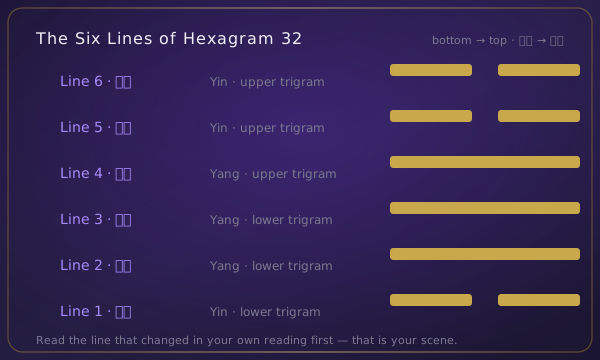
Each line of Hexagram 32 is one scene in the life of duration — its forced beginnings, its dissolving regret, its virtue test, its empty field, its positions, and its shaking.
Line 1 (初六) — Deep-dug constancy; perseverance is ominous; nothing is favorable. The scene: the duration pursued too hard at the beginning. The modern reading: the warning line. The commitment extracted before it has grown — 浚恒 — is ominous. Duration has a tempo, and the tempo at the start is growth, not permanence. The bond that demands the ending first is the one this hexagram marks.
Line 2 (九二) — The regret dissolves. The scene: the constancy held at the center, and the doubt that cancels. The modern reading: the balance line. Duration held at the middle position — not forced, not abandoned — dissolves its own regret (悔亡). The hexagram's center is where constancy becomes natural.
Line 3 (九三) — Not constant in virtue; perhaps bearing the shame of it; perseverance is regret. The scene: the drift, and its arriving cost. The modern reading: the hardest line. 不恒其德,或承之羞 — the virtue that was never constant, and the shame that comes to collect it. The hexagram does not threaten; it schedules.
Line 4 (九四) — The field has no game. The scene: the constant pursuit with no object. The modern reading: the emptiness line. The loyalty that hunts empty ground — the position held faithfully, the strategy pursued faithfully, with nothing underneath to catch. Duration without an object is the hexagram's quietest failure.
Line 5 (六五) — Constant in virtue; perseverance — for the wife, good fortune; for the husband, ominous. The scene: the same virtue, weighed at different positions. The modern reading: the position line. The hexagram's concession to its era carries its deepest teaching: constancy is real, and its weight is positional. What is virtue in one place is rigidity in another, and the mature art is knowing which position you hold.
Line 6 (上六) — The constancy is shaken; misfortune. The scene: the duration that vibrates apart. The modern reading: the extremity line. 振恒 — even the long thing can be shaken, and the Book's verdict is 凶. The hexagram does not promise that constancy survives everything. It promises only that the true bearing is blameless while it holds.
When all six lines change: Hexagram 32 turns toward Hexagram 33 — duration completed becomes retreat. The storm that has endured becomes the wisdom to withdraw before it turns.
How to Read Hexagram 32 with the Number Oracle
Hexagram 32 reaches you the same way every hexagram does: through three numbers that arise naturally while you hold your question — a clock, a receipt, a page number, a number that simply surfaces. The first number sets the upper trigram, the second the lower trigram, and the third identifies the changing line. Enter your three numbers and your question at numbers-oracle.com and you will get the hexagram plus an AI interpretation written for your situation — free, no registration. For the mechanics, read how three numbers become a hexagram →
Your lucky energy for Hexagram 32: Wood element (the body trigram, wind below). Lucky colors are green and tender sprout tones; the matching crystal is malachite, traditionally associated with growth, renewal, and fresh starts.
Related hexagrams: Hexagram 31 (Influence) — the attraction that duration holds; Hexagram 53 (Development) — constancy at walking pace; Hexagram 33 (Retreat) — the wisdom that follows the long storm.
Hexagram 32: Common Questions
What does hexagram 32 mean in one sentence?
Hexagram 32 means duration — success belongs to the long thing that holds, and the hexagram's whole teaching is that constancy is a direction kept true and a virtue kept constant, not a position defended.
Is hexagram 32 good for love?
Hexagram 32 is the Book's commitment hexagram — its judgment grants success, no blame, and forward motion to the enduring configuration. Its one warning is at the beginning: do not force duration (浚恒). And its deepest teaching is about position: the same virtue weighs differently at different places in a bond, and knowing yours is the mature art.
What should I do when I receive hexagram 32?
Check which line changed. Deep-dug constancy (line 1) means do not demand permanence before it is grown; the regret dissolving (line 2) means hold the center; inconstancy of virtue (line 3) means the drift has a scheduled cost; the field with no game (line 4) means check what you are actually hunting; constant virtue (line 5) means know the weight of your position; the shaken constancy (line 6) means even duration has its limit.
Why is hexagram 32 called "Duration"?
Because its image is thunder and wind together — two forces of movement, enduring as one. The old translators rendered it Duration or Constancy because the hexagram's subject is the long thing: what it requires (a true direction, a constant virtue, a real object) and the one tempo it cannot survive — permanence forced at the beginning.
Thunder and wind endure by agreeing on a direction, not by standing still.