I Ching Hexagram 33 (Retreat): Meaning in Love, Career and Life
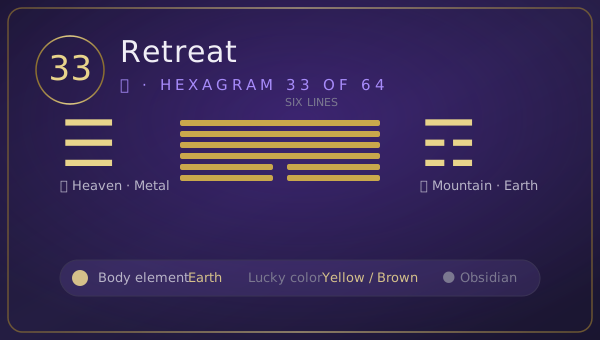
Hexagram 33 is the retreat hexagram of the I Ching: heaven rising above the mountain, the small force withdrawing before the great. Its classical judgment reads "success; small benefit through perseverance" (亨,小利贞), and its image — heaven above, mountain below — says the noble one "keeps the small man at a distance, not with hatred but with dignity" (远小人,不恶而严). When Hexagram 33 appears in a reading, it describes withdrawal: the strategic retreat, the timely exit — and the hexagram's exact counsel about the difference between retreating and fleeing.
The Story of Hexagram 33: The Boat on Five Lakes
The story is one of the most famous exits in Chinese history, and it begins at the end of a victory. In 473 BCE, after twenty years of preparation, the state of Yue finally destroyed Wu. King Goujian — the man who had tasted the gall bladder before every meal for a decade — was now the supreme ruler of his world. And in that moment of total triumph, one of his two great ministers quietly began planning to leave.
His name was Fan Li, the strategist who had designed the long revenge. According to the Records of the Grand Historian, he had already seen the pattern: "After the flying birds are gone, the good bow is stored; after the cunning hare is dead, the running hound is cooked." (《史记·越王勾践世家》: 飞鸟尽,良弓藏;狡兔死,走狗烹) He wrote to his colleague Wen Zhong — the other architect of the victory — warning him that Goujian was a man you could share hardship with but not prosperity, and that the wise course was to leave. Wen Zhong did not believe it, and was later forced to kill himself.
Fan Li did leave. He took a small boat out onto the Five Lakes, and later, under a new name, became one of the wealthiest merchants of his age — the records say he made and lost fortunes three times and redistributed them each time, and died respected. The retreat was not defeat. The retreat was the second half of the strategy.
That is the hexagram's mountain under the rising heaven: 遁 is not running away. It is withdrawing with the dignity of a man who has already understood what the next hexagram is.
What Is Hexagram 33?
- Name: 遁 (Dùn), traditionally rendered Retreat; also translated as Withdrawal, The Pig, or Retiring from the Field
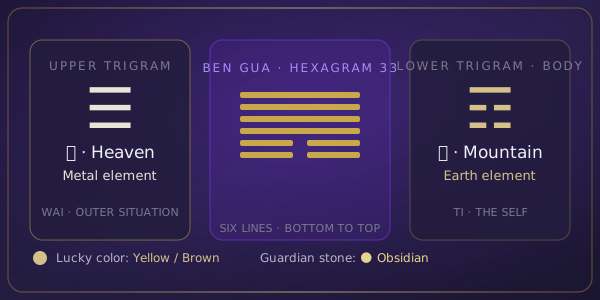
- Structure: Heaven over Mountain — the sky rising above the mass, the small force withdrawing below
- Position: 33 of 64, the hexagram after Duration; what the long storm teaches
- Element: Earth on the body trigram — the lower trigram (mountain) belongs to Earth; heaven above belongs to Metal
- Body trigram: the lower trigram (mountain, Earth), which in plum blossom divination represents the self
- Core images: heaven rising above the mountain, the pig's tail, the yellow ox-hide leather, the fat retreat, the five lakes
The Core Meaning of Hexagram 33
The judgment of Hexagram 33 grants success to retreat — 亨 — with the modifier that keeps it honest: 小利贞, small benefit through perseverance. Retreat is not the grand victory; it is the favorable small thing, and the hexagram's whole discipline is in knowing which kind of withdrawal you are performing.
Three things this hexagram are telling you, each standing on its own:
Retreat is a position, not a panic. The image is geometric: heaven above, mountain below — two forces that no longer touch, each going its own direction with dignity. The retreat the hexagram blesses is the one taken from strength, with the distance kept by structure rather than by hatred (不恶而严). The small man is kept at a distance without being attacked.
The retreat must be clean at its attachment points. The second line is the hexagram's most concrete image: held with yellow ox-hide leather, and it cannot be untied (执之用黄牛之革,莫之胜说). Some attachments are too strong to release mid-retreat — the bond, the obligation, the debt of the heart — and the hexagram says: hold them, and let the holding be the strength of the position, not the thing that drags you back.
The fullest retreat is the fat one. The final line is the hexagram's destination: 肥遁,无不利 — the fat, unhurried, well-provisioned retreat, with nothing unfavorable. Fan Li's boat on the Five Lakes is this line: the exit that was planned, resourced, and complete. The fat retreat is not escape; it is the second half of the strategy.
The question Hexagram 33 answers is not "am I giving up?" It is: is this withdrawal clean, dignified, and well-provisioned — or is it the tail of the pig being dragged?
Hexagram 33 in Love and Relationships
If you are single: Hexagram 33 describes the season of strategic withdrawal — from a pattern, a pursuit, a person, or simply from the market's pressure to be coupled. The hexagram's counsel for the single season: retreat with dignity (不恶而严), keep the distance by structure rather than resentment, and provision the exit (肥遁). The first line is its warning: the retreat's tail — the one who withdraws last, half-heartedly, still looking back.
In an early or uncertain stage: Early love under Hexagram 33 is the decision about approach and withdrawal — and the hexagram's lines are its manual. The pig's tail (line 1) is the withdrawal that comes too late, after the situation has already moved. The held leather (line 2) is the attachment that cannot be released mid-approach. The timely retreat (line 5) is the withdrawal that keeps its integrity. And the final line is its promise: 肥遁,无不利 — the well-provisioned exit, nothing unfavorable.
In a stable relationship: A stable relationship drawing Hexagram 33 is in a necessary withdrawal — the distance that has become strategic, the space that has to be taken. The hexagram's counsel for the long bond: keep the distance with dignity, not hatred (不恶而严). The retreat inside a long bond is not the end of it; it is the mountain rising under heaven, each force keeping its own direction until the directions can meet again.
In a crisis: If the relationship is at the final line — the fat retreat — Hexagram 33's verdict is 无不利, nothing unfavorable, and this is one of the hexagram's most liberating moments. Sometimes the favorable thing is the complete, provisioned, unhurried exit. The hexagram does not bless every bond; it blesses the withdrawal that is clean. Fan Li did not owe Goujian his life because he had helped him win.
Hexagram 33 in Career, Money and Decisions
Career: This is the strategic-withdrawal hexagram of professional life — the exit from the failing venture, the resignation before the collapse, the strategic retreat from the losing position. Its career counsel is the judgment: retreat is success (亨), small and clean (小利贞). The third line is its career warning: the tied retreat — the person who tries to withdraw while still holding on (系遁), carrying the disease of the old position. And the final line is its career promise: 肥遁 — the provisioned exit. Fan Li's boat is the career image: plan it, resource it, take it complete.
Money: Hexagram 33 governs money in withdrawal — cutting the loss, exiting the position, the strategic retreat from the losing bet. Its financial counsel is the hexagram's structure: keep the distance with dignity (no scorched earth), release what can be released, and hold — with yellow leather, deliberately — what cannot. The fat retreat (肥遁) is its financial image: the exit that is provisioned rather than desperate. The records of Fan Li are its final promise: the man who withdrew cleanly built a second fortune on the other side.
Decision: Hexagram 33 says: retreat — cleanly, with dignity, and well provisioned. If you are deciding whether to withdraw — the position, the bond, the pursuit, the market — the hexagram's test is threefold: is the exit complete (not the pig's tail dragged), is the distance kept by structure rather than hatred (不恶而严), and is the retreat provisioned (肥遁)? The decision it blesses is the second half of the strategy; the decision it marks is the retreat that was really a flight.
The Changing Lines of Hexagram 33: Six Scenes
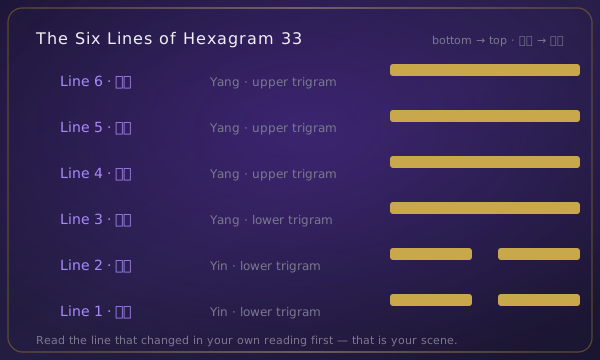
Each line of Hexagram 33 is one scene in the life of a retreat — its tail, its held leather, its tied sickness, its timeliness, and its fat provision.
Line 1 (初六) — The pig's tail in retreat; danger; do not use having somewhere to go. The scene: the withdrawal that has come too late, the tail still dragging. The modern reading: the danger line. The retreat made last — after the situation has already turned — is dangerous, and the hexagram forbids the movement (勿用有攸往). The late exit is not the exit the hexagram blesses.
Line 2 (六二) — Held with yellow ox-hide leather; none can untie it. The scene: the attachment too strong to release. The modern reading: the held line. Some things cannot be untied mid-retreat — the bond, the obligation, the debt — and the hexagram's counsel is to hold it deliberately (yellow leather, the color of the center) and let the holding be the position's strength rather than its drag.
Line 3 (九三) — The tied retreat; there is sickness and danger; keeping servants and concubines is favorable. The scene: the withdrawal that never quite happened. The modern reading: the failure line. 系遁 — the retreat still tied to the position it is leaving, carrying its disease (有疾厉). The half-withdrawal is its own kind of captivity. The hexagram's small mercy: keep what serves you (畜臣妾吉).
Line 4 (九四) — The liking retreat: the noble one is favorable, the small man is not. The scene: the voluntary, welcomed exit. The modern reading: the position line. The retreat that is chosen — not forced, not fled — is favorable for the noble one and impossible for the small man, whose identity is the position being left. The line grades the retreater, not the retreat.
Line 5 (九五) — The praiseworthy retreat; perseverance is favorable. The scene: the withdrawal that earns its reputation. The modern reading: the center line. 嘉遁 — the retreat so clean, so timely, so well-executed that it becomes praise. The hexagram's central blessing: the exit at the center of power is the one that is remembered as wisdom.
Line 6 (上九) — The fat retreat; nothing is unfavorable. The scene: the provisioned, unhurried, complete exit. The modern reading: the completion line and the hexagram's destination. 肥遁,无不利 — the boat with its supplies, the plan with its resources, the exit with nothing dragging. This is Fan Li's line, and the hexagram grants it its whole favorable set.
When all six lines change: Hexagram 33 turns toward Hexagram 34 — retreat completed becomes great power. The mountain that withdrew becomes the thunder that returns.
How to Read Hexagram 33 with the Number Oracle
Hexagram 33 reaches you the same way every hexagram does: through three numbers that arise naturally while you hold your question — a clock, a receipt, a page number, a number that simply surfaces. The first number sets the upper trigram, the second the lower trigram, and the third identifies the changing line. Enter your three numbers and your question at numbers-oracle.com and you will get the hexagram plus an AI interpretation written for your situation — free, no registration. For the mechanics, read how three numbers become a hexagram →
Your lucky energy for Hexagram 33: Earth element (the body trigram, the mountain below). Lucky colors are yellow and earth brown; the matching crystal is obsidian, traditionally associated with protection, grounding, and shielding from stress.
Related hexagrams: Hexagram 32 (Duration) — the long storm before the wisdom; Hexagram 34 (Great Power) — the thunder that returns; Hexagram 59 (Dispersion) — the dissolving that retreat prepares.
Hexagram 33: Common Questions
What does hexagram 33 mean in one sentence?
Hexagram 33 means retreat as strategy — success belongs to the withdrawal that is clean, dignified, well provisioned, and taken from strength rather than from flight.
Is hexagram 33 good or bad?
Hexagram 33 grants success to retreat (亨) — which makes it one of the Book's misunderstood favorable signs. Its warnings are precise: the pig's tail (line 1, the late exit) and the tied retreat (line 3, the withdrawal that never happened). The hexagram is favorable for the clean exit and unfavorable for the half-exit.
What should I do when I receive hexagram 33?
Check which line changed. The pig's tail (line 1) means the retreat is late — do not compound it; the yellow leather (line 2) means hold what cannot be untied, deliberately; the tied retreat (line 3) means stop carrying the old position's sickness; the liking retreat (line 4) means the voluntary exit is yours; the praiseworthy retreat (line 5) means the clean exit becomes reputation; the fat retreat (line 6) means provision it completely and go.
Why is hexagram 33 called "Retreat"?
Because its image is heaven rising above the mountain — the small force withdrawing below the great, each keeping its own direction. The old translators rendered it Retreat or Withdrawal because the hexagram's lines are a manual on the strategic exit: what makes it clean, what makes it late, and the fat, provisioned retreat that the Book grants nothing unfavorable.
The bow is stored when the birds are gone. The wise one is already on the water.