I Ching Hexagram 34 (The Power of the Great): Meaning in Love, Career and Life
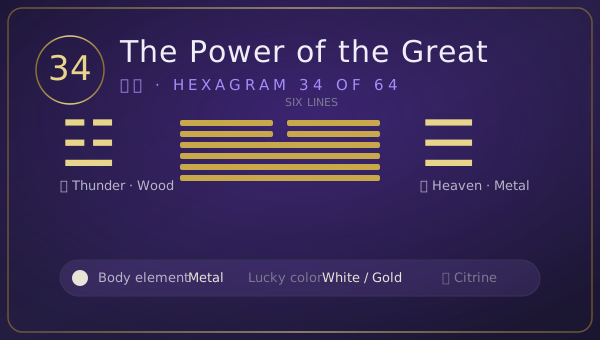
Hexagram 34 is the great-power hexagram of the I Ching: thunder sounding in the sky above heaven, force at full scale in the open air. Its classical judgment is three characters — 利贞, favorable perseverance — and its image — thunder above heaven — says the noble one "does not tread where ritual does not permit" (非礼弗履). When Hexagram 34 appears in a reading, it describes strength at its peak: the moment of maximum power — and the hexagram's single-minded counsel about the one thing power at this scale must never do.
The Story of Hexagram 34: The Thunder in the Open Sky
The scene is the most exposed image in the Book: thunder not in a cloud, not under the earth — thunder in the open sky, above heaven itself. Nothing contains it. Nothing mediates it. The old commentators read the hexagram from that exposure: 大壮 is power at full scale, and power at full scale is power that can be seen from everywhere, including by itself.
The judgment is famously spare: 利贞. Favorable perseverance. Three characters for the Book's strength hexagram, and the brevity is the whole teaching. Power does not need the Book's encouragement; it needs the Book's condition. What keeps great power favorable is not more power — it is 贞, correctness, the ritual boundary. And the image says the same thing in one sentence: 非礼弗履 — the noble one does not tread where ritual does not permit. Power at its peak has exactly one failure mode, and it is the same failure mode at every line.
The lines trace it. The first is power in the toes (壮于趾) — strength in the feet, the impulse to charge — and the hexagram's verdict is 征凶. The second line is the center where power is simply correct (贞吉). The third is the hexagram's central image: 小人用壮,君子用罔 — the small man uses force, the noble one uses nothing — and then the ram butting the fence, entangling its horns (羝羊触藩,羸其角). The fourth line is the fence broken, the horns free, the strength that has found its correct channel (藩决不羸,壮于大舆之輹). The fifth is the sheep lost at the fence line (丧羊于易) — the force that gives up its own stubbornness — and 无悔. And the final line is the ram again: butting the fence, unable to retreat, unable to advance (不能退,不能遂) — and the hexagram's strange mercy: 无攸利,艰则吉. No benefit in this position, and if you hold through the difficulty, good fortune.
The ram in the fence is the whole hexagram: strength with no ritual boundary is strength entangled.
What Is Hexagram 34?
- Name: 大壮 (Dà Zhuàng), traditionally rendered The Power of the Great; also translated as Great Vigor, Great Strength, or Preponderance of Strength
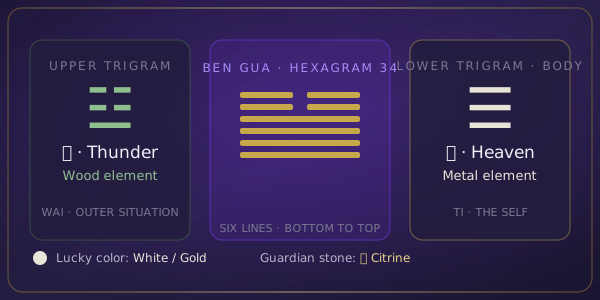
- Structure: Thunder over Heaven — the quake in the open sky, force at full exposure
- Position: 34 of 64, the hexagram after Retreat; what the withdrawal returns as
- Element: Metal on the body trigram — the lower trigram (heaven) belongs to Metal; thunder above belongs to Wood
- Body trigram: the lower trigram (heaven, Metal), which in plum blossom divination represents the self
- Core images: thunder in the open sky, power in the toes, the ram butting the fence, the broken fence, the sheep lost at the boundary
The Core Meaning of Hexagram 34
The judgment of Hexagram 34 is one condition — 利贞 — and the image is one prohibition — 非礼弗履. For the Book's peak-strength hexagram, this is the entire teaching. Power at full scale does not need encouragement; it needs a boundary, and the boundary has a name: ritual, correctness, the place where treading is permitted. Everything unfavorable in this hexagram is the same failure — force applied outside its permitted ground.
Three things this hexagram is telling you, each standing on its own:
Strength at its peak is strength at its most exposed. Thunder in the open sky — nothing contains the force, nothing mediates it. The hexagram's situation is not the acquisition of power; it is the visibility of power, to others and to itself. What the hexagram guards against is not weakness; it is the self-certainty that full exposure produces.
The failure mode has one name: the ram in the fence. The third line and the final line are the same image — the ram butting the fence, entangling its horns, unable to retreat, unable to advance. Force applied where force is not permitted does not fail by meeting a stronger force; it fails by entangling itself. The fence does not fight the ram. The fence simply does not move.
The correct channel is the fence broken, not the fence ignored. The fourth line is the hexagram's resolution: 藩决不羸 — the fence opens, the horns are free. The strength that finds its correct channel is not the strength that broke the boundary; it is the strength that found the opening. The difference between line 3 and line 4 is not the amount of power. It is the direction.
The question Hexagram 34 answers is not "am I strong?" It is: is my strength inside its permitted ground — and am I the ram at the fence or the ram through the opening?
Hexagram 34 in Love and Relationships
If you are single: Hexagram 34 describes the season of full personal power — the strength, the visibility, the capacity to act. The hexagram's counsel for the single season is its image: 非礼弗履. Power in connection is attractive only inside ritual ground; strength that ignores the boundary is the ram at the fence. The first line is its warning: 壮于趾 — the impulse to charge, the advance powered by the feet instead of the direction.
In an early or uncertain stage: Early love under Hexagram 34 is two strong people meeting — and the hexagram's counsel is its whole teaching: keep the strength inside the permitted ground. The ram's image maps the early bond precisely: the fence that is butted (line 3) is the boundary pushed by force; the fence that opens (line 4) is the boundary found. And the fifth line's lost sheep is the early bond's quiet gift: 丧羊于易 — the stubborn force given up at the boundary, and no regret.
In a stable relationship: A stable relationship drawing Hexagram 34 is in a power phase — one or both partners at full strength, and the hexagram's counsel for the phase is its condition: 利贞. Power in a long bond is favorable only through correctness — the ritual ground of the relationship, the places each partner's strength is permitted to tread. The final line is its long-bond honesty: 不能退,不能遂 — the position where neither advancing nor retreating is available — and its mercy: 艰则吉. Hold through it.
In a crisis: If the relationship is at the final line — the ram entangled, unable to move either way — Hexagram 34's arithmetic is exact: 无攸利,艰则吉. No benefit in this position, and if you hold through the difficulty, good fortune. The entangled crisis is not resolved by more force (that is what entangled it) but by the perseverance that outlasts the entanglement.
Hexagram 34 in Career, Money and Decisions
Career: This is the peak-power hexagram of professional life — the promotion, the authority, the moment of maximum capacity. Its career counsel is the judgment: 利贞 — power is favorable only through correctness. The image is the career discipline: 非礼弗履 — do not act outside your permitted ground, no matter how strong you are. The third line is the career warning of the whole Book: 小人用壮,君子用罔 — the small man uses force, the noble one uses restraint. The ram at the fence is the career failure that no amount of strength fixes.
Money: Hexagram 34 governs money at full power — the peak cycle, the dominant position, the capital with force behind it. Its financial counsel is the condition: 利贞. Strength in money is favorable only through correctness — the discipline, the boundary, the permitted ground. The ram's image is its financial warning: the position that pushed where it was not permitted, entangled, unable to retreat or advance. And the fifth line's lost sheep is its financial gift: the stubborn position given up at the boundary, and no regret.
Decision: Hexagram 34 says: you have the strength — check the ground. If you are deciding how to use power — position, capital, authority, capacity — the hexagram's test is its image: is this treading permitted (非礼弗履), and is this the ram through the opening or the ram at the fence? The decision it blesses is the strength inside its correct channel; the decision it marks is the force that entangled itself.
The Changing Lines of Hexagram 34: Six Scenes
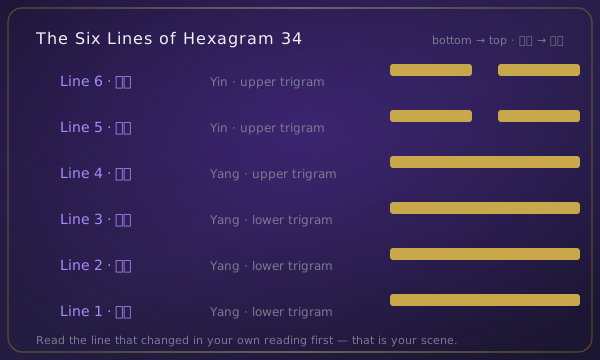
Each line of Hexagram 34 is one scene in the life of great power — its toes, its center, its entangled ram, its opened fence, its lost sheep, and its stuck ram.
Line 1 (初九) — Power in the toes; to advance is ominous; with sincerity, there is relief. The scene: strength in the feet, the impulse to charge before the direction. The modern reading: the warning line. 壮于趾 — power at the wrong end of the body, the advance powered by momentum rather than ground. The hexagram's verdict: 征凶. The charge is the failure.
Line 2 (九二) — Perseverance is favorable. The scene: power at the center, simply correct. The modern reading: the center line. The hexagram's simplest blessing — 贞吉 — belongs to the strength that is simply inside its ground. No special action required: power held correctly is its own good fortune.
Line 3 (九三) — The small man uses force; the noble one uses nothing. Perseverance brings danger. The ram butts the fence and entangles its horns. The scene: the strength applied where it is not permitted. The modern reading: the central warning and the hexagram's signature image. The contrast is exact: force versus restraint (用壮 versus 用罔). And the ram at the fence — 羝羊触藩,羸其角 — the force that does not meet resistance but entanglement.
Line 4 (九四) — Perseverance is favorable; the regret dissolves. The fence opens, the horns are not entangled; the strength is in the great cart's axle. The scene: the strength that found its correct channel. The modern reading: the resolution line. 藩决不羸 — the fence opens, the horns are free. Not the boundary broken — the opening found. The strength in the great cart's axle (壮于大舆之輹) is power doing what power is for: carrying load.
Line 5 (六五) — The sheep is lost at the boundary; no regret. The scene: the stubborn force given up at the fence line. The modern reading: the surrender line. 丧羊于易 — the ram's own stubbornness, lost where the boundary was crossed. The hexagram grants 无悔: the force that gives up its force at the right line has no regret.
Line 6 (上六) — The ram butts the fence; it cannot retreat, it cannot advance. Nothing is favorable; holding through the difficulty is good fortune. The scene: the strength that has entangled itself completely. The modern reading: the extremity line. 不能退,不能遂 — neither direction available, the full weight of the ram against the immovable fence. The hexagram's strange double verdict: 无攸利,艰则吉. No benefit, and perseverance through it is the good fortune.
When all six lines change: Hexagram 34 turns toward Hexagram 35 — great power completed becomes progress. The ram through the opening becomes the sun over the earth.
How to Read Hexagram 34 with the Number Oracle
Hexagram 34 reaches you the same way every hexagram does: through three numbers that arise naturally while you hold your question — a clock, a receipt, a page number, a number that simply surfaces. The first number sets the upper trigram, the second the lower trigram, and the third identifies the changing line. Enter your three numbers and your question at numbers-oracle.com and you will get the hexagram plus an AI interpretation written for your situation — free, no registration. For the mechanics, read how three numbers become a hexagram →
Your lucky energy for Hexagram 34: Metal element (the body trigram, heaven below). Lucky colors are white, gold, and silver; the matching crystal is citrine, traditionally associated with abundance and clear, joyful energy.
Related hexagrams: Hexagram 33 (Retreat) — the withdrawal that precedes the return; Hexagram 28 (Great Excess) — the other overload hexagram, weight over structure; Hexagram 35 (Progress) — the sunrise the thunder announces.
Hexagram 34: Common Questions
What does hexagram 34 mean in one sentence?
Hexagram 34 means the power of the great — strength at full scale, favorable only through perseverance and correctness, with the hexagram's single warning being the ram that butts the fence instead of finding the opening.
Is hexagram 34 good or bad?
Hexagram 34 is conditional in the Book's plainest way — its judgment is only 利贞. Power at this scale is favorable through correctness and unfavorable outside it. The first line's charge is ominous, the third line's ram is entangled, and the final line is stuck. The hexagram's favorable lines are the ones where strength stays inside its permitted ground.
What should I do when I receive hexagram 34?
Check which line changed. Power in the toes (line 1) means do not charge — check the direction; perseverance favorable (line 2) means your strength is simply correct here; the ram at the fence (line 3) means stop applying force where it is not permitted; the fence opens (line 4) means find the opening, do not break the boundary; the sheep lost at the boundary (line 5) means give up the stubborn force without regret; the ram stuck (line 6) means hold through the difficulty — the perseverance is the way.
Why is hexagram 34 called "The Power of the Great"?
Because its image is thunder in the open sky — 雷在天上 — force at full scale with nothing containing it. The old translators rendered it Great Vigor or The Power of the Great because the hexagram's subject is peak strength, and its whole teaching is the image's one sentence: the noble one does not tread where ritual does not permit.
The fence does not fight the ram. It simply does not move, and waits.