I Ching Hexagram 35 (Progress): Meaning in Love, Career and Life
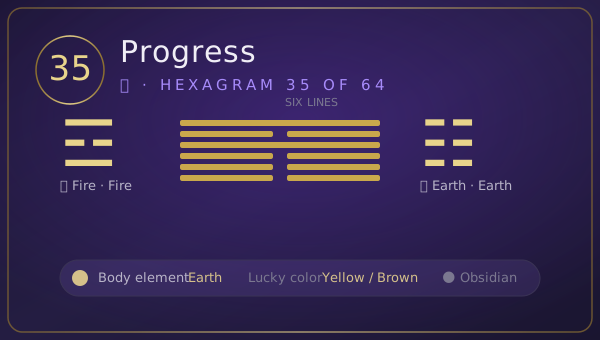
Hexagram 35 is the progress hexagram of the I Ching: the sun rising over the earth, light advancing across the ground. Its classical judgment reads "the noble lord is rewarded with horses and numerous gifts; the king receives him three times in a single day" (康侯用锡马蕃庶,昼日三接), and its image — brightness rising above the ground — says the noble one "illuminates his own bright virtue" (自昭明德). When Hexagram 35 appears in a reading, it describes advancement: the sunrise of a situation, recognition arriving, the way opening upward — with the hexagram's honest notes on how progress is earned and how it is lost.
The Story of Hexagram 35: The Sun Over the Field
The scene is dawn over flat ground. The light does not choose a direction — it arrives everywhere at once, and everything it touches becomes visible. The old commentators read the hexagram from that universality: 晋 is progress as illumination, not as conquest. The sun does not take the field; it reveals it. And what the sun rises over is the earth — the receptive, the humble, the ground that lets itself be lit.
The judgment's image is a court scene: the noble lord rewarded with horses, received three times in one day (昼日三接). Recognition at this speed is unusual, and the hexagram's lines explain what earns it. The first line is progress under resistance — 晋如摧如 — advancing, being pushed back — and the hexagram's counsel is 贞吉 with 罔孚: perseverance is favorable even without trust, and generosity without resentment (裕无咎). The second is the line of sorrow — 晋如愁如 — advancing through grief, and the hexagram's promise: the great blessing arrives, from the king's mother (受兹介福,于其王母). The third is the line of the crowd's consent (众允) — the regret dissolves because everyone agrees. The fourth is the hexagram's warning: 晋如鼫鼠 — progress like the rat — the advancement that is cautious to the point of parasitism, and the verdict is 贞厉. The fifth is the hexagram's center: 悔亡,失得勿恤 — the regret dissolves; do not grieve over gains or losses. And the final line is progress at its extremity: 晋其角 — the advance of the horns — the hexagram's counsel is to use it for attacking the city, with danger and good fortune together (厉吉,无咎).
Progress, in this hexagram, is the sun: it does not conquer the ground. It rises over it, and lets the ground be what is lit.
What Is Hexagram 35?
- Name: 晋 (Jìn), traditionally rendered Progress; also translated as Advancement, Rising, or The Sunrise
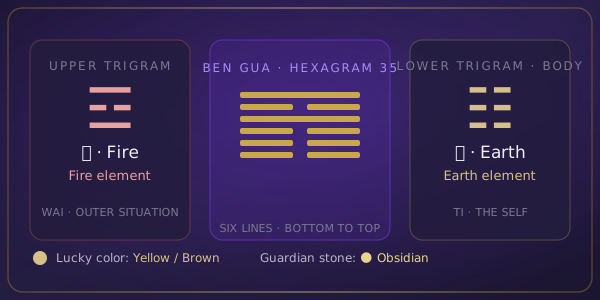
- Structure: Fire over Earth — the sun climbing above the ground, light spreading over the receptive
- Position: 35 of 64, the hexagram after The Power of the Great; what the ram through the opening becomes
- Element: Earth on the body trigram — the lower trigram (earth) belongs to Earth; fire above belongs to Fire
- Body trigram: the lower trigram (earth, Earth), which in plum blossom divination represents the self
- Core images: the sun over the earth, the horses and the triple reception, the rat-like advance, the horns at the extremity, the king's mother
The Core Meaning of Hexagram 35
The judgment of Hexagram 35 describes recognition at full speed — the horses, the numerous gifts, the three receptions in a day. Progress in this hexagram is not private achievement; it is advancement that is seen, rewarded, and received by the powers that be. And the image says what makes the progress legitimate: 自昭明德 — the noble one illuminates his own bright virtue. The sun rises over the earth because the sun is the sun; the progress that is recognized is the progress that was already real.
Three things this hexagram is telling you, each standing on its own:
Progress is illumination, not conquest. The sun does not take the field — it reveals it. The hexagram's advancement is the kind that makes things visible: your work, your virtue, your position. What the hexagram rewards is the self-lit (自昭), not the self-promoted.
Advance happens through resistance, and that is the correct path. The first line is the hexagram's opening teaching: 晋如摧如 — advancing and being pushed back. Progress in this hexagram is not a straight rise; it is a rise with pushback, and the hexagram grants perseverance its favor (贞吉) even without trust (罔孚). The resistance is not evidence against the progress.
The rat is the failure mode. The fourth line is the hexagram's warning: 晋如鼫鼠 — progress like the rat. The cautious, grasping, parasitical advance — the one that takes without illuminating, that climbs without being seen for what it is. The hexagram attaches 厉, danger, to the rat's progress. Advancement without virtue is the rat's movement.
The question Hexagram 35 answers is not "am I rising?" It is: is my progress illumination — is the virtue already real, and is the advance the sun's or the rat's?
Hexagram 35 in Love and Relationships
If you are single: Hexagram 35 describes the season of rising visibility — the self becoming lit, and connection following the light. The hexagram's counsel for the single season is its image: 自昭明德 — illuminate your own virtue. What attracts at this line is not pursuit but radiance; the sun does not chase the field. And the first line is its comfort: progress through resistance, perseverance favorable even without trust.
In an early or uncertain stage: Early love under Hexagram 35 is the rising — the connection becoming visible, the light spreading over both people. The hexagram's lines map it: the advance through pushback (line 1) is the early bond's resistance, met with perseverance; the great blessing from the king's mother (line 2) is the support that arrives from the older, wiser source; the crowd's consent (line 3) is the mutual recognition. And the rat (line 4) is its warning: the advance that is cautious to the point of parasitism.
In a stable relationship: A stable relationship drawing Hexagram 35 is in a rising phase — the bond becoming more visible, more recognized, more itself. The hexagram's counsel for the phase is its center: 悔亡,失得勿恤 — the regret dissolves, and gains and losses are both not to be grieved. Long bonds rise by the same discipline the sun has: continue illuminating (自昭), do not tally the ledger of the rise.
In a crisis: If the relationship is at the final line — the horns at the extremity — Hexagram 35's counsel is its image: 维用伐邑. Progress at its extremity is for the city, for the internal structure — the relationship's own walls, its own patterns. The hexagram attaches both danger and good fortune (厉吉,无咎): the decisive act at the extremity is dangerous and favorable at once.
Hexagram 35 in Career, Money and Decisions
Career: This is the advancement hexagram of professional life — the promotion, the recognition, the rising phase. Its career counsel is the image: 自昭明德 — illuminate your own virtue. The recognition the hexagram describes (the horses, the triple reception) comes to the already-real. The rat line is its career warning: the parasitic advance, the climb that takes without illuminating. And the fifth line is its career center: 失得勿恤 — do not grieve over the gains and losses of the rise; the rise is not a ledger.
Money: Hexagram 35 governs money in a rising cycle — the favorable market, the growing position, the expanding inflow. Its financial counsel is the same as its career counsel: the rise follows the real. The rat (line 4) is its financial warning — the gain that is parasitic, the position that climbs without substance. The fifth line's discipline is its financial center: do not tally (失得勿恤). The cycle that rises is not improved by the anxiety of watching it.
Decision: Hexagram 35 says: rise — and be already real. If you are deciding whether to advance — the position, the move, the visibility — the hexagram's test is its image: is my virtue already illuminated (自昭), and is this the sun's rise or the rat's climb? The decision it blesses is the advance that follows the real; the decision it marks is the progress that was only ever a climb.
The Changing Lines of Hexagram 35: Six Scenes
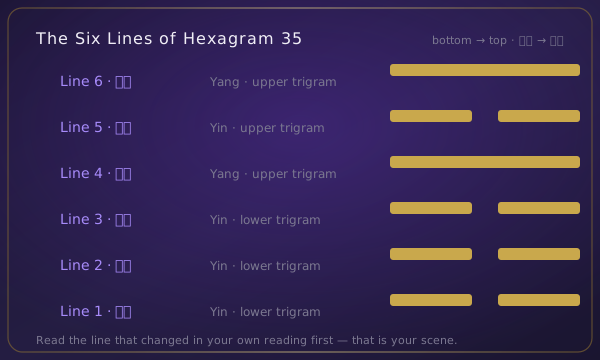
Each line of Hexagram 35 is one scene in the life of a progress — its pushback, its blessing, its consent, its rat, its center, and its horns.
Line 1 (初六) — Advancing, being pushed back; perseverance is favorable; without trust; generosity brings no blame. The scene: the rise that meets resistance. The modern reading: the opening line. Progress in this hexagram begins with pushback (摧如) — and the hexagram grants perseverance its favor (贞吉) even where trust is absent (罔孚). The generosity without resentment (裕无咎) is the line's practice.
Line 2 (六二) — Advancing through sorrow; perseverance is favorable. The great blessing is received, from the king's mother. The scene: the rise through grief, and the support that arrives. The modern reading: the blessing line. The advancement that has cost something — 愁如, the sorrow — receives the great blessing (介福), and the source is named: the king's mother. The older, wiser, nurturing source is where the blessing comes from.
Line 3 (六三) — The crowd consents; the regret dissolves. The scene: the advance that everyone agrees to. The modern reading: the consent line. 众允,悔亡 — progress at this line is possible because the consent is real. The hexagram's teaching: some advances are carried by the crowd's genuine agreement, and the regret dissolves where the consent was honest.
Line 4 (九四) — Advancing like the rat; perseverance brings danger. The scene: the climb that is parasitic. The modern reading: the warning line. 晋如鼫鼠 — the rat's progress, cautious and grasping, taking without illuminating. The hexagram attaches 厉: advancement without virtue is the rat's movement, and it is dangerous however well it climbs.
Line 5 (六五) — The regret dissolves; do not grieve over gains or losses; going forward is favorable, nothing unfavorable. The scene: the rise at the center, freed from the ledger. The modern reading: the center line and the hexagram's keystone. 悔亡,失得勿恤,往吉,无不利 — the regret dissolves, the tallying stops, and the forward motion is granted the hexagram's fullest favor. The center of progress is the place where the rise stops being an accounting.
Line 6 (上九) — Advancing the horns; using it to attack the city; danger and good fortune; no blame; perseverance brings regret. The scene: progress at its extremity, turned inward. The modern reading: the extremity line. 晋其角,维用伐邑 — the horns are for the city, the internal structure. The decisive act at the extremity carries danger and good fortune together (厉吉,无咎), and the hexagram's final note is its honesty: perseverance past this point is regret (贞吝).
When all six lines change: Hexagram 35 turns toward Hexagram 36 — progress completed becomes the darkening. The sun at its height begins its descent.
How to Read Hexagram 35 with the Number Oracle
Hexagram 35 reaches you the same way every hexagram does: through three numbers that arise naturally while you hold your question — a clock, a receipt, a page number, a number that simply surfaces. The first number sets the upper trigram, the second the lower trigram, and the third identifies the changing line. Enter your three numbers and your question at numbers-oracle.com and you will get the hexagram plus an AI interpretation written for your situation — free, no registration. For the mechanics, read how three numbers become a hexagram →
Your lucky energy for Hexagram 35: Earth element (the body trigram, the ground below). Lucky colors are yellow and earth brown; the matching crystal is obsidian, traditionally associated with protection, grounding, and shielding from stress.
Related hexagrams: Hexagram 34 (The Power of the Great) — the strength the rise follows; Hexagram 36 (Darkening of the Light) — the descent that follows the height; Hexagram 46 (Pushing Upward) — the other ascent, wood rising from earth.
Hexagram 35: Common Questions
What does hexagram 35 mean in one sentence?
Hexagram 35 means progress as illumination — advancement that is recognized because it was already real, rising through resistance, with the rat's parasitic climb as the named failure mode.
Is hexagram 35 good or bad?
Hexagram 35 is one of the Book's favorable advancement signs — its judgment describes recognition at full speed, and its center line grants 往吉,无不利. Its warnings are precise: the rat's progress (line 4) and perseverance past the extremity (line 6's 贞吝). The hexagram favors the rise that follows the real.
What should I do when I receive hexagram 35?
Check which line changed. Advancing through pushback (line 1) means persevere without trust; through sorrow (line 2) means the blessing comes from the wise source; the crowd's consent (line 3) means the agreement is real; the rat (line 4) means the climb without virtue is dangerous; the center (line 5) means stop tallying gains and losses; the horns (line 6) means turn the extremity inward — and know when to stop.
Why is hexagram 35 called "Progress"?
Because its image is the sun rising over the earth — 明出地上 — light spreading over the receptive ground without taking anything. The old translators rendered it Progress or Advancement because the hexagram's subject is the rise that is seen: the horses, the gifts, the triple reception, all arriving to the one whose virtue was already illuminated.
The sun does not conquer the field. It rises over it, and the field becomes itself.