I Ching Hexagram 36 (Darkening of the Light): Meaning in Love, Career and Life
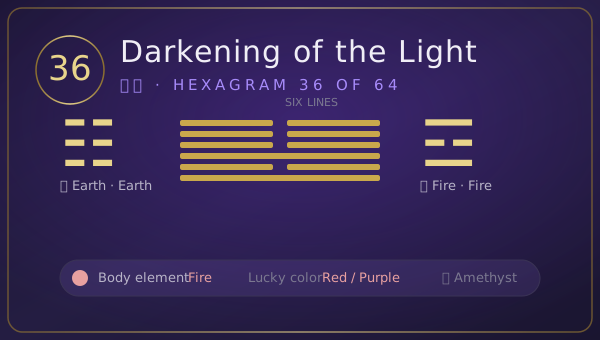
Hexagram 36 is the darkening-of-the-light hexagram of the I Ching: the sun sinking into the earth, brightness going underground. Its classical judgment reads "favorable through hard perseverance" (利艰贞), and its image — light entering the ground — says the noble one "goes among the multitudes and uses darkness to be bright" (莅众,用晦而明). When Hexagram 36 appears in a reading, it describes the season when the light must be hidden: not because the light is gone, but because the world it shines in has turned hostile — and the hexagram's exact counsel about how brightness survives underground.
The Story of Hexagram 36: The Gall Bladder
In 494 BCE the state of Wu crushed Yue at Kuaiji. King Goujian of Yue was taken north as a retainer, and when he was finally released home he did not raise an army — he raised a gall bladder. For ten years he kept it beside his seat and tasted it before every meal, a daily reminder of humiliation and a slow fuse of resolve. To Wu he looked docile and useful; in the dark he rebuilt Yue — granaries, soldiers, alliances. When the fuse reached the powder, Yue rose and erased Wu from the map. (Source: Records of the Grand Historian, House of Goujian of Yue)
The hexagram's own lines tell the same story at different scales. The first line is the bird in flight, wings drooping, the noble one traveling and not eating for three days — the light going into hiding, and the hexagram's honesty that the hiding costs (初九:明夷于飞,垂其翼。君子于行,三日不食). The second is the wounded thigh and the strong horse that saves (六二:明夷,夷于左股,用拯马壮,吉) — the light that was injured and the speed that rescued it. The third is the southern hunt and the great head taken (九三:明夷于南狩,得其大首) — the light that struck, from the dark. The fourth is the hexagram's hidden center: entering the left side, capturing the heart of the darkening itself, and exiting through the gate (六四:入于左腹,获明夷之心,出于门庭). The fifth is the hexagram's named case: 箕子之明夷 — Jizi's darkening — the wise minister who feigned madness to survive a tyrant, and the hexagram's verdict on him: 利贞, favorable through perseverance. And the final line is the hexagram's extremity: first rising to heaven, then sinking into the earth (上六:不明晦,初登于天,后入于地).
The light is not gone. The light is underground. The hexagram's whole teaching is what the light does while it is down there.
What Is Hexagram 36?
- Name: 明夷 (Míng Yí), traditionally rendered Darkening of the Light; also translated as Injury of the Bright, The Intelligence Wounded, or Brilliance Injured
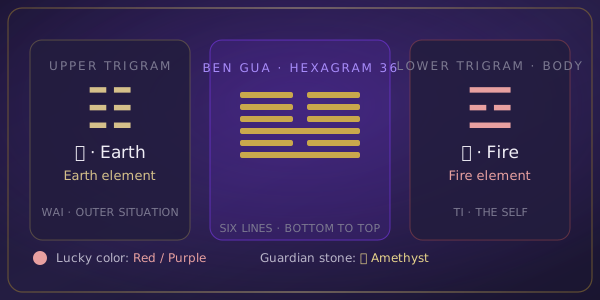
- Structure: Earth over Fire — the sun sinking into the ground, brightness beneath the surface
- Position: 36 of 64, the hexagram after Progress; what the sun at its height becomes
- Element: Fire on the body trigram — the lower trigram (fire) belongs to Fire; earth above belongs to Earth
- Body trigram: the lower trigram (fire, Fire), which in plum blossom divination represents the self
- Core images: the sun into the earth, the drooping wing, the wounded thigh, Jizi's feigned madness, the gall bladder
The Core Meaning of Hexagram 36
The judgment of Hexagram 36 is one instruction — 利艰贞 — favorable through hard perseverance — and the image is the hexagram's whole strategy: 用晦而明. Use darkness to be bright. The light that goes underground is not extinguished; it is concealed, and the concealment is what preserves it for the season when it can rise again. The hexagram does not romanticize this season — the first line's traveler does not eat for three days — but it is unambiguous about its favorability.
Three things this hexagram is telling you, each standing on its own:
The light is hidden because the world has turned, not because the light is wrong. The sun into the earth is a natural event, not a moral failure. The hexagram's season is one in which visibility has become danger — for the truth, for the person carrying it, for the work. 用晦而明 is not deception; it is the correct relationship between brightness and a hostile sky.
Concealment is a skill with techniques. The hexagram's lines are its manual: droop the wing (look harmless), use the strong horse (move fast when injured), capture the heart of the darkening (understand your enemy's actual motive), and know the named case — Jizi, who feigned madness. Each line is a technique for staying bright while appearing otherwise.
The darkening ends, and the light knows it. The final line — first heaven, then earth — is the hexagram's promise in reverse: what rose has set, and what has set will rise. The hexagram is a season, not a sentence. Goujian's ten years ended. The gall bladder was kept for the season it was needed.
The question Hexagram 36 answers is not "why is this happening?" It is: what does my light do while it is underground — and do I know the techniques of the dark?
Hexagram 36 in Love and Relationships
If you are single: Hexagram 36 describes a season when visibility is dangerous — the self that must dim to survive a hostile environment. The hexagram's counsel for the single season: use darkness to be bright (用晦而明). The first line's three days without eating is its honesty: the dimming costs. And its fifth line is its comfort: Jizi's case — the one who survived by appearing mad was not mad; the patience was the strategy.
In an early or uncertain stage: Early love under Hexagram 36 is the bond that must hide — the circumstances hostile, the visibility dangerous. The hexagram's lines are its manual for exactly this: the drooping wing (line 1, look harmless), the strong horse (line 2, move quickly when injured), the heart of the darkening (line 4, understand what the hostility actually wants). Early bonds in hostile seasons survive by the hexagram's techniques, not by defiance.
In a stable relationship: A stable relationship drawing Hexagram 36 is in a hard external season — the family, the work, the world, against the bond. The hexagram's counsel for the long term is its image: 用晦而明 — the relationship uses darkness to stay bright. What is hidden is not lost; what is concealed survives. And its fifth line is its long-bond promise: 箕子之明夷,利贞 — the patience of the apparent fool is favorable through perseverance. The long bond survives hostile seasons by the gall bladder, not the army.
In a crisis: If the relationship is at the final line — first heaven, then earth — Hexagram 36's promise is its extremity: what has set will rise. The crisis is the sinking, and the hexagram does not pretend the sinking is not real (初登于天,后入于地). What it offers is the season's discipline: the light underground is the light that kept itself.
Hexagram 36 in Career, Money and Decisions
Career: This is the concealment hexagram of professional life — the hostile organization, the dangerous visibility, the season when the truth cannot be said out loud. Its career counsel is the image: 用晦而明 — use darkness to be bright. The hexagram's techniques are the career techniques: the drooping wing (look less dangerous), the strong horse (exit fast when injured), the heart of the darkening (line 4 — understand the actual motive of the hostility). And Jizi's case is the hexagram's career comfort: the one who survived by appearing mad was not mad.
Money: Hexagram 36 governs money in hostile seasons — the drawdown, the concealed position, the season when visibility is loss. Its financial counsel: hide the light. The first line's cost (three days without eating) is the hexagram's honesty — concealment is not free. The second line's strong horse is its liquidity image: move fast when wounded. And the final line is its promise: what has set rises. The concealed position kept through the season is the position that survives to the next one.
Decision: Hexagram 36 says: dim, do not die. If you are deciding how to hold your light — the truth, the position, the visibility, the bond — the hexagram's test is its image: is the world currently one where brightness is safe (用晦而明), and do I know the techniques of the dark? The decision it blesses is the concealed light; the decision it marks is the radiance that insisted on a hostile sky.
The Changing Lines of Hexagram 36: Six Scenes
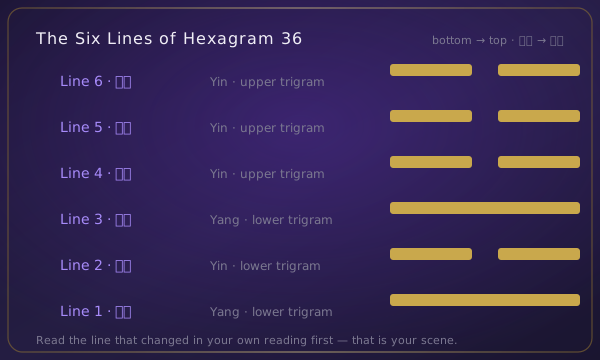
Each line of Hexagram 36 is one scene in the life of a hidden light — its drooping wing, its wounded thigh, its southern hunt, its captured heart, its feigned madness, and its setting.
Line 1 (初九) — The darkening in flight, the wings drooping; the noble one travels and does not eat for three days; there is somewhere to go, and the host speaks. The scene: the light going into hiding, at cost. The modern reading: the opening line and its honesty. The dimming is real and the price is real — three days without food, and the host's words (the gossip, the explanation owed). The hiding works, and it is not free.
Line 2 (六二) — The darkening injures the left thigh; saved by a strong horse; good fortune. The scene: the light that was wounded, and the speed that rescued it. The modern reading: the rescue line. The injury is real (夷于左股), and the rescue is named: the strong horse — the fast exit, the quick move, the resources held for exactly this moment. The hexagram grants it 吉.
Line 3 (九三) — The darkening in the southern hunt; capturing the great head; do not be hasty in perseverance. The scene: the light that struck, from the dark. The modern reading: the strike line. The southern hunt — the campaign from concealment — captures the great head (得其大首). The condition: 不可疾贞 — do not be hasty. The strike from the dark is favorable, and it is favorable on the dark's schedule.
Line 4 (六四) — Entering the left side, capturing the heart of the darkening; exiting through the gate and courtyard. The scene: the one who understood the enemy's actual motive. The modern reading: the hidden center and the hexagram's keystone. 入于左腹,获明夷之心,出于门庭 — into the belly, taking the heart, out through the gate. The intelligence that understands the hostility from inside is what exits freely.
Line 5 (六五) — Jizi's darkening; favorable through perseverance. The scene: the wise minister who feigned madness to survive. The modern reading: the center line and the hexagram's named case. 箕子之明夷,利贞 — the apparent fool who was not a fool, and the hexagram's verdict on the patience: favorable through perseverance. The concealment that preserves the wise one is blessed.
Line 6 (上六) — Not bright, dark; first rising to heaven, then sinking into the earth. The scene: the full arc of the light, from zenith to underground. The modern reading: the extremity line. 不明晦,初登于天,后入于地 — the light that was at its height is now beneath. The hexagram does not soften the sinking. It records the arc, and the arc contains the promise: what sank has, once, risen.
When all six lines change: Hexagram 36 turns toward Hexagram 37 — the darkening completed becomes the family. The light that survived underground becomes the foundation built at home.
How to Read Hexagram 36 with the Number Oracle
Hexagram 36 reaches you the same way every hexagram does: through three numbers that arise naturally while you hold your question — a clock, a receipt, a page number, a number that simply surfaces. The first number sets the upper trigram, the second the lower trigram, and the third identifies the changing line. Enter your three numbers and your question at numbers-oracle.com and you will get the hexagram plus an AI interpretation written for your situation — free, no registration. For the mechanics, read how three numbers become a hexagram →
Your lucky energy for Hexagram 36: Fire element (the body trigram, the sun below). Lucky colors are red and warm purple; the matching crystal is amethyst, traditionally associated with clarity of mind and calm, open insight.
Related hexagrams: Hexagram 35 (Progress) — the height before the sinking; Hexagram 37 (The Family) — the foundation the hidden light builds; Hexagram 11 (Peace) — the window the darkening is waiting for.
Hexagram 36: Common Questions
What does hexagram 36 mean in one sentence?
Hexagram 36 means the darkening of the light — a season when brightness must go underground to survive a hostile world, favorable through hard perseverance, with the hexagram's manual of concealment as its gift.
Is hexagram 36 bad?
Hexagram 36 is favorable in its judgment (利艰贞) — it is a season, not a verdict. The hexagram grants good fortune to the rescued light (line 2), the strike from the dark (line 3), the captured heart (line 4), and Jizi's patience (line 5). What it does not promise is that the season is painless: the first line's traveler does not eat for three days.
What should I do when I receive hexagram 36?
Check which line changed. The drooping wing (line 1) means hide, and accept the cost; the wounded thigh (line 2) means move fast — the strong horse is for this; the southern hunt (line 3) means the strike from darkness is possible, unhurried; the left side (line 4) means understand the hostility's actual motive; Jizi's darkening (line 5) means the patience of the apparent fool is favorable; first heaven then earth (line 6) means the sinking is real — and what sank has once risen.
Why is hexagram 36 called "Darkening of the Light"?
Because its image is the sun sinking into the earth — 明入地中 — brightness going underground while remaining entirely itself. The old translators rendered it Darkening of the Light or Brilliance Injured because the hexagram's subject is concealment: how brightness survives a hostile sky, what it costs, and the season when it rises again.
The gall bladder was kept for the ten years it was needed. So is your light.