I Ching Hexagram 37 (The Family) in Love: What It Means for Your Relationship and Home
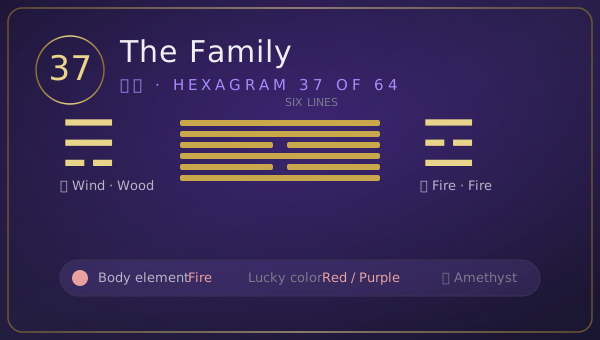
Hexagram 37 is the family hexagram of the I Ching: fire in the stove, wind rising from it — the household as the source from which everything visible in the world comes forth. Its classical judgment reads "favorable for the woman's perseverance" (利女贞), and its image — wind coming from fire — says the noble one "has substance in his words and constancy in his conduct" (言有物而行有恒). When Hexagram 37 appears in a reading, it describes the foundation structure: the home, the family, the inner order that becomes the outer world — and the hexagram's exact counsel about who holds what.
The Story of Hexagram 37: The Three Moves
Around 370 BCE, near a cemetery in the state of Zou, a widow was raising her young son. Mencius — the boy who would become the most famous Confucian after the master himself — was playing in the burial ground, cheerfully imitating the grave-diggers and mourners. His mother watched, and decided the environment was wrong. She moved.
The new house was near a marketplace. The boy quickly learned the merchants' calls — the bargaining, the slaughtering pigs, the language of the butcher's stall. His mother watched again, and decided the environment was still wrong. She moved a second time.
The third house was beside a school. The boy learned the rituals, the courtesies, the bows and the reading. His mother settled there, and the tradition that grew from that household shaped two thousand years of Chinese education. (Source: Biographies of Exemplary Women, Mother of Mencius of Zou)
The hexagram's image is the household as the wind's source — 风自火出, wind coming from fire. What happens inside the stove determines what moves outside the house. Mencius's mother did not teach her son by lecturing; she selected the environment, three times, and let the wind blow from where she had chosen to build the fire. That is the hexagram's whole method: the inner order is chosen, deliberately, and the outer world is what that order produces.
What Is Hexagram 37?
- Name: 家人 (Jiā Rén), traditionally rendered The Family; also translated as The Household, Domestic Relationships, or The Members of the Family
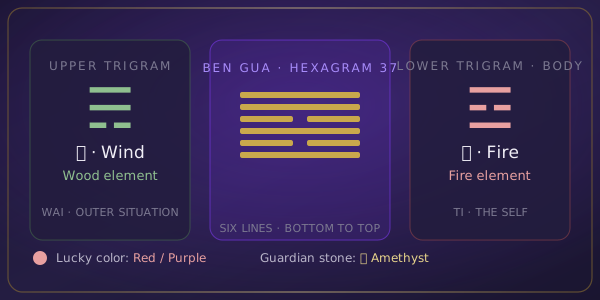
- Structure: Fire over Wind — the flame inside, the wind rising from it, the inner order producing the outer movement
- Position: 37 of 64, the hexagram after Darkening of the Light; what the hidden light builds
- Element: Wood on the body trigram — the lower trigram (wind) belongs to Wood; fire above belongs to Fire
- Body trigram: the lower trigram (wind, Wood), which in plum blossom divination represents the self
- Core images: wind from fire, the fence around the home, the women's quarters, the king arriving at the home, the awe that completes
The Core Meaning of Hexagram 37
The judgment of Hexagram 37 is four characters — 利女贞, favorable for the woman's perseverance — and they are the hexagram's most discussed line. The traditional reading assigns the household's foundational perseverance to the woman of the house; the modern reading is wider but no less structural. The household holds through someone's constancy, and the hexagram's whole subject is who holds what, and in what order.
Three things this hexagram is telling you, each standing on its own:
The household is the wind's source. 风自火出 — what moves in the world comes from what burns at home. The hexagram treats the family not as a retreat from the world but as its origin. The order (or disorder) inside the house is the wind that reaches every field. This is why the hexagram's position is central: after the hidden light survives (36), the first structure it builds is the home.
Words and conduct are the household's discipline. The image's instruction is exact: 言有物而行有恒 — substance in words, constancy in conduct. The household is built by what is said and what is done, daily, with no gap between them. The third line is the hexagram's warning about the gap: the household that is severe (嗃嗃) ends well, and the household that is merely sweet (嘻嘻) ends in regret.
The family has positions, and the positions are held. The hexagram's lines assign roles — the woman's perseverance (the judgment), the women's quarters (line 2), the husband's words (line 3), the wealth of the household (line 4), the king arriving at home (line 5), and the awe that completes (line 6). The hexagram does not pretend the roles are identical; it teaches that each is real, and that the household works when each is held.
The question Hexagram 37 answers is not "is my family perfect?" It is: is the inner order chosen deliberately — and is each position in the house actually being held?
Hexagram 37 in Love and Relationships
If you are single: Hexagram 37 describes the foundation season — the self as household, the inner order that will become the outer bond. The hexagram's counsel for the single season is Mencius's mother: choose the environment. What you are building inside now is the wind that will reach every relationship later. And the hexagram's judgment is its honesty: the household holds through someone's perseverance — start being the person who holds.
In an early or uncertain stage: Early love under Hexagram 37 is the first household questions — the environment each person comes from, the order each one carries, the fire each one is building. The hexagram's lines are its counsel: the fence around the home (line 1) means guard the beginning; the women's quarters (line 2) means each position held at the center; the severe household (line 3) means honesty over sweetness. Early bonds reveal their nature by which order they bring to the shared house.
In a stable relationship: A stable relationship drawing Hexagram 37 is the household itself — this is the hexagram's home territory. Its counsel for the long bond is the image: 风自火出. The order inside the relationship is the wind that reaches every other field of both lives. The hexagram's fifth line is its long-bond promise: 王假有家,勿恤吉 — the king arrives at the home and does not need to worry. The household that is truly ordered does not require the outside world's rescue. And its final line is its long-bond completion: 威如,终吉 — the awe, the dignity, and the ending in good fortune.
In a crisis: If the relationship is at the third line — the severe household or the sweet one — Hexagram 37's arithmetic is its counsel: 嗃嗃 ends in good fortune (悔厉吉), and 嘻嘻 ends in regret (终吝). The crisis of the household is almost always the gap between the words and the conduct — the image's 言有物而行有恒. The repair is the same discipline the hexagram teaches at every line: substance in what is said, constancy in what is done.
Hexagram 37 in Career, Money and Decisions
Career: This is the household-as-organization hexagram — the team as family, the company as household, the inner order that produces the outer work. Its career counsel is the image: 风自火出 — the culture inside is the wind that reaches every field. The hexagram's lines are its organizational manual: the fence (line 1) means guard the boundaries; the women's quarters (line 2) means each position held at the center; the severe-over-sweet rule (line 3) means the culture that is honest outlasts the one that is merely pleasant.
Money: Hexagram 37 governs the household's wealth — the family budget, the shared economy, the home's resources. Its financial counsel is the fourth line: 富家,大吉 — the wealth of the household, and the hexagram's great good fortune. Money in this hexagram is household money: the resource that makes the inner order possible. And its fifth line is its promise: 勿恤吉 — the ordered household does not need to worry about its means.
Decision: Hexagram 37 says: choose the environment. If you are deciding where to build your fire — the home, the household, the inner order of a team or a self — the hexagram's test is its image: is the order inside chosen deliberately, and is each position in the house actually held? The decision it blesses is the chosen environment; the decision it marks is the household that happened by accident.
The Changing Lines of Hexagram 37: Six Scenes
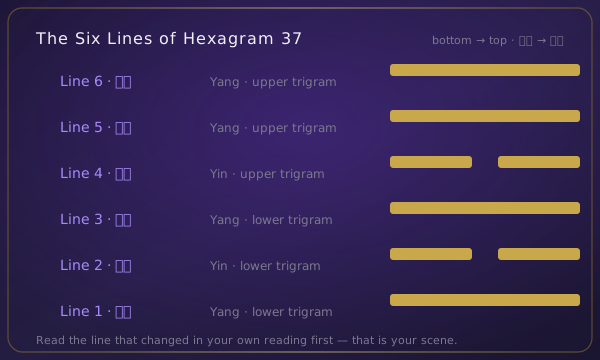
Each line of Hexagram 37 is one scene in the life of a household — its fence, its quarters, its severity, its wealth, its king, and its awe.
Line 1 (初九) — The fence around the home; the regret dissolves. The scene: the boundary drawn before anything enters. The modern reading: the foundation line. The household begins with a fence (闲有家) — what is allowed in and what is not — and the hexagram grants 悔亡. The boundaries drawn early are what keep the later regret from arriving.
Line 2 (六二) — Nothing is undertaken; at the center, preparing the food; perseverance is favorable. The scene: the household's center, and the daily work held there. The modern reading: the center line. 无攸遂,在中馈 — nothing grand undertaken; the cooking at the center. The hexagram's teaching: the household is held by the unglamorous daily work at its middle, and perseverance in that work is the favorability.
Line 3 (九三) — The family is severe: regret, danger, good fortune. The wife and children giggle: in the end, regret. The scene: the two household disciplines, and their opposite endings. The modern reading: the warning line. The severe household (嗃嗃) — the rules kept, the tensions held — ends in good fortune through the danger (悔厉吉). The giggling household (嘻嘻) — the sweetness, the avoidance — ends in regret (终吝). The hexagram's arithmetic is exact.
Line 4 (六四) — The wealth of the household; great good fortune. The scene: the household prosperous, and the hexagram's blessing. The modern reading: the prosperity line. 富家,大吉 — the wealth that makes the inner order possible, granted the hexagram's great fortune. Money in this hexagram is not the point; it is what the point is made of.
Line 5 (九五) — The king arrives at the home; do not worry; good fortune. The scene: the outermost power entering the innermost structure. The modern reading: the center line and the hexagram's promise. 王假有家,勿恤吉 — the king comes home, and does not need to worry. The household that is truly ordered needs no rescue from the world; the world comes to it.
Line 6 (上九) — With awe, good fortune in the end. The scene: the household completed, and the quality that completes it. The modern reading: the completion line. 威如,终吉 — the awe, the dignity, the weight that a well-ordered house carries. The household ends in good fortune when it ends in gravity.
When all six lines change: Hexagram 37 turns toward Hexagram 38 — the family completed becomes opposition. The wind that rose from one fire meets the wind from another.
How to Read Hexagram 37 with the Number Oracle
Hexagram 37 reaches you the same way every hexagram does: through three numbers that arise naturally while you hold your question — a clock, a receipt, a page number, a number that simply surfaces. The first number sets the upper trigram, the second the lower trigram, and the third identifies the changing line. Enter your three numbers and your question at numbers-oracle.com and you will get the hexagram plus an AI interpretation written for your situation — free, no registration. For the mechanics, read how three numbers become a hexagram →
Your lucky energy for Hexagram 37: Wood element (the body trigram, wind below). Lucky colors are green and tender sprout tones; the matching crystal is malachite, traditionally associated with growth, renewal, and fresh starts.
Related hexagrams: Hexagram 36 (Darkening of the Light) — the hidden light that builds the home; Hexagram 38 (Opposition) — the wind from another fire; Hexagram 8 (Holding Together) — the household extended into alliance.
Hexagram 37: Common Questions
What does hexagram 37 mean in one sentence?
Hexagram 37 means the family as foundation — the household is the wind's source, the inner order chosen deliberately that produces everything visible in the outer world, held by substance in words and constancy in conduct.
Is hexagram 37 good for love?
Hexagram 37 is the Book's home hexagram — favorable for the household held by perseverance, with its fifth line's king arriving home (勿恤吉) as its long-bond promise. Its warning is the third line: the giggling household ends in regret, the severe one ends in good fortune. The hexagram favors the honest structure over the pleasant one.
What should I do when I receive hexagram 37?
Check which line changed. The fence (line 1) means guard what enters the house early; the center (line 2) means hold the unglamorous daily work; the severe household (line 3) means keep the rules over the giggles; the wealth of the household (line 4) means resource the inner order; the king arrives home (line 5) means the ordered household needs no rescue; with awe (line 6) means the household completes in gravity.
Why is hexagram 37 called "The Family"?
Because its image is wind coming from fire — 风自火出 — what moves outside the house is produced by what burns inside it. The old translators rendered it The Family or The Household because the hexagram's whole subject is the inner order as origin: the fence, the positions, the daily work, and the wind that reaches every field.
She moved twice for the school. The wind from that fire has not stopped moving.