I Ching Hexagram 38 (Opposition) in Love: What It Means for Your Relationship
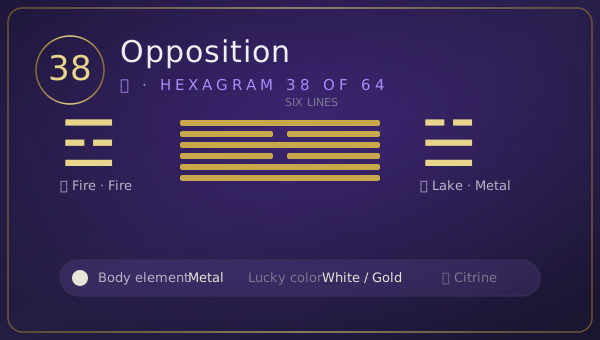
Hexagram 38 is the opposition hexagram of the I Ching: fire rising while the lake sinks, two elements that want nothing to do with each other. Its classical judgment reads "small affairs are favorable" (小事吉), and its image — fire above, the marsh below — says the noble one "is the same in kind but different in particular" (同而异). When Hexagram 38 appears in a reading, it describes estrangement: the relationship, team, or situation where two honest parties have become opposites — and the hexagram's exact counsel about what survives opposition and what it costs.
The Story of Hexagram 38: The General and the Minister
The story is one of the most famous reconciliations in Chinese history. Around 279 BCE, the state of Zhao had a problem with two of its own men. General Lian Po was the kingdom's sword — decades of campaigns, a temper to match, and a grievance: a man named Lin Xiangru, a minister of words rather than battles, had been promoted above him. Lian Po announced that he intended to humiliate Lin the next time he saw him.
Lin Xiangru, hearing this, began avoiding the general. He declined the court processions; he took the side roads; his own retainers were humiliated by what looked like cowardice. And then he explained, and the explanation is the hexagram's whole teaching: he had kept his distance, he said, not from fear of the general, but because the two of them were the twin pillars of Zhao — and the quarrel between them was the one thing the rival state of Qin was waiting for. "When two tigers fight, one must stand aside." (《史记·廉颇蔺相如列传》: 两虎相斗,必有一伤 — "when two tigers fight, one must be wounded.")
The general heard the explanation, and did what the hexagram's lines describe. He stripped off his outer robe, carried a bramble on his bare shoulder — the traditional gesture of the penitent — and came to Lin's gate to apologize. The two men became sworn friends, and the alliance held the kingdom for years.
The hexagram's judgment is 小事吉 — small affairs are favorable. Opposition does not prevent everything; it prevents the great things. What survives it is the small, deliberate, humble act: the apology at the gate.
What Is Hexagram 38?
- Name: 睽 (Kuí), traditionally rendered Opposition; also translated as Estrangement, Polarising, or Alienation
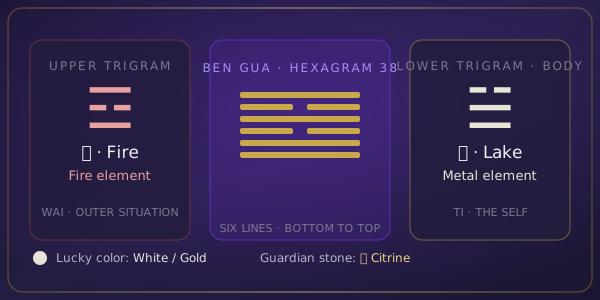
- Structure: Fire over the Lake — flame rising, water sinking, two elements in opposite motion
- Position: 38 of 64, the hexagram after The Family; what the wind from one fire meets
- Element: Metal on the body trigram — the lower trigram (the lake) belongs to Metal; fire above belongs to Fire
- Body trigram: the lower trigram (the lake, Metal), which in plum blossom divination represents the self
- Core images: fire above the lake, the lost horse that returns by itself, the dragging cart, the bow drawn and unstrung, the rain that ends the opposition
The Core Meaning of Hexagram 38
The judgment of Hexagram 38 is deliberately narrow: 小事吉 — small affairs are favorable. Opposition does not kill everything; it kills the scale. The great alliance, the grand gesture, the full trust — these are not available in a 睽 season. What is available is the small, exact, humble act, and the hexagram grants it favor. The image says what the opposition does not have to mean: 同而异 — the same in kind, different in particular. Two parties can share everything structural and still be burning in opposite directions.
Three things this hexagram is telling you, each standing on its own:
Opposition is structural, not personal. Fire and the lake do not quarrel — they simply move in incompatible directions. The hexagram's estrangement is usually not betrayal; it is the discovery that two honest forces want different things. What the hexagram asks is that you stop reading the opposition as a verdict on the other person's character.
The small act is the whole available movement. 小事吉 — the judgment's entire counsel. The grand reconciliation is not available; the small one is. The second line's meeting in the lane (遇主于巷) is the hexagram's image: the encounter in the narrow place, not the parade. Lian Po's bramble on the shoulder is the small act that ended the opposition.
Opposition resolves in rain, not in victory. The final line is the hexagram's strangest and most hopeful image: the rain that falls when the opposites meet (往遇雨则吉). Opposition, in this hexagram's cosmology, is the dry separation of fire and water — and the resolution is the two meeting as weather. Not one defeating the other; both becoming something new.
The question Hexagram 38 answers is not "who is right?" It is: what is the small act available to me — and can I hold the difference without requiring the victory?
Hexagram 38 in Love and Relationships
If you are single: Hexagram 38 describes the season of estrangement — from connection, from the dating world, sometimes from your own idea of relationship. The hexagram's counsel for the single season: 小事吉 — the small thing is available. The grand re-entry is not. And the first line is its comfort: 丧马勿逐,自复 — the lost horse does not need chasing; it returns on its own. What has been lost to opposition often comes back when the chasing stops.
In an early or uncertain stage: Early love under Hexagram 38 is two people discovering their opposition — the difference that appeared, the incompatible direction. The hexagram's lines are its counsel: the lane encounter (line 2) is the meeting in the narrow place; the dragging cart (line 3) is the bond that looks wrecked and completes anyway; the lone opposition (line 4) is the meeting of the one who is apart with the one who is also apart. And the final line's rain is its promise: the opposites meet as weather.
In a stable relationship: A stable relationship drawing Hexagram 38 is in estrangement — the two honest directions that have stopped meeting. The hexagram's counsel for the long bond is its judgment: 小事吉. The grand gesture is not available, and it was never the answer. The small act — the apology at the gate, the bramble on the shoulder — is the whole movement. And its image is the long-bond teaching: 同而异. The same in kind, different in particular: what the long bond requires is not sameness but the holding of difference without the demand for victory.
In a crisis: If the relationship is at the final line — the bow drawn at the pig, the ghost in the cart — Hexagram 38's counsel is its extremity: 先张之弧,后说之弧. The bow is drawn, and then unstrung. The enemy turns out to be a matchmaker. The crisis of opposition is the moment when the weapon comes down — and the hexagram's promise is attached to the unstringing: 匪寇婚媾,往遇雨则吉. The rain falls when the opposites meet.
Hexagram 38 in Career, Money and Decisions
Career: This is the estrangement hexagram of professional life — the team split, the partnership in opposition, the two honest directions inside one organization. Its career counsel is the judgment: 小事吉 — small affairs are favorable. The grand reorganization is not available; the small act is. Lian Po's bramble is the career image: the penitent's shoulder, the apology at the gate. And the image is the career teaching: 同而异 — the same in kind, different in particular. The estranged colleagues share more than the opposition suggests.
Money: Hexagram 38 governs money in opposition — the dispute, the split, the deal in estrangement. Its financial counsel is the judgment: 小事吉. The grand settlement is not available; the small transaction is. The first line's lost horse is its financial comfort: 丧马勿逐,自复 — the loss that returns without chasing. And the final line's rain is its financial promise: the opposites meet as weather, and the meeting is favorable.
Decision: Hexagram 38 says: the small act, not the grand gesture. If you are deciding how to meet the opposition — the person, the team, the difference — the hexagram's test is its judgment: is this small (available) or grand (not available), and can I hold the difference without requiring the victory? The decision it blesses is the bramble on the shoulder; the decision it marks is the bow that stays strung.
The Changing Lines of Hexagram 38: Six Scenes
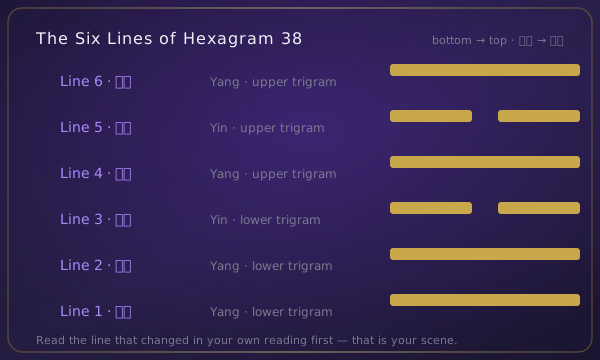
Each line of Hexagram 38 is one scene in the life of an opposition — its lost horse, its lane encounter, its dragging cart, its lone meeting, its shared flesh, and its rain.
Line 1 (初九) — The regret dissolves; the lost horse does not need chasing; it returns by itself. Seeing the bad person: no blame. The scene: the loss that heals itself, and the tolerance that is not weakness. The modern reading: the opening line. 丧马勿逐,自复 — what opposition has taken returns when the chasing stops. And 见恶人无咎 — even the encounter with the bad person is blameless: opposition requires the tolerance to meet what opposes you.
Line 2 (九二) — Meeting the lord in the lane; no blame. The scene: the encounter in the narrow place. The modern reading: the reconciliation line. Not the parade, not the summit — the lane. The small, exact, unceremonious meeting is what the hexagram grants its favor. Lian Po at the gate is this line.
Line 3 (六三) — Seeing the cart dragged, the ox stopped, the man's face tattooed and nose cut off. No beginning, but an end. The scene: the bond that looks destroyed and completes anyway. The modern reading: the perseverance line. 见舆曳,其牛掣,其人天且劓,无初有终 — the wreckage, the mutilation, and the hexagram's promise: no beginning, but an ending. Opposition does not prevent completion; it prevents the appearance of one.
Line 4 (九四) — Opposition in isolation; meeting the original man; exchanged sincerity; danger, but no blame. The scene: the one who is apart, meeting the one who is also apart. The modern reading: the meeting line. 睽孤,遇元夫,交孚,厉无咎 — the isolated opposites find each other, exchange sincerity, and the danger is passed through (厉无咎). Opposition ends when the isolated meet.
Line 5 (六五) — The regret dissolves; his kin bite through the skin; going forward, what blame is there? The scene: the opposition that turns out to be family. The modern reading: the center line. 厥宗噬肤 — the kinsmen eating together, the estrangement that resolves into recognition. The hexagram's central promise: what looked like opposition was, underneath, kin.
Line 6 (上九) — Opposition in isolation: seeing a pig covered in mud, a cart loaded with ghosts — first the bow is drawn, then it is unstrung. Not a bandit, a matchmaker; going forward, meeting the rain, good fortune. The scene: the enemy that was never an enemy. The modern reading: the completion line and the hexagram's strangest image. The pig in the mud, the ghost in the cart, the bow drawn and then unstrung — the opposition dissolves into its opposite: 匪寇婚媾,往遇雨则吉. The rain falls when the opposites meet.
When all six lines change: Hexagram 38 turns toward Hexagram 39 — opposition completed becomes obstruction. The rain that fell becomes the water that blocks.
How to Read Hexagram 38 with the Number Oracle
Hexagram 38 reaches you the same way every hexagram does: through three numbers that arise naturally while you hold your question — a clock, a receipt, a page number, a number that simply surfaces. The first number sets the upper trigram, the second the lower trigram, and the third identifies the changing line. Enter your three numbers and your question at numbers-oracle.com and you will get the hexagram plus an AI interpretation written for your situation — free, no registration. For the mechanics, read how three numbers become a hexagram →
Your lucky energy for Hexagram 38: Metal element (the body trigram, the lake below). Lucky colors are white, gold, and silver; the matching crystal is citrine, traditionally associated with abundance and clear, joyful energy.
Related hexagrams: Hexagram 37 (The Family) — the household before the opposition; Hexagram 13 (Fellowship) — the hexagram's mirror image, likeness instead of estrangement; Hexagram 6 (Conflict) — opposition that has become dispute.
Hexagram 38: Common Questions
What does hexagram 38 mean in one sentence?
Hexagram 38 means opposition — estrangement between two honest parties moving in incompatible directions, where small affairs are favorable, the grand gesture is not available, and the resolution is rain rather than victory.
Is hexagram 38 bad for love?
Hexagram 38 is difficult but not condemned — its judgment is 小事吉, small affairs are favorable. The hexagram's gift to relationships is its honesty: opposition is structural (fire and the lake, not betrayal), and what survives it is the small act. Its promise is the final line's rain: the opposites meet as weather.
What should I do when I receive hexagram 38?
Check which line changed. The lost horse (line 1) means stop chasing what returns by itself; the lane encounter (line 2) means the small meeting is the reconciliation; the dragging cart (line 3) means the bond completes despite the wreckage; the lone meeting (line 4) means the isolated find each other; the kinsmen (line 5) means the opposition was family underneath; the bow unstrung (line 6) means the enemy was a matchmaker — the rain is coming.
Why is hexagram 38 called "Opposition"?
Because its image is fire above the lake — flame rising while water sinks, two elements with nothing to say to each other. The old translators rendered it Opposition or Estrangement because the hexagram's subject is difference: how two honest parties become opposites, what small act survives it, and the rain that falls when they finally meet.
When two tigers fight, the wise one is already standing aside.