I Ching Hexagram 40 (Deliverance): Meaning in Love, Career and Life
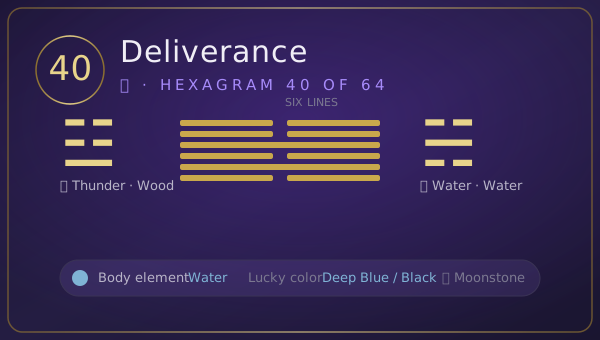
Hexagram 40 is the deliverance hexagram of the I Ching: thunder and rain together, the storm that releases what it gathered. Its classical judgment reads "favorable to the southwest. Nowhere to go — coming back is good fortune. Somewhere to go — early morning is good fortune" (利西南。无所往,其来复吉。有攸往,夙吉), and its image — thunder and rain — says the noble one "pardons transgressions and forgives faults" (赦过宥罪). When Hexagram 40 appears in a reading, it describes release: the obstruction dissolving, the pressure lifting — and the hexagram's exact counsel about the window that opens after a long block.
The Story of Hexagram 40: Thunder and Rain
The scene is the moment a storm breaks. Thunder and rain together — 雷雨作,解 — the release that the obstruction (39) was holding all along. The water on the ridge becomes the water that falls, and what was stuck begins to move. The old commentators read the hexagram from that exact motion: deliverance is not the absence of the storm; it is the storm doing what storms do.
The judgment is the hexagram's timing manual, and it is unusually specific. 利西南 — the same southwest as the obstruction: the low, yielding direction. 无所往,其来复吉 — if there is nowhere to go, coming back is good fortune. 有攸往,夙吉 — if there is somewhere to go, the early morning is good fortune. The commentators read this as a rule of windows: deliverance is a season, and seasons have their hours. Move at dawn, or return to rest — but do not spend the release.
The lines are the life of a release. The first line is 无咎 — no blame, the release at its simplest. The second is the hexagram's central image: 田获三狐 — the hunt captures three foxes — and the yellow arrow found with them (得黄矢). The third is the hexagram's warning: 负且乘,致寇至 — the burden carried on the carriage, the bandits invited — the release that becomes its own provocation. The fourth is the thumb released (解而拇) — the small attachment that had to go — and the friends who arrive (朋至斯孚). The fifth is the hexagram's center: the noble one released, and the sincerity that even the small man is held by (君子维有解,吉,有孚于小人). And the final line is the hexagram's decisive image: the falcon on the high wall, shot by the duke (公用射隼于高墉之上,获之) — the obstruction itself, at its perch, removed.
The storm does not apologize for the obstruction it was holding. It releases, and the release has its hours.
What Is Hexagram 40?
- Name: 解 (Xiè), traditionally rendered Deliverance; also translated as Release, Loosening, or Solution
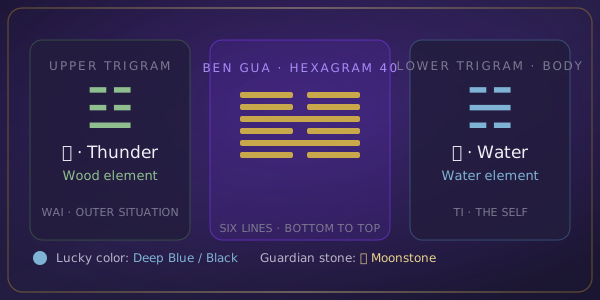
- Structure: Thunder over Water — the quake and the rain, the release of what was gathered
- Position: 40 of 64, the hexagram after Obstruction; what the blocked path becomes
- Element: Water on the body trigram — the lower trigram (water) belongs to Water; thunder above belongs to Wood
- Body trigram: the lower trigram (water, Water), which in plum blossom divination represents the self
- Core images: thunder and rain, the three foxes, the yellow arrow, the released thumb, the falcon on the wall
The Core Meaning of Hexagram 40
The judgment of Hexagram 40 is a window manual: favorable to the southwest, and then the two-timed instruction. Nowhere to go — come back. Somewhere to go — go at dawn. Deliverance is a season with hours, and the hexagram's whole counsel is about not wasting the release.
Three things this hexagram is telling you, each standing on its own:
Release follows obstruction, and it is the same water. The hexagram after the block is the storm that was holding the block. Deliverance does not come from nowhere; it is what the obstruction was gathering. What the hexagram asks is that you recognize the release when it comes — most people in long blocks do not.
The window has hours. 无所往,其来复吉 — if there is nowhere to go, return. 有攸往,夙吉 — if there is somewhere to go, go at dawn. The release is not a permanent state; it is an opening with a schedule. The image says what the release is for: 赦过宥罪 — pardoning, forgiving, releasing what was held. The window that opens after a block is for letting go, not for new conquests.
The obstruction itself has a perch, and it can be shot. The final line is the hexagram's decisive teaching: the falcon on the high wall — the source of the obstruction, at its own height, and the duke's arrow. Deliverance is not only the dissolving of pressure; it is the removal of what caused it. The release is complete when the falcon is down.
The question Hexagram 40 answers is not "is it over?" It is: the window is open — do I move at dawn, or return and rest, and has the falcon been removed from its wall?
Hexagram 40 in Love and Relationships
If you are single: Hexagram 40 describes the season after the block — the obstruction dissolving, the path opening. The hexagram's counsel for the single season is its judgment: if there is somewhere to go, go at dawn (夙吉). The release after a long blocked season has hours, and the early ones are the favorable ones. And its second line is its image: the hunt that captures three foxes — the release comes with the old evasions caught.
In an early or uncertain stage: Early love under Hexagram 40 is the bond after the block — the obstruction between two people dissolving. The hexagram's lines are its counsel: the released thumb (line 4) is the small attachment that had to go before the bond could move; the friends who arrive (朋至斯孚) are the circle that gathers once the release is real. And the third line is its warning: 负且乘 — the release that becomes display, the burden carried on the carriage, inviting the bandits.
In a stable relationship: A stable relationship drawing Hexagram 40 is in release — the long obstruction between the partners dissolving. The hexagram's counsel for the phase is its image: 赦过宥罪 — pardoning, forgiving. The release is for letting go, not for scoring. What the window opens for is the forgiveness that the blocked season made impossible. And the final line is its promise: the falcon on the wall — the source of the block — can be removed.
In a crisis: If the relationship is at the third line — the burden on the carriage — Hexagram 40's warning is its extremity: 负且乘,致寇至,贞吝. The release that becomes provocation — the relief that is displayed, the burden that is worn as status — invites the bandits. The hexagram's crisis counsel: use the release for pardoning (赦过宥罪), not for parading.
Hexagram 40 in Career, Money and Decisions
Career: This is the release hexagram of professional life — the blocked project unblocking, the stuck situation dissolving, the window after the long obstruction. Its career counsel is the judgment's timing: go at dawn (夙吉), or return and rest (来复吉). The release has hours, and the hexagram rewards the one who moves in the early ones. The second line's three foxes is its career image: the release comes with the old evasions caught. And the final line is its career completion: the falcon on the wall — the source of the block — removed.
Money: Hexagram 40 governs money in release — the frozen asset thawing, the blocked return arriving, the window after the drawdown. Its financial counsel is the same timing: move at dawn, or return. The release is for releasing (赦过宥罪) — the forgiveness of the debt, the writing-off, the letting-go of what was held — not for new commitments. The third line is its financial warning: the relief that becomes display invites the loss.
Decision: Hexagram 40 says: the window is open — check the hour. If you are deciding how to use the release, the hexagram's test is its judgment: is there somewhere to go (then dawn, 夙吉) or nowhere (then return, 来复吉)? The decision it blesses is the timely use of the release; the decision it marks is the release spent on display.
The Changing Lines of Hexagram 40: Six Scenes
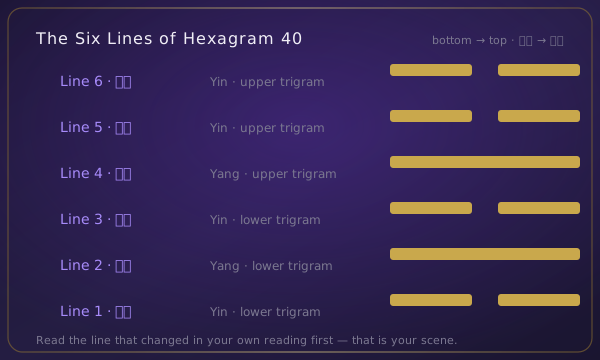
Each line of Hexagram 40 is one scene in the life of a release — its foxes, its burdens, its thumbs, its pardons, and its falcon.
Line 1 (初六) — No blame. The scene: the release at its simplest, without complication. The modern reading: the opening line. The deliverance at its foundation needs nothing added — 无咎. The release that is simply accepted, without performance, is the release the hexagram grants.
Line 2 (九二) — The hunt captures three foxes; the yellow arrow is found; perseverance is favorable. The scene: the release, and the old evasions caught in it. The modern reading: the central line and the hexagram's image. 田获三狐,得黄矢 — the three foxes (the old dodges, the worn evasions) captured, and the yellow arrow (the straight, correct instrument) found with them. The release comes with the truth recovered.
Line 3 (六三) — The burden carried on the carriage; the bandits arrive; perseverance is regret. The scene: the release that becomes provocation. The modern reading: the warning line. 负且乘,致寇至 — the porter's load worn as the rider's seat, the relief displayed, and the bandits invited. The hexagram's arithmetic: 贞吝. The release spent on status returns as loss.
Line 4 (九四) — Release the thumb; the friends arrive with sincerity. The scene: the small attachment that had to go, and the circle that gathers after. The modern reading: the release line. 解而拇,朋至斯孚 — the thumb (the small grip, the minor attachment holding the whole hand) released, and the friends arriving with sincerity. The small letting-go is what makes the gathering possible.
Line 5 (六五) — The noble one has release; good fortune; he has sincerity even toward the small man. The scene: the release at the center, and its reach. The modern reading: the center line. 君子维有解,吉,有孚于小人 — the noble one released, and the sincerity that extends even to the small man. The hexagram's center is the release that includes everyone, including the ones the release was not for.
Line 6 (上六) — The duke shoots the falcon on the high wall; captures it; nothing is unfavorable. The scene: the obstruction itself, at its perch, removed. The modern reading: the completion line and the hexagram's decisive image. 公用射隼于高墉之上,获之,无不利 — the falcon (the source of the block) on the high wall (its position of power), shot. The release is complete when the cause is removed.
When all six lines change: Hexagram 40 turns toward Hexagram 41 — deliverance completed becomes decrease. The release that pardoned becomes the letting-go that clears.
How to Read Hexagram 40 with the Number Oracle
Hexagram 40 reaches you the same way every hexagram does: through three numbers that arise naturally while you hold your question — a clock, a receipt, a page number, a number that simply surfaces. The first number sets the upper trigram, the second the lower trigram, and the third identifies the changing line. Enter your three numbers and your question at numbers-oracle.com and you will get the hexagram plus an AI interpretation written for your situation — free, no registration. For the mechanics, read how three numbers become a hexagram →
Your lucky energy for Hexagram 40: Water element (the body trigram, the rain below). Lucky colors are deep blue and black; the matching crystal is moonstone, traditionally associated with intuition, dreams, and emotional flow.
Related hexagrams: Hexagram 39 (Obstruction) — the block the release dissolves; Hexagram 16 (Enthusiasm) — the thunder before the rain; Hexagram 59 (Dispersion) — the dissolving at another scale.
Hexagram 40: Common Questions
What does hexagram 40 mean in one sentence?
Hexagram 40 means deliverance — the release after obstruction, favorable when used at its hour: going at dawn if there is somewhere to go, returning to rest if there is not, and pardoning rather than parading.
Is hexagram 40 good or bad?
Hexagram 40 is favorable — it is the Book's release hexagram, and its judgment grants good fortune to both the going and the returning. Its one warning is the third line: the release that becomes display (负且乘) invites the bandits. The hexagram is favorable for the release used for pardoning and unfavorable for the release spent on status.
What should I do when I receive hexagram 40?
Check which line changed. No blame (line 1) means accept the release simply; the three foxes (line 2) means the release comes with the old evasions caught; the burden on the carriage (line 3) means do not display the relief; the released thumb (line 4) means let go of the small attachment; the noble released (line 5) means extend the sincerity even to the small man; the falcon on the wall (line 6) means remove the source of the block.
Why is hexagram 40 called "Deliverance"?
Because its image is thunder and rain together — 雷雨作 — the storm releasing what it gathered, the water on the ridge becoming the water that falls. The old translators rendered it Deliverance or Release because the hexagram's subject is the window after the block: its hours, its purpose (pardoning), and the falcon on the wall that must come down.
The storm does not apologize for the obstruction it was holding. It releases, and the release has its dawn.