I Ching Hexagram 41 (Decrease): Meaning in Love, Career and Life
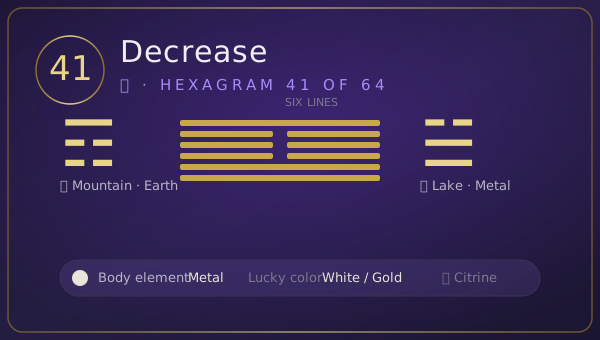
Hexagram 41 is the decrease hexagram of the I Ching: the lake diminished below the mountain, the water taken down so the height can rise. Its classical judgment reads "with sincerity, supreme good fortune, no blame; perseverance is favorable; favorable to have somewhere to go" (有孚,元吉,无咎,可贞,利有攸往), and its image — the marsh below the mountain — says the noble one "restrains his anger and stifles his desire" (惩忿窒欲). When Hexagram 41 appears in a reading, it describes loss that is not defeat: the subtraction that makes the sum work, and the hexagram's exact counsel about what to let go of.
The Story of Hexagram 41: The Lake Below the Mountain
The scene is a mountain with a marsh at its foot — and the marsh is smaller than it was. The old commentators read the hexagram from that geometry: the lake below has decreased so that the mountain above can be full. 损 is not destruction; it is transfer. What goes down from the top makes the bottom rise, and the whole structure stands straighter because something was given up.
The judgment is startlingly generous for a hexagram named decrease: 有孚,元吉,无咎 — sincerity, supreme good fortune, no blame. The decrease that is sincere is granted the Book's highest fortune. What the hexagram condemns is not loss but the clinging that refuses it.
The lines are a manual on what decrease actually requires. The first line is the hexagram's discipline: 酌损之 — decrease by measure. The service is done quickly (已事遄往), the loss is measured (酌), and the hexagram grants 无咎. The second is the hexagram's paradox: 弗损益之 — not decreasing is the increase. The perseverance that does not subtract is the favorable position (利贞,征凶 — to advance here is ominous). The third is the hexagram's most quoted arithmetic: 三人行,则损一人 — when three walk, one is lost; 一人行,则得其友 — when one walks, the friend is found. Decrease is what a group pays to become a pair. The fourth is the small disease removed (损其疾,使遄有喜) — the decrease that is a healing. The fifth is the hexagram's center: 或益之十朋之龟 — someone gives the ten-pair tortoise, the priceless gift — and it cannot be refused (弗克违,元吉). And the final line repeats the second: 弗损益之 — the decrease that is not a decrease, granted no blame, perseverance favorable, and somewhere to go.
The lake gave its water. The mountain kept its height. The hexagram's whole question is what you are willing to subtract.
What Is Hexagram 41?
- Name: 损 (Sǔn), traditionally rendered Decrease; also translated as Loss, Diminution, or Subtraction
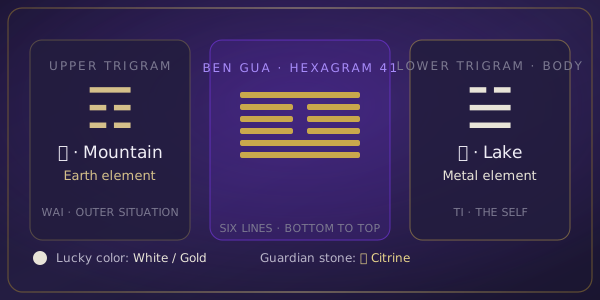
- Structure: Mountain over the Lake — the marsh diminished below, the mass full above
- Position: 41 of 64, the hexagram after Deliverance; what the release becomes
- Element: Metal on the body trigram — the lower trigram (the lake) belongs to Metal; the mountain above belongs to Earth
- Body trigram: the lower trigram (the lake, Metal), which in plum blossom divination represents the self
- Core images: the diminished lake, the measured decrease, three walking become one, the removed disease, the priceless tortoise
The Core Meaning of Hexagram 41
The judgment of Hexagram 41 grants supreme good fortune to decrease — 元吉 — which makes it one of the Book's most counterintuitive promises. The subtraction that is sincere is the favorable configuration. What the hexagram teaches is not how to avoid loss but how to decrease correctly: by measure, by the right part, at the right time.
Three things this hexagram is telling you, each standing on its own:
Decrease is transfer, not destruction. The image is the marsh below diminished so the mountain above can be full. What is taken from one place arrives in another. The hexagram's arithmetic is not zero-sum; it is structural — the whole stands straighter because something was given up.
The correct decrease is measured. The first line's 酌损之 is the hexagram's discipline: decrease by the cup, by measure, not by the flood. The service is done quickly, the loss is weighed, and the hexagram grants no blame to the measured subtraction. What it does not grant is the decrease by demolition.
The deepest teaching is that some things must not be decreased. The second and final lines both say 弗损益之 — not decreasing is the increase. The hexagram knows there are positions where the subtraction is the error: the core, the root, the thing that must stay whole. The art is knowing which is which — the disease to remove (line 4) and the substance to keep (lines 2 and 6).
The question Hexagram 41 answers is not "what am I losing?" It is: is this decrease measured and sincere — and is this the part that should go, or the part that must stay?
Hexagram 41 in Love and Relationships
If you are single: Hexagram 41 describes the season of subtraction — the self being decreased of something so the structure can stand straighter. The hexagram's counsel for the single season: 酌损之 — decrease by measure. The anger and the desire (惩忿窒欲, the image) are the hexagram's named targets: what the single season subtracts is what the next bond will not have to carry.
In an early or uncertain stage: Early love under Hexagram 41 is the subtraction phase — each person decreasing something so the two can stand together. The hexagram's lines are its manual: the measured decrease (line 1) is the small surrender done quickly; three walking become one (line 3) is the group that must thin so the pair can find each other; the removed disease (line 4) is the small habit subtracted with joy.
In a stable relationship: A stable relationship drawing Hexagram 41 is in its decrease phase — something being given up, and the hexagram's counsel for the long bond is its image: 惩忿窒欲. Restrain the anger, stifle the desire. The long bond is not built by addition; it is built by the daily subtraction of what does not belong. And its fifth line is its long-bond promise: the priceless gift that cannot be refused — 十朋之龟,弗克违 — what the decrease earns cannot be sent back.
In a crisis: If the relationship is at the second line — not decreasing is the increase — Hexagram 41's paradox is its crisis counsel: 弗损益之,征凶. To advance here is ominous. The crisis is usually the moment when someone is subtracting from the wrong part — cutting the root to trim the branch. The hexagram's crisis instruction: find the disease (line 4) and leave the substance (lines 2 and 6) alone.
Hexagram 41 in Career, Money and Decisions
Career: This is the decrease hexagram of professional life — the subtraction phase, the cutting back, the loss that makes the structure stand. Its career counsel is the judgment: sincere decrease is supreme good fortune (元吉). The first line's discipline is the career discipline: 酌损之 — decrease by measure, quickly, with no blame. The second line's warning is the career warning: some positions must not be decreased (弗损益之,征凶). And the third line's arithmetic is its career image: three walking become one — the team that must thin so the core can find itself.
Money: Hexagram 41 governs money in decrease — the cut, the loss, the subtraction that makes the sum work. Its financial counsel is the judgment: the measured, sincere decrease is granted supreme fortune. The first line is its financial discipline: subtract by measure (酌损之), not by flood. The fourth line is its financial image: the disease removed brings the quick joy (损其疾,使遄有喜). And the fifth line is its financial promise: the priceless gift arrives and cannot be refused — the decrease that is correctly done earns what cannot be returned.
Decision: Hexagram 41 says: decrease — by measure, and from the right part. If you are deciding what to give up — the position, the expense, the habit, the claim — the hexagram's test is its discipline: is this subtraction measured (酌) or is it demolition, and is this the disease (line 4) or the substance (lines 2 and 6)? The decision it blesses is the sincere measured decrease; the decision it marks is the cut from the root.
The Changing Lines of Hexagram 41: Six Scenes
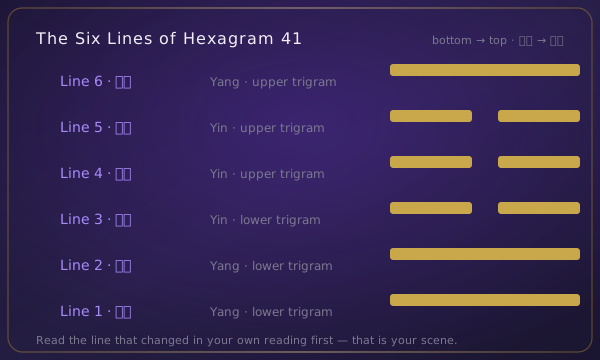
Each line of Hexagram 41 is one scene in the life of a decrease — its measures, its non-decreases, its thinned group, its healed disease, and its priceless gift.
Line 1 (初九) — The service is done quickly; decrease by measure; no blame. The scene: the subtraction done fast and weighed. The modern reading: the discipline line. 已事遄往,酌损之 — the work finished, the decrease measured. The hexagram grants 无咎 to the quick, weighed subtraction. What it does not grant is the delay that turns the decrease into a wound.
Line 2 (九二) — Perseverance is favorable; to advance is ominous. Not decreasing is the increase. The scene: the position where subtraction is the error. The modern reading: the paradox line. 弗损益之 — not decreasing is itself the increase. The hexagram's warning: 征凶. Some things must stay whole, and the discipline of keeping them is the favorable move.
Line 3 (六三) — When three walk, one is lost; when one walks, the friend is found. The scene: the group that thins into the pair. The modern reading: the arithmetic line. The hexagram's most quoted teaching — decrease as the mechanism by which the crowd becomes the bond. What is lost from the group returns as the friend.
Line 4 (六四) — Decrease the disease; make it quick and there is joy; no blame. The scene: the subtraction that is a healing. The modern reading: the healing line. 损其疾,使遄有喜 — the disease decreased, quickly, with joy. The hexagram's clearest image of what decrease is for: removing what should never have been there.
Line 5 (六五) — Someone gives the ten-pair tortoise; it cannot be refused; supreme good fortune. The scene: the priceless gift that arrives through the decrease. The modern reading: the center line. 或益之十朋之龟,弗克违,元吉 — the gift that cannot be sent back, granted the supreme fortune. What the sincere decrease earns is beyond return.
Line 6 (上九) — Not decreasing is the increase; no blame; perseverance is favorable; favorable to have somewhere to go. The scene: the completion of the non-decrease. The modern reading: the completion line. 弗损益之,无咎,贞吉,利有攸往 — the whole favorable set granted to the position where nothing was subtracted from what mattered. The decrease that ended correctly is the one that stopped.
When all six lines change: Hexagram 41 turns toward Hexagram 42 — decrease completed becomes increase. What was subtracted below arrives above.
How to Read Hexagram 41 with the Number Oracle
Hexagram 41 reaches you the same way every hexagram does: through three numbers that arise naturally while you hold your question — a clock, a receipt, a page number, a number that simply surfaces. The first number sets the upper trigram, the second the lower trigram, and the third identifies the changing line. Enter your three numbers and your question at numbers-oracle.com and you will get the hexagram plus an AI interpretation written for your situation — free, no registration. For the mechanics, read how three numbers become a hexagram →
Your lucky energy for Hexagram 41: Metal element (the body trigram, the lake below). Lucky colors are white, gold, and silver; the matching crystal is citrine, traditionally associated with abundance and clear, joyful energy.
Related hexagrams: Hexagram 40 (Deliverance) — the release that becomes decrease; Hexagram 42 (Increase) — the hexagram's mirror; Hexagram 23 (Splitting Apart) — the decrease that is not measured.
Hexagram 41: Common Questions
What does hexagram 41 mean in one sentence?
Hexagram 41 means decrease — sincere, measured subtraction granted supreme good fortune, where the art is knowing what to give up (the disease, the measure) and what must never be decreased (the substance).
Is hexagram 41 bad?
Hexagram 41 grants supreme good fortune (元吉) to the sincere decrease — it is one of the Book's favorable hexagrams despite its name. Its warnings are precise: advancing at the second line is ominous (the position where nothing should be subtracted). The hexagram is unfavorable for the cut from the root and favorable for the removal of the disease.
What should I do when I receive hexagram 41?
Check which line changed. Measured decrease (line 1) means subtract quickly and by measure; not decreasing (line 2) means keep this whole — do not cut here; three walk become one (line 3) means let the group thin so the pair can find itself; decrease the disease (line 4) means remove what should never have been there; the priceless gift (line 5) means what the decrease earns cannot be returned; the non-decrease completed (line 6) means the subtraction has ended — keep what is left.
Why is hexagram 41 called "Decrease"?
Because its image is the lake diminished below the mountain — 山下有泽 — the marsh lower so the mass above can be full. The old translators rendered it Decrease or Loss because the hexagram's subject is subtraction as structure: what giving up correctly looks like, and the two positions where the giving up is the error.
When three walk, one is lost. The friend was in the loss the whole time.