I Ching Hexagram 47 (Oppression): Meaning in Love, Career and Life
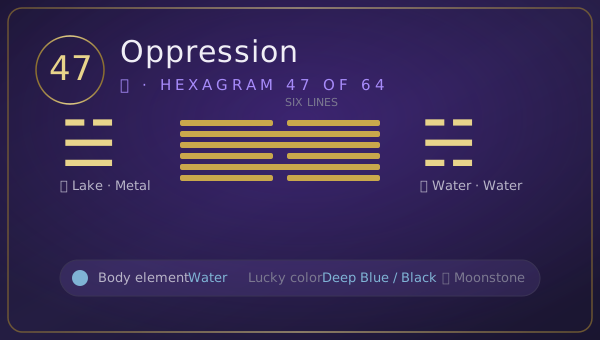
Hexagram 47 is the oppression hexagram of the I Ching: the lake dried up, the water trapped below with no way to rise. Its classical judgment reads "success; perseverance; the great person is favorable; no blame. He has words, and they are not believed" (亨,贞,大人吉,无咎。有言不信), and its image — the marsh without water — says the noble one "gives up his life to fulfill his purpose" (致命遂志). When Hexagram 47 appears in a reading, it describes exhaustion: the spirit under constraint, the truth that cannot be heard — and the hexagram's exact counsel about what a person does when there is no water left in the lake.
The Story of Hexagram 47: The Letter from the Prison
In 99 BCE, one of the most trusted officials of the Han dynasty was sentenced to death for a crime he did not commit. The sentence was commuted — to something worse. Sima Qian, the Grand Historian, was castrated.
He had been completing his father's life work: a history of everything, from the Yellow Emperor to his own emperor. The choice offered was suicide (the honorable option for a mutilated courtier) or completion (the shame of living on to finish the book). He chose completion, and the letter he wrote to his friend Ren An explaining why is one of the most famous documents in Chinese literature.
He catalogued what men have made of extremity. King Wen of Zhou composed the Book of Changes while imprisoned at Youli. Confucius wrote the Spring and Autumn Annals while stranded between Chen and Cai. Qu Yuan wrote Li Sao while exiled. Sun Tzu's Art of War was written after the loss of his feet. "All of these men had a burden in their hearts and could not express it," he wrote. "Therefore they spoke of what was past, and thought of what was to come." (《报任安书》: 此人皆意有所郁结,不得通其道,故述往事,思来者)
The hexagram's judgment contains the sentence that describes his position exactly: 有言不信 — he has words, and they are not believed. The man in oppression speaks, and the world does not hear. What the hexagram grants him is not the hearing but the completion: 致命遂志 — give up the life, fulfill the purpose. The lake has no water. The history gets written anyway.
What Is Hexagram 47?
- Name: 困 (Kùn), traditionally rendered Oppression; also translated as Exhaustion, Entangled, or Constriction
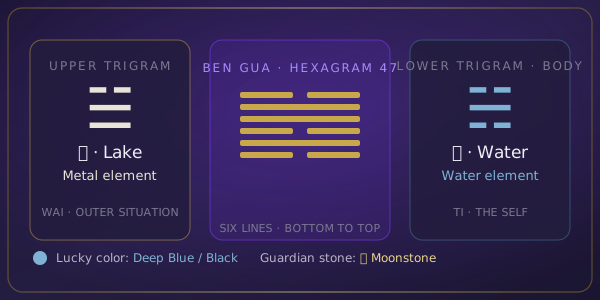
- Structure: Lake over Water — the marsh dried up, the water trapped below with no ascent
- Position: 47 of 64, the hexagram after Pushing Upward; what the risen tree becomes
- Element: Water on the body trigram — the lower trigram (water) belongs to Water; the lake above belongs to Metal
- Body trigram: the lower trigram (water, Water), which in plum blossom divination represents the self
- Core images: the lake without water, the tree stump in the ravine, the wine and food, the bronze chariot, the vines
The Core Meaning of Hexagram 47
The judgment of Hexagram 47 is the Book's most difficult promise: success (亨), perseverance (贞), the great person favorable (大人吉), no blame (无咎) — granted to the man in oppression. The hexagram does not deny the extremity; it locates the success inside it. And its final sentence is the hexagram's diagnosis: 有言不信 — the words of the oppressed are not believed. The truth spoken from the pit does not travel.
Three things this hexagram are telling you, each standing on its own:
The oppression is the position, not the failure. The lake without water is a configuration, not a verdict. What the hexagram describes is the spirit under constraint — the truth that cannot be heard, the resource that cannot rise, the person whose words the world has stopped crediting. The success the hexagram grants is not escape; it is the manner of holding the position.
The image is the whole counsel: give up the life, fulfill the purpose. 致命遂志 — the two verbs are the hexagram's entire teaching. What is given up is the life as the self wanted it; what is fulfilled is the purpose that survives the wanting. Sima Qian's choice is the hexagram's case study: the honorable death refused, the book completed.
Words from the pit are not believed, and the work does not need them. 有言不信 is the hexagram's realism. The oppressed do not need to be heard to do the work; they need to do the work. The hexagram grants its favor to the completion, not to the audience. What the pit produces is not propaganda; it is the book.
The question Hexagram 47 answers is not "when will this end?" It is: what is the purpose that survives the giving up of the life — and can I complete it without being believed?
Hexagram 47 in Love and Relationships
If you are single: Hexagram 47 describes the exhausted season — the self in the pit, the words not believed. The hexagram's counsel for the single season is its image: 致命遂志 — give up the life as planned, fulfill the purpose that survives. The single season under oppression is not the season for being heard; it is the season for completing what only you can complete.
In an early or uncertain stage: Early love under Hexagram 47 is the bond formed in constraint — the circumstances hostile, the words not believed. The hexagram's lines are its counsel: the tree stump in the ravine (line 1) is the three years unseen; the wine and food (line 2) is the hidden provision that arrives; the bronze chariot (line 4) is the reluctant arrival with an ending.
In a stable relationship: A stable relationship drawing Hexagram 47 is in its constrained season — the external oppression, the pit that both partners are in. The hexagram's counsel for the long bond is its judgment: 大人吉 — the great person, the mature one, is the favorable configuration. Constraint is survived by the partner who does not need to be believed. And its final line is the long-bond warning: the vines (困于葛藟) — the constraint that has become entanglement — and its counsel: say the thing about the movement (曰动悔) before it is too late.
In a crisis: If the relationship is at the third line — among the rocks, among the thorns, entering the house and not seeing the wife — Hexagram 47's verdict is 凶, and the hexagram does not soften it. The oppression that has reached the home is the extremity, and what the hexagram offers is its judgment's standing grant: the completion is still available (致命遂志), even here.
Hexagram 47 in Career, Money and Decisions
Career: This is the exhaustion hexagram of professional life — the constrained position, the truth not credited, the work surviving without its audience. Its career counsel is the image: 致命遂志 — give up the life as planned, fulfill the purpose. The career under oppression is survived by completion, not by being heard (有言不信). The second line's wine and food is its hidden provision: the resources that arrive while the position is constrained. And the final line is its warning: the vines — the entanglement — and its counsel: speak about the movement before it is too late.
Money: Hexagram 47 governs money in constraint — the frozen asset, the trapped resource, the lake without water. Its financial counsel is the judgment: the great person is favorable (大人吉) — constraint is survived by maturity, not by force. The second line's provision (困于酒食,朱绂方来) is its financial image: the resources that arrive in the constrained position, for the sacrifice (利用享祀) — and the warning: 征凶, do not advance. The fifth line is its financial extremity: the nose and feet cut (劓刖) — the mutilation of the position — and its slow release (乃徐有说).
Decision: Hexagram 47 says: the lake is dry — complete the purpose. If you are deciding what to do in constraint, the hexagram's test is its image: what survives the giving up of the life (遂志), and can the work be completed without the audience (有言不信)? The decision it blesses is the completion; the decision it marks is the advance out of the pit (征凶 — the hexagram forbids it).
The Changing Lines of Hexagram 47: Six Scenes
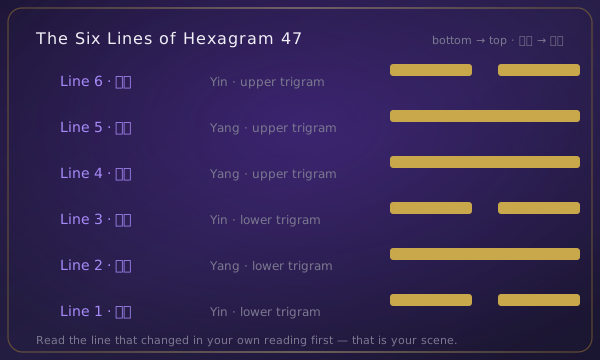
Each line of Hexagram 47 is one scene in the life of an oppression — its ravine, its provisions, its rocks, its chariot, its mutilation, and its vines.
Line 1 (初六) — The buttocks oppressed by the tree stump; entering the dark ravine; for three years not seen. The scene: the person who has disappeared into the pit. The modern reading: the descent line. 臀困于株木,入于幽谷,三岁不觌 — the constraint that removes the person from view entirely. The hexagram does not promise the visibility; it records the three years.
Line 2 (九二) — Oppressed in wine and food; the scarlet sash is coming; favorable for sacrifice; to advance is ominous, no blame. The scene: the hidden provision arriving in the pit. The modern reading: the provision line. 困于酒食,朱绂方来,利用享祀,征凶,无咎 — the resources that arrive while constrained, for the consecration, with the advance forbidden. The provision is for the sacrifice, not for the escape.
Line 3 (六三) — Oppressed among the rocks, resting on the thorns; entering his house, he does not see his wife; misfortune. The scene: the constraint that has reached the home. The modern reading: the extremity line. 困于石,据于蒺藜,入于其宫,不见其妻,凶 — the rocks, the thorns, and the house without the wife. The Book's verdict is unqualified: 凶.
Line 4 (九四) — Coming slowly; oppressed by the bronze chariot; regret, but there is an ending. The scene: the reluctant arrival, at its own pace. The modern reading: the arrival line. 来徐徐,困于金车,吝,有终 — the slow coming, the chariot that oppresses, the regret, and the ending that arrives anyway. The hexagram grants the arrival its 有终.
Line 5 (九五) — Nose and feet cut off; oppressed by the scarlet sash; slowly there is release; favorable for sacrifice. The scene: the mutilation of the position, and its slow easing. The modern reading: the center line. 劓刖,困于赤绂,乃徐有说,利用祭祀 — the cutting, the constraint of the office, and the slow release (徐有说). The hexagram's center is the extremity that loosens, on the hexagram's schedule.
Line 6 (上六) — Oppressed by the vines, by the creeping plants; he says, movement brings regret; if there is regret, going forward is good fortune. The scene: the constraint that has become entanglement, and its one exit. The modern reading: the completion line. 困于葛藟,于臲卼,曰动悔,有悔,征吉 — the vines, the unstable position, the words about the movement, and the good fortune that comes from speaking them. The exit from the vines is the honesty about the entanglement.
When all six lines change: Hexagram 47 turns toward Hexagram 48 — oppression completed becomes the well. The purpose completed becomes the source that nourishes.
How to Read Hexagram 47 with the Number Oracle
Hexagram 47 reaches you the same way every hexagram does: through three numbers that arise naturally while you hold your question — a clock, a receipt, a page number, a number that simply surfaces. The first number sets the upper trigram, the second the lower trigram, and the third identifies the changing line. Enter your three numbers and your question at numbers-oracle.com and you will get the hexagram plus an AI interpretation written for your situation — free, no registration. For the mechanics, read how three numbers become a hexagram →
Your lucky energy for Hexagram 47: Water element (the body trigram, the water below). Lucky colors are deep blue and black; the matching crystal is moonstone, traditionally associated with intuition, dreams, and emotional flow.
Related hexagrams: Hexagram 29 (The Abysmal) — the pit without the constraint; Hexagram 48 (The Well) — the source the completion becomes; Hexagram 36 (Darkening of the Light) — the hidden light in hostile times.
Hexagram 47: Common Questions
What does hexagram 47 mean in one sentence?
Hexagram 47 means oppression — exhaustion where the words are not believed, and the hexagram's success belongs to the one who gives up the life as planned and completes the purpose that survives.
Is hexagram 47 good or bad?
Hexagram 47 grants success and no blame to the constrained position (亨,大人吉,无咎) — it is one of the Book's most remarkable promises. Its hard lines are real: the house without the wife (line 3) is 凶. The hexagram is favorable for the completion and unfavorable for the advance (征凶 — repeated at lines 2 and 5).
What should I do when I receive hexagram 47?
Check which line changed. The dark ravine (line 1) means the invisibility is the position; wine and food (line 2) means the provision is for the sacrifice, not the escape; rocks and thorns (line 3) means the constraint has reached home; the bronze chariot (line 4) means the slow arrival still ends; nose and feet cut (line 5) means the release is slow and real; the vines (line 6) means speak about the movement — the honesty is the exit.
Why is hexagram 47 called "Oppression"?
Because its image is the lake without water — 泽无水 — the marsh dried up, the water trapped below with no ascent. The old translators rendered it Oppression or Exhaustion because the hexagram's subject is the spirit under constraint: the words not believed, the purpose that survives, and the completion that does not need its audience.
He had words, and they were not believed. The history got written anyway.