I Ching Hexagram 48 (The Well): Meaning in Love, Career and Life
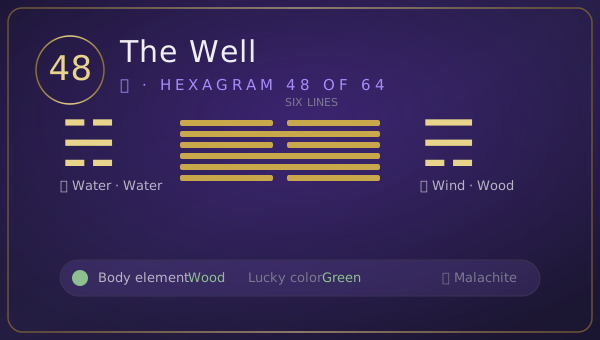
Hexagram 48 is the well hexagram of the I Ching: wood drawing water up from below, the source that serves everyone without moving. Its classical judgment reads "one may change the town, but one does not change the well; it neither loses nor gains; those who come and those who go, all draw from it. The rope does not reach the water, or the jug breaks before arriving — misfortune" (改邑不改井,无丧无得,往来井井。汔至,亦未繘井,羸其瓶,凶), and its image — wood over water — says the noble one "encourages the people and urges them to help one another" (劳民劝相). When Hexagram 48 appears in a reading, it describes the source: the nourishment that does not deplete, the center that does not move — and the hexagram's exact counsel about what happens when the rope is too short.
The Story of Hexagram 48: The Rope and the Jug
The scene is a well at the center of a village. The town has been rebuilt around it a hundred times; the well has never moved. People come, draw water, and go. The well does not choose among them, does not keep score, and does not run dry — because it is not a reservoir. It is a source, and a source is fed from below what anyone can see.
The old commentators read the hexagram from that geometry: 井 is the one structure in the Book that serves everyone equally. The judgment says it precisely — 改邑不改井, the town changes, the well does not. And the judgment's warning is the hexagram's whole practical counsel: 汔至,亦未繘井,羸其瓶,凶 — the rope does not reach the water, the jug breaks on the way up, misfortune. The well is not the problem. The equipment is.
The lines are the biography of a well. The first line is the mud — 井泥不食 — the well so silted that no one drinks from it, and even the birds stay away (旧井无禽). The second is the well's valley, where the fish are shot (井谷射鲋) — the source reduced to a fishing pond, the jug leaky (瓮敝漏). The third is the hexagram's center: the well cleared and no one drinks (井渫不食) — and the hexagram's compassion — 为我心恻, it grieves my heart — with its promise: when the king sees clearly (王明), all receive the blessing (并受其福). The fourth is the well relined (井甃) — the repair — 无咎. The fifth is the well at its center: the cold spring, clear and drunk (井洌,寒泉食). And the final line is the well opened to all — 井收勿幕 — the mouth uncovered, the source available to everyone, and the hexagram grants it 有孚元吉.
The well has never once run out. What runs out is the rope.
What Is Hexagram 48?
- Name: 井 (Jǐng), traditionally rendered The Well; also translated as The Source, The Well of Nourishment, or The Pit
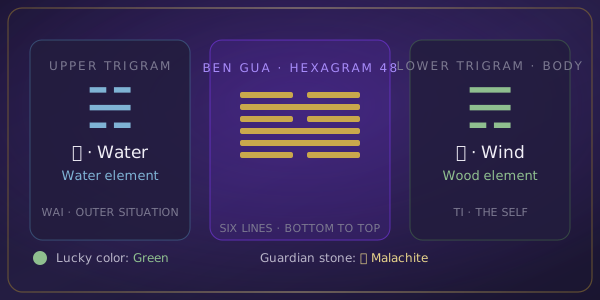
- Structure: Water over Wood — the water drawn up by the wood, the source served from below
- Position: 48 of 64, the hexagram after Oppression; what the completed purpose becomes
- Element: Wood on the body trigram — the lower trigram (wood) belongs to Wood; water above belongs to Water
- Body trigram: the lower trigram (wood, Wood), which in plum blossom divination represents the self
- Core images: the unchanging well, the mud and the birds, the cleared well no one drinks, the relined wall, the cold spring, the uncovered mouth
The Core Meaning of Hexagram 48
The judgment of Hexagram 48 is the Book's source manual. The town may be rebuilt; the well may not be moved — 改邑不改井. The source is the one fixed point in a changing world, and it neither loses nor gains (无丧无得): it serves, and serving is not depletion. The warning is entirely about the equipment: 羸其瓶,凶 — the jug breaks, misfortune. What fails is never the source; it is the rope, the jug, and the hand that lowers them.
Three things this hexagram is telling you, each standing on its own:
The source is fixed; the town is not. 改邑不改井 — the hexagram's first clause is its first teaching. What serves everyone does not relocate to be convenient. The well's value is precisely that it does not move when the village does. What the hexagram asks of the source is immovability; what it asks of the village is to keep drawing.
Serving is not depleting. 无丧无得 — the well neither loses nor gains. The source is not a reservoir that empties; it is a spring that is fed from below what anyone can see. This is why the hexagram's final line is the uncovered mouth (勿幕): the source that is available to all is the source that stays full.
The failure is always in the equipment. The judgment's warning and the lines' progression are the same teaching at different scales: the mud (line 1), the leaky jug (line 2), the uncleared well (line 3), the broken rope. The source is not the problem; the access is. And the repair is named: 井甃 — reline the walls (line 4), and the blame dissolves.
The question Hexagram 48 answers is not "has the source run dry?" It is: is the equipment sound — the rope long enough, the jug whole, the well cleared — and is the mouth uncovered?
Hexagram 48 in Love and Relationships
If you are single: Hexagram 48 describes the self as source — the fixed well that serves without moving. The hexagram's counsel for the single season: be the well. The town changes; the well does not. What the single season builds is the immovable center that others will draw from, and the hexagram's promise is that the source neither loses nor gains — serving is not depleting.
In an early or uncertain stage: Early love under Hexagram 48 is two sources meeting — and the hexagram's lines are its counsel. The mud (line 1) is the bond drawing from silted water; the leaky jug (line 2) is the access failing; the cleared well no one drinks (line 3) is the source ready and unseen — and the hexagram's promise: when the king sees clearly (王明), all receive the blessing. The right person drinks when the seeing is clear.
In a stable relationship: A stable relationship drawing Hexagram 48 is the long bond as well — the source the two of you have become, fixed while the town changes around you. The hexagram's counsel for the long term is its judgment: 无丧无得 — serving is not depleting. The well that gives every day is not emptier; it is fed from below. And its final line is the long-bond promise: the uncovered mouth (井收勿幕) — the source available to everyone, granted sincerity and supreme good fortune.
In a crisis: If the relationship is at the second line — the well reduced to a fishing pond, the jug leaky — Hexagram 48's diagnosis is the equipment: 瓮敝漏. The source is intact; the access has failed. The repair is the fourth line: reline the well (井甃) — fix the access, and the blame dissolves. The crisis of a source relationship is never the source.
Hexagram 48 in Career, Money and Decisions
Career: This is the source hexagram of professional life — the person or work that serves without depleting, the center that does not move. Its career counsel is the judgment: 改邑不改井 — the town changes, the well does not. The source career is the one that stays fixed while organizations rebuild around it. The lines are its career manual: the mud (line 1) is the skill silted; the leaky jug (line 2) is the delivery failing; the cleared well no one drinks (line 3) is the competence ready and unseen, with the hexagram's promise: when the king sees clearly, all receive the blessing.
Money: Hexagram 48 governs money as source — the income that serves, the resource that does not deplete, the nourishment shared. Its financial counsel is the judgment: 无丧无得 — giving is not emptying. The source economy is the one that is fed from below what anyone can see. And the warning is the equipment: 羸其瓶,凶 — the jug breaks. What fails is the access, not the source: the channel, the delivery, the rope that was too short.
Decision: Hexagram 48 says: fix the equipment, uncover the mouth. If you are deciding how to serve — the work, the bond, the resource — the hexagram's test is its lines: is the well cleared (井渫), is the jug whole (无敝漏), is the rope long enough (繘), and is the mouth uncovered (勿幕)? The decision it blesses is the sound access to a fixed source; the decision it marks is the short rope and the broken jug.
The Changing Lines of Hexagram 48: Six Scenes
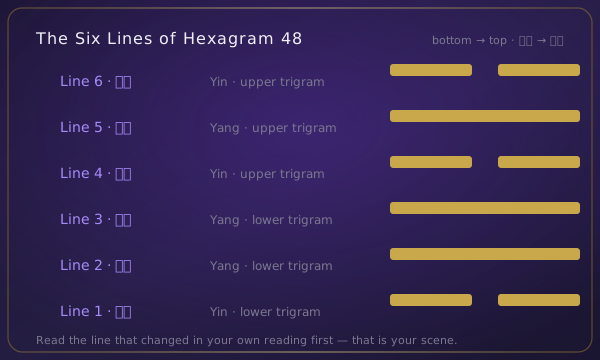
Each line of Hexagram 48 is one scene in the life of a well — its mud, its fish, its clearing, its relining, its spring, and its open mouth.
Line 1 (初六) — The well's mud is not drunk; the old well has no birds. The scene: the source silted beyond use. The modern reading: the silted line. 井泥不食,旧井无禽 — the well so neglected that even the birds stay away. The source has not moved; the access has died. The hexagram's first task is the dredging.
Line 2 (九二) — The well's valley shoots the fish; the jug is leaky and broken. The scene: the source reduced to a pond, the access failing. The modern reading: the failing line. 井谷射鲋,瓮敝漏 — the well that no longer serves water but fish, and the jug that leaks. The diagnosis is the equipment, not the source.
Line 3 (九三) — The well is cleared but no one drinks from it; this grieves my heart; one may draw from it; if the king sees clearly, all receive the blessing. The scene: the source ready, and the seeing that is not yet clear. The modern reading: the center line and the hexagram's compassion. 井渫不食,为我心恻,可用汲,王明,并受其福 — the cleared well, the grief, and the promise: when the king sees clearly (王明), everyone receives the blessing. The source is ready; the seeing is the work.
Line 4 (六四) — The well is relined; no blame. The scene: the repair of the walls. The modern reading: the repair line. 井甃,无咎 — the relining, and the blame dissolves. What the mud line silted, the repair restores. The source was never the problem; the walls were.
Line 5 (九五) — The well is clear; the cold spring is drunk. The scene: the source at its center, served. The modern reading: the center line. 井洌,寒泉食 — the clear well, the cold spring, the drinking. The source that has been cleared, relined, and seen is the source that serves.
Line 6 (上六) — The well is gathered in; do not cover the mouth; with sincerity, supreme good fortune. The scene: the source opened to all. The modern reading: the completion line and the hexagram's destination. 井收勿幕,有孚元吉 — the mouth uncovered, the source available to everyone, granted sincerity and supreme fortune. The well that serves all is the well that stays full.
When all six lines change: Hexagram 48 turns toward Hexagram 49 — the well completed becomes revolution. The source that has served becomes the fire that transforms.
How to Read Hexagram 48 with the Number Oracle
Hexagram 48 reaches you the same way every hexagram does: through three numbers that arise naturally while you hold your question — a clock, a receipt, a page number, a number that simply surfaces. The first number sets the upper trigram, the second the lower trigram, and the third identifies the changing line. Enter your three numbers and your question at numbers-oracle.com and you will get the hexagram plus an AI interpretation written for your situation — free, no registration. For the mechanics, read how three numbers become a hexagram →
Your lucky energy for Hexagram 48: Wood element (the body trigram, the wood below). Lucky colors are green and tender sprout tones; the matching crystal is malachite, traditionally associated with growth, renewal, and fresh starts.
Related hexagrams: Hexagram 47 (Oppression) — the pit before the source; Hexagram 27 (Nourishment) — the other source hexagram, the mouth; Hexagram 59 (Dispersion) — the dissolving the well prevents.
Hexagram 48: Common Questions
What does hexagram 48 mean in one sentence?
Hexagram 48 means the well — the fixed source that serves everyone without depleting, where the town changes and the well does not, and every failure is a failure of the equipment, not the source.
Is hexagram 48 good or bad?
Hexagram 48 is favorable for the source that is cleared, relined, and uncovered — its final line grants 有孚元吉. Its misfortune is the judgment's own: the short rope and the broken jug (羸其瓶,凶). The hexagram is unfavorable for silted access and favorable for the open mouth.
What should I do when I receive hexagram 48?
Check which line changed. The mud (line 1) means the source is silted — dredge it; the fish and the leaky jug (line 2) means the access has failed — fix the equipment; the cleared well (line 3) means the source is ready and the seeing must clear; the relining (line 4) means repair the walls; the cold spring (line 5) means the source now serves; the uncovered mouth (line 6) means open it to everyone.
Why is hexagram 48 called "The Well"?
Because its image is wood drawing water from below — 木上有水 — the source served from depths no one sees. The old translators rendered it The Well because the hexagram's subject is the fixed center: the town changes, the well does not, and what fails is never the source but the rope, the jug, and the hand that lowers them.
The well has never once run out. What runs out is the rope.