I Ching Hexagram 49 (Revolution): Meaning in Love, Career and Life
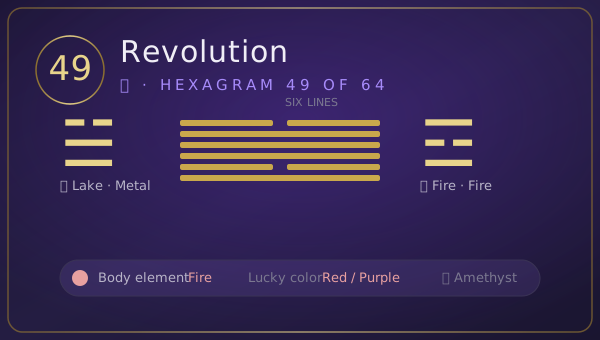
Hexagram 49 is the revolution hexagram of the I Ching: fire inside the lake, the element of transformation burning within the element of depth. Its classical judgment reads "on the day of completion, there is sincerity; supreme success; favorable perseverance; the regret dissolves" (巳日乃孚,元亨利贞,悔亡), and its image — fire within the marsh — says the noble one "orders the seasons and makes the time clear" (治历明时). When Hexagram 49 appears in a reading, it describes transformation at scale: the change that replaces an order — and the hexagram's exact counsel about when, how, and how completely such change is made.
The Story of Hexagram 49: The Wooden Post
In 359 BCE, a minor official named Gongsun Yang — later known as Shang Yang — stood before the court of the state of Qin with a proposal to remake the entire state. The king of Qin was interested but not yet convinced, and the reformer knew that a law nobody trusts is worse than no law at all. So he did something unprecedented: he performed trust.
According to the Records of the Grand Historian, Shang Yang had a wooden post erected at the south gate of the capital, and announced that anyone who moved it to the north gate would be rewarded with ten pieces of gold. The crowd laughed — the offer was too strange to believe. He raised it to fifty. Still no one moved. Finally one man did it, and was paid the fifty gold on the spot. The record notes what happened next: the people believed the law. (《史记·商君列传》: 令行期年,秦民之国都言初令之不便者以千数…… 令行十年,秦民大悦)
What followed was the most consequential reform program of the Warring States period: the abolition of the old well-field system, the reorganization of the population into units of mutual responsibility, uniform weights and measures, and a merit system that let commoners earn rank by military service. Within a decade the state was transformed; within a generation, the reformed Qin had unified the world. The reformer himself was less lucky — after the king's death, the aristocracy he had displaced tore him apart with chariots. But the structure he built outlasted him by centuries.
The hexagram's judgment names the day: 巳日乃孚 — on the day of completion, there is sincerity. Shang Yang understood that reform does not begin with the change; it begins with the belief that the change is real. The fifty gold was not a bribe. It was the day of completion.
What Is Hexagram 49?
- Name: 革 (Gé), traditionally rendered Revolution; also translated as Change, Reform, or The Skin Shed
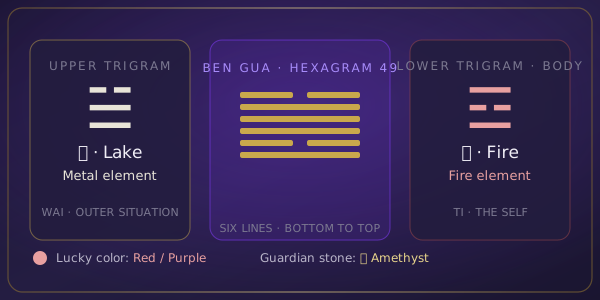
- Structure: Lake over Fire — the fire within the marsh, transformation burning in the depths
- Position: 49 of 64, the hexagram after The Well; what the served source becomes
- Element: Fire on the body trigram — the lower trigram (fire) belongs to Fire; the lake above belongs to Metal
- Body trigram: the lower trigram (fire, Fire), which in plum blossom divination represents the self
- Core images: fire in the lake, the wooden post at the gate, the day of completion, the tiger's change, the leopard's change, the changed faces
The Core Meaning of Hexagram 49
The judgment of Hexagram 49 locates the whole teaching in time: 巳日乃孚 — on the day of completion, there is sincerity. Revolution is not the moment the new order is declared; it is the moment the new order is believed. Everything the hexagram has to say about how change is made follows from that: the day must be right, the sincerity must precede the act, and the regret dissolves (悔亡) when both conditions are met.
Three things this hexagram is telling you, each standing on its own:
The day of completion comes before the change. 巳日乃孚 is the hexagram's sequence: the day is completed, and then there is belief. The fifty gold at the gate is the day being completed — the proof, paid on the spot, that the new order is real. What the hexagram asks of the reformer is not the vision but the demonstration.
Reform begins with restraint, not force. The opening line is the hexagram's discipline: 巩用黄牛之革 — bound fast with the yellow ox-hide. Before the change, the binding. The reformer who begins by securing the foundations (the trust, the day, the proof) is the one whose change holds. The image says what the change is for: 治历明时 — ordering the seasons, making the time clear.
The change reaches everyone, and at different depths. The fifth and sixth lines are the hexagram's most famous images. 大人虎变 — the great person changes like a tiger (the visible, total transformation of the stripe). 君子豹变 — the noble one changes like a leopard (the patterned, partial change). And 小人革面 — the small man changes only his face. The hexagram grades its transformations honestly: some changes go all the way through, and some only reach the surface.
The question Hexagram 49 answers is not "should things change?" It is: is the day complete — is the change believed — and is this a tiger's change or a changed face?
Hexagram 49 in Love and Relationships
If you are single: Hexagram 49 describes the season of total change — the self being remade, the old order replaced. The hexagram's counsel for the single season is its judgment: the day of completion comes first (巳日乃孚). Before the new self is announced, it must be demonstrated — to yourself, first. The opening line's ox-hide is its discipline: bind fast before you change.
In an early or uncertain stage: Early love under Hexagram 49 is the transformation phase — the old orders each person carried being replaced by the new thing between them. The hexagram's lines are its counsel: the ox-hide binding (line 1) is the foundation secured before the change; the day of completion (line 2) is the moment the change becomes believable; the three tellings (line 3) is the change announced and repeated until it is trusted.
In a stable relationship: A stable relationship drawing Hexagram 49 is in revolution — the order of the bond being replaced. The hexagram's counsel for the long term is its judgment: 巳日乃孚. The change the bond needs is not the announcement; it is the day of completion, the proof paid on the spot. And its final lines are its long-bond grading: the tiger's change (大人虎变) is the total transformation; the changed face (小人革面) is the one that does not reach the depths. The hexagram asks which one the bond is doing.
In a crisis: If the relationship is at the final line — the changed faces — Hexagram 49's verdict is 征凶,居贞吉: to advance is ominous; dwelling in perseverance is favorable. The crisis of change is the change that was only facial — the surface rearranged, the structure untouched. The hexagram's crisis counsel: stop advancing the face-change; hold the position and do the real change, or admit it was never real.
Hexagram 49 in Career, Money and Decisions
Career: This is the transformation hexagram of professional life — the reorganization, the pivot, the old order replaced. Its career counsel is the judgment: 巳日乃孚 — the day of completion comes first. The reform that works begins with the demonstration (the fifty gold), not the announcement. The opening line is its discipline: bind fast with the ox-hide (巩用黄牛之革) — secure the foundation before changing it. And its final lines grade the transformation: the tiger's change, the leopard's change, the changed face.
Money: Hexagram 49 governs money in transformation — the restructuring, the new order of resources, the change that replaces the old. Its financial counsel is the judgment's sequence: complete the day (巳日) before the change is believed (乃孚). The fifty gold is its financial image: the proof, paid on the spot, that the new order is real. And the final line's grading is its financial honesty: some changes go all the way through (虎变), and some are only faces (革面) — and the face-change advanced is ominous.
Decision: Hexagram 49 says: change — and complete the day first. If you are deciding whether to transform, the hexagram's test is its judgment: is the change believed (is the day complete, is the proof paid), is the foundation secured (the ox-hide), and is this a tiger's change or a changed face? The decision it blesses is the believed transformation; the decision it marks is the announced-but-unproven one.
The Changing Lines of Hexagram 49: Six Scenes
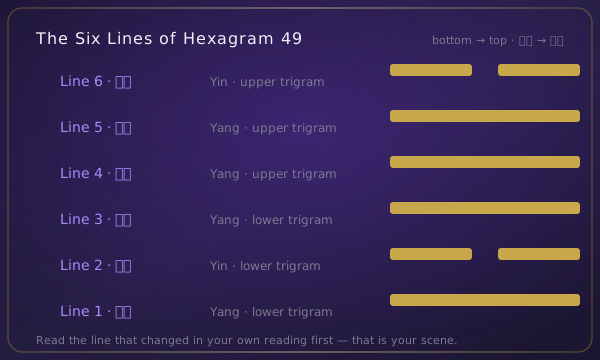
Each line of Hexagram 49 is one scene in the life of a revolution — its bindings, its day, its tellings, its orders, its tiger, and its faces.
Line 1 (初九) — Bound fast with the yellow ox-hide. The scene: the restraint before the change. The modern reading: the foundation line. 巩用黄牛之革 — the binding with the yellow hide, the color of the center. Before the revolution, the securing. What the hexagram asks of the reformer at the beginning is not vision but restraint.
Line 2 (六二) — On the day of completion, it is changed; to advance is favorable, no blame. The scene: the day completed, and the change that follows. The modern reading: the day line. 巳日乃革之,征吉,无咎 — the day of completion, the change made, and the advance granted. The sequence is the whole teaching: the belief first, the change second.
Line 3 (九三) — To advance is ominous; perseverance brings danger. The words of change are three times completed; then there is sincerity. The scene: the announcement repeated until it is trusted. The modern reading: the telling line. 革言三就,有孚 — the change's words told three times, and then the sincerity. The hexagram's realism: belief takes repetition, and the repetition is the work.
Line 4 (九四) — The regret dissolves; with sincerity, the mandate is changed; good fortune. The scene: the mandate itself transformed. The modern reading: the mandate line. 悔亡,有孚改命,吉 — the regret dissolved, the mandate changed, and the good fortune. The change at this line reaches the deepest structure: not the policy, the mandate.
Line 5 (九五) — The great person changes like a tiger; even before divination, there is sincerity. The scene: the total, visible transformation. The modern reading: the center line. 大人虎变,未占有孚 — the tiger's change, and the belief that precedes even the casting. The great person's transformation is so complete that it is trusted before it is verified.
Line 6 (上六) — The noble one changes like a leopard; the small man changes his face. To advance is ominous; dwelling in perseverance is favorable. The scene: the two grades of change, and the warning attached to the lower. The modern reading: the completion line. 君子豹变,小人革面,征凶,居贞吉 — the patterned change, the facial change, and the verdict: advancing the face-change is ominous; dwelling is favorable. The hexagram's final honesty about which changes are real.
When all six lines change: Hexagram 49 turns toward Hexagram 50 — revolution completed becomes the cauldron. The fire that transformed becomes the vessel that refines.
How to Read Hexagram 49 with the Number Oracle
Hexagram 49 reaches you the same way every hexagram does: through three numbers that arise naturally while you hold your question — a clock, a receipt, a page number, a number that simply surfaces. The first number sets the upper trigram, the second the lower trigram, and the third identifies the changing line. Enter your three numbers and your question at numbers-oracle.com and you will get the hexagram plus an AI interpretation written for your situation — free, no registration. For the mechanics, read how three numbers become a hexagram →
Your lucky energy for Hexagram 49: Fire element (the body trigram, the fire below). Lucky colors are red and warm purple; the matching crystal is amethyst, traditionally associated with clarity of mind and calm, open insight.
Related hexagrams: Hexagram 48 (The Well) — the source that becomes the fire; Hexagram 50 (The Cauldron) — the vessel the transformation feeds; Hexagram 25 (Innocence) — the unforced life after the revolution.
Hexagram 49: Common Questions
What does hexagram 49 mean in one sentence?
Hexagram 49 means revolution — transformation at scale where the day of completion comes before the change is believed, the regret dissolves, and the hexagram's final grading distinguishes the tiger's change from the changed face.
Is hexagram 49 good or bad?
Hexagram 49 grants supreme success and the dissolving of regret (元亨,悔亡) to change that is believed — it is one of the Book's strong transformation signs. Its warnings are about timing and depth: advancing before the day is complete is ominous, and the face-change advanced is ominous. The hexagram favors the proven, total change.
What should I do when I receive hexagram 49?
Check which line changed. The ox-hide (line 1) means secure the foundation before changing; the day of completion (line 2) means prove it first, then change; the three tellings (line 3) means repeat until believed; the changed mandate (line 4) means the change reaches the deepest structure; the tiger's change (line 5) means the total transformation is trusted; the changed face (line 6) means stop advancing the surface change.
Why is hexagram 49 called "Revolution"?
Because its image is fire within the lake — 泽中有火 — the element of transformation burning inside the element of depth. The old translators rendered it Revolution or Change because the hexagram's subject is the replacement of an order: the day that must be completed, the proof that must be paid, and the difference between the tiger's change and the face.
The fifty gold was not a bribe. It was the day being completed.