I Ching Hexagram 50 (The Cauldron): Meaning in Love, Career and Life
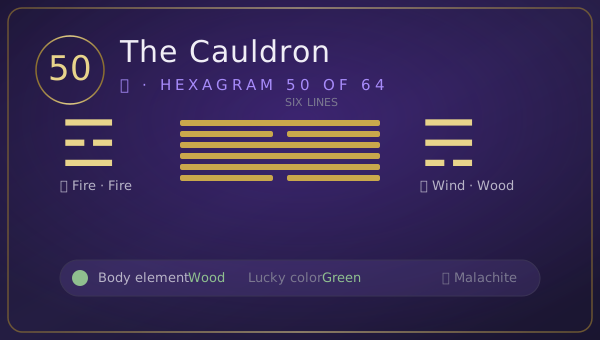
Hexagram 50 is the cauldron hexagram of the I Ching: fire beneath the vessel, wood burning under the bronze. Its classical judgment is the Book's shortest supreme blessing — 元吉,亨 — and its image — fire over wood — says the noble one "takes his proper position and consolidates the mandate" (正位凝命). When Hexagram 50 appears in a reading, it describes refinement: the vessel that transforms raw material into nourishment, the structure that turns what is raw into what feeds — and the hexagram's exact counsel about the vessel, the fire, and what happens when either fails.
The Story of Hexagram 50: The Nine Cauldrons
The Zuo Commentary preserves the moment when an object became a mandate. In 606 BCE, the king of Chu was expanding northward and sent to inquire of the court of Zhou about the weight and size of the nine cauldrons — the ritual vessels cast centuries earlier from the tribute bronze of the Nine Provinces, each inscribed with the geography and the creatures of its region. The courtier Wangsun Man understood the question perfectly: the king of Chu was asking whether the cauldrons were light enough to carry away.
His answer became one of the most quoted passages of early Chinese political thought. The virtue of the Zhou house, he said, is not in the cauldrons but in the virtue that cast them; and the virtue of Chu is not in the army but in whether the mandate still holds. "The cauldrons' weight," he concluded, "lies in the brightness of virtue, not in the cauldrons." (《左传·宣公三年》: 在德不在鼎)
The tradition traced the nine cauldrons to the Great Yu, the tamer of the flood, who cast them from the Nine Provinces' bronze after he had drained the world. They passed from Xia to Shang to Zhou — each dynasty receiving them as the sign of the mandate, each losing them when the mandate moved. The cauldrons themselves never changed. What changed was the fire beneath them.
The hexagram's image is the cauldron on its fire — 木上有火 — the vessel and the flame, each useless without the other. What the hexagram teaches is the same thing Wangsun Man said: the vessel is real, and the mandate is not in the vessel. It is in what cooks.
What Is Hexagram 50?
- Name: 鼎 (Dǐng), traditionally rendered The Cauldron; also translated as The Ting, The Vessel, or The Sacrificial Cauldron
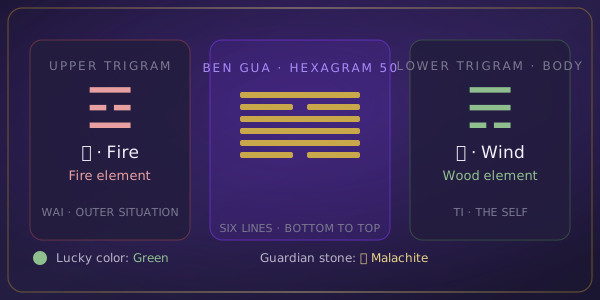
- Structure: Fire over Wood — flame beneath the vessel, the transformation fed from below
- Position: 50 of 64, the hexagram after Revolution; what the transformation feeds
- Element: Wood on the body trigram — the lower trigram (wood) belongs to Wood; fire above belongs to Fire
- Body trigram: the lower trigram (wood, Wood), which in plum blossom divination represents the self
- Core images: fire under the cauldron, the overturned vessel, the broken leg, the yellow ears and golden handles, the jade handle
The Core Meaning of Hexagram 50
The judgment of Hexagram 50 is 元吉,亨 — supreme good fortune and success, the Book's shortest supreme blessing. The cauldron is the hexagram of refinement: the structure that takes raw material and fire and produces nourishment. What the hexagram describes is not power but transformation — the vessel that turns what is raw into what feeds, held in its proper position, with the mandate consolidated.
Three things this hexagram is telling you, each standing on its own:
The vessel and the fire are one system. 木上有火 — the image is not the fire and not the cauldron; it is the relationship. Raw material without fire is raw; fire without a vessel is a conflagration. What the hexagram describes is refinement as a structure: the right vessel, the right fuel, held in the right position (正位凝命).
The vessel must be cleared, and it must be whole. The opening line is the hexagram's foundational image: 鼎颠趾 — the cauldron overturned — and its purpose: 利出否, to cast out the refuse. The vessel that is to be filled must first be emptied. And the fourth line is the hexagram's warning: 鼎折足,覆公餗 — the leg breaks, the duke's meal spills, and the Book's verdict is 凶. The vessel's integrity is the transformation's precondition.
The refinement reaches everyone, and it ends in the highest position. The fifth line is the vessel perfected: yellow ears, golden handles (黄耳金铉) — the center of the hexagram, the cauldron at its proper function. And the final line is its completion: the jade handle (玉铉) — the refinement granted 大吉,无不利. The cauldron that has transformed ends in the highest material.
The question Hexagram 50 answers is not "what can I become?" It is: is the vessel whole — cleared, sound-legged, properly positioned — and is the fire burning beneath it?
Hexagram 50 in Love and Relationships
If you are single: Hexagram 50 describes the self as vessel — the structure that transforms raw material into nourishment. The hexagram's counsel for the single season: clear the vessel (利出否 — cast out the refuse) and take the proper position (正位凝命). What the single season builds is not the meal; it is the cauldron that will cook it. And the fourth line is its warning: the broken leg — the structural failure that spills everything.
In an early or uncertain stage: Early love under Hexagram 50 is the refinement phase — two people transforming raw material (experience, history, habit) into something that feeds. The hexagram's lines are its counsel: the overturned vessel (line 1) is the casting-out of the refuse; the food in the cauldron (line 2) is the substance the vessel now holds; the blocked ears (line 3) are the transformation that cannot be delivered.
In a stable relationship: A stable relationship drawing Hexagram 50 is the cauldron — the structure that has been feeding for years. The hexagram's counsel for the long term is its image: 正位凝命 — take the proper position, consolidate the mandate. The long bond is the vessel in its position, and the position is the work. And its final line is its promise: the jade handle — the refinement that ends in the highest material.
In a crisis: If the relationship is at the fourth line — the broken leg — Hexagram 50's verdict is 凶, and the hexagram is precise about the failure: the leg, the support, the small structural part that held the whole vessel. What spills is the duke's meal (覆公餗) — the nourishment that was for everyone. The crisis of refinement is the structural failure of the vessel, and the hexagram's counsel is in the image: check the legs before the fire.
Hexagram 50 in Career, Money and Decisions
Career: This is the refinement hexagram of professional life — the structure that transforms raw material into value, the position that consolidates. Its career counsel is the judgment: supreme good fortune (元吉) for the vessel in its proper position (正位凝命). The lines are its career manual: clear the vessel (line 1), fill it (line 2), deliver the meal (line 3), check the legs (line 4), and perfect the handles (line 5). The broken leg is the career warning: the small structural failure that spills everything.
Money: Hexagram 50 governs money as refinement — the structure that transforms resources into nourishment, the position that holds. Its financial counsel is the image: the vessel and the fire, neither useful alone. The overturned cauldron (line 1) is its financial image of clearing: the refuse cast out before the filling. The broken leg (line 4) is its financial warning: the small structural failure — the one unexamined support — that spills the whole position. And the final line's jade handle is its promise: the refinement that ends in the highest material.
Decision: Hexagram 50 says: check the vessel, then build the fire. If you are deciding whether to refine — the project, the bond, the self — the hexagram's test is its image: is the vessel whole (cleared, sound-legged, positioned), and is the fuel beneath it real? The decision it blesses is the transformation in a sound vessel; the decision it marks is the fire under the broken leg.
The Changing Lines of Hexagram 50: Six Scenes
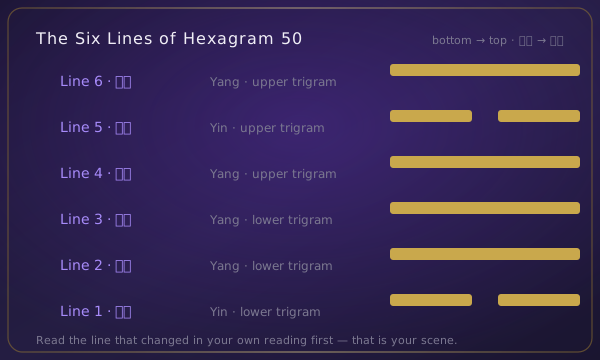
Each line of Hexagram 50 is one scene in the life of a cauldron — its overturning, its filling, its blocked ears, its broken leg, its golden handles, and its jade.
Line 1 (初六) — The cauldron is overturned; favorable for casting out the refuse; taking a concubine for the sake of her son; no blame. The scene: the vessel emptied before it can be filled. The modern reading: the clearing line. 鼎颠趾,利出否 — the overturned cauldron, and its purpose: the refuse cast out. The refinement begins with the emptying. The concubine's son is the hexagram's image of what the cleared vessel is for: new life.
Line 2 (九二) — The cauldron has substance; my adversary has illness; I cannot reach him; good fortune. The scene: the vessel full, and the approach blocked. The modern reading: the filling line. 鼎有实,我仇有疾,不我能即,吉 — the substance in the vessel, the adversary's illness, the approach refused, and the good fortune. What is filled is not shared with what is sick.
Line 3 (九三) — The cauldron's ears are changed; its movement is blocked; the pheasant's fat is not eaten; the rain is about to come, the regret turns; in the end, good fortune. The scene: the transformation that cannot be delivered. The modern reading: the blocked line. 鼎耳革,其行塞,雉膏不食,方雨亏悔,终吉 — the ears changed, the movement blocked, the fat uneaten, and the rain that turns the regret into good fortune. The nourishment exists; the delivery is the work.
Line 4 (九四) — The cauldron's leg breaks; the duke's meal spills; its form is soaked; misfortune. The scene: the vessel failing at its support. The modern reading: the warning line and the hexagram's only hard verdict. 鼎折足,覆公餗,其形渥,凶 — the broken leg, the spilled meal, the soaked form, and the Book's 凶. The refinement that spills is the vessel whose support was not checked.
Line 5 (六五) — The cauldron with yellow ears and golden handles; perseverance is favorable. The scene: the vessel perfected, at its proper function. The modern reading: the center line. 鼎黄耳金铉,贞吉 — the yellow ears (the color of the center) and the golden handles (the metal of value). The cauldron at the center of the hexagram is the cauldron doing exactly what it is for.
Line 6 (上九) — The cauldron with the jade handle; great good fortune; nothing is unfavorable. The scene: the refinement at its highest material. The modern reading: the completion line and the hexagram's destination. 鼎玉铉,大吉,无不利 — the jade handle, the great good fortune, nothing unfavorable. The transformation that has been held in a sound vessel ends in the highest material there is.
When all six lines change: Hexagram 50 turns toward Hexagram 51 — the cauldron completed becomes the arousing shock. The refinement that fed becomes the thunder that awakens.
How to Read Hexagram 50 with the Number Oracle
Hexagram 50 reaches you the same way every hexagram does: through three numbers that arise naturally while you hold your question — a clock, a receipt, a page number, a number that simply surfaces. The first number sets the upper trigram, the second the lower trigram, and the third identifies the changing line. Enter your three numbers and your question at numbers-oracle.com and you will get the hexagram plus an AI interpretation written for your situation — free, no registration. For the mechanics, read how three numbers become a hexagram →
Your lucky energy for Hexagram 50: Wood element (the body trigram, the wood below). Lucky colors are green and tender sprout tones; the matching crystal is malachite, traditionally associated with growth, renewal, and fresh starts.
Related hexagrams: Hexagram 49 (Revolution) — the fire that became the cauldron; Hexagram 27 (Nourishment) — the mouth the cauldron feeds; Hexagram 22 (Grace) — the other fire, beneath the mountain.
Hexagram 50: Common Questions
What does hexagram 50 mean in one sentence?
Hexagram 50 means the cauldron — supreme good fortune for the refinement held in a sound vessel: cleared, properly legged, properly positioned, with the fire burning beneath it and the mandate consolidated.
Is hexagram 50 good or bad?
Hexagram 50 grants the Book's shortest supreme blessing — 元吉,亨 — to the vessel in its proper position. Its one hard line is the fourth: the broken leg, the spilled meal, 凶. The hexagram is favorable for the sound vessel and unfavorable for the unchecked support.
What should I do when I receive hexagram 50?
Check which line changed. The overturned cauldron (line 1) means cast out the refuse before filling; the substance (line 2) means the vessel is full — keep it from what is sick; the changed ears (line 3) means fix the delivery, not the nourishment; the broken leg (line 4) means check the support — this is the failure line; yellow ears and golden handles (line 5) means the vessel is at its proper function; the jade handle (line 6) means the refinement ends in the highest material.
Why is hexagram 50 called "The Cauldron"?
Because its image is fire beneath the vessel — 木上有火 — wood burning under bronze, raw material becoming nourishment. The old translators kept the ritual name because the hexagram's subject is refinement as structure: the vessel, the fire, the position, and the old commentary's reminder that the mandate is not in the vessel but in what cooks.
The cauldrons never changed. What changed was the fire beneath them.