I Ching Hexagram 51 (The Arousing): Meaning in Love, Career and Life
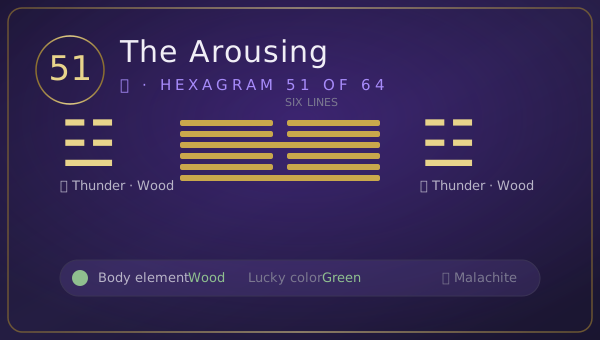
Hexagram 51 is the arousing hexagram of the I Ching: thunder upon thunder, the shock doubled, the quake that comes from directly below. Its classical judgment reads "success. The shock comes with terrifying cries; afterwards, laughing words. The shock terrifies for a hundred miles, and the sacrificial ladle is not dropped" (亨。震来虩虩,笑言哑哑。震惊百里,不丧匕鬯), and its image — thunder repeated — says the noble one "in fear and trembling examines and corrects himself" (恐惧修省). When Hexagram 51 appears in a reading, it describes shock: the event that arrives without warning, the awakening that cannot be scheduled — and the hexagram's exact counsel about what survives a quake.
The Story of Hexagram 51: The Ladle and the Shout
The scene is a court ritual at its most sacred moment. The sacrificial wine is being offered — the ladle lifted, the libation about to be poured — and then the thunder arrives. Not the distant rumble of weather, but the shock that terrifies for a hundred miles (震惊百里), the quake that stops every heart in the courtyard.
The judgment's final clause is the hexagram's whole teaching: 不丧匕鬯 — the ladle is not dropped. The ritual is not interrupted. The shock is real, the terror is real (虩虩 — the terrified cries), and the pouring continues. And then the hexagram's most human image: afterwards, the laughing words (笑言哑哑). The fear first, the laughter second, and the ceremony held through both.
The old commentators read the hexagram from that geometry: 洊雷 — thunder repeated — the shock that comes and comes, doubling. What the hexagram describes is not the single startle but the sustained quake, and the image names the correct response: 恐惧修省 — fear and trembling, examination and correction. The shock is not merely survived; it is used. What the quake reveals is what was loose.
The lines are the anatomy of a shock. The first line is the hexagram's promise in full: the terrified cries, then the laughing words — 吉. The second is the shock that comes with danger and costs the cowries (震来厉,亿丧贝) — the flight to the high mound, and the hexagram's counsel: 勿逐,七日得 — do not chase; in seven days it returns. The third is the shock that trembles through (震苏苏) — and the movement that has no blame (震行无眚). The fourth is the hexagram's warning: 震遂泥 — the shock that sinks into mud. The fifth is the shock coming and going with danger (震往来厉) — and the hexagram's counsel: 亿无丧,有事 — nothing is lost; there is work to do. And the final line is the hexagram's extremity: the trembling, the wide eyes (震索索,视矍矍) — the advance is ominous — and the hexagram's strange comfort: the shock did not strike him, it struck his neighbor (震不于其躬,于其邻) — no blame — but the marriage talks (婚媾有言) are uneasy.
The thunder does not announce. The ladle does not drop. That is the whole hexagram.
What Is Hexagram 51?
- Name: 震 (Zhèn), traditionally rendered The Arousing; also translated as Shock, Thunder, or The Exciting Power
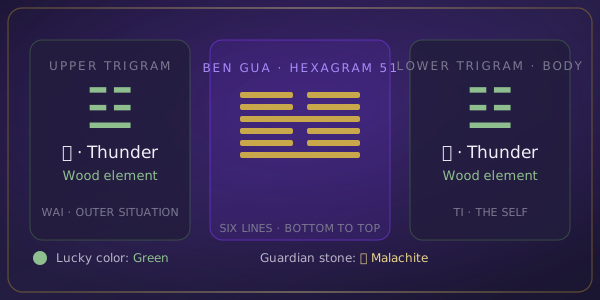
- Structure: Thunder over Thunder — the quake doubled, the shock from directly below
- Position: 51 of 64, the hexagram after The Cauldron; what the refinement that fed becomes
- Element: Wood on the body trigram — the lower trigram (thunder) belongs to Wood; thunder above also belongs to Wood
- Body trigram: the lower trigram (thunder, Wood), which in plum blossom divination represents the self
- Core images: the ladle not dropped, the terrified cries, the laughing words, the cowries lost and returned, the neighbor struck
The Core Meaning of Hexagram 51
The judgment of Hexagram 51 is the Book's manual for the shock, and its structure is the teaching: 亨 — success — is granted, then the sequence is given. The terrified cries first (虩虩), the laughing words second (哑哑), and the ceremony held through both (不丧匕鬯). What the hexagram promises is not the absence of shock but the survival of the ritual through it.
Three things this hexagram are telling you, each standing on its own:
The shock comes from below, and it cannot be scheduled. Thunder upon thunder — the quake arrives from directly beneath, which is why nothing prepares for it. The hexagram's first teaching is honesty: the shock is real, the terror is real, and the hexagram does not ask you to be unafraid. It asks you to keep pouring.
The shock reveals what was loose. The image is the hexagram's use of the event: 恐惧修省 — the fear and trembling are the occasion for examination and correction. What a quake does to a structure is show what was never sound. The shock that is used is the shock that becomes the audit.
The neighbor's shock is also information. The final line is the hexagram's strangest comfort: 震不于其躬,于其邻 — the shock did not strike him, it struck his neighbor. No blame — and the uneasy marriage talks. The quake that spares you is not meaningless; it is the preview. What the hexagram asks is that you treat the neighbor's shock as your own information.
The question Hexagram 51 answers is not "how do I avoid the shock?" It is: the quake has come — what was loose, what am I correcting, and is the ladle still in my hand?
Hexagram 51 in Love and Relationships
If you are single: Hexagram 51 describes the season of shock — the event that arrives from below and rearranges everything. The hexagram's counsel for the single season is its judgment: the terrified cries, then the laughing words, and the ceremony held through both. What survives a shock season is the person who did not drop the ladle — who kept the ritual of their own life intact while the ground moved.
In an early or uncertain stage: Early love under Hexagram 51 is the shock — the event, the revelation, the thing that arrives unannounced. The hexagram's lines are its counsel: the terrified cries then laughter (line 1) is the bond that survives its own shock; the lost cowries (line 2) are the cost of the quake — and the hexagram's promise: do not chase; in seven days it returns; the trembling (line 3) is the movement that has no blame.
In a stable relationship: A stable relationship drawing Hexagram 51 has been shocked — the revelation, the crisis, the event from below. The hexagram's counsel for the long bond is its image: 恐惧修省 — the fear is the occasion for examination. What the quake revealed (the loose thing) is the work. And its second line is its long-bond promise: the cowries lost return — 勿逐,七日得. Do not chase what the shock took; it comes back on its own.
In a crisis: If the relationship is at the final line — the trembling, the wide eyes — Hexagram 51's verdict is 征凶, and its comfort is the neighbor's clause: the shock struck the neighbor, not him. The crisis that spares you is the preview of the next one — and the hexagram's note about the uneasy marriage talks (婚媾有言) is its honesty: surviving a shock does not make the conversations after it easy.
Hexagram 51 in Career, Money and Decisions
Career: This is the shock hexagram of professional life — the sudden event, the crisis from below, the reorganization that arrives unannounced. Its career counsel is the judgment: the ceremony is held (不丧匕鬯) — what survives a professional shock is the ritual that did not stop. The image is the career use: 恐惧修省 — the fear is the audit. And the second line is its career promise: the cowries lost return — do not chase; the loss comes back.
Money: Hexagram 51 governs money in shock — the sudden loss, the market event, the crisis from below. Its financial counsel is the judgment: the ladle is not dropped — the ritual of the position survives the quake. The second line's cowries (震来厉,亿丧贝) are its financial image: the loss the shock brings, and the hexagram's counsel — 勿逐,七日得 — do not chase the loss; it returns. And the final line is its financial extremity: the trembling and the wide eyes — the advance is ominous after the shock.
Decision: Hexagram 51 says: the shock has come — hold the ladle. If you are deciding what to do in the aftermath, the hexagram's test is its judgment: is the ceremony continuing (the ritual of your life, unbroken), is the fear being used for examination (修省), and is the neighbor's shock being treated as information? The decision it blesses is the held ritual; the decision it marks is the ladle on the floor.
The Changing Lines of Hexagram 51: Six Scenes
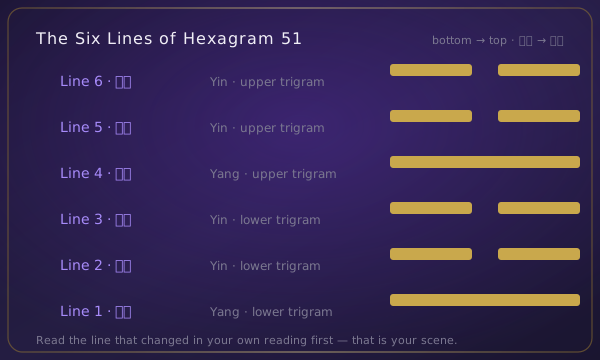
Each line of Hexagram 51 is one scene in the life of a shock — its cries, its cowries, its trembling, its mud, its work, and its neighbor.
Line 1 (初九) — The shock comes with terrified cries; afterwards, laughing words; good fortune. The scene: the fear, then the laughter, in the hexagram's own order. The modern reading: the promise line. 震来虩虩,后笑言哑哑,吉 — the shock, the terror, the laughter, and the good fortune. The hexagram's whole sequence in one line: the fear is first, and it is not the end.
Line 2 (六二) — The shock comes with danger; cowries are lost; climb to the high mound; do not chase; in seven days, it is regained. The scene: the loss the shock brings, and the return that comes unchased. The modern reading: the loss line and its promise. 震来厉,亿丧贝,跻于九陵,勿逐,七日得 — the danger, the lost cowries, the high ground, and the recovery that arrives on its own. What the shock took returns without the chase.
Line 3 (六三) — The shock trembles through; the movement has no blame. The scene: the quake that passes through the whole body. The modern reading: the trembling line. 震苏苏,震行无眚 — the trembling, and the movement that is blameless. The shock that moves through you, and does not stop you, is the shock with no blame.
Line 4 (九四) — The shock sinks into mud. The scene: the quake that becomes a bog. The modern reading: the warning line. 震遂泥 — the shock that sinks. The event that was survived becomes the mire that is not escaped. The hexagram's image of the aftermath that traps.
Line 5 (六五) — The shock comes and goes with danger; nothing is lost; there is work to do. The scene: the repeated quake, and the work it leaves. The modern reading: the center line. 震往来厉,亿无丧,有事 — the shock coming and going, nothing lost, and the business that remains. The hexagram's center is the position that survives repetition and is left with work.
Line 6 (上六) — Trembling, trembling; the eyes wide; to advance is ominous. The shock does not strike him, it strikes his neighbor; no blame; the marriage talks have words. The scene: the extremity of fear, and the neighbor's shock. The modern reading: the extremity line. 震索索,视矍矍,征凶。震不于其躬,于其邻,无咎,婚媾有言 — the trembling, the advance forbidden, the neighbor struck, no blame, and the uneasy conversations. Surviving the shock is not the same as being at ease after it.
When all six lines change: Hexagram 51 turns toward Hexagram 52 — the arousing completed becomes keeping still. The thunder that has awakened becomes the mountain that rests.
How to Read Hexagram 51 with the Number Oracle
Hexagram 51 reaches you the same way every hexagram does: through three numbers that arise naturally while you hold your question — a clock, a receipt, a page number, a number that simply surfaces. The first number sets the upper trigram, the second the lower trigram, and the third identifies the changing line. Enter your three numbers and your question at numbers-oracle.com and you will get the hexagram plus an AI interpretation written for your situation — free, no registration. For the mechanics, read how three numbers become a hexagram →
Your lucky energy for Hexagram 51: Wood element (the body trigram, thunder upon thunder). Lucky colors are green and tender sprout tones; the matching crystal is malachite, traditionally associated with growth, renewal, and fresh starts.
Related hexagrams: Hexagram 50 (The Cauldron) — the refinement the shock awakens; Hexagram 52 (Keeping Still) — the mountain after the thunder; Hexagram 16 (Enthusiasm) — the single thunder, before the doubling.
Hexagram 51: Common Questions
What does hexagram 51 mean in one sentence?
Hexagram 51 means the arousing — the shock that comes from below and cannot be scheduled, where success belongs to the one whose ceremony is not interrupted, whose fear becomes the audit, and whose laughing words come after the terrified cries.
Is hexagram 51 good or bad?
Hexagram 51 grants success (亨) to the shock survived — it is not a misfortune hexagram but a manual. Its warnings are about the aftermath: the shock that sinks into mud (line 4) and the advance after the trembling (line 6's 征凶). The hexagram is favorable for the held ritual and the used fear.
What should I do when I receive hexagram 51?
Check which line changed. Terrified cries then laughter (line 1) means the sequence is the promise; lost cowries (line 2) means do not chase what the shock took; trembling through (line 3) means the movement through the fear is blameless; sinking into mud (line 4) means the aftermath is the trap now; coming and going (line 5) means survive the repetition and do the work; the neighbor's shock (line 6) means the spared quake is information — and the conversations after will be uneasy.
Why is hexagram 51 called "The Arousing"?
Because its image is thunder upon thunder — 洊雷 — the shock doubled, the quake from directly below. The old translators rendered it The Arousing or Shock because the hexagram's subject is the unannounced event: the terror, the laughter, the ladle that does not drop, and the audit that the fear makes possible.
The thunder does not announce. The ladle does not drop. That is the whole hexagram.