I Ching Hexagram 52 (Keeping Still): Meaning in Love, Career and Life
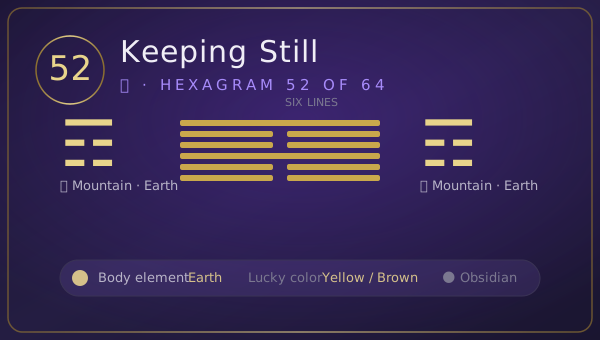
Hexagram 52 is the keeping-still hexagram of the I Ching: mountain upon mountain, stillness doubled, the mass that does not turn. Its classical judgment reads "keep the back still; do not seek the body; walk into the courtyard and do not see the person; no blame" (艮其背,不获其身,行其庭,不见其人,无咎), and its image — mountains repeated — says the noble one "does not let his thoughts go beyond his position" (思不出其位). When Hexagram 52 appears in a reading, it describes stillness: the discipline of not moving, the mountain that does not chase — and the hexagram's exact counsel about which parts must stop and what happens when the stopping is misplaced.
The Story of Hexagram 52: The Back That Does Not Turn
The scene is a mountain range seen from above — ridge behind ridge, nothing moving, nothing reaching toward anything. The old commentators read the hexagram's judgment as an instruction in anatomy: 艮其背 — keep the back still. Not the whole body. The back. The part that turns, the part that follows what is behind you — that is the part that must be held.
The commentators were precise about why. The back is where the self is reached from behind — the pull, the claim, the influence that arrives from where you are not looking. 不获其身 — do not let the body be seized. And the final image is the hexagram's completion: 行其庭,不见其人 — walking into your own courtyard and not seeing the person. Not blindness — the discipline of not turning toward what is in the courtyard. The hexagram's stillness is not sleep; it is the refusal to turn.
The image says what the stillness is for: 思不出其位 — the thoughts do not go beyond the position. The mountain does not occupy the valley. The noble one's mind stays where his body is. And the lines are the anatomy of the stopping, part by part, with the hexagram's honesty that stopping the wrong part is its own kind of harm. The toes stop (艮其趾) — favorable, and the condition: 利永贞, the perseverance that does not stop. The calves stop (艮其腓) — and the line's honesty: 不拯其随,其心不快 — the one below cannot save the one above, and the heart is not glad. The waist stops (艮其限) — and the hexagram's warning: 列其夤,厉熏心 — the spine splits, the danger smokes in the heart. The body stops (艮其身) — 无咎. The jaw stops (艮其辅) — the words in order, the regret dissolves. And the mountain at its completion (敦艮) — 吉.
The mountain does not turn. That is why it is still standing.
What Is Hexagram 52?
- Name: 艮 (Gèn), traditionally rendered Keeping Still; also translated as The Mountain, Resting in Stillness, or The Stopping
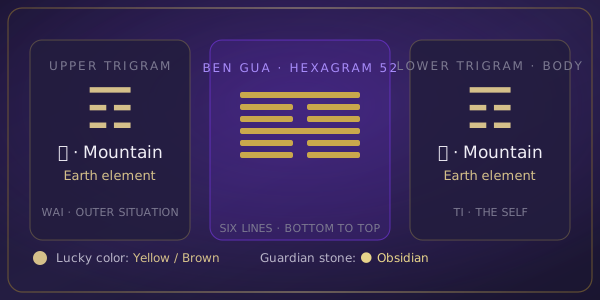
- Structure: Mountain over Mountain — stillness doubled, the mass that does not reach
- Position: 52 of 64, the hexagram after The Arousing; what the awakened shock becomes
- Element: Earth on the body trigram — the lower trigram (mountain) belongs to Earth; the mountain above also belongs to Earth
- Body trigram: the lower trigram (mountain, Earth), which in plum blossom divination represents the self
- Core images: the doubled mountain, the still back, the toes and the calves, the splitting waist, the ordered jaw, the thick mountain
The Core Meaning of Hexagram 52
The judgment of Hexagram 52 is the Book's most anatomically precise instruction: 艮其背,不获其身,行其庭,不见其人,无咎. Keep the back still — the part that turns toward what follows. Do not let the body be seized. Walk into your own courtyard and do not see the person in it. The hexagram grants no blame to this discipline, and the image says what it is for: 思不出其位 — the thoughts do not go beyond the position.
Three things this hexagram is telling you, each standing on its own:
Stillness is selective, and the back is the selection. The judgment does not say stop everything. It says stop the back — the turning part, the following part, the part that seizes what is behind you. What the hexagram teaches is not paralysis but the discipline of not turning toward the claim that arrives from behind.
The thoughts stay where the body is. 思不出其位 — the mountain does not occupy the valley. The hexagram's stillness is mental before it is physical: the mind that stays in its position, that does not project itself into the courtyard, into the other person's business, into the next thing.
Stopping the wrong part is its own kind of injury. The lines are the hexagram's cautionary anatomy: the calves that cannot save the thighs (line 2), the waist that splits the spine (line 3, 厉熏心). Stillness applied at the wrong joint becomes harm. The hexagram's discipline is exact about where the stopping belongs.
The question Hexagram 52 answers is not "should I stop?" It is: which part is turning that should not — and is the stopping applied at the back, or at the waist?
Hexagram 52 in Love and Relationships
If you are single: Hexagram 52 describes the season of stillness — the discipline of not turning, not chasing, not reaching into the courtyard. The hexagram's counsel for the single season is its judgment: keep the back still. What arrives from behind (the pull, the availability, the claim) is not seized. And its image is the single-season discipline: 思不出其位 — the mind stays where the body is.
In an early or uncertain stage: Early love under Hexagram 52 is the discipline of not turning — the restraint that is not disinterest. The hexagram's lines are its counsel: the toes (line 1) are the first restraint, and its condition: 利永贞; the calves (line 2) are the honest admission that the one below cannot save the one above; the jaw (line 5) is the words in order, the regret dissolved. And the third line is its warning: the waist — stopping at the wrong joint — 厉熏心.
In a stable relationship: A stable relationship drawing Hexagram 52 is in its stillness phase — the discipline of not turning toward what is behind the bond. The hexagram's counsel for the long term is its judgment: 不获其身 — do not let the body be seized. The long bond is kept by the part that does not turn: the back, the discipline, the refusal to follow what pulls from behind. And its completion is its promise: the thick mountain (敦艮) — 吉.
In a crisis: If the relationship is at the third line — the waist stopping, the spine splitting — Hexagram 52's warning is its extremity: 厉熏心. The crisis of stillness is the stopping applied at the wrong joint — the person who holds still in the wrong place, splits, and the danger smokes in the heart. The hexagram's crisis counsel: move the stillness to the back.
Hexagram 52 in Career, Money and Decisions
Career: This is the stillness hexagram of professional life — the discipline of not turning, not reaching, not chasing. Its career counsel is the judgment: keep the back still (艮其背) — the part that follows what is behind. The image is the career discipline: 思不出其位 — the thoughts stay in the position. The lines are its career anatomy: the toes (line 1) are the first restraint; the waist (line 3) is the career warning — stopping at the wrong joint splits the spine; the jaw (line 5) is the professional speech in order.
Money: Hexagram 52 governs money in stillness — the discipline of not chasing, not turning toward the pull. Its financial counsel is the judgment: do not let the body be seized (不获其身) — the position is held by the part that does not turn. The second line's cowry-analogy applies: what the stillness does not chase is what returns. And the fifth line's ordered jaw is its financial discipline: the words about money in order, the regret dissolved.
Decision: Hexagram 52 says: stop — at the back, not at the waist. If you are deciding whether to move, the hexagram's test is its anatomy: which part is turning that should not, and is the stopping applied where it belongs? The decision it blesses is the selective stillness — the back held, the thoughts in position; the decision it marks is the stop at the wrong joint.
The Changing Lines of Hexagram 52: Six Scenes
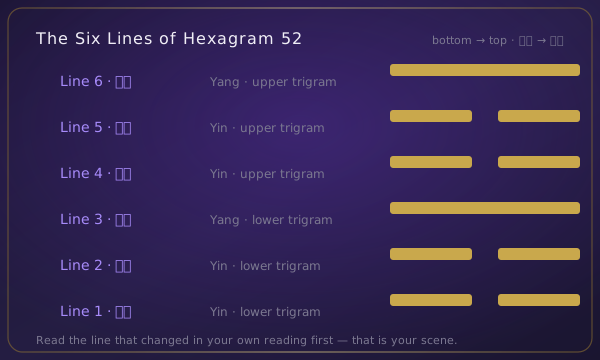
Each line of Hexagram 52 is one scene in the life of a stillness — its toes, its calves, its waist, its body, its jaw, and its thickness.
Line 1 (初六) — Keep the toes still; no blame; favorable for perpetual perseverance. The scene: the restraint at the feet, the first stopping. The modern reading: the foundation line. 艮其趾,无咎,利永贞 — the toes held, no blame, and the condition: the perseverance that does not stop. The beginning of stillness is the restraint of the step, and the restraint is favorable only if it holds.
Line 2 (六二) — Keep the calves still; not saving what follows, the heart is not glad. The scene: the honest anatomy of partial stillness. The modern reading: the partial line. 艮其腓,不拯其随,其心不快 — the calves held, and the hexagram's honesty: the one below cannot save the one above, and the heart is not glad. Stillness at the wrong joint is not peace.
Line 3 (九三) — Keep the waist still; the spine splits; the danger smokes in the heart. The scene: the stopping that injures the stopper. The modern reading: the warning line. 艮其限,列其夤,厉熏心 — the waist held, the spine split, and the danger smoking in the heart. The hexagram's clearest image of stillness misapplied: the stop at the wrong joint becomes the injury.
Line 4 (六四) — Keep the body still; no blame. The scene: the stillness at the torso, the correct joint. The modern reading: the body line. 艮其身,无咎 — the body held, no blame. The stopping that is applied where it belongs is granted the hexagram's favor.
Line 5 (六五) — Keep the jaw still; the words are in order; the regret dissolves. The scene: the stillness at the mouth, and its order. The modern reading: the speech line. 艮其辅,言有序,悔亡 — the jaw held, the words in sequence, and the regret dissolved. The hexagram's teaching about speech: what is held is not silenced; it is ordered.
Line 6 (上六) — Thick stillness; good fortune. The scene: the mountain at its completion, mass all the way through. The modern reading: the completion line and the hexagram's destination. 敦艮,吉 — the thick, sincere, complete stillness, granted good fortune. The mountain that is still all the way through is the mountain that stands.
When all six lines change: Hexagram 52 turns toward Hexagram 53 — stillness completed becomes development. The mountain that does not turn becomes the tree that grows on it.
How to Read Hexagram 52 with the Number Oracle
Hexagram 52 reaches you the same way every hexagram does: through three numbers that arise naturally while you hold your question — a clock, a receipt, a page number, a number that simply surfaces. The first number sets the upper trigram, the second the lower trigram, and the third identifies the changing line. Enter your three numbers and your question at numbers-oracle.com and you will get the hexagram plus an AI interpretation written for your situation — free, no registration. For the mechanics, read how three numbers become a hexagram →
Your lucky energy for Hexagram 52: Earth element (the body trigram, mountain upon mountain). Lucky colors are yellow and earth brown; the matching crystal is obsidian, traditionally associated with protection, grounding, and shielding from stress.
Related hexagrams: Hexagram 51 (The Arousing) — the thunder the mountain follows; Hexagram 53 (Development) — the tree that grows on the mountain; Hexagram 15 (Modesty) — the mountain inside the earth.
Hexagram 52: Common Questions
What does hexagram 52 mean in one sentence?
Hexagram 52 means keeping still — the discipline of not turning, granted no blame when applied at the back and the jaw, and marked dangerous when applied at the waist.
Is hexagram 52 good or bad?
Hexagram 52 grants no blame (无咎) to its discipline — it is a favorable configuration for stillness, not a punishment. Its one danger is the third line: the waist-stopping that splits the spine (厉熏心). The hexagram is favorable for the selective stillness and unfavorable for the stopping at the wrong joint.
What should I do when I receive hexagram 52?
Check which line changed. The toes (line 1) means hold the first step without letting go; the calves (line 2) means admit the partial stillness is not peace; the waist (line 3) means the stop is at the wrong joint — move it to the back; the body (line 4) means the stillness is correctly placed; the jaw (line 5) means hold the speech into order; the thick mountain (line 6) means the stillness is complete.
Why is hexagram 52 called "Keeping Still"?
Because its image is mountain upon mountain — 兼山 — stillness doubled, the mass that does not reach toward anything. The old translators rendered it Keeping Still or The Mountain because the hexagram's subject is selective stillness: the back that does not turn, the thoughts that stay in position, and the anatomy of where the stopping belongs.
The mountain does not turn. That is why it is still standing.