I Ching Hexagram 53 (Development): Meaning in Love, Career and Life
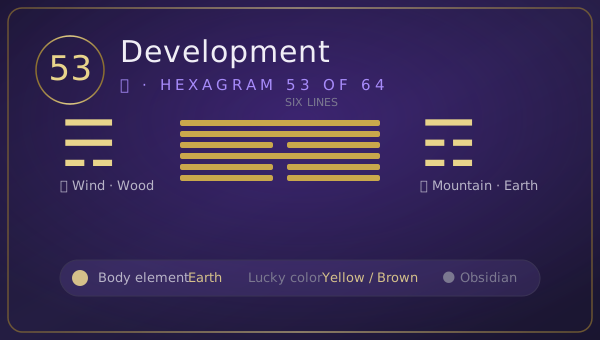
Hexagram 53 is the development hexagram of the I Ching: a tree growing on the mountain, the wood rising stage by stage toward its full height. Its classical judgment reads "the woman's marriage is good fortune; favorable perseverance" (女归吉,利贞), and its image — wood on the mountain — says the noble one "dwells in worthy virtue and improves the customs" (居贤德善俗). When Hexagram 53 appears in a reading, it describes gradual progress: the advance by stages, the growth that cannot be hurried — and the hexagram's exact counsel about what each stage requires.
The Story of Hexagram 53: The Geese Landing
The scene is a skein of wild geese coming down to the riverbank — not all at once, but stage by stage. First to the sandbar (鸿渐于干), then to the rock (鸿渐于磐), then to the plain (鸿渐于陆), then to the tree (鸿渐于木), then to the mound (鸿渐于陵), and finally to the high ridge, where the feathers become the ritual ornament (其羽可用为仪).
The old commentators read the whole hexagram from that flight: 渐 is development, and development moves like geese. Each landing is a real stage — the geese do not skip the sandbar to reach the rock, and the rock does not become the tree. What the hexagram describes is the advance that is complete at every stage: the bird at the sandbar is not failing to be at the mound; it is being exactly where a goose at its stage should be.
The judgment's marriage image (女归吉) is the hexagram's central analogy. The woman's marriage — 归 — is the return to her proper place, and the hexagram grants it good fortune because it is gradual. Nothing about the correct union is rushed. And the lines tell the story of each stage with the hexagram's characteristic honesty: the sandbar (line 1) is where the young ones are in danger and the words fly — and yet 无咎; the rock (line 2) is where the eating and drinking are peaceful (饮食衎衎) — 吉; the plain (line 3) is the stage that goes wrong — the husband campaigns and does not return, the wife conceives and does not carry — 凶 — and the hexagram's condition: 利御寇, favorable for defending; the tree (line 4) is the stage that finds its rafter (或得其桷) — 无咎; the mound (line 5) is the stage that waits — the wife three years not conceiving, and the hexagram's promise: 终莫之胜,吉 — in the end, nothing can overcome it; and the high ridge (line 6) is where the feathers become the ornament (其羽可用为仪) — 吉.
The geese do not argue with the stages. They land at each one, and the landing is the journey.
What Is Hexagram 53?
- Name: 渐 (Jiàn), traditionally rendered Development; also translated as Gradual Progress, The Slow Advance, or The Marrying Maiden's Return
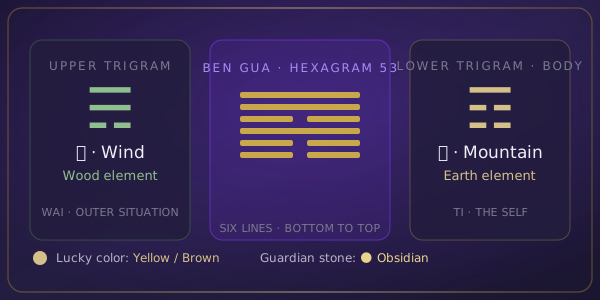
- Structure: Wind over Mountain — the wood on the mass, the tree rising toward its height
- Position: 53 of 64, the hexagram after Keeping Still; what the mountain does not become
- Element: Earth on the body trigram — the lower trigram (mountain) belongs to Earth; wind above belongs to Wood
- Body trigram: the lower trigram (mountain, Earth), which in plum blossom divination represents the self
- Core images: the tree on the mountain, the geese's stages, the sandbar and the rock, the rafter, the feathers as ornament
The Core Meaning of Hexagram 53
The judgment of Hexagram 53 grants good fortune to the gradual — 女归吉,利贞 — and the image says what the gradual is: wood on the mountain, the tree rising stage by stage. What the hexagram describes is development as a sequence of real stages, each one complete in itself, none of them skippable. The advance that works is the advance that honors where it actually is.
Three things this hexagram is telling you, each standing on its own:
Each stage is real, and the stage is not the failure. The sandbar goose is not a failed mound goose. The hexagram's stages are positions, not waypoints, and each carries its own instruction. What the hexagram punishes is not the stage but the refusal of it: the third line's husband who campaigns when he should stay, the wife who conceives when she should wait.
Some stages are for defending, not advancing. The third line is the hexagram's one hard stage — 凶 — and its counsel is named: 利御寇. The plain is the exposed place, the stage where the advance stops and the defense begins. The hexagram grants that not every stage is for going forward; some are for holding.
The completion is the feathers becoming the ornament. The final line is the hexagram's destination: 其羽可用为仪. The journey, completed stage by stage, produces something that can be used as ritual — the flight that becomes the ceremony. What the gradual development builds is not the height; it is the ornament.
The question Hexagram 53 answers is not "am I there yet?" It is: which stage am I actually on — and does this stage require advancing, waiting, or defending?
Hexagram 53 in Love and Relationships
If you are single: Hexagram 53 describes the gradual season — the development that moves stage by stage. The hexagram's counsel for the single season is its judgment: the marriage is good fortune because it is gradual (女归吉). The stages are the hexagram's gift: you are not failing to be at the mound; you are being exactly where a goose at your stage should be.
In an early or uncertain stage: Early love under Hexagram 53 is the stages — the sandbar, the rock, the plain. The hexagram's lines are its manual: the sandbar (line 1) is the early stage where the young ones are in danger and the words fly, and yet no blame; the rock (line 2) is the peaceful eating and drinking, the good fortune; the plain (line 3) is the exposed stage — the one that goes wrong when the timing is forced.
In a stable relationship: A stable relationship drawing Hexagram 53 is the long development — the bond that has been growing stage by stage for years. The hexagram's counsel for the long term is its judgment: 利贞 — perseverance. The stages are the long bond's map, and the fifth line is its promise: the wife three years not conceiving, and in the end nothing overcomes (终莫之胜,吉). What has been waiting at its stage is not failing; it is developing.
In a crisis: If the relationship is at the third line — the plain, the exposure — Hexagram 53's verdict is 凶, and its counsel is precise: 利御寇. The crisis stage is the defending stage, not the advancing one. The hexagram grants that some seasons are for holding the position, and the plain is one of them.
Hexagram 53 in Career, Money and Decisions
Career: This is the gradual-advance hexagram of professional life — the development that moves stage by stage, the career that grows like wood on the mountain. Its career counsel is the judgment: perseverance (利贞), and the image: dwell in worthy virtue, improve the customs (居贤德善俗). The stages are its career map: the sandbar (line 1) is the junior position, dangerous and noisy; the rock (line 2) is the settled position; the plain (line 3) is the exposed position — the one that requires defense, not advance.
Money: Hexagram 53 governs money in gradual development — the accumulation that grows stage by stage, the position that matures. Its financial counsel is the judgment's patience: the stages are real, and the stage is not the failure. The rock (line 2) is its financial image: the peaceful eating and drinking of the settled position. The plain (line 3) is its financial warning: the exposed position requires defense. And the feathers-as-ornament (line 6) is its promise: the gradual accumulation becomes the ritual — the wealth that becomes what it was for.
Decision: Hexagram 53 says: advance by stages. If you are deciding whether to move, the hexagram's test is its flight: which stage am I actually on, and does this stage require advancing, waiting, or defending? The decision it blesses is the stage-correct move; the decision it marks is the skip — the goose that refuses the sandbar.
The Changing Lines of Hexagram 53: Six Scenes
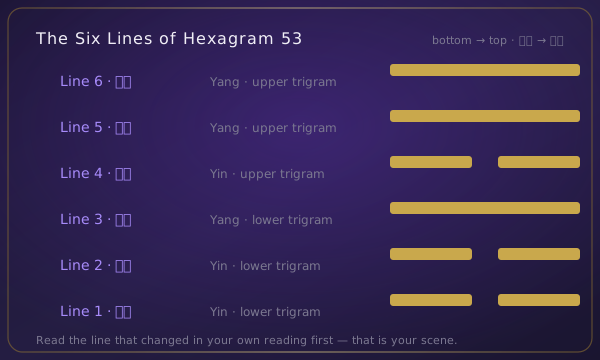
Each line of Hexagram 53 is one scene in the geese's flight — its sandbar, its rock, its plain, its tree, its mound, and its ridge.
Line 1 (初六) — The geese advance to the sandbar; the young ones are in danger; there are words, but no blame. The scene: the first landing, exposed and noisy. The modern reading: the foundation line. 鸿渐于干,小子厉,有言,无咎 — the sandbar, the danger to the young, the words that fly, and the no blame. The first stage is not safe, and it is blameless.
Line 2 (六二) — The geese advance to the rock; eating and drinking in peace; good fortune. The scene: the settled landing, the feast. The modern reading: the settled line. 鸿渐于磐,饮食衎衎,吉 — the rock, the peaceful eating and drinking, and the good fortune. The stage that has found its footing is the stage that can feed.
Line 3 (九三) — The geese advance to the plain; the husband campaigns and does not return; the wife conceives and does not carry; misfortune. Favorable for defending against bandits. The scene: the exposed stage, and the forced timing. The modern reading: the warning line. 鸿渐于陆,夫征不复,妇孕不育,凶,利御寇 — the plain, the advance that does not return, the conception that does not carry, and the misfortune. The counsel: 利御寇 — this stage is for defending.
Line 4 (六四) — The geese advance to the tree; perhaps it finds its rafter; no blame. The scene: the stage that finds its place to rest. The modern reading: the rafter line. 鸿渐于木,或得其桷,无咎 — the tree, the rafter (the cross-beam that fits), and the no blame. The stage that has found its support is granted the hexagram's favor.
Line 5 (九五) — The geese advance to the mound; the wife for three years does not conceive; in the end, nothing can overcome it; good fortune. The scene: the waiting stage, and its promise. The modern reading: the center line. 鸿渐于陵,妇三岁不孕,终莫之胜,吉 — the mound, the three years, and the hexagram's promise: in the end, nothing overcomes. What has waited at its stage is not failing.
Line 6 (上九) — The geese advance to the high ridge; its feathers can be used as ritual ornaments; good fortune. The scene: the flight that becomes the ceremony. The modern reading: the completion line and the hexagram's destination. 鸿渐于陆,其羽可用为仪,吉 — the high ridge, and the feathers that become the ornament. The gradual development, completed, produces what can be used as ritual.
When all six lines change: Hexagram 53 turns toward Hexagram 54 — development completed becomes the marrying maiden. The geese that landed become the marriage that is timed.
How to Read Hexagram 53 with the Number Oracle
Hexagram 53 reaches you the same way every hexagram does: through three numbers that arise naturally while you hold your question — a clock, a receipt, a page number, a number that simply surfaces. The first number sets the upper trigram, the second the lower trigram, and the third identifies the changing line. Enter your three numbers and your question at numbers-oracle.com and you will get the hexagram plus an AI interpretation written for your situation — free, no registration. For the mechanics, read how three numbers become a hexagram →
Your lucky energy for Hexagram 53: Earth element (the body trigram, the mountain below). Lucky colors are yellow and earth brown; the matching crystal is obsidian, traditionally associated with protection, grounding, and shielding from stress.
Related hexagrams: Hexagram 52 (Keeping Still) — the mountain the tree grows on; Hexagram 32 (Duration) — constancy at the pace of the geese; Hexagram 46 (Pushing Upward) — the other gradual rise, wood in the earth.
Hexagram 53: Common Questions
What does hexagram 53 mean in one sentence?
Hexagram 53 means development — gradual progress stage by stage, where each landing is real and complete, some stages require defending rather than advancing, and the completed flight produces the feathers that become ritual.
Is hexagram 53 good or bad?
Hexagram 53 is favorable — its judgment is good fortune and perseverance (女归吉,利贞) — with one hard stage. The plain (line 3) is 凶: the exposed stage where the forced timing fails. The hexagram is favorable for the stage-correct move and unfavorable for the skip.
What should I do when I receive hexagram 53?
Check which line changed. The sandbar (line 1) means the first stage is exposed and blameless; the rock (line 2) means the settled stage feeds; the plain (line 3) means this stage is for defending, not advancing; the tree (line 4) means find the rafter that fits; the mound (line 5) means the waiting stage is promised — nothing overcomes in the end; the high ridge (line 6) means the gradual flight becomes the ornament.
Why is hexagram 53 called "Development"?
Because its image is wood growing on the mountain — 山上有木 — the tree rising stage by stage toward its height. The old translators rendered it Development or Gradual Progress because the hexagram's lines are the geese's flight: the sandbar, the rock, the plain, the tree, the mound, the ridge — each a real stage, none skippable.
The geese do not argue with the stages. The landing is the journey.