I Ching Hexagram 54 (The Marrying Maiden) in Love: What It Means for Your Relationship
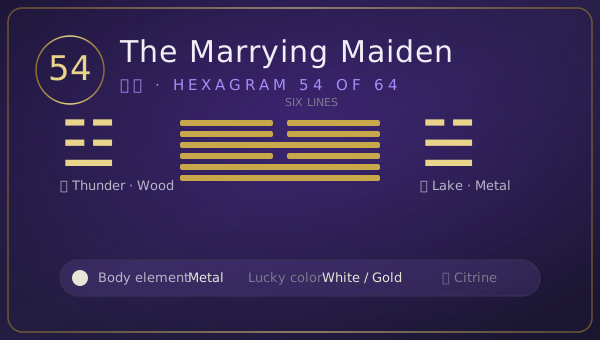
Hexagram 54 is the marrying-maiden hexagram of the I Ching: thunder above the lake, the union that is formed at the wrong position. Its classical judgment reads "to advance is ominous; nothing is favorable" (征凶,无攸利), and its image — thunder over the marsh — says the noble one "knows the end through the lasting, and knows the flaw through the enduring" (永终知敝). When Hexagram 54 appears in a reading, it describes the improper position: the bond formed at the wrong time, in the wrong order, for the wrong reason — and the hexagram's exact counsel about what a person does with a position they did not choose.
The Story of Hexagram 54: The Royal Marriage
The hexagram's fifth line carries the Book's most famous marriage image: 帝乙归妹 — Di Yi gives his daughter in marriage. The scene, drawn from the world of the early Zhou, is a royal alliance: the king of Shang giving his daughter to the rising house of Zhou. And the hexagram's lines are brutally honest about what the marriage looks like from inside.
The maiden does not go as the principal wife. She goes as a companion (归妹以娣) — and the hexagram's first line names her position exactly: 跛能履, a lame woman who can still walk. The second line: 眇能视, a one-eyed woman who can still see. She goes with a defect acknowledged, in a position diminished, and the hexagram does not pretend otherwise. The third line shows her waiting (归妹以须) and then returning as the companion again (反归以娣). The fourth line shows the delayed marriage (归妹愆期) — the wedding that comes late, and the hexagram's quiet comfort: 迟归有时, the late marriage has its own time. And the fifth line — the royal marriage itself — grants the hexagram's one clear good fortune, and even there the image is sobering: the bride's sleeves are not as fine as her companion's (其君之袂,不如其娣之袂良) — and the moon is almost full (月几望) — the peak that has begun to wane.
The old commentators read the hexagram as the Book's honesty about position: 归妹 is the union formed where the position is wrong, and the hexagram's entire counsel is about how such a position is held. The image gives the method: 永终知敝 — know the end through what lasts, and know the flaw through what endures. The maiden who knows her position is diminished is the maiden who can hold it.
What Is Hexagram 54?
- Name: 归妹 (Guī Mèi), traditionally rendered The Marrying Maiden; also translated as The Return of the Maiden, Marrying the Younger Sister, or The Improper Union
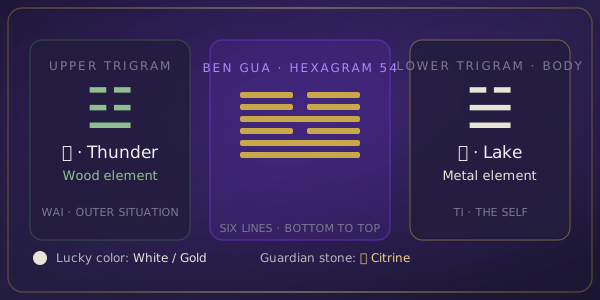
- Structure: Thunder over the Lake — the quake above the marsh, the union at the wrong position
- Position: 54 of 64, the hexagram after Development; what the timed geese become
- Element: Metal on the body trigram — the lower trigram (the lake) belongs to Metal; thunder above belongs to Wood
- Body trigram: the lower trigram (the lake, Metal), which in plum blossom divination represents the self
- Core images: the maiden as companion, the lame walk and the one eye, the delayed marriage, the royal alliance, the sleeves not as fine, the almost-full moon
The Core Meaning of Hexagram 54
The judgment of Hexagram 54 is the Book's most discouraging opening — 征凶,无攸利 — to advance is ominous; nothing is favorable. The hexagram describes the improper position: the bond, the role, the place that was entered at the wrong time and in the wrong order. What the hexagram teaches is not how to escape such a position (it does not promise escape) but how it is held with the eyes open.
Three things this hexagram is telling you, each standing on its own:
The position is diminished, and the diminishment must be seen. The lame woman who walks, the one-eyed woman who sees — the hexagram's images are not insults; they are the accurate description of a position entered at a disadvantage. What the hexagram asks is that the diminishment be seen and not performed away. The maiden who pretends her position is principal is the maiden the hexagram cannot help.
The delayed position has its own time. The fourth line is the hexagram's one comfort: 归妹愆期,迟归有时 — the delayed marriage, and its own season. Not every position must be entered now; the one that comes late has the time that belongs to it. The hexagram grants this line its quiet favor.
The end must be known through the enduring. The image is the hexagram's whole method: 永终知敝. Know how it ends by what lasts; know the flaw by what endures. A position held with its flaw visible is a position that can be held. The maiden who knows the moon is almost full is the maiden who is not surprised by the waning.
The question Hexagram 54 answers is not "how do I get the right position?" It is: can I see this position accurately — diminished, delayed, already past its peak — and hold it anyway, with the eyes open?
Hexagram 54 in Love and Relationships
If you are single: Hexagram 54 describes the season of the improper position — the self in a diminished place, or approaching connection from one. The hexagram's counsel for the single season is its judgment's inverse: do not advance (征凶). The position that is wrong is not fixed by moving into it. And its fourth line is its comfort: the delayed has its own time (迟归有时). The single season under 归妹 is the season for accurate self-assessment, not for the advance.
In an early or uncertain stage: Early love under Hexagram 54 is the bond formed at the wrong position — the timing wrong, the order wrong, the foundation diminished. The hexagram's lines are its manual: the companion position (line 1) is the bond entered as secondary; the one-eyed sight (line 2) is the partial view held honestly; the waiting and the return (line 3) is the bond that stalls and returns to its proper place; the delayed marriage (line 4) is the bond that comes late and on its own time.
In a stable relationship: A stable relationship drawing Hexagram 54 is in a diminished position — the bond that everyone can see is not what it should have been. The hexagram's counsel for the long bond is its image: 永终知敝 — know the end through what endures. The position held with its flaw visible is the position that can be held. And the fifth line is its long-bond promise: the royal marriage — even the diminished union is granted good fortune, with the moon-almost-full as its honest condition: the peak has already begun to wane.
In a crisis: If the relationship is at the final line — the woman holding the empty basket, the man cutting the sheep that does not bleed — Hexagram 54's verdict is 无攸利, nothing is favorable, and the hexagram's images are its diagnosis: the ritual without substance, the sacrifice without blood. The crisis of the improper position is the ceremony that everyone can see is empty. The hexagram does not offer the repair; it offers the seeing.
Hexagram 54 in Career, Money and Decisions
Career: This is the improper-position hexagram of professional life — the role entered at the wrong time, the diminished position, the function that is not what it should be. Its career counsel is the judgment: do not advance (征凶). The position that is wrong is not fixed by pushing into it. And the image is its method: 永终知敝 — know the end through the enduring. The professional who sees their diminished position accurately is the one who can hold it or leave it on purpose.
Money: Hexagram 54 governs money in the improper position — the investment made at the wrong time, the commitment that was never right. Its financial counsel is the judgment: nothing is favorable (无攸利). The final line's empty basket and bloodless sheep are its financial images: the transaction without substance, the position that looks like a ritual and is not one. And the fourth line's delayed marriage is its financial patience: the late position has its own time.
Decision: Hexagram 54 says: see the position accurately before anything else. If you are deciding whether to advance, the hexagram's answer is its judgment: do not (征凶). The decision it blesses is the honest assessment — the diminishment seen, the delay accepted, the flaw known through the enduring; the decision it marks is the advance into a position that was never right.
The Changing Lines of Hexagram 54: Six Scenes
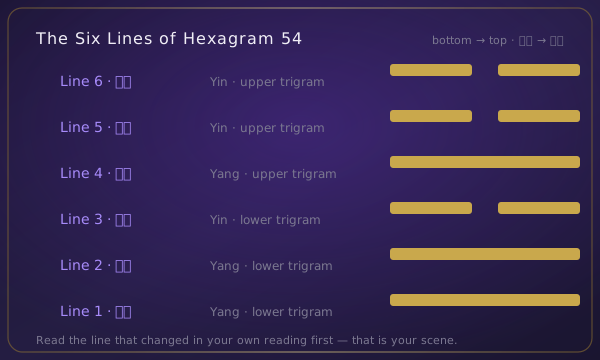
Each line of Hexagram 54 is one scene in the life of an improper position — its companions, its partial sights, its returns, its delays, its royal marriage, and its empty ritual.
Line 1 (初九) — The marrying maiden goes as the companion; the lame woman can walk; to advance is good fortune. The scene: the maiden entering at the diminished position. The modern reading: the foundation line. 归妹以娣,跛能履,征吉 — the companion position, the lame walk, and the advance granted. The hexagram's paradox: the diminished position, entered honestly and held, is the one that can advance.
Line 2 (九二) — The one-eyed woman can see; favorable for the hidden person's perseverance. The scene: the partial sight, held. The modern reading: the partial line. 眇能视,利幽人之贞 — the one eye, and the perseverance of the person in obscurity. What the hexagram grants is not the full sight but the perseverance that holds the partial one.
Line 3 (六三) — The marrying maiden waits, and returns as the companion. The scene: the bond that stalls and returns to its proper place. The modern reading: the return line. 归妹以须,反归以娣 — the waiting, and the return to the companion position. The position that does not advance returns to where it actually is.
Line 4 (九四) — The marrying maiden delays the time; the late marriage has its season. The scene: the delayed union, and its own clock. The modern reading: the delay line. 归妹愆期,迟归有时 — the delayed marriage, and the time that belongs to it. The hexagram's one quiet comfort: the late position is not the failed position.
Line 5 (六五) — Di Yi gives his daughter in marriage; the sovereign's sleeves are not as fine as her companion's; the moon is almost full; good fortune. The scene: the royal marriage, diminished and blessed. The modern reading: the center line and the hexagram's signature image. 帝乙归妹,其君之袂,不如其娣之袂良,月几望,吉 — the royal alliance, the sleeves not as fine, the moon almost full, and the good fortune. Even the diminished union is blessed, with the honest condition attached: the peak is already waning.
Line 6 (上六) — The woman holds the basket but it has no substance; the man cuts the sheep but it has no blood; nothing is favorable. The scene: the ritual without substance. The modern reading: the extremity line. 女承筐无实,士刲羊无血,无攸利 — the empty basket, the bloodless sacrifice, and nothing favorable. The improper position at its end is the ceremony that everyone can see is empty.
When all six lines change: Hexagram 54 turns toward Hexagram 55 — the marrying maiden completed becomes abundance. The position held with its flaw known becomes the fullness that is honest.
How to Read Hexagram 54 with the Number Oracle
Hexagram 54 reaches you the same way every hexagram does: through three numbers that arise naturally while you hold your question — a clock, a receipt, a page number, a number that simply surfaces. The first number sets the upper trigram, the second the lower trigram, and the third identifies the changing line. Enter your three numbers and your question at numbers-oracle.com and you will get the hexagram plus an AI interpretation written for your situation — free, no registration. For the mechanics, read how three numbers become a hexagram →
Your lucky energy for Hexagram 54: Metal element (the body trigram, the lake below). Lucky colors are white, gold, and silver; the matching crystal is citrine, traditionally associated with abundance and clear, joyful energy.
Related hexagrams: Hexagram 53 (Development) — the timed marriage the geese prepared; Hexagram 11 (Peace) — the other royal marriage, 帝乙归妹, at its favorable moment; Hexagram 32 (Duration) — the long bond the diminished position is not.
Hexagram 54: Common Questions
What does hexagram 54 mean in one sentence?
Hexagram 54 means the marrying maiden — the improper position entered at a disadvantage, where the judgment warns against advancing, the comfort is that the delayed has its own time, and the method is knowing the end through what endures.
Is hexagram 54 bad for love?
Hexagram 54 is the Book's hardest hexagram for relationships — its judgment is 征凶,无攸利 — but it is not a curse. The companion who walks honestly (line 1) is granted the advance, the delayed marriage (line 4) has its season, and even the diminished royal union (line 5) is granted good fortune. The hexagram is unfavorable for the advance and favorable for the honest holding.
What should I do when I receive hexagram 54?
Check which line changed. The companion position (line 1) means enter honestly at the diminished position; the one-eyed sight (line 2) means hold the partial view with perseverance; the waiting and return (line 3) means the bond returns to its proper place; the delayed marriage (line 4) means the late has its own time; the royal marriage (line 5) means even the diminished union can be blessed; the empty basket (line 6) means the ritual has no substance — see it.
Why is hexagram 54 called "The Marrying Maiden"?
Because its lines are the story of a maiden entering marriage at the wrong position — as companion, with a lame walk and a one eye, waiting, delayed, and finally at the royal alliance with sleeves not as fine as her companion's. The old translators kept the marriage reading because the hexagram's subject is the improper position: how it is entered, how it is held, and the eyes-open honesty it requires.
The moon is almost full. That is not the same as full — and the maiden knows it.