I Ching Hexagram 55 (Abundance): Meaning in Love, Career and Life
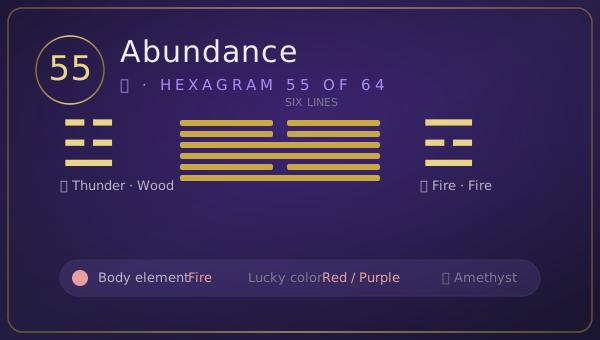
Hexagram 55 is the abundance hexagram of the I Ching: thunder and lightning at full power together, the sky at its brightest and loudest. Its classical judgment reads "success. The king reaches it; do not worry; it is favorable to be at the noon" (亨,王假之,勿忧,宜日中), and its image — thunder and lightning together — says the noble one "decides lawsuits and applies the penalties" (折狱致刑). When Hexagram 55 appears in a reading, it describes fullness at its peak: the zenith — and the hexagram's exact counsel about the one thing a zenith must never do.
The Story of Hexagram 55: The Noon That Must Not Move
The scene is a storm at its height: lightning and thunder at once, the sky doing everything it can do at the same moment. The old commentators read the hexagram from that simultaneity — 雷电皆至 — and they noticed what the judgment says next: 宜日中. It is favorable to be at noon. Not approaching noon, not past noon — at it. The zenith is the favorable position, and the hexagram's whole counsel is about what a zenith does next.
The answer, in the hexagram's own geometry, is: nothing. The zenith does not climb. What the hexagram describes is the configuration where fullness is complete and the only available error is the one that tries to stay.
The lines are the anatomy of a peak, and each one is a warning about the light going. The first line is the meeting of equals (遇其配主) — the abundance shared with the one who matches it — and the hexagram grants 往有尚. The second line is the hexagram's central image: 丰其蔀,日中见斗 — the canopy so thick that at noon one sees the Big Dipper — the dimming at the peak — and the hexagram's counsel: 有孚发若 — let the sincerity shine through — 吉. The third line is the dimming deepened: the screen so dense that at noon one sees the small stars (日中见沫) — and the image of the broken right arm (折其右肱) — and 无咎 anyway. The fourth line is the same canopy, the same Big Dipper at noon (丰其蔀,日中见斗) — and this time the meeting of the equal (遇其夷主) — 吉. The fifth line is the hexagram's center: 来章 — the pattern arrives — 有庆誉,吉. And the final line is the hexagram's extremity: the house made huge, the household screened (丰其屋,蔀其家) — the peeping into the door, the emptiness, the three years unseen (窥其户,阒其无人,三岁不觌) — and the Book's verdict: 凶.
The noon is complete. The hexagram's whole teaching is that a complete noon has one job: to be exactly what it is, for exactly as long as it is.
What Is Hexagram 55?
- Name: 丰 (Fēng), traditionally rendered Abundance; also translated as Fullness, Great Abundance, or The Zenith
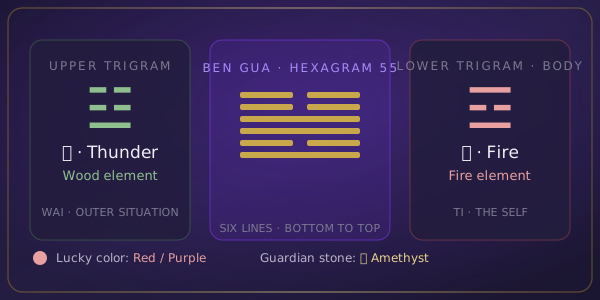
- Structure: Thunder over Fire — the quake and the flame at full power, the storm at its height
- Position: 55 of 64, the hexagram after The Marrying Maiden; what the honest position becomes
- Element: Fire on the body trigram — the lower trigram (fire) belongs to Fire; thunder above belongs to Wood
- Body trigram: the lower trigram (fire, Fire), which in plum blossom divination represents the self
- Core images: thunder and lightning together, the noon, the canopy and the Big Dipper, the broken right arm, the huge empty house
The Core Meaning of Hexagram 55
The judgment of Hexagram 55 is the Book's peak manual: 亨 — success — 王假之,勿忧 — the king reaches it, do not worry — 宜日中 — it is favorable to be at noon. The zenith is not the danger; the zenith is the favorable position. What the hexagram warns against is not the peak but the attempt to hold the peak — and the image says what the peak is for: 折狱致刑 — deciding, judging, applying. Fullness is the position from which decisions are made.
Three things this hexagram is telling you, each standing on its own:
The noon is the favorable position. 宜日中 — the judgment's own words. The zenith is not the fall; it is the height from which things are decided. What the hexagram grants the peak is success and the absence of worry. The peak is not condemned; it is used.
The dimming begins at the peak, and it is seen at noon. The second, third, and fourth lines all describe the same phenomenon: the canopy, the Big Dipper visible at noon, the small stars. The hexagram's realism — the light starts going while it is still noon, and the ones who see it are the ones watching the sky. The counsel at line 2 is the hexagram's method: 有孚发若 — let the sincerity shine through the canopy.
The huge house is the extremity. The final line is the hexagram's 凶: the house made vast, the household screened, the door peeped through and the emptiness found. The peak that becomes a monument to itself — the abundance that walls itself in — is the configuration the Book condemns. Three years unseen.
The question Hexagram 55 answers is not "am I at the top?" It is: the noon is here — am I deciding with it, seeing its dimming, and refusing the huge house?
Hexagram 55 in Love and Relationships
If you are single: Hexagram 55 describes the peak season — the self at its fullest, the noon of connection. The hexagram's counsel for the single season: 宜日中 — be at the noon, and use it. The peak is the position from which the real decisions are made (折狱致刑). And its warning is the canopy: the dimming that starts at noon is seen only by the ones watching the sky.
In an early or uncertain stage: Early love under Hexagram 55 is the bond at its peak — the fullness, the lightning. The hexagram's lines are its counsel: the meeting of equals (line 1) is the bond between two at their noon; the canopy at noon (lines 2 and 4) is the dimming that begins at the peak, and the counsel is the same: let the sincerity shine through (有孚发若). The early bond at its height is watching for the first dimming.
In a stable relationship: A stable relationship drawing Hexagram 55 is the long bond at its peak — the years of fullness. The hexagram's counsel for the phase is its judgment: 勿忧 — do not worry — and 宜日中 — use the noon. The long bond at its zenith is the position from which the real decisions are made. And the final line is its warning: the huge house — the abundance that walls itself in, the door peeped through and the emptiness found. The peak that becomes a monument is the one that empties.
In a crisis: If the relationship is at the final line — the screened house, the three years unseen — Hexagram 55's verdict is 凶, and its image is the diagnosis: the abundance that became architecture. What was full became a structure, and the structure became empty. The hexagram's crisis counsel is earlier in its own lines: see the canopy at noon, and let the sincerity through while the light is still there.
Hexagram 55 in Career, Money and Decisions
Career: This is the zenith hexagram of professional life — the position at its peak, the success at full scale. Its career counsel is the judgment: 宜日中 — use the noon — and 折狱致刑 — the peak is the position from which the real decisions are made. The lines are its career manual: the meeting of equals (line 1), the canopy at noon (lines 2 and 4 — the dimming that starts at the peak, met with sincerity shining through), and the pattern arriving (line 5). The final line is its career warning: the huge house — the success that becomes a monument.
Money: Hexagram 55 is the Book's peak-abundance sign for money — 亨,王假之,勿忧 — success, the king reaches it, do not worry. Its financial counsel: the noon is the favorable position, and the noon is for deciding (折狱致刑 — the judgment applied). The canopy lines are its financial realism: the cycle dims at its peak, and the ones who see it are the ones watching. And the final line is its financial extremity: the fortune that walls itself in, the three years unseen.
Decision: Hexagram 55 says: the noon is here — decide with it. If you are deciding what to do at the peak, the hexagram's test is its judgment: am I using the noon (宜日中), am I seeing the canopy (the dimming that starts at noon), and am I refusing the huge house (the monument)? The decision it blesses is the decision made from the zenith; the decision it marks is the wall that turns the peak into an empty house.
The Changing Lines of Hexagram 55: Six Scenes
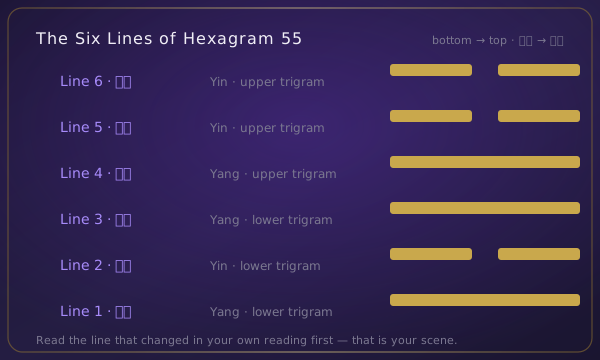
Each line of Hexagram 55 is one scene in the life of a noon — its equals, its canopies, its patterns, and its empty house.
Line 1 (初九) — Meeting its matching lord; though the period is full, no blame; going forward is honored. The scene: the abundance shared with the equal. The modern reading: the foundation line. 遇其配主,虽旬无咎,往有尚 — the meeting of equals, the full period, and the honored advance. The peak shared with the one who matches it is the peak that moves.
Line 2 (六二) — The canopy is full; at noon one sees the Big Dipper; going forward meets suspicion and illness; with sincerity, let it shine through; good fortune. The scene: the dimming at the peak, and the sincerity that cuts it. The modern reading: the canopy line and the hexagram's method. 丰其蔀,日中见斗,往得疑疾,有孚发若,吉 — the thick canopy, the Big Dipper at noon, and the counsel: let the sincerity shine through. The light that is going is met by the truth that shows.
Line 3 (九三) — The canopy is dense; at noon one sees the small stars; breaking the right arm; no blame. The scene: the dimming deepened, and the injury that is blameless. The modern reading: the deepened line. 丰其沛,日中见沫,折其右肱,无咎 — the dense screen, the small stars, the broken right arm, and the no blame. The peak that injures is not the peak that is condemned.
Line 4 (九四) — The canopy is full; at noon one sees the Big Dipper; meeting its level lord; good fortune. The scene: the same canopy, and the meeting that happens under it. The modern reading: the meeting line. 丰其蔀,日中见斗,遇其夷主,吉 — the thick canopy, the Big Dipper at noon, and the meeting of the equal. The dimming that brings the right people together is granted good fortune.
Line 5 (六五) — The pattern arrives; there is celebration and praise; good fortune. The scene: the hexagram's center, and what arrives at it. The modern reading: the center line. 来章,有庆誉,吉 — the pattern (the brilliance, the art, the visible form) arrives, with celebration and praise. The peak at its center is the peak that is recognized.
Line 6 (上六) — The house is made huge; the household is screened; peeping at the door, it is empty and still; for three years not seen; misfortune. The scene: the abundance that became architecture. The modern reading: the extremity line and the hexagram's 凶. 丰其屋,蔀其家,窥其户,阒其无人,三岁不觌,凶 — the huge house, the screened household, the empty door, the three years. The peak that walls itself in is the peak that empties.
When all six lines change: Hexagram 55 turns toward Hexagram 56 — abundance completed becomes the wanderer. The huge house empty becomes the traveler on the road.
How to Read Hexagram 55 with the Number Oracle
Hexagram 55 reaches you the same way every hexagram does: through three numbers that arise naturally while you hold your question — a clock, a receipt, a page number, a number that simply surfaces. The first number sets the upper trigram, the second the lower trigram, and the third identifies the changing line. Enter your three numbers and your question at numbers-oracle.com and you will get the hexagram plus an AI interpretation written for your situation — free, no registration. For the mechanics, read how three numbers become a hexagram →
Your lucky energy for Hexagram 55: Fire element (the body trigram, the flame below). Lucky colors are red and warm purple; the matching crystal is amethyst, traditionally associated with clarity of mind and calm, open insight.
Related hexagrams: Hexagram 54 (The Marrying Maiden) — the honest position before the peak; Hexagram 14 (Great Possession) — the other fullness, at the scale of the sun; Hexagram 56 (The Wanderer) — the road after the huge house.
Hexagram 55: Common Questions
What does hexagram 55 mean in one sentence?
Hexagram 55 means abundance at the zenith — success at noon, favorable for deciding, with the hexagram's warning that the dimming starts at the peak and the huge house is the extremity.
Is hexagram 55 good or bad?
Hexagram 55 is favorable — its judgment is success, the king reaching it, no worry (亨,王假之,勿忧) — with the peak's own conditions attached. The noon must be used (宜日中), the canopy must be seen (日中见斗), and the huge house (line 6) is 凶. The hexagram is favorable for the zenith in motion and unfavorable for the peak that walls itself in.
What should I do when I receive hexagram 55?
Check which line changed. The meeting of equals (line 1) means share the peak with your match; the canopy at noon (line 2) means see the dimming and let the sincerity through; the dense screen (line 3) means the injury at the peak is blameless; the meeting under the canopy (line 4) means the dimming brings the right people; the pattern arriving (line 5) means the peak is recognized; the huge house (line 6) means the monument is the emptiness.
Why is hexagram 55 called "Abundance"?
Because its image is thunder and lightning together — 雷电皆至 — the sky at its fullest and loudest, everything happening at once. The old translators rendered it Abundance or Fullness because the hexagram's subject is the zenith: the noon that must be used, the canopy that dims at noon, and the house that empties itself by growing.
The noon is complete. A complete noon has one job — to be exactly what it is.