I Ching Hexagram 56 (The Wanderer): Meaning in Love, Career and Life
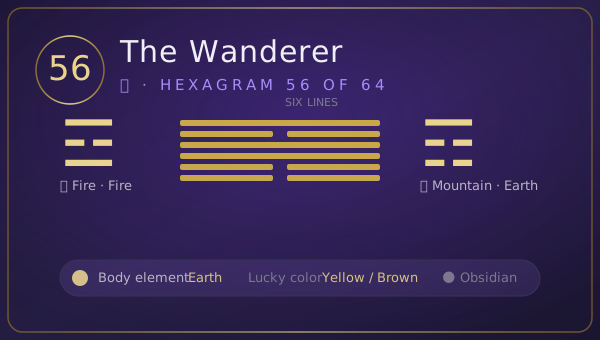
Hexagram 56 is the wanderer hexagram of the I Ching: fire burning on the mountain, the flame that has no home in the rock. Its classical judgment reads "small success; for the wanderer, perseverance is good fortune" (小亨,旅贞吉), and its image — fire on the mountain — says the noble one "is clear and careful in applying punishments and does not prolong the lawsuits" (明慎用刑而不留狱). When Hexagram 56 appears in a reading, it describes exile: the life lived away from the source, the person without the ground beneath them — and the hexagram's exact counsel about how the wanderer survives.
The Story of Hexagram 56: The Stranded Sage
The records of the Grand Historian preserve the most famous journey in Chinese philosophy. Confucius, at the age of fifty-six, left the state of Lu with his disciples, hoping to find a ruler who would implement his vision of government. He traveled for fourteen years. He was driven out of Wei, besieged in Kuang, starved between Chen and Cai, mocked wherever he went. The account of the siege of Kuang and the starvation between Chen and Cai describes a company surrounded by hostile forces for days, with the food gone and the master still playing his lute.
At the lowest point — the road between the states of Chen and Cai, with no food and his followers falling ill around him — the records say Confucius turned to his disciples and asked the question that is the hexagram's whole teaching. My Way is not the Way of the vulgar, he said. If my Way is right, why am I starving on this road? And then he answered his own question: the ones who hold to the Way through poverty and lowliness — King Wen before he had the throne, the sages in their obscurity — they are the ones whose Way is proven. "The noble one can be impoverished and still not lose the Way." (《史记·孔子世家》: 君子固穷,小人穷斯滥矣)
The wanderer's position is not the failure of the Way. The wanderer's position is the Way, tested by the road. Fire on the mountain has no root in the rock — and it still burns.
What Is Hexagram 56?
- Name: 旅 (Lǚ), traditionally rendered The Wanderer; also translated as The Traveler, Exile, or The Stranger
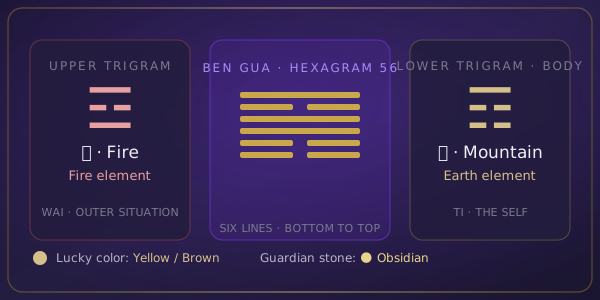
- Structure: Fire over Mountain — the flame on the mass, the fire with no root in the rock
- Position: 56 of 64, the hexagram after Abundance; what the empty house becomes
- Element: Earth on the body trigram — the lower trigram (mountain) belongs to Earth; fire above belongs to Fire
- Body trigram: the lower trigram (mountain, Earth), which in plum blossom divination represents the self
- Core images: fire on the mountain, the inn and its provisions, the burned inn, the lost servant, the bird's nest aflame
The Core Meaning of Hexagram 56
The judgment of Hexagram 56 is deliberately modest: 小亨 — small success — 旅贞吉 — for the wanderer, perseverance is good fortune. The hexagram does not promise the exile ends; it promises the exile is survivable, correctly held. What it describes is the life lived away from the source: the stranger in the land, the flame with no root in the rock, the person whose ground is wherever they are standing.
Three things this hexagram is telling you, each standing on its own:
The wanderer's position is real, and it is held by smallness. 小亨 — the success is small. The wanderer does not conquer the land; the wanderer passes through it correctly. The hexagram's modesty is its accuracy: the exile's victories are the inn found, the provisions kept, the servant who stays. Not the empire.
The wanderer's resources are carried, not rooted. The second line is the hexagram's central image: 旅即次,怀其资,得童仆,贞吉 — the traveler reaches the inn, keeps his provisions close, gains a trustworthy servant. What the wanderer has is what can be carried: the capital, the skills, the few loyal people. And the image says how the wanderer treats the land: 明慎用刑而不留狱 — clear and careful, and nothing prolonged. The stranger in the land is judged by how they hold what is not theirs.
The burned inn is the failure, and the lost servant is its sign. The third line is the hexagram's warning: 旅焚其次,丧其童仆 — the inn burns, the servant is lost. The wanderer who loses the inn and the servant has lost the two things the wanderer has. The final line is the extremity: the bird's nest aflame, the wanderer who first laughed and now weeps, the ox lost in the change (丧牛于易) — 凶.
The question Hexagram 56 answers is not "when do I get home?" It is: am I holding the wanderer's position correctly — the provisions kept, the servant trusted, the land treated carefully?
Hexagram 56 in Love and Relationships
If you are single: Hexagram 56 describes the season of wandering — the self without the ground beneath it, the life in transition. The hexagram's counsel for the single season is its judgment: 旅贞吉 — perseverance is good fortune for the wanderer. The single season away from the source is not the failed season; it is the season that tests what the person carries. And its second line is its promise: the inn, the provisions, the trustworthy servant — what the wanderer has is enough.
In an early or uncertain stage: Early love under Hexagram 56 is the bond between two wanderers — both without the ground beneath them. The hexagram's lines are its counsel: the inn and the provisions (line 2) is the bond formed in transition, kept by what is carried; the burned inn (line 3) is the bond that loses its shelter and its people; the pheasant shot (line 5) is the single arrow that brings the command — the recognition that arrives to the wanderer.
In a stable relationship: A stable relationship drawing Hexagram 56 is the long bond as travelers — the life that never fully rooted, the home that is wherever the two of you are. The hexagram's counsel for the long term is its image: 明慎用刑而不留狱 — clear, careful, and nothing prolonged. The wanderer couple treats their land carefully and holds nothing too long. And the final line is its warning: the bird's nest aflame — the home that was built and burned, the laughing that turned to weeping.
In a crisis: If the relationship is at the final line — the nest aflame, the ox lost — Hexagram 56's verdict is 凶, and its sequence is the diagnosis: first the laughing, then the weeping (先笑后号咷). The wanderer who built the nest as if it were a home, and lost it in the change, is the hexagram's extremity. What the hexagram offers is its judgment's standing grant: the perseverance of the wanderer (旅贞吉) — even the burned nest does not end the road.
Hexagram 56 in Career, Money and Decisions
Career: This is the exile hexagram of professional life — the job away from home, the career in transition, the position in a land that is not yours. Its career counsel is the judgment: 小亨 — the success is small — and 旅贞吉 — perseverance is the wanderer's fortune. The second line is its career image: the inn, the provisions kept close, the trustworthy servant — what the career wanderer has is what can be carried. And the image is its discipline: clear, careful, and nothing prolonged.
Money: Hexagram 56 governs money in exile — the resources carried, the income that has no root in the land. Its financial counsel is the second line: keep the provisions close (怀其资), gain the trustworthy servant (得童仆贞吉). The wanderer's wealth is portable wealth, and the hexagram's warning is the third line: the burned inn — the position that loses its shelter and its people. The final line is its extremity: the ox lost in the change (丧牛于易) — the great resource lost in a single transaction.
Decision: Hexagram 56 says: hold the wanderer's position — small, careful, portable. If you are deciding how to live in transition, the hexagram's test is its second line: are the provisions kept close, is the servant trustworthy, and is the land being treated with the clarity and care the stranger owes it? The decision it blesses is the correctly held exile; the decision it marks is the nest built as if it were permanent.
The Changing Lines of Hexagram 56: Six Scenes
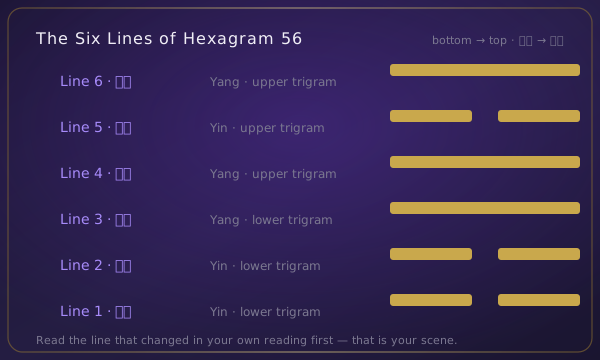
Each line of Hexagram 56 is one scene in the life of a wanderer — its pettiness, its inn, its fire, its position, its pheasant, and its nest.
Line 1 (初六) — The wanderer is petty and trivial; this is what invites disaster. The scene: the exile who shrinks to the size of his fear. The modern reading: the warning line. 旅琐琐,斯其所取灾 — the trivial, grasping wanderer, and the disaster that the pettiness invites. The hexagram's first lesson: the wanderer's danger is his own smallness.
Line 2 (六二) — The wanderer reaches the inn; keeps his provisions close; gains a trustworthy servant; perseverance is good fortune. The scene: the exile correctly resourced. The modern reading: the central line and the hexagram's promise. 旅即次,怀其资,得童仆贞吉 — the inn, the provisions, the servant, and the good fortune. What the wanderer has is what can be carried, and what can be carried is enough.
Line 3 (九三) — The wanderer's inn burns; he loses his trustworthy servant; perseverance brings danger. The scene: the loss of the shelter and the people. The modern reading: the warning line. 旅焚其次,丧其童仆,贞厉 — the burned inn, the lost servant, and the danger. The wanderer who loses the two things the wanderer has is in the hexagram's hardest position.
Line 4 (九四) — The wanderer rests in a place; gains his provisions and axe; my heart is not glad. The scene: the exile resourced and uneasy. The modern reading: the resting line. 旅于处,得其资斧,我心不快 — the place, the provisions and the axe, and the heart that is not glad. The wanderer's security does not resolve the wanderer's homelessness, and the hexagram records the unease honestly.
Line 5 (六五) — He shoots the pheasant; one arrow is lost; in the end, the command and the praise. The scene: the single arrow that brings the recognition. The modern reading: the center line. 射雉,一矢亡,终以誉命 — the pheasant, the lost arrow, and the command that arrives. The wanderer's recognition comes at the cost of the single shot, and it comes.
Line 6 (上九) — The bird's nest is aflame; the wanderer first laughs, then weeps; he loses the ox in the change; misfortune. The scene: the home that was built and burned. The modern reading: the extremity line. 鸟焚其巢,旅人先笑后号咷,丧牛于易,凶 — the nest, the laughing and the weeping, the ox lost in the change, and the 凶. The wanderer who built as if permanent is the wanderer the hexagram grieves.
When all six lines change: Hexagram 56 turns toward Hexagram 57 — the wanderer completed becomes the gentle. The road that had no home becomes the wind that has no root either — and moves everything.
How to Read Hexagram 56 with the Number Oracle
Hexagram 56 reaches you the same way every hexagram does: through three numbers that arise naturally while you hold your question — a clock, a receipt, a page number, a number that simply surfaces. The first number sets the upper trigram, the second the lower trigram, and the third identifies the changing line. Enter your three numbers and your question at numbers-oracle.com and you will get the hexagram plus an AI interpretation written for your situation — free, no registration. For the mechanics, read how three numbers become a hexagram →
Your lucky energy for Hexagram 56: Earth element (the body trigram, the mountain below). Lucky colors are yellow and earth brown; the matching crystal is obsidian, traditionally associated with protection, grounding, and shielding from stress.
Related hexagrams: Hexagram 55 (Abundance) — the empty house before the road; Hexagram 36 (Darkening of the Light) — the hidden light in hostile lands; Hexagram 59 (Dispersion) — the dissolving the road leads to.
Hexagram 56: Common Questions
What does hexagram 56 mean in one sentence?
Hexagram 56 means the wanderer — small success for the exile held correctly, where the provisions are kept close, the servant is trustworthy, the land is treated with care, and the nest built as permanent is the named failure.
Is hexagram 56 good or bad?
Hexagram 56 is modestly favorable — 小亨,旅贞吉 — the exile's success is small and the perseverance is real. Its extremity is the final line: the nest aflame, the laughing turned to weeping, 凶. The hexagram is favorable for the correctly held transition and unfavorable for the home built in the land that was never yours.
What should I do when I receive hexagram 56?
Check which line changed. The petty wanderer (line 1) means do not shrink — the smallness invites the disaster; the inn and provisions (line 2) means what you carry is enough; the burned inn (line 3) means the shelter and the people are lost — endure; the resting place (line 4) means the resources are there and the unease is honest; the pheasant (line 5) means the recognition comes at the cost of one shot; the nest aflame (line 6) means the permanence was the illusion — the road continues.
Why is hexagram 56 called "The Wanderer"?
Because its image is fire burning on the mountain — 山上有火 — the flame with no root in the rock, burning anyway. The old translators rendered it The Wanderer or The Traveler because the hexagram's subject is the life lived away from the source: the inn, the provisions, the servant, and the road that does not end at the nest.
The noble one can be impoverished on the road and still not lose the Way.