I Ching Hexagram 57 (The Gentle): Meaning in Love, Career and Life
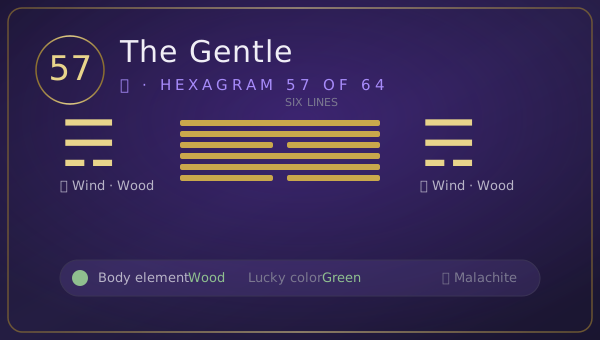
Hexagram 57 is the gentle hexagram of the I Ching: wind upon wind, the current that penetrates everything without breaking anything. Its classical judgment reads "small success; favorable to have somewhere to go; favorable to see the great person" (小亨,利有攸往,利见大人), and its image — wind following wind — says the noble one "repeats the commands and carries out the work" (申命行事). When Hexagram 57 appears in a reading, it describes influence by persistence: the force that does not push, the penetration that works by continuing — and the hexagram's exact counsel about the difference between the gentle and the weak.
The Story of Hexagram 57: The Wind Under the Door
The scene is wind, watched closely. It does not strike the door; it goes under it. It does not argue with the wall; it goes around it. And by the end of the day, everything in the house smells of where the wind has been. The old commentators read the hexagram from that method: 巽 is the gentle, and the gentle penetrates. Not the strongest force — the most persistent one.
The judgment is modest — 小亨, small success — and the hexagram's favors are specific: somewhere to go (利有攸往) and the great person (利见大人). The gentle is not the conqueror; it is the current that reaches. And the image says how the gentle is actually applied: 申命行事 — repeat the commands, carry out the work. The wind does not announce once; it keeps blowing. Influence in this hexagram is a matter of repetition, not volume.
The lines are the anatomy of the gentle, and the hexagram is unusually honest about where it fails. The first line is the hexagram's paradox: 进退 — advance and retreat, the wind that cannot decide — and its counsel: 利武人之贞, favorable for the warrior's perseverance. The gentle at its weakest moment needs the warrior's bone. The second line is the hexagram's central image: 巽在床下 — the penetration under the bed — and the scene of the scribe and the shaman, all in a flurry (用史巫纷若) — 吉,无咎. The third line is the hexagram's warning: 频巽 — the repeated, exhausting penetration — 吝. The fourth line is the hexagram's reward: 悔亡,田获三品 — the regret dissolves, the hunt takes three kinds of game. The fifth line is the hexagram's center: 贞吉悔亡,无不利,无初有终 — no beginning, but an end — and its timing rule: 先庚三日,后庚三日 — three days before, three days after — 吉. And the final line is the hexagram's extremity: 巽在床下,丧其资斧 — the penetration under the bed, and the provisions and axe lost — 贞凶.
The wind does not push. It continues. The hexagram's whole question is whether the continuing is gentle or merely repeated.
What Is Hexagram 57?
- Name: 巽 (Xùn), traditionally rendered The Gentle; also translated as The Penetrating Wind, The Submissive, or The Winding
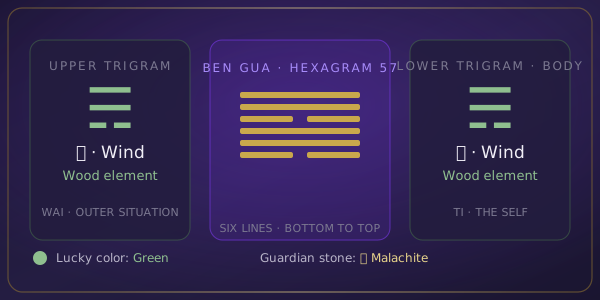
- Structure: Wind over Wind — the current doubled, penetration by persistence
- Position: 57 of 64, the hexagram after The Wanderer; what the road becomes
- Element: Wood on the body trigram — the lower trigram (wind) belongs to Wood; wind above also belongs to Wood
- Body trigram: the lower trigram (wind, Wood), which in plum blossom divination represents the self
- Core images: wind under the door, the scribe and the shaman, the three kinds of game, the three days before and after, the provisions and axe lost under the bed
The Core Meaning of Hexagram 57
The judgment of Hexagram 57 grants the gentle its modest favors — 小亨,利有攸往,利见大人 — and the image says how the gentle works: 申命行事. Repeat the commands; carry out the work. The wind does not announce once; it keeps blowing. What the hexagram describes is influence by persistence, and its whole teaching is about the line where persistence becomes exhaustion.
Three things this hexagram is telling you, each standing on its own:
The gentle penetrates by continuing. Wind under the door, wind around the wall — the hexagram's method is repetition, not force. What the gentle achieves, it achieves by being still there when the strong thing has stopped. The image's instruction is the method: repeat the command, do the work, again.
The gentle at its weakest needs the warrior's bone. The first line is the hexagram's paradox: 进退 — the wind that hesitates, neither advancing nor retreating — and its counsel is the strange one: 利武人之贞. The gentle without resolve is the wind that cannot decide, and the hexagram's remedy is the soldier's perseverance. Gentleness is a method, not a temperament.
The repeated penetration has a limit. The third line is the hexagram's warning: 频巽,吝 — the penetration repeated past its meaning, the flattery that persists, the insistence that has become noise. The gentle that does not know when to stop is the gentle that exhausts itself. The fifth line's timing rule is the correction: 先庚三日,后庚三日 — before and after, the sequence observed.
The question Hexagram 57 answers is not "am I being heard?" It is: is my influence penetrating by persistence — and is the persistence still gentle, or has it become the repeated flattery?
Hexagram 57 in Love and Relationships
If you are single: Hexagram 57 describes the gentle season — influence by persistence, the current that reaches without pushing. The hexagram's counsel for the single season is its image: 申命行事 — repeat, continue, do the work. What draws people is not the loud announcement; it is the wind that is still blowing when the loud thing stopped. And its first line is its warning: the hesitation (进退) — the wind that cannot decide — needs the warrior's bone.
In an early or uncertain stage: Early love under Hexagram 57 is the gentle penetration — the influence that works by continuing. The hexagram's lines are its counsel: the scribe and the shaman under the bed (line 2) is the bond influenced through the small, persistent attentions — and the hexagram grants it 吉; the repeated penetration (line 3) is the attention that has become flattery; the three kinds of game (line 4) is the harvest the persistence brings.
In a stable relationship: A stable relationship drawing Hexagram 57 is the long bond as wind — influence that persists, penetration that does not push. The hexagram's counsel for the long term is its image: repeat the commands (申命), carry out the work (行事). The long bond is kept by the things that keep being done, not the things that were said once. And its fifth line is its promise: 无初有终 — no beginning, but an end. The gentle completes what the strong only starts.
In a crisis: If the relationship is at the final line — the provisions and axe lost under the bed — Hexagram 57's verdict is 贞凶, and its image is the diagnosis: the penetration that has gone under the bed one time too many. The gentle that persists past its limit loses the very resources (the provisions, the axe) that made it effective. The hexagram's crisis counsel is the fifth line's timing: before and after, the sequence observed.
Hexagram 57 in Career, Money and Decisions
Career: This is the gentle-influence hexagram of professional life — the leadership that penetrates, the work that persists. Its career counsel is the judgment: small success (小亨), somewhere to go (利有攸往), and see the great person (利见大人). The image is the career discipline: 申命行事 — repeat the instruction, carry out the work. The second line's scribe and shaman are its career image of correct influence: the flurry of small, persistent attentions. And the third line is its career warning: the repeated penetration that has become noise (频巽,吝).
Money: Hexagram 57 governs money by gentle persistence — the slow accumulation, the influence that compounds. Its financial counsel is the image: repeat, continue, carry out. The fourth line's three kinds of game (田获三品) is its financial image: the harvest the persistent method brings. The fifth line's timing rule (先庚三日,后庚三日) is its financial discipline: before and after, the sequence observed. And the final line is its financial warning: the resources lost under the bed — the method that persisted past its meaning.
Decision: Hexagram 57 says: penetrate by continuing. If you are deciding how to influence — the person, the team, the market — the hexagram's test is its image: is the influence persistent (still blowing when the loud thing stopped), is it gentle (not the repeated flattery), and is the timing observed (before and after)? The decision it blesses is the wind that is still there; the decision it marks is the noise that repeated.
The Changing Lines of Hexagram 57: Six Scenes
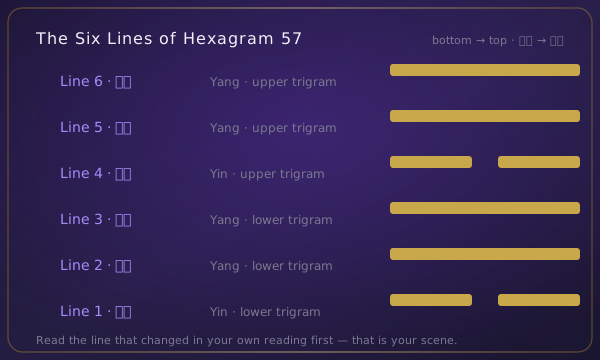
Each line of Hexagram 57 is one scene in the life of the gentle — its hesitation, its flurry, its repetition, its harvest, its timing, and its loss.
Line 1 (初六) — Advancing, retreating; favorable for the warrior's perseverance. The scene: the wind that cannot decide. The modern reading: the paradox line. 进退,利武人之贞 — the hesitation, and the soldier's perseverance. The gentle at its weakest needs the warrior's bone; gentleness is a method, not a temperament.
Line 2 (九二) — The penetration under the bed; using the scribe and the shaman in a flurry; good fortune, no blame. The scene: the influence that works through the small, persistent attentions. The modern reading: the central line and the hexagram's image. 巽在床下,用史巫纷若,吉无咎 — under the bed, the scribe and the shaman all in a flurry, and the good fortune. The gentle's influence is the many small things, repeated.
Line 3 (九三) — The repeated penetration; regret. The scene: the persistence that has become noise. The modern reading: the warning line. 频巽,吝 — the penetration repeated past its meaning, the flattery that persists. The gentle that does not know when to stop is the gentle that exhausts.
Line 4 (六四) — The regret dissolves; the hunt takes three kinds of game. The scene: the harvest the persistent method brings. The modern reading: the harvest line. 悔亡,田获三品 — the regret dissolved, the three kinds of game. The gentle that has persisted correctly receives three kinds of return.
Line 5 (九五) — Perseverance is favorable, the regret dissolves; nothing is unfavorable; no beginning, but an end. Three days before, three days after; good fortune. The scene: the hexagram's center, and its timing rule. The modern reading: the center line. 贞吉悔亡,无不利,无初有终,先庚三日,后庚三日,吉 — perseverance, the regret dissolved, no beginning but an end, and the timing rule: before and after. The gentle completes what the strong only starts.
Line 6 (上九) — The penetration under the bed; he loses his provisions and axe; perseverance is ominous. The scene: the method that persisted past its meaning. The modern reading: the extremity line. 巽在床下,丧其资斧,贞凶 — under the bed, and the provisions and the axe lost. The gentle that went under the bed one time too many loses the very resources that made it work.
When all six lines change: Hexagram 57 turns toward Hexagram 58 — the gentle completed becomes the joyous. The wind that penetrated becomes the lake that reflects.
How to Read Hexagram 57 with the Number Oracle
Hexagram 57 reaches you the same way every hexagram does: through three numbers that arise naturally while you hold your question — a clock, a receipt, a page number, a number that simply surfaces. The first number sets the upper trigram, the second the lower trigram, and the third identifies the changing line. Enter your three numbers and your question at numbers-oracle.com and you will get the hexagram plus an AI interpretation written for your situation — free, no registration. For the mechanics, read how three numbers become a hexagram →
Your lucky energy for Hexagram 57: Wood element (the body trigram, wind upon wind). Lucky colors are green and tender sprout tones; the matching crystal is malachite, traditionally associated with growth, renewal, and fresh starts.
Related hexagrams: Hexagram 56 (The Wanderer) — the road the wind follows; Hexagram 59 (Dispersion) — the wind released over the water; Hexagram 9 (Small Taming) — the other gentle force, crossing the sky.
Hexagram 57: Common Questions
What does hexagram 57 mean in one sentence?
Hexagram 57 means the gentle — small success for the wind that penetrates by continuing, where influence is repetition rather than volume, and the persistence past its limit is the named failure.
Is hexagram 57 good or bad?
Hexagram 57 is modestly favorable — 小亨,利有攸往,利见大人 — with the gentle's own conditions. The repeated penetration (line 3) is 吝 and the resources lost under the bed (line 6) is 贞凶. The hexagram is favorable for the persistent gentle influence and unfavorable for the flattery that repeated.
What should I do when I receive hexagram 57?
Check which line changed. Advancing and retreating (line 1) means the hesitation needs the warrior's bone; the scribe and shaman (line 2) means influence works through small persistent attentions; the repeated penetration (line 3) means the flattery has become noise — stop; the three kinds of game (line 4) means the harvest the persistence brings; the timing rule (line 5) means before and after, the sequence observed; the provisions lost (line 6) means the method persisted past its meaning.
Why is hexagram 57 called "The Gentle"?
Because its image is wind upon wind — 随风 — the current doubled, the force that penetrates by continuing rather than pushing. The old translators rendered it The Gentle or The Penetrating Wind because the hexagram's subject is influence by persistence: the wind under the door, the command repeated, and the line where persistence becomes noise.
The wind does not push. It continues. That is the whole method.