I Ching Hexagram 58 (The Joyous): Meaning in Love, Career and Life
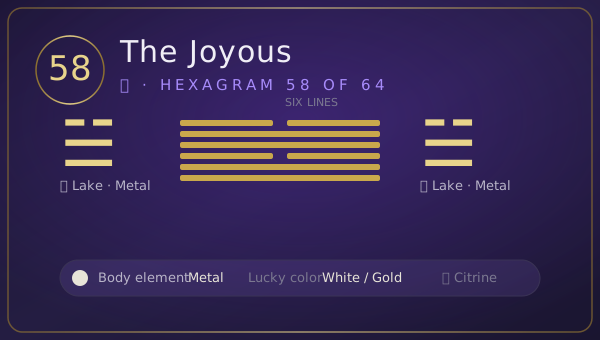
Hexagram 58 is the joyous hexagram of the I Ching: lake upon lake, the open water that reflects the sky and reflects the other water. Its classical judgment reads "success; favorable perseverance" (亨,利贞), and its image — lakes joined — says the noble one "studies and practices with his friends" (朋友讲习). When Hexagram 58 appears in a reading, it describes joy: the open exchange, the pleasure that is shared rather than consumed — and the hexagram's exact counsel about which joys are genuine and which are the kind that devour.
The Story of Hexagram 58: The Two Lakes
The scene is two lakes side by side, both open, both reflecting. The old commentators read the hexagram from that adjacency: 丽泽 — the lakes joined. Joy in this hexagram is not the well that nourishes (48) and not the fire that clings (30). It is the open water that recognizes itself in the other open water. What the image names is the mechanism: 朋友讲习 — friends studying and practicing together. The joy of Hexagram 58 is the joy of exchange, and exchange requires another open surface.
The judgment is simple — 亨,利贞 — success and perseverance — and the lines grade the joys with unusual directness. The first line is the harmonious joy (和兑) — the pleasure that is at peace with itself — 吉. The second line is the sincere joy (孚兑) — the gladness that is genuine, and the hexagram's gift: 悔亡, the regret dissolves. The third line is the hexagram's warning: 来兑,凶 — the joy that comes from outside, the pleasure that is fetched, the manufactured delight. The fourth line is the joy that deliberates (商兑未宁) — the pleasure that is still being weighed — and its promise: 介疾有喜, the isolation from the disease brings joy. The fifth line is the hexagram's danger: 孚于剥,有厉 — sincerity toward what is being stripped away, and danger. And the final line is the hexagram's extremity: 引兑 — the joy that is drawn, pulled, seduced — with no verdict attached, which is itself the verdict.
The lakes do not drink each other. They reflect each other, and both stay full.
What Is Hexagram 58?
- Name: 兑 (Duì), traditionally rendered The Joyous; also translated as Joy, Pleasure, The Lake, or The Open
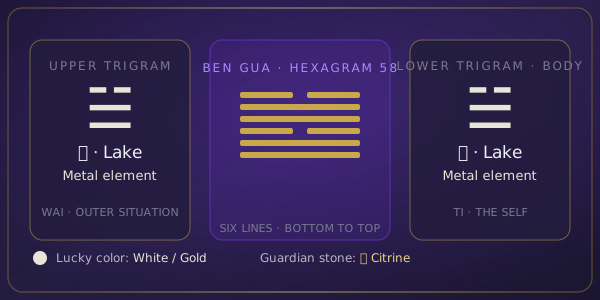
- Structure: Lake over Lake — the open water joined, the joy that reflects
- Position: 58 of 64, the hexagram after The Gentle; what the wind that penetrated becomes
- Element: Metal on the body trigram — the lower trigram (the lake) belongs to Metal; the lake above also belongs to Metal
- Body trigram: the lower trigram (the lake, Metal), which in plum blossom divination represents the self
- Core images: the joined lakes, the harmonious joy, the sincere joy, the fetched joy, the joy that deliberates, the drawn joy
The Core Meaning of Hexagram 58
The judgment of Hexagram 58 grants success and perseverance to joy — 亨,利贞 — and the image says what kind of joy this is: the joy of friends studying together (朋友讲习). What the hexagram describes is not pleasure as consumption but pleasure as exchange. The lake that reflects the lake stays full precisely because it gave nothing up.
Three things this hexagram is telling you, each standing on its own:
Genuine joy is exchange, not consumption. 丽泽 — the lakes joined. The joy that works in this hexagram is the joy that has another open surface to reflect: the study together, the conversation, the shared practice. What the image names is the mechanism — friends, study, practice — and the mechanism requires another lake.
The sincere joy dissolves regret. The second line is the hexagram's gift: 孚兑,吉,悔亡 — the joy that is genuine, granted good fortune and the dissolving of regret. What the hexagram promises is not that joy erases the past; it is that genuine gladness dissolves the residue the past left.
The fetched joy is the named failure. The third line is the hexagram's only hard verdict: 来兑,凶. The joy that is fetched — the pleasure sourced from outside, the delight that must be brought in — is ominous. And the final line is its extremity: 引兑 — the joy that is drawn, pulled, seduced. The hexagram grades its joys by their source: from within and exchanged (lines 1-2) or from outside and pulled (lines 3 and 6).
The question Hexagram 58 answers is not "am I happy?" It is: is this joy exchanged — does it have another open surface — or is it the kind that is fetched and drawn?
Hexagram 58 in Love and Relationships
If you are single: Hexagram 58 describes the joyous season — the self as open lake, the joy that reflects. The hexagram's counsel for the single season is its image: 朋友讲习 — study and practice with friends. The joy that makes a person ready for connection is the joy that is already shared, already exchanged. And its third line is the single-season warning: the fetched joy (来兑) — the pleasure sourced from outside — is ominous.
In an early or uncertain stage: Early love under Hexagram 58 is two open lakes — the exchange that reflects both ways. The hexagram's lines are its counsel: the harmonious joy (line 1) is the pleasure at peace with itself; the sincere joy (line 2) is the genuine gladness, granted the dissolving of regret; the fetched joy (line 3) is the bond that sources its delight from outside — and the hexagram's verdict: 凶.
In a stable relationship: A stable relationship drawing Hexagram 58 is the long bond as joined lakes — the joy that has been exchanged for years. The hexagram's counsel for the long term is its image: friends, study, practice together. The long bond stays full because it reflects; it does not drink. And its fifth line is its warning: 孚于剥,有厉 — the sincerity directed toward what is being stripped away. The joyous bond must watch what it is being sincere about.
In a crisis: If the relationship is at the final line — the drawn joy (引兑) — Hexagram 58's extremity has no verdict attached, which is the hexagram's most ominous silence. The joy that is pulled and seduced is the joy that has no source of its own. The hexagram's crisis counsel is its first lines: return to the harmonious and the sincere — the joy that is at peace with itself, exchanged with the open lake.
Hexagram 58 in Career, Money and Decisions
Career: This is the joyous-exchange hexagram of professional life — the team that studies together, the work that is practiced with friends, the pleasure of the exchange itself. Its career counsel is the judgment: success and perseverance (亨,利贞) for the joy that is shared. The image is the career structure: 朋友讲习 — the study and the practice, done together. And the third line is its career warning: the fetched joy — the satisfaction sourced from outside, the praise, the perk — is ominous.
Money: Hexagram 58 governs money as exchange — the transaction that leaves both sides full, the wealth that circulates as joy. Its financial counsel is the hexagram's mechanism: the lakes reflect, and neither empties. The second line's sincere joy (悔亡) is its financial image: the exchange that is genuine dissolves the residue. And the final line's drawn joy is its financial extremity: the gain that is pulled and seduced — the profit with no source of its own.
Decision: Hexagram 58 says: exchange, do not consume. If you are deciding where the joy comes from — the work, the bond, the money — the hexagram's test is its image: is this the lake reflecting the lake (another open surface, both full), or is it the fetched and drawn joy (the pleasure with no source)? The decision it blesses is the exchanged joy; the decision it marks is the pulled one.
The Changing Lines of Hexagram 58: Six Scenes
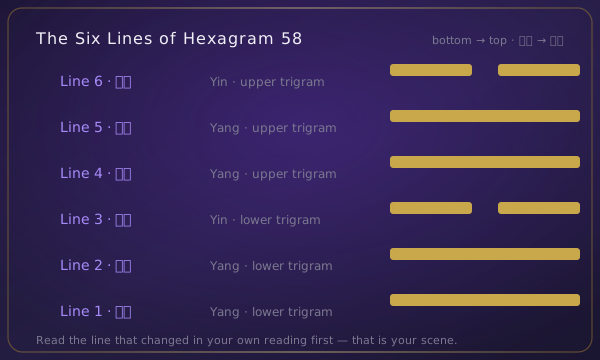
Each line of Hexagram 58 is one scene in the life of a joy — its harmony, its sincerity, its fetching, its deliberation, its stripping, and its drawing.
Line 1 (初九) — Harmonious joy; good fortune. The scene: the pleasure at peace with itself. The modern reading: the foundation line. 和兑,吉 — the joy that is in harmony, granted good fortune. The hexagram's opening blessing belongs to the gladness that is not at war with itself.
Line 2 (九二) — Sincere joy; good fortune; the regret dissolves. The scene: the genuine delight, and its gift. The modern reading: the sincere line. 孚兑,吉,悔亡 — the joy that is real, granted good fortune and the dissolving of regret. What the hexagram promises is not that joy erases the past; it is that genuine gladness dissolves the residue.
Line 3 (六三) — The joy that comes; misfortune. The scene: the pleasure that must be fetched. The modern reading: the warning line and the hexagram's only hard verdict. 来兑,凶 — the joy sourced from outside, and the ominousness. What must be brought in is not joy; it is its substitute.
Line 4 (九四) — The joy deliberates, not yet at peace; being separated from the disease, there is joy. The scene: the pleasure that is still being weighed. The modern reading: the deliberating line. 商兑未宁,介疾有喜 — the joy under consideration, the unease, and the promise: separation from the disease brings joy. The pleasure that examines itself is the pleasure that survives.
Line 5 (九五) — Sincerity toward what is being stripped; there is danger. The scene: the gladness directed at the wrong object. The modern reading: the danger line. 孚于剥,有厉 — the sincerity toward the stripping, and the danger. The joyous bond must watch what it is being sincere about; not every open surface reflects back.
Line 6 (上九) — The drawn joy. The scene: the pleasure that is pulled and seduced. The modern reading: the extremity line. 引兑 — the joy with no source of its own, and the hexagram's most ominous silence: no verdict attached. The joy that is drawn is the joy that has already been decided.
When all six lines change: Hexagram 58 turns toward Hexagram 59 — the joyous completed becomes dispersion. The lake that reflected becomes the water that dissolves.
How to Read Hexagram 58 with the Number Oracle
Hexagram 58 reaches you the same way every hexagram does: through three numbers that arise naturally while you hold your question — a clock, a receipt, a page number, a number that simply surfaces. The first number sets the upper trigram, the second the lower trigram, and the third identifies the changing line. Enter your three numbers and your question at numbers-oracle.com and you will get the hexagram plus an AI interpretation written for your situation — free, no registration. For the mechanics, read how three numbers become a hexagram →
Your lucky energy for Hexagram 58: Metal element (the body trigram, lake upon lake). Lucky colors are white, gold, and silver; the matching crystal is citrine, traditionally associated with abundance and clear, joyful energy.
Related hexagrams: Hexagram 57 (The Gentle) — the wind the lake reflects; Hexagram 16 (Enthusiasm) — the other joy, at the drum's tempo; Hexagram 45 (Gathering Together) — the lakes that gather.
Hexagram 58: Common Questions
What does hexagram 58 mean in one sentence?
Hexagram 58 means the joyous — success for the joy that is exchanged rather than consumed, where the lakes reflect each other and both stay full, and the joy that is fetched or drawn is the named failure.
Is hexagram 58 always good?
Hexagram 58 grants success and perseverance (亨,利贞) — but it grades its joys. The harmonious and sincere joys (lines 1-2) are favorable; the fetched joy (line 3) is 凶; the drawn joy (line 6) is left without verdict, which is the hexagram's most ominous silence. The hexagram is favorable for the exchanged joy and unfavorable for the sourced-from-outside one.
What should I do when I receive hexagram 58?
Check which line changed. Harmonious joy (line 1) means the gladness at peace with itself is the good fortune; sincere joy (line 2) means the genuine dissolves the regret; the fetched joy (line 3) means the pleasure sourced from outside is ominous; the deliberating joy (line 4) means examine it — separation from the disease brings joy; sincerity toward the stripping (line 5) means watch what you are being glad about; the drawn joy (line 6) means the pulled pleasure has no source — return to the exchange.
Why is hexagram 58 called "The Joyous"?
Because its image is lakes joined — 丽泽 — open water reflecting open water, neither emptying the other. The old translators rendered it The Joyous or The Lake because the hexagram's subject is joy as exchange: the friends studying together, the pleasure that reflects, and the fetched joy that is its shadow.
The lakes do not drink each other. They reflect each other, and both stay full.