I Ching Hexagram 59 (Dispersion): Meaning in Love, Career and Life
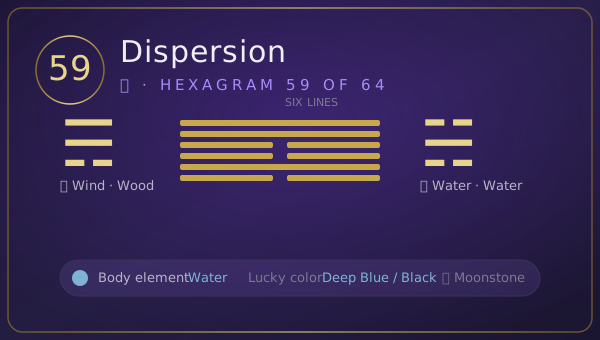
Hexagram 59 is the dispersion hexagram of the I Ching: wind moving over the water, the surface broken into movement, the ice dissolving. Its classical judgment reads "success. The king reaches the temple; favorable to cross the great water; favorable perseverance" (亨。王假有庙,利涉大川,利贞), and its image — wind on the water — says the early kings "offered to the High Lord and established the temple" (享于帝立庙). When Hexagram 59 appears in a reading, it describes dissolving: the rigidity that breaks up, the blockage that melts — and the hexagram's exact counsel about what dispersion makes possible and what it requires.
The Story of Hexagram 59: The Wind on the Ice
The scene is a frozen river in early spring. The ice has held all winter — the solid surface, the road, the structure. And then the wind comes over the water, and the surface begins to move. Not cracked by force — dissolved by contact. The old commentators read the hexagram from that exact motion: 涣 is dispersion, and the wind on the water is what happens to rigidity when the right current touches it.
The judgment is the hexagram's paradox: success (亨) — and the king at the temple (王假有庙) — and the crossing of the great water (利涉大川). The dissolution is favorable, and it is consecrated. What the early kings did with the image was build the temple — 享于帝立庙 — because dispersion is not only destruction; it is the breaking-up that lets the sacred be rebuilt. The rigid ice had to go before the river could flow, and the river is what carries.
The lines are the anatomy of a dissolving. The first line is the hexagram's rescue: 用拯马壮 — saved by a strong horse — 吉. The second line is the hexagram's flight: 涣奔其机 — the dissolution runs to the perch — 悔亡. The third line is the hexagram's center: 涣其躬 — the dissolution of the self — 无悔. The fourth line is the hexagram's most quoted line: 涣其群,元吉 — the dissolution of the group — supreme good fortune — and then the image that has no natural reading at all: 涣有丘,匪夷所思 — the dispersion produces a mound; it is beyond what the ordinary mind thinks. The fifth line is the hexagram's proclamation: 涣汗其大号 — the dissolution sweats out its great cry — 涣王居,无咎. And the final line is the hexagram's extremity: 涣其血,去逖出 — the dissolution of the blood, the going out and away — 无咎.
The ice does not argue with the wind. It dissolves, and the river remembers it was a river.
What Is Hexagram 59?
- Name: 涣 (Huàn), traditionally rendered Dispersion; also translated as Dissolution, Dispersal, or The Melting
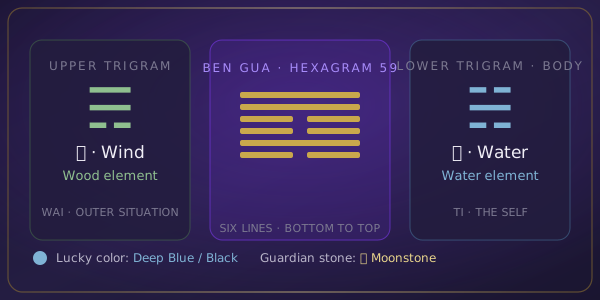
- Structure: Wind over Water — the current over the surface, the rigidity dissolving into movement
- Position: 59 of 64, the hexagram after The Joyous; what the reflected lake becomes
- Element: Water on the body trigram — the lower trigram (water) belongs to Water; wind above belongs to Wood
- Body trigram: the lower trigram (water, Water), which in plum blossom divination represents the self
- Core images: wind on the water, the strong horse, the perch, the mound from dispersion, the great cry, the blood released
The Core Meaning of Hexagram 59
The judgment of Hexagram 59 grants success to dispersion — and consecrates it. The king reaches the temple; the early kings offered and built. What the hexagram describes is the favorable dissolving: the rigidity that breaks up is not only destroyed; it is released into movement. And the crossing is promised — 利涉大川 — because the river that flows is the river that carries.
Three things this hexagram are telling you, each standing on its own:
Dispersion is consecrated, not merely destructive. 王假有庙 — the king at the temple — is the judgment's first image. The breaking-up that the hexagram blesses is the one that makes the sacred possible. What the early kings did with the image was build the temple: the rigid structure had to dissolve before the true worship could be established.
The self must be dissolved too. The third line is the hexagram's center: 涣其躬,无悔 — the dissolution of the self, and no regret. What is being dispersed is not only the external rigidity; it is the self's own hardness. The person who does not dissolve with the ice is the person who stands on it when it goes.
The dispersion produces what the ordinary mind cannot think. The fourth line is the hexagram's miracle: 涣有丘,匪夷所思 — the dispersion makes a mound; it is beyond the ordinary thinking. The dissolution of the group produces a structure — a gathering point, a height, something that was not there when the group was solid. What breaks up becomes something the mind did not plan.
The question Hexagram 59 answers is not "how do I hold this together?" It is: is this rigidity ready to dissolve — and what will the dispersion build that the solid structure could not?
Hexagram 59 in Love and Relationships
If you are single: Hexagram 59 describes the dissolving season — the rigidity of the self breaking up, the ice going. The hexagram's counsel for the single season is its third line: 涣其躬 — dissolve the self — 无悔. What the single season disperses is the person's own hardness, and the hexagram grants no regret to the one who dissolves with the season.
In an early or uncertain stage: Early love under Hexagram 59 is the bond dissolving its structures — the defenses, the plans, the rigid shapes each person arrived in. The hexagram's lines are its counsel: the strong horse (line 1) is the rescue that arrives at speed; the perch (line 2) is the bond that runs to its position; the self dissolved (line 3) is the bond that has let its own hardness go. And the fourth line is its promise: the dispersion of the pair produces the mound — what the bond becomes when its rigidity goes.
In a stable relationship: A stable relationship drawing Hexagram 59 is in dissolution — the old structure of the bond breaking up. The hexagram's counsel for the long term is its judgment: the king at the temple. What the dissolution makes possible is the rebuilt sacred — the relationship reconsecrated after its rigid form has gone. And the fifth line is its promise: the great cry (涣汗其大号) — the proclamation that the dissolution makes possible.
In a crisis: If the relationship is at the final line — the blood released, the going out — Hexagram 59's verdict is 无咎, and its image is the release: 涣其血,去逖出. What the crisis disperses is the wound itself — the blood that was held, the injury that was kept — and the hexagram grants no blame to the release. The extremity of dispersion is the extremity of letting go.
Hexagram 59 in Career, Money and Decisions
Career: This is the dissolution hexagram of professional life — the rigid structure breaking up, the organization melting into new form. Its career counsel is the judgment: success and the crossing (利涉大川) for the dispersion that is consecrated (王假有庙). The lines are its career manual: the strong horse (line 1) is the rescue at speed; the perch (line 2) is the position the dissolution runs to; the self dissolved (line 3) is the career that lets its own hardness go. And the fourth line is its promise: the dispersion of the team produces the mound — the structure that was not planned.
Money: Hexagram 59 governs money in dissolution — the frozen asset thawing, the rigid position melting into movement. Its financial counsel is the judgment: the crossing is available to what flows (利涉大川). The strong horse (line 1) is its liquidity image: the rescue at speed. The great cry (line 5) is its proclamation: the announcement the dissolution makes possible. And the final line's released blood is its financial extremity: the loss let go, the wound released, no blame.
Decision: Hexagram 59 says: let the rigidity dissolve — and consecrate what comes. If you are deciding whether to hold the structure or let it go, the hexagram's test is its judgment: is this rigidity ready to break up, is the dissolution being consecrated (the temple), and can I dissolve my own hardness with it (涣其躬)? The decision it blesses is the released river; the decision it marks is the ice held past its season.
The Changing Lines of Hexagram 59: Six Scenes
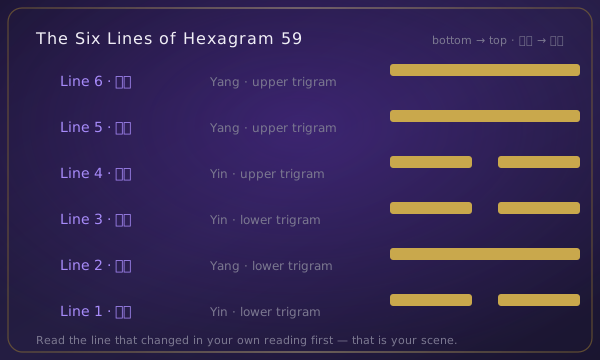
Each line of Hexagram 59 is one scene in the life of a dispersion — its rescue, its perch, its self, its mound, its cry, and its blood.
Line 1 (初六) — Saved by a strong horse; good fortune. The scene: the rescue that arrives at speed. The modern reading: the foundation line. 用拯马壮,吉 — the strong horse, and the good fortune. The dissolution at its beginning is the dissolution that is met by the fast rescue. What moves the dispersing person is the strong horse, not the willpower.
Line 2 (九二) — The dissolution runs to the perch; the regret dissolves. The scene: the dispersal that finds its position. The modern reading: the perch line. 涣奔其机,悔亡 — the run to the perch, and the regret dissolved. What is dispersing is not lost; it is relocating. The perch is where the dispersing thing comes to rest.
Line 3 (六三) — The dissolution of the self; no regret. The scene: the self dispersing with the season. The modern reading: the center line and the hexagram's keystone. 涣其躬,无悔 — the self dissolved, and no regret. What is being dispersed is not only the external rigidity; it is the self's own hardness. The person who does not dissolve with the ice stands on it when it goes.
Line 4 (六四) — The dissolution of the group; supreme good fortune. The dispersion produces a mound; it is beyond what the ordinary mind thinks. The scene: the breaking-up that builds. The modern reading: the miracle line. 涣其群,元吉,涣有丘,匪夷所思 — the group dissolved, the supreme fortune, and the mound that the ordinary mind cannot think. What breaks up becomes something that was not there when it was solid.
Line 5 (九五) — The dissolution sweats out its great cry; dispersing the king's dwelling; no blame. The scene: the proclamation the melting makes possible. The modern reading: the center line. 涣汗其大号,涣王居,无咎 — the great cry like sweat, the king's dwelling dispersed, and no blame. The dissolution at the center is the dissolution that announces itself — the structure breaks, and the cry goes out.
Line 6 (上六) — The dissolution of the blood; going out and away; no blame. The scene: the wound released. The modern reading: the extremity line. 涣其血,去逖出,无咎 — the blood dispersed, the going out, and no blame. What the extremity of dissolution releases is the injury itself — the thing that was held, and the holding that was the harm.
When all six lines change: Hexagram 59 turns toward Hexagram 60 — dispersion completed becomes limitation. The river that flowed becomes the lake with its banks.
How to Read Hexagram 59 with the Number Oracle
Hexagram 59 reaches you the same way every hexagram does: through three numbers that arise naturally while you hold your question — a clock, a receipt, a page number, a number that simply surfaces. The first number sets the upper trigram, the second the lower trigram, and the third identifies the changing line. Enter your three numbers and your question at numbers-oracle.com and you will get the hexagram plus an AI interpretation written for your situation — free, no registration. For the mechanics, read how three numbers become a hexagram →
Your lucky energy for Hexagram 59: Water element (the body trigram, the water below). Lucky colors are deep blue and black; the matching crystal is moonstone, traditionally associated with intuition, dreams, and emotional flow.
Related hexagrams: Hexagram 58 (The Joyous) — the lake before the wind; Hexagram 45 (Gathering Together) — the gathering the dispersion dissolves; Hexagram 20 (Contemplation) — the other wind over the ground.
Hexagram 59: Common Questions
What does hexagram 59 mean in one sentence?
Hexagram 59 means dispersion — success for the rigidity that dissolves, consecrated at the temple, where the self dissolves with the structure and the breaking-up produces the mound the ordinary mind cannot think.
Is hexagram 59 good or bad?
Hexagram 59 grants success, the crossing, and supreme good fortune at its fourth line (元吉) — it is one of the Book's favorable hexagrams despite its name. Every line of it is favorable or blameless. The hexagram is unfavorable only for the ice held past its season, which is the failure of not being in this hexagram at all.
What should I do when I receive hexagram 59?
Check which line changed. The strong horse (line 1) means the rescue arrives at speed — take it; the perch (line 2) means the dispersing thing is relocating, not lost; the self dissolved (line 3) means let your own hardness go; the group dissolved (line 4) means the breaking-up builds the unplanned mound; the great cry (line 5) means the dissolution announces itself; the blood released (line 6) means the wound is let go.
Why is hexagram 59 called "Dispersion"?
Because its image is wind moving over the water — 风行水上 — the surface broken into movement, the ice dissolving by contact. The old translators rendered it Dispersion or Dissolution because the hexagram's subject is the favorable melting: what breaks up, what it releases, and the mound that the dispersion builds.
The ice does not argue with the wind. It dissolves, and the river remembers it was a river.