I Ching Hexagram 60 (Limitation): Meaning in Love, Career and Life
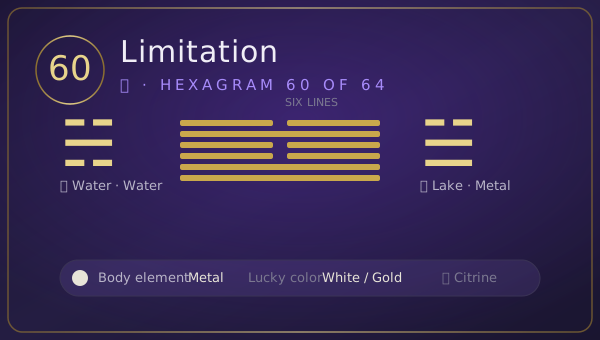
Hexagram 60 is the limitation hexagram of the I Ching: the lake with water standing in it, the banks that hold what would otherwise flood. Its classical judgment reads "success. Bitter limitation is not to be persevered in" (亨。苦节不可贞), and its image — water over the lake — says the noble one "establishes the measures and numbers and deliberates on virtue and conduct" (制数度,议德行). When Hexagram 60 appears in a reading, it describes boundaries: the structure that holds — and the hexagram's exact counsel about the difference between the limit that liberates and the limit that embitters.
The Story of Hexagram 60: The Lake With Its Banks
The scene is a lake at its proper level — water held by its banks, full and bounded. The old commentators read the hexagram from that geometry: 节 is limitation, and the lake's banks are not the lake's enemy. Without them, the water is a flood; with them, the water is a lake. What the hexagram describes is the structure that holds, and its first teaching is that the holding is favorable — success (亨) belongs to the bounded.
But the judgment carries the hexagram's warning in its second sentence: 苦节不可贞 — bitter limitation is not to be persevered in. The banks that were built to hold the water can become the walls that imprison the person who built them. What the hexagram distinguishes is the limit that holds (favorable) and the limit that has become its own ritual of deprivation (bitter, and not perseverable).
The image says what the correct limitation is for: 制数度,议德行 — establish the measures, deliberate on the conduct. The banks are the measures: the budget, the schedule, the rule, the rhythm. And the lines grade the limitations. The first line is the hexagram's discipline: 不出户庭 — not going out of the door and courtyard — 无咎. The second is the hexagram's warning: 不出门庭,凶 — not going out of the gate — misfortune. The commentators' reading is precise: the door to the courtyard is the limit that protects; the gate to the world is the limit that imprisons. The third line is the hexagram's honesty: 不节若,则嗟若 — without limitation, the sighing — and the hexagram's strange mercy: 无咎. The fourth line is the favorable limit: 安节,亨. The fifth line is the hexagram's center: 甘节,吉,往有尚 — sweet limitation, good fortune, and the going that is honored. And the final line is the extremity: 苦节,贞凶,悔亡 — bitter limitation, ominous in perseverance, and the regret that dissolves anyway.
The lake's banks hold the water. The hexagram's whole question is whether the banks have become the point.
What Is Hexagram 60?
- Name: 節 (Jié), traditionally rendered Limitation; also translated as Restriction, Moderation, or The Regulated*
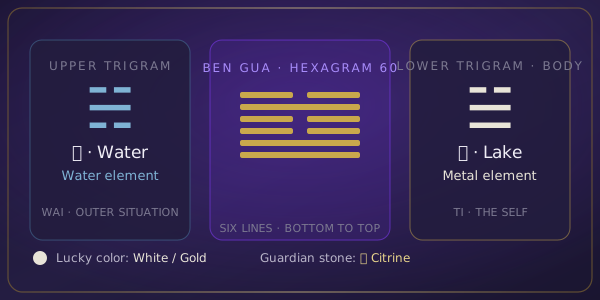
- Structure: Water over the Lake — the water standing in the marsh, the banks that hold
- Position: 60 of 64, the hexagram after Dispersion; what the flowed river becomes
- Element: Metal on the body trigram — the lower trigram (the lake) belongs to Metal; water above belongs to Water
- Body trigram: the lower trigram (the lake, Metal), which in plum blossom divination represents the self
- Core images: the lake with its banks, the door and the courtyard, the gate, the sighing, the sweet limitation, the bitter limitation
The Core Meaning of Hexagram 60
The judgment of Hexagram 60 grants success to limitation — 亨 — with the hexagram's one warning: 苦节不可贞. The limit that holds is favorable; the limit that has become its own ritual of deprivation is not perseverable. What the hexagram describes is the structure that holds, and its whole teaching is about where the holding ends and the wall begins.
Three things this hexagram are telling you, each standing on its own:
The banks are favorable. 亨 — success belongs to the bounded. The lake's banks are not the lake's enemy; without them the water is a flood. What the hexagram grants the limit is the Book's success, and the image says what the limit is for: 制数度 — the measures, the budget, the schedule, the rule.
The gate is the line where protection becomes prison. The first and second lines are the hexagram's most careful distinction: not going out of the door and courtyard (不出户庭) is blameless; not going out of the gate (不出门庭) is ominous. The limit at the courtyard is the limit that protects; the limit at the gate is the limit that imprisons. The hexagram's anatomy of the boundary is exact.
Sweet limitation is the center; bitter limitation is the extremity. The fifth line's 甘节 — sweet limitation, good fortune, and the honored going — is the hexagram's destination. The final line's 苦节 — bitter limitation — is its warning. The same structure, held at different temperatures: the limit that is lived as rhythm (sweet) and the limit that is lived as deprivation (bitter). The judgment has already said the bitter one is not perseverable.
The question Hexagram 60 answers is not "should I set limits?" It is: is this limit holding the water — or has the holding become the point, and the banks become the walls?
Hexagram 60 in Love and Relationships
If you are single: Hexagram 60 describes the season of limitation — the self with its boundaries, the life held by its banks. The hexagram's counsel for the single season is its judgment: the limit is favorable (亨), and the image is its discipline: establish the measures (制数度). What the single season builds is the structure that will hold the next bond — and the hexagram's warning is the bitter limit: the discipline that has become deprivation.
In an early or uncertain stage: Early love under Hexagram 60 is the boundaries forming — the banks of the new bond. The hexagram's lines are its counsel: the door and courtyard (line 1) is the limit that protects; the gate (line 2) is the limit that imprisons — and the hexagram's verdict: 凶; the sighing (line 3) is the bond without limitation, and its strange mercy: no blame.
In a stable relationship: A stable relationship drawing Hexagram 60 is the long bond as bounded lake — the structure that holds, the banks that keep it a lake. The hexagram's counsel for the long term is its center: 甘节 — sweet limitation. The rhythm that is lived as joy, not as deprivation: the budget, the schedule, the agreements, all held sweetly. And its final line is its warning: the bitter limit — the rules that have become the point — and the judgment's verdict: not perseverable.
In a crisis: If the relationship is at the final line — bitter limitation — Hexagram 60's verdict is 贞凶,悔亡, and the hexagram's honesty is its gift: ominous in perseverance, and the regret dissolves anyway. The crisis of limitation is the structure that has become the wall — and the hexagram's counsel is the judgment's own: the bitter limit is not to be persevered in. Let the bank go.
Hexagram 60 in Career, Money and Decisions
Career: This is the limitation hexagram of professional life — the structure that holds, the boundaries that keep the work a lake. Its career counsel is the judgment: success for the bounded (亨), and the image: establish the measures (制数度) — the budget, the schedule, the rule. The lines are its career anatomy: the door and courtyard (line 1) is the limit that protects; the gate (line 2) is the limit that imprisons — 凶; the sweet limitation (line 5) is the rhythm lived as joy; the bitter limitation (line 6) is the structure that has become the wall.
Money: Hexagram 60 is the Book's budget hexagram — limitation applied to resources. Its financial counsel is the judgment: the bounded is successful, and the image is the financial discipline: establish the measures (制数度). The fifth line's sweet limitation is its financial center: the budget lived as rhythm, granted good fortune and the honored going. And the final line is its financial extremity: the bitter budget — the discipline that has become deprivation — and the judgment's verdict: not perseverable.
Decision: Hexagram 60 says: set the limit — and keep it sweet. If you are deciding what boundaries to build, the hexagram's test is its lines: is this limit holding the water (favorable) or has it become the wall (bitter), and is it at the courtyard (protective) or the gate (imprisoning)? The decision it blesses is the sweet limitation; the decision it marks is the bitter one.
The Changing Lines of Hexagram 60: Six Scenes
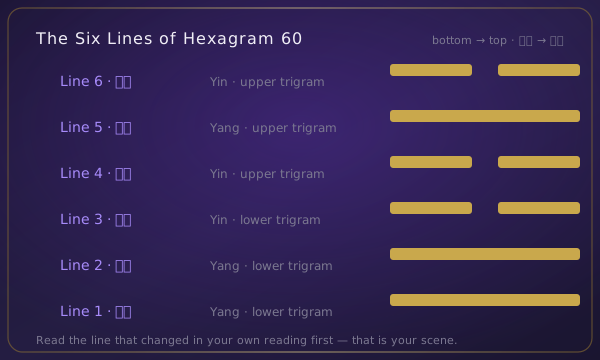
Each line of Hexagram 60 is one scene in the life of a limitation — its courtyard, its gate, its sighing, its rest, its sweetness, and its bitterness.
Line 1 (初九) — Not going out of the door and courtyard; no blame. The scene: the limit that protects. The modern reading: the foundation line. 不出户庭,无咎 — the door and courtyard held, and no blame. The limit at the courtyard is the limit that keeps the person safe, and the hexagram grants it its favor.
Line 2 (九二) — Not going out of the gate; misfortune. The scene: the limit that imprisons. The modern reading: the warning line. 不出门庭,凶 — the gate held shut, and the misfortune. The hexagram's most careful distinction: the courtyard limit protects; the gate limit confines. The same structure, one step too far.
Line 3 (六三) — Without limitation, then sighing; no blame. The scene: the unbounded life, and its sound. The modern reading: the unbounded line. 不节若,则嗟若,无咎 — no limitation, the sighing, and the strange mercy: no blame. The hexagram does not condemn the unbounded; it records what the unbounded sounds like.
Line 4 (六四) — Contented limitation; success. The scene: the limit lived at peace. The modern reading: the content line. 安节,亨 — the limitation that is rested in, granted success. The boundary that is not resented is the boundary that holds.
Line 5 (九五) — Sweet limitation; good fortune; going forward is honored. The scene: the limit lived as rhythm. The modern reading: the center line and the hexagram's destination. 甘节,吉,往有尚 — sweet limitation, good fortune, and the going that is honored. The structure held at the right temperature is the structure that moves.
Line 6 (上六) — Bitter limitation; perseverance is ominous; the regret dissolves. The scene: the limit that has become deprivation. The modern reading: the extremity line. 苦节,贞凶,悔亡 — bitter limitation, ominous in perseverance, and the regret that dissolves anyway. The judgment has already said the bitter limit is not perseverable; the line is its receipt.
When all six lines change: Hexagram 60 turns toward Hexagram 61 — limitation completed becomes inner truth. The lake with its banks becomes the wind on its surface — sincerity inside the structure.
How to Read Hexagram 60 with the Number Oracle
Hexagram 60 reaches you the same way every hexagram does: through three numbers that arise naturally while you hold your question — a clock, a receipt, a page number, a number that simply surfaces. The first number sets the upper trigram, the second the lower trigram, and the third identifies the changing line. Enter your three numbers and your question at numbers-oracle.com and you will get the hexagram plus an AI interpretation written for your situation — free, no registration. For the mechanics, read how three numbers become a hexagram →
Your lucky energy for Hexagram 60: Metal element (the body trigram, the lake below). Lucky colors are white, gold, and silver; the matching crystal is citrine, traditionally associated with abundance and clear, joyful energy.
Related hexagrams: Hexagram 59 (Dispersion) — the river before the banks; Hexagram 41 (Decrease) — the other subtraction, by measure; Hexagram 22 (Grace) — the plain form, limitation's cousin.
Hexagram 60: Common Questions
What does hexagram 60 mean in one sentence?
Hexagram 60 means limitation — success for the bounded, where the banks hold the water and the holding is favorable, until the limit at the gate becomes prison and the sweet limitation turns bitter.
Is hexagram 60 good or bad?
Hexagram 60 is favorable — its judgment is success (亨) — with one condition stated in the judgment itself: bitter limitation is not to be persevered in (苦节不可贞). The gate limit (line 2) is 凶 and the bitter limit (line 6) is ominous in perseverance. The hexagram is favorable for the sweet limitation and unfavorable for the deprivation.
What should I do when I receive hexagram 60?
Check which line changed. The door and courtyard (line 1) means the protective limit is favorable; the gate (line 2) means the limit has become prison — open it; the sighing (line 3) means the unbounded life has its sound; contented limitation (line 4) means the boundary at peace holds; sweet limitation (line 5) means the rhythm lived as joy is the honored going; bitter limitation (line 6) means the structure has become deprivation — the judgment says do not persevere.
Why is hexagram 60 called "Limitation"?
Because its image is water standing in the lake — 泽上有水 — the banks that hold what would otherwise flood. The old translators rendered it Limitation or Restriction because the hexagram's subject is the structure that holds: the measures, the budget, the rule, and the exact point where the holding becomes the wall.
The lake's banks hold the water. The hexagram's whole question is whether the banks have become the point.