I Ching Hexagram 61 (Inner Truth): Meaning in Love, Career and Life
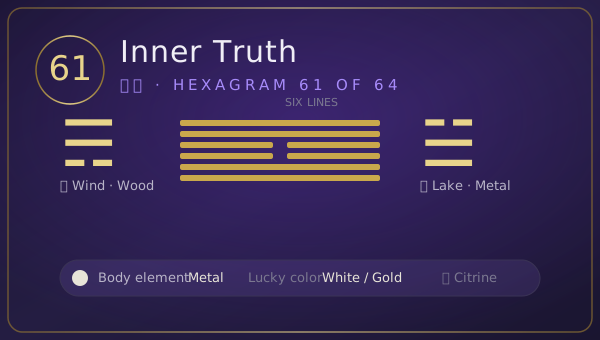
Hexagram 61 is the inner-truth hexagram of the I Ching: wind moving over the lake, the current that touches the depths without disturbing the surface. Its classical judgment reads "piglet and fish — good fortune; favorable to cross the great water; favorable perseverance" (豚鱼吉,利涉大川,利贞), and its image — wind over the marsh — says the noble one "deliberates on lawsuits and delays executions" (议狱缓死). When Hexagram 61 appears in a reading, it describes sincerity at the center: the truth that moves without force, the trust that is felt before it is spoken — and the hexagram's exact counsel about what inner truth reaches and what it cannot.
The Story of Hexagram 61: The Promise Worth Gold
The Records of the Grand Historian preserve the saying that made a man's name into a proverb. Ji Bu was a general of the early Han dynasty — famously blunt, famously reliable. The chronicler records the saying that circulated about him in his own lifetime: "With a hundred catties of gold, it is not as good as a promise from Ji Bu." (《史记·季布栾布列传》: 得黄金百斤,不如得季布一诺)
The phrase outlived the general by two thousand years. In Chinese, 一诺千金 — a promise worth a thousand pieces of gold — still means exactly what it meant the day it was coined: the word that holds. What the chronicler was recording was not that Ji Bu was eloquent. It was that his words and his conduct were the same thing, and everyone in the empire could plan around that.
The hexagram's judgment names the same quality in the hexagram's own strange image: 豚鱼吉 — piglet and fish, good fortune. The commentators argue about the image; the most common reading is that sincerity reaches what sincerity should not reach — the humble and the deep, the small creature and the fish at the bottom. Inner truth moves the things that force cannot move. And the second line is the hexagram's signature scene: the crane crying in the shade, its young answering — I have a good goblet, and I will share it with you (鸣鹤在阴,其子和之,我有好爵,吾与尔靡之). The truth in the hidden place calls, and the answer comes from where you cannot see.
The goblet is shared because the sincerity was heard. That is the whole hexagram.
What Is Hexagram 61?
- Name: 中孚 (Zhōng Fú), traditionally rendered Inner Truth; also translated as Sincerity at the Center, The Faithful Heart, or Inner Confidence
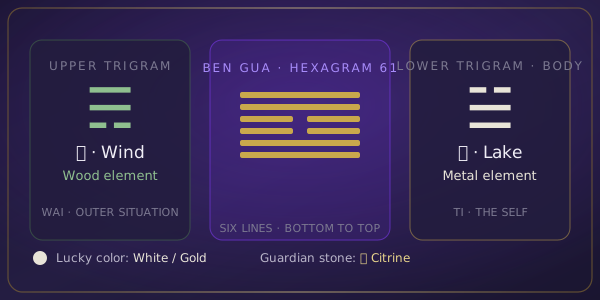
- Structure: Wind over the Lake — the current over the depths, the truth that touches without disturbing
- Position: 61 of 64, the hexagram after Limitation; what the bounded lake becomes
- Element: Metal on the body trigram — the lower trigram (the lake) belongs to Metal; wind above belongs to Wood
- Body trigram: the lower trigram (the lake, Metal), which in plum blossom divination represents the self
- Core images: the piglet and the fish, the crane in the shade, the shared goblet, the drum and the stillness, the almost-full moon, the sound ascending to heaven
The Core Meaning of Hexagram 61
The judgment of Hexagram 61 grants good fortune and the crossing — 豚鱼吉,利涉大川,利贞 — to inner truth. Sincerity at the center is not one virtue among many; it is the configuration from which the great water is crossable. And the image says what the sincerity does in practice: 议狱缓死 — deliberate on the lawsuits, delay the executions. The truthful person is slow to judge, because the truth they carry has taught them what force cannot see.
Three things this hexagram are telling you, each standing on its own:
Inner truth moves what force cannot. 豚鱼吉 — the piglet and the fish. The sincerity at the center reaches the humble and the deep, the small and the hidden. What the hexagram describes is influence without contact: the wind on the lake moves the depths without touching the surface. What is sincere is felt before it is spoken.
The truth in the hidden place calls, and the answer comes. The second line is the hexagram's signature: the crane in the shade, the young answering, the goblet shared. What is at the center is heard by what is at the center — the hidden sincerity calls to the hidden response. The sharing (吾与尔靡之) is what the answered call looks like.
The sound that ascends to heaven is the extremity. The final line is the hexagram's warning: 翰音登于天,贞凶 — the sound rising to heaven, ominous in perseverance. The sincerity that becomes announcement — the truth that is proclaimed instead of held — is the hexagram's failure. Inner truth is for moving the depths, not for filling the sky.
The question Hexagram 61 answers is not "am I sincere?" It is: is the truth at the center — moving what force cannot, calling what is hidden, and refusing the sound that ascends to heaven?
Hexagram 61 in Love and Relationships
If you are single: Hexagram 61 describes the season of inner truth — the sincerity at the center that moves without force. The hexagram's counsel for the single season is its judgment: the piglet and the fish (豚鱼吉) — sincerity reaches what sincerity should not reach. What draws people is not the pursuit; it is the truth held at the center, felt before it is spoken. And its second line is its promise: the crane in the shade — the hidden call, and the answer that comes from where you cannot see.
In an early or uncertain stage: Early love under Hexagram 61 is the truth at the center being felt — the bond that moves without being pushed. The hexagram's lines are its counsel: the crane and the young (line 2) is the hidden call and the answering; the drum and the stillness (line 3) is the early bond's mixed signals; the almost-full moon (line 4) is the bond at its peak, and its counsel: the horse lost, and no blame — let the pride go.
In a stable relationship: A stable relationship drawing Hexagram 61 is the long bond held by inner truth — the sincerity at the center that has been felt for years. The hexagram's counsel for the long term is its image: 议狱缓死 — deliberate, delay. The long bond is kept by the slowness to judge, because the truth carried has taught what force cannot see. And its fifth line is its promise: the sincerity that binds like a cord (有孚挛如) — the trust that holds everything together.
In a crisis: If the relationship is at the final line — the sound ascending to heaven — Hexagram 61's verdict is 贞凶, and its image is the diagnosis: the sincerity that became announcement. The truth that is proclaimed instead of held, the virtue that fills the sky — the hexagram's crisis counsel: return the truth to the center, where it moves what force cannot.
Hexagram 61 in Career, Money and Decisions
Career: This is the inner-truth hexagram of professional life — the person whose word and conduct are the same thing, the trust that lets others plan. Its career counsel is the judgment: good fortune and the crossing (利涉大川) for the sincere center. The image is the career discipline: deliberate, delay (议狱缓死) — the leader who is slow to judge has seen what force cannot. And the final line is its career warning: the sound ascending to heaven — the virtue that is announced instead of held.
Money: Hexagram 61 governs money held by trust — the promise worth gold, the word that lets others plan. Its financial counsel is the judgment: sincerity reaches what force cannot (豚鱼吉). The second line's shared goblet is its financial image: the answered call, the shared resource. The fifth line's binding sincerity (有孚挛如) is its financial promise: the trust that holds the position together. And the final line is its financial extremity: the announced instead of held — the sound without the center.
Decision: Hexagram 61 says: hold the truth at the center. If you are deciding how to move a situation, the hexagram's test is its image: is this sincerity (moving what force cannot) or is it announcement (the sound ascending to heaven)? The decision it blesses is the crane in the shade — the hidden call and the answering; the decision it marks is the drumbeat that fills the sky.
The Changing Lines of Hexagram 61: Six Scenes
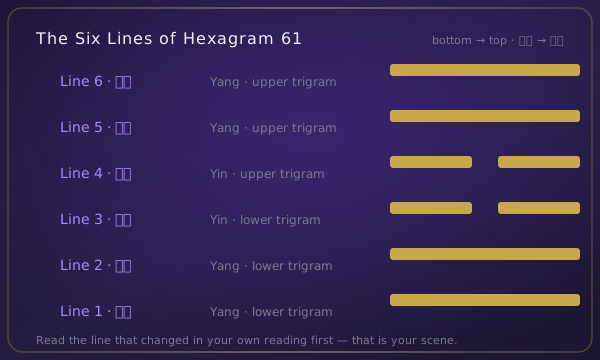
Each line of Hexagram 61 is one scene in the life of an inner truth — its readiness, its crane, its mixed signals, its moon, its binding, and its sound.
Line 1 (初九) — Preparedness is good fortune; if there is something else, one is not at ease. The scene: the sincerity that is ready, and the distraction that disturbs it. The modern reading: the foundation line. 虞吉,有它不燕 — the readiness, the good fortune, and the condition: the other thing makes it uneasy. The truth at the center must be the only thing at the center.
Line 2 (九二) — The crane cries in the shade; its young answers; I have a good goblet; I will share it with you. The scene: the hidden call, and the answering. The modern reading: the signature line. 鸣鹤在阴,其子和之,我有好爵,吾与尔靡之 — the crane in the shade, the young answering, the goblet shared. What is at the center is heard by what is at the center; the sharing is what the answered call looks like.
Line 3 (六三) — Finding its match; now the drum, now the stillness; now weeping, now singing. The scene: the truth that meets its equal, and the alternation. The modern reading: the alternation line. 得敌,或鼓或罢,或泣或歌 — the match found, the drum and the stillness, the weeping and the singing. The sincere meeting is not stable; it alternates, and the alternation is the meeting.
Line 4 (六四) — The moon is almost full; the horse is lost; no blame. The scene: the peak, and the loss that is blameless. The modern reading: the loss line. 月几望,马匹亡,无咎 — the almost-full moon, the horse lost, and no blame. What the sincere position lets go (the pride, the companion) is the loss the hexagram grants.
Line 5 (九五) — With sincerity binding like a cord; no blame. The scene: the truth at the center, holding everything. The modern reading: the center line. 有孚挛如,无咎 — the sincerity that binds like a cord, and no blame. The trust at the center is what holds the whole configuration together.
Line 6 (上九) — The sound ascends to heaven; perseverance is ominous. The scene: the sincerity that became announcement. The modern reading: the extremity line and the hexagram's warning. 翰音登于天,贞凶 — the sound rising to heaven, ominous in perseverance. The truth that is proclaimed instead of held is the truth that has left the center.
When all six lines change: Hexagram 61 turns toward Hexagram 62 — inner truth completed becomes the small excess. The truth at the center becomes the care in the small things.
How to Read Hexagram 61 with the Number Oracle
Hexagram 61 reaches you the same way every hexagram does: through three numbers that arise naturally while you hold your question — a clock, a receipt, a page number, a number that simply surfaces. The first number sets the upper trigram, the second the lower trigram, and the third identifies the changing line. Enter your three numbers and your question at numbers-oracle.com and you will get the hexagram plus an AI interpretation written for your situation — free, no registration. For the mechanics, read how three numbers become a hexagram →
Your lucky energy for Hexagram 61: Metal element (the body trigram, the lake below). Lucky colors are white, gold, and silver; the matching crystal is citrine, traditionally associated with abundance and clear, joyful energy.
Related hexagrams: Hexagram 60 (Limitation) — the structure the sincerity fills; Hexagram 9 (Small Taming) — the other binding sincerity; Hexagram 37 (The Family) — the household the truth builds.
Hexagram 61: Common Questions
What does hexagram 61 mean in one sentence?
Hexagram 61 means inner truth — good fortune and the crossing for the sincerity held at the center, which moves what force cannot, calls what is hidden, and fails only when it becomes the sound ascending to heaven.
Is hexagram 61 always good?
Hexagram 61 grants good fortune and the crossing (豚鱼吉,利涉大川) — it is one of the Book's favorable sincerity signs. Its one hard verdict is the final line: the sound ascending to heaven (翰音登于天,贞凶). The hexagram is favorable for the truth held at the center and unfavorable for the truth that is announced.
What should I do when I receive hexagram 61?
Check which line changed. Preparedness (line 1) means the truth must be the only thing at the center; the crane in the shade (line 2) means the hidden call and the answering — share the goblet; the drum and stillness (line 3) means the sincere meeting alternates; the almost-full moon (line 4) means the blameless loss — let the pride go; the binding cord (line 5) means the trust holds everything; the sound to heaven (line 6) means stop announcing and return the truth to the center.
Why is hexagram 61 called "Inner Truth"?
Because its image is wind moving over the lake — 泽上有风 — the current that touches the depths without disturbing the surface. The old translators rendered it Inner Truth or Sincerity at the Center because the hexagram's subject is the truth held inside: the piglet and the fish it reaches, the crane it answers, and the sound it must never become.
A promise from Ji Bu was worth more than a hundred catties of gold. That was the whole currency.