I Ching Hexagram 62 (Preponderance of the Small): Meaning in Love, Career and Life
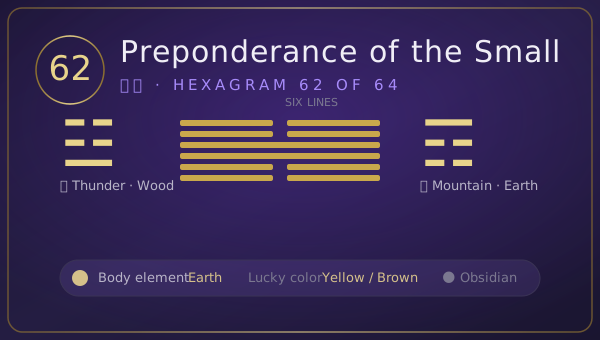
Hexagram 62 is the small-excess hexagram of the I Ching: thunder above the mountain, the small thing that goes past its mark — the bird that flies a little too low. Its classical judgment reads "success; favorable perseverance. Small things may be done; great things may not. The flying bird leaves its sound behind; not favorable to go up; favorable to go down; great good fortune" (亨,利贞。可小事,不可大事。飞鸟遗之音,不宜上,宜下,大吉), and its image — thunder on the mountain — says the noble one "in conduct exceeds in reverence, in mourning exceeds in grief, in spending exceeds in frugality" (行过乎恭,丧过乎哀,用过乎俭). When Hexagram 62 appears in a reading, it describes the small over: the excess that is not the great excess (28) — and the hexagram's exact counsel about which direction the bird flies.
The Story of Hexagram 62: The Bird Flying Low
The scene is a bird in flight, slightly below its proper altitude. Not fallen — flying low. The old commentators read the hexagram from that image: 小过 is the small excess, the going-past that is small rather than great. And the judgment gives the bird its instruction in the hexagram's most quoted sentence: 飞鸟遗之音,不宜上,宜下 — the flying bird leaves its sound behind; not favorable to go up; favorable to go down; great good fortune.
The bird that flies too high at this hexagram's configuration is the bird in danger. The bird that flies low — that keeps to the small, the humble, the under-wood — is the bird that is granted the great fortune. What the hexagram describes is the excess that stays small: the reverence that exceeds slightly, the grief that exceeds slightly, the frugality that exceeds slightly. The image's three cases are the whole teaching — the noble one exceeds in the directions that cost him, never in the directions that inflate him.
The lines are the bird's flight at each altitude. The first line is the hexagram's warning at its plainest: 飞鸟以凶 — the flying bird, misfortune. The second line is the hexagram's geography: passing the grandfather, meeting the grandmother; not reaching the lord, meeting the minister (过其祖,遇其妣,不及其君,遇其臣) — and 无咎. The third line is the hexagram's hard warning: not passing the guard, following leads to being wounded (弗过防之,从或戕之,凶). The fourth line is the hexagram's center: no blame; not passing, meeting; going forward is dangerous — it must be guarded; do not use perpetual perseverance (无咎,弗过遇之,往厉必戒,勿用永贞). The fifth line is the hexagram's central image: dense clouds, no rain, from my western suburb (密云不雨,自我西郊) — the same image as Hexagram 9 — and the duke shooting what is in the hole (公弋取彼在穴). And the final line is the hexagram's extremity: not meeting, but passing (弗遇过之) — the bird caught in the net (飞鸟离之) — 凶, and the hexagram's final word: 是谓灾眚 — this is what is called calamity.
The bird flies low, and leaves its sound behind. That is the whole hexagram in one image.
What Is Hexagram 62?
- Name: 小过 (Xiǎo Guò), traditionally rendered Preponderance of the Small; also translated as Small Excess, Excess of the Small, or The Small Passing
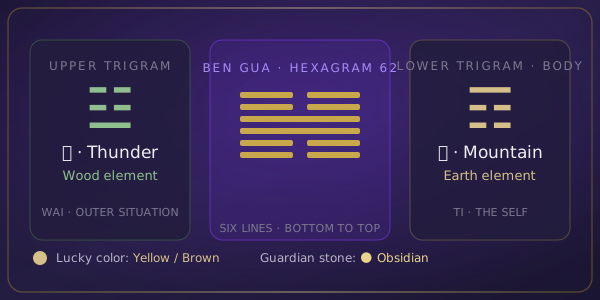
- Structure: Thunder over Mountain — the quake on the mass, the small over-reaching
- Position: 62 of 64, the hexagram after Inner Truth; what the sincere center becomes
- Element: Earth on the body trigram — the lower trigram (mountain) belongs to Earth; thunder above belongs to Wood
- Body trigram: the lower trigram (mountain, Earth), which in plum blossom divination represents the self
- Core images: the bird flying low, the grandfather and the grandmother, the unguarded pass, the dense clouds without rain, the bird in the net
The Core Meaning of Hexagram 62
The judgment of Hexagram 62 is the Book's most precise instruction about scale: 可小事,不可大事 — small things may be done; great things may not. The hexagram describes the configuration where the excess is small, and its entire counsel is about keeping it that way. The bird's instruction is the direction: 不宜上,宜下 — not up, down. And the image says where the small excess belongs: in reverence, in grief, in frugality — the directions that cost the self, never the ones that inflate it.
Three things this hexagram are telling you, each standing on its own:
The scale is fixed, and the scale is small. 可小事,不可大事 — the hexagram's judgment is its subject. What is possible at this configuration is the small thing, held small. The attempt to make the small excess into a great one is the failure the hexagram names at every line.
The direction is down. 不宜上,宜下,大吉 — the bird does not go up. What the hexagram grants the great fortune to is the descending bird, the small excess that stays under the wood, the excess that costs rather than claims. The image's three cases are the direction made concrete: exceed in reverence, in grief, in frugality.
The unguarded pass is the danger. The third line is the hexagram's warning: 弗过防之,从或戕之 — not passing the guard, and the following that leads to being wounded. The small excess that stops guarding — the small thing that stops watching its small boundary — is the thing that gets wounded. The bird that stops flying low is the bird in the net.
The question Hexagram 62 answers is not "is this too much?" It is: is this excess still small — flying low, exceeding in the directions that cost, guarding the pass?
Hexagram 62 in Love and Relationships
If you are single: Hexagram 62 describes the season of the small excess — the self exceeding slightly in the directions that cost. The hexagram's counsel for the single season is its image: exceed in reverence, in grief, in frugality (行过乎恭,丧过乎哀,用过乎俭). The humility that slightly over-does, the mourning that slightly over-grieves, the spending that slightly over-saves. The direction is down (宜下), and the hexagram grants the great fortune to the descending.
In an early or uncertain stage: Early love under Hexagram 62 is the small excess — the bond held small, flying low. The hexagram's lines are its counsel: the grandfather and the grandmother (line 2) is the bond that meets what is below rather than what is above; the unguarded pass (line 3) is the boundary that stopped being watched; the dense clouds without rain (line 5) is the bond that gathers but does not yet fall — and the hexagram's counsel: shoot what is in the hole (公弋取彼在穴) — the small thing, taken small.
In a stable relationship: A stable relationship drawing Hexagram 62 is the long bond as small excess — the reverence that slightly exceeds, the frugality that slightly exceeds, held for years. The hexagram's counsel for the long term is its judgment: small things may be done (可小事). The long bond is kept by the small excesses in the directions that cost, never the ones that claim. And its final line is its warning: the bird in the net — the small excess that tried to become great.
In a crisis: If the relationship is at the final line — the bird caught in the net — Hexagram 62's verdict is 凶, and its final word is the hexagram's most sobering phrase: 是谓灾眚 — this is what is called calamity. The small excess that stopped flying low, that passed where it should have met, is the calamity the hexagram names. What it offers is its judgment's standing grant: the direction is down (宜下), and the great fortune belongs to the bird that takes it.
Hexagram 62 in Career, Money and Decisions
Career: This is the small-excess hexagram of professional life — the role held small, the contribution that exceeds slightly in the directions that cost. Its career counsel is the judgment: small things may be done; great things may not (可小事,不可大事). The image is the career discipline: exceed in reverence, in grief, in frugality. And the direction is the career direction: down (宜下) — the professional who exceeds downward, in humility and thrift, is the one the hexagram grants the great fortune.
Money: Hexagram 62 governs money held small — the modest position, the frugal excess, the resource that is carefully under-flown. Its financial counsel is the judgment: small things (可小事) — the small transaction, the small excess in the direction of frugality (用过乎俭). The fifth line's dense clouds without rain is its financial image: the accumulation that gathers but does not fall — and the hexagram's counsel: shoot what is in the hole — the small gain, taken small. And the final line is its financial extremity: the bird in the net — the small position that tried to become great.
Decision: Hexagram 62 says: keep it small, and fly low. If you are deciding the scale of the move, the hexagram's test is its judgment: is this a small thing (可小事) or a great thing (不可大事), and is the direction down (宜下)? The decision it blesses is the small excess held small — reverence, grief, frugality; the decision it marks is the bird that climbed.
The Changing Lines of Hexagram 62: Six Scenes
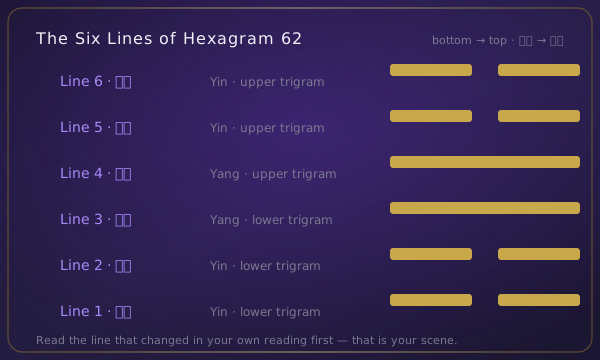
Each line of Hexagram 62 is one scene in the life of a small excess — its bird, its grandparents, its pass, its guard, its clouds, and its net.
Line 1 (初六) — The flying bird — misfortune. The scene: the bird at its wrong altitude, in the hexagram's plainest verdict. The modern reading: the warning line. 飞鸟以凶 — the flying bird, and the misfortune. The small excess that is not yet flying low is the small excess the hexagram condemns first.
Line 2 (六二) — Passing the grandfather, meeting the grandmother; not reaching the lord, meeting the minister; no blame. The scene: the excess that goes past what is above to meet what is below. The modern reading: the geography line. 过其祖,遇其妣,不及其君,遇其臣,无咎 — the grandfather passed, the grandmother met, the lord not reached, the minister met. The hexagram's direction made relational: the small excess goes down, and the going down is blameless.
Line 3 (九三) — Not passing the guard; following leads to being wounded; misfortune. The scene: the boundary that stopped being watched. The modern reading: the hard line. 弗过防之,从或戕之,凶 — the unguarded pass, the following that wounds, and the misfortune. The small excess that stops guarding its small boundary is the small excess that gets cut.
Line 4 (九四) — No blame; not passing, meeting; going forward is dangerous — it must be guarded; do not use perpetual perseverance. The scene: the small excess at the center, with its conditions. The modern reading: the center line. 无咎,弗过遇之,往厉必戒,勿用永贞 — no blame, the meeting without passing, the forward guarded, the perseverance refused. The hexagram's center is the position that meets without exceeding, and it holds only with the guard kept.
Line 5 (六五) — Dense clouds, no rain, from my western suburb; the duke shoots what is in the hole. The scene: the gathering that does not fall, and the small take. The modern reading: the central image. 密云不雨,自我西郊,公弋取彼在穴 — the same clouds as Hexagram 9, and the duke's arrow into the hole. What the small excess takes, it takes small — what is in the hole, not what is in the sky.
Line 6 (上六) — Not meeting, but passing; the flying bird is caught in the net; misfortune. This is what is called calamity. The scene: the bird that climbed, and the net. The modern reading: the extremity line and the hexagram's final word. 弗遇过之,飞鸟离之,凶,是谓灾眚 — the passing without meeting, the bird netted, and the name the hexagram gives it: calamity. The small excess that became great is the calamity the hexagram has been warning about since line 1.
When all six lines change: Hexagram 62 turns toward Hexagram 63 — the small excess completed becomes after completion. The bird that flew low becomes the order that holds.
How to Read Hexagram 62 with the Number Oracle
Hexagram 62 reaches you the same way every hexagram does: through three numbers that arise naturally while you hold your question — a clock, a receipt, a page number, a number that simply surfaces. The first number sets the upper trigram, the second the lower trigram, and the third identifies the changing line. Enter your three numbers and your question at numbers-oracle.com and you will get the hexagram plus an AI interpretation written for your situation — free, no registration. For the mechanics, read how three numbers become a hexagram →
Your lucky energy for Hexagram 62: Earth element (the body trigram, the mountain below). Lucky colors are yellow and earth brown; the matching crystal is obsidian, traditionally associated with protection, grounding, and shielding from stress.
Related hexagrams: Hexagram 28 (Great Excess) — the excess at the other scale; Hexagram 61 (Inner Truth) — the center the small excess serves; Hexagram 15 (Modesty) — the mountain inside the earth, flying low by nature.
Hexagram 62: Common Questions
What does hexagram 62 mean in one sentence?
Hexagram 62 means preponderance of the small — success for the excess that stays small, where the bird flies low rather than climbing, the exceeding happens in reverence and grief and frugality, and the bird in the net is the named calamity.
Is hexagram 62 good or bad?
Hexagram 62 grants success, perseverance, and great good fortune (亨,利贞,大吉) — it is favorable for the small thing held small. Its misfortunes are about scale and altitude: the flying bird (line 1), the unguarded pass (line 3), and the netted bird (line 6). The hexagram is favorable for the small excess that flies low and unfavorable for the one that climbs.
What should I do when I receive hexagram 62?
Check which line changed. The flying bird (line 1) means the altitude is wrong — descend; the grandmother (line 2) means the direction is down, and the going down is blameless; the unguarded pass (line 3) means the small boundary stopped being watched — guard it; the meeting without passing (line 4) means meet without exceeding, and keep the guard; the clouds without rain (line 5) means take what is in the hole — the small gain, taken small; the bird in the net (line 6) means the climb was the calamity.
Why is hexagram 62 called "Preponderance of the Small"?
Because its image is thunder on the mountain — 山上有雷 — the small thing that goes past its mark, the bird flying slightly below its proper altitude. The old translators rendered it Small Excess or Preponderance of the Small because the hexagram's subject is scale: what may be done small, what may not be done great, and the bird's instruction — not up, down.
The bird flies low, and leaves its sound behind. That is the whole hexagram.